
The Struggles of Brown, Jones & Robinson, as the book is properly titled, is one of Trollope’s less well known and even lesser read novels. I don’t know why The Folio Society in their complete Trollope novels series decided to drop ‘The Struggles of’ from the title other than the probable difficulty of fitting all the words into the standard spine layout for the series. That this is a relatively unknown work can be judged by its sporadic printing history and the fact that even The Trollope Society themselves largely dismiss it in a single paragraph write up and that the list of primary characters on that web page fails to mention any of Mr Brown, Mr Jones or Mr Robinson. I mentioned the printing history because it is so odd for a novelist of the stature of Trollope, Longman along with Chapman & Hall both declined the novel and it first appeared in eight monthly parts in The Cornhill Magazine in 1861/2. Despite being written in 1857 it didn’t appear as a book until American publisher Harper’s Library issued a copy in 1862, the first British edition was Smith, Elder’s (who also published The Cornhill Magazine) copy in 1870, there then followed another American edition in 1882 and then nothing for ninety nine years!
It largely seems to have been reprinted since 1981 as part of sets of complete works with no publisher judging it sufficiently commercial to make it a stand alone book in its own right. Indeed even The Folio Society, whose copy I have, left it to the last to be printed of the forty seven Trollope novels in their complete set which they started in 1989 with ‘Can You Forgive Her?’ and finally finished in 1999 with this book and then topped off the collection with Trollope’s autobiography. There isn’t even a Wikipedia entry for the novel. With all that in mind it was with some trepidation that I decided to see if it was really that bad.
Happily the answer is no, and whilst it isn’t a great novel I definitely enjoyed it both as a satire of the advertising industry and a tale of intertwined relationships. To set the scene Mr Brown becomes a widower at the start of the book and gains control of his wife’s butter business which he has no interest in so subsequently sells. He has two daughters Sarah Jane who had married Mr Jones and Maryanne who is single but has promised marriage to Mr Brisket, the butcher. Mr Robinson has fallen in love with the flighty Maryanne to the extreme annoyance of the much larger butcher who several times threatens him with violence if he doesn’t stay away from her. Oddly the three title characters subsequently start a business together selling haberdashery which none of them know anything about, with Brown putting up the money, Jones being the floor manager and Robinson in charge of advertising, he also takes charge of the decor and uniforms in the shop which is themed around the recently invented colour, magenta. The original capital in the business is stated as £4,000, which is the equivalent of around £365,000 today, a massive sum to start a small business with, but right from the off the partners, encouraged by Robinson, planned big with significant premises at 81 Bishopsgate Street and a significant amount of staff to match. What they didn’t have was much stock as Robinson was convinced that spending a lot on advertising would bring people in and then you could sell them what you had, rather than what you had promised you had.

It is not only Robinson’s extremely expensive advertising ploys, which range from horse riding knights in armour, to liverymen handing out leaflets but Jones’s dodgy selling which involved putting high quality items in the windows with low prices then actually selling similar looking but lower quality items to the customers for the same price which leads to the reputation of the business starting to fall away. Brown meanwhile is still dealing badly with his two daughters who see their inheritance frittered away in the business whilst he banks less than the actual takings and salts some away from himself. It’s difficult to find a single likeable character in the book with the possible exception of Robinson who is more naive than criminal, Brown’s two daughters are truly horrible and I rejoiced when Maryanne, after playing Brisket and Robinson off one another throughout the book ends up with neither of them and both count themselves lucky to be rid of her.The firm needless to say burns through the large amount of capital it started with in about a year and goes bust, a story that could be applied to numerous businesses that have more ideas than plans or solid foundations. It would have been interesting to see what Trollope would have made of the various overinflated dotcom and IT companies and dodgy banks built on loans to them over the last twenty years but ‘The Struggles of Brown, Jones and Robinson’ is an excellent primer on dubious companies living well beyond their means but believed to be sound right up until they crash. It may not ever have been rated highly but it should be read by anyone looking to start, or invest, in a company in the present day.

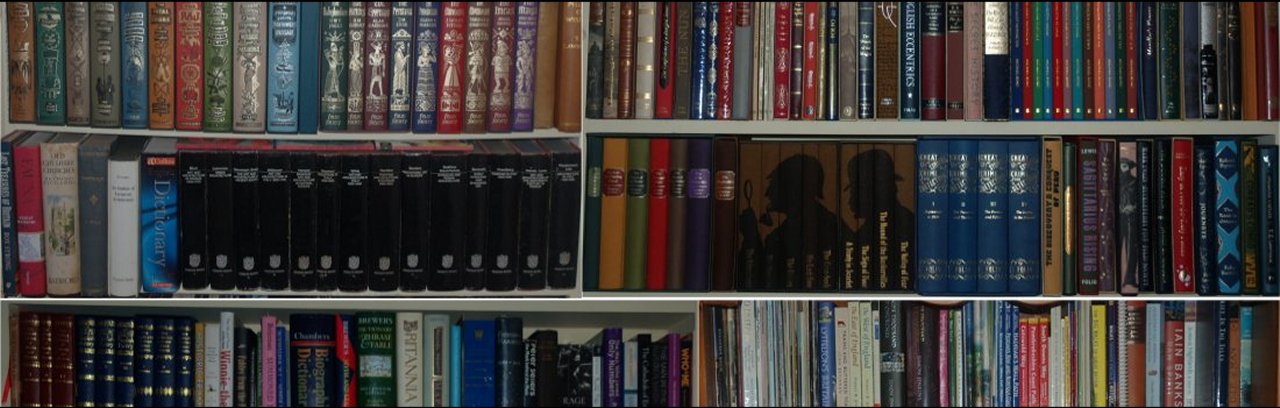
The forty eight Trollope books in the complete works set by the Folio Society.
 Ramblings on my bookshelves
While it wasn’t my favorite Trollope, I found that “The Struggles of Brown, Jones and Robinson” picked up as it went along and I’d argue that Maryanne becomes a sympathetic, if not exactly likeable, character. As both she and the narrator point out repeatedly, she’s honest and direct. One thing I like about Trollope is his appreciation of women’s position in society:
“It has been so from the beginning,” she said. “When I first knew Brisket, it was not for any love I had for the man, but because mother took him up. Mother promised him money; and then I said I’d marry him,—not because I cared for him, but because he was respectable and all right. And then mother hadn’t the money when the pinch came, and, of course, Brisket wasn’t going to be put upon;—why should he? So I took up with Robinson, and you knew it, father.”
“I did, Maryanne; I did.”
“Of course you did. I wasn’t going to make a fool of myself for no man. I have got myself to look to; and if I don’t do it myself, they who is about me won’t do it for me.”
“Your old father would do anything for you.”
“Father, I hate words! What I want is deeds. Well, then;—Robinson came here and was your partner, and meanwhile I thought it was all right. And who was it interfered? Why, you did. When Brisket went to you, you promised him the money: and then he went and upset Robinson. And we had that supper in Smithfield, and Robinson was off, and I was to be Mrs. Brisket out of hand. But then, again, the money wasn’t there.”
“I couldn’t make the money, Maryanne.”
“Father, it’s a shame for you to tell such falsehoods before your own daughters.”
“Oh, Maryanne! you wicked girl!” said Sarah Jane.
“If I’m wicked, there’s two of us so, Sarah Jane! You had the money, and you gave it to Robinson for them notices of his. I know all about it now! And then what could you expect of Brisket? Of course he was off. There was no fal-lal about love, and all that, with him. He wanted a woman to look after his house; but he wanted something with her. And I wanted a roof over my head;—which I’m not likely to have, the way you’re going on.”
“While I have a morsel, you shall have half.”
“And when you haven’t a morsel, how will it be then? Of course when I saw all this, I felt myself put upon. There was Jones getting his money out of the shop!”
“Well, miss,” said Sarah Jane; “and isn’t he a partner?”
“You ain’t a partner, and I don’t know what business you have there. But every one was helping themselves except me. I was going to the wall. I have always been going to the wall. Well; when Brisket was off, I took up with Robinson again. I always liked him the best, only I never thought of my own likings. I wasn’t that selfish. I took up with Robinson again; but I wasn’t going to be any man’s wife, if he couldn’t put a roof over my head. Well, father, you know what was said then, and now you’re going back from it.”
“I suppose you’d better have Mr. Brisket,” said the old man, after a pause.
“Will you give Brisket those five hundred pounds?” And then those embassies to Aldersgate Street were made by Mrs. Poppins and by Mr. Jones. During this time Maryanne, having spoken her mind freely, remained silent and sullen. That her father would not go out on the appointed day, she knew. That she would not marry Robinson unless he did, she knew also. She did not like Brisket; but, as she had said, she was not so selfish as to let that stand in the way. If it was to be Brisket, let it be Brisket. Only let something be done.
LikeLike