
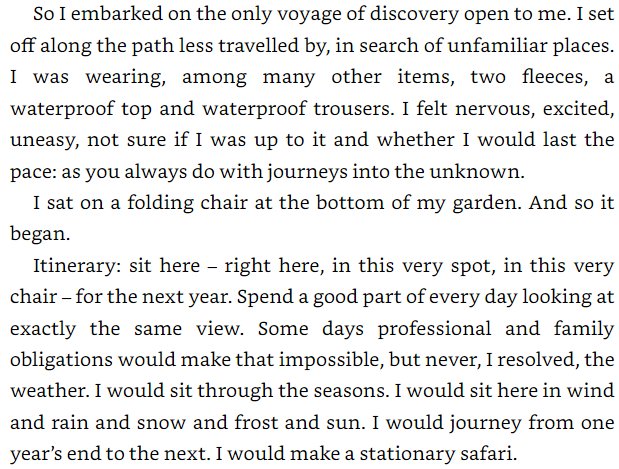
So this August I am devoting to natural history and by contrast with last week’s book from the 18th century this is so contemporary that it was written during the various covid lockdowns here in the UK and was first published by Simon & Schuster on the 13th April 2023. Simon Barnes was looking forward to a trip to South Africa as a guide on a wildlife tour when all of a sudden he wasn’t going anywhere, so decided to really not go anywhere and just sit in a chair at the bottom of his garden for a year and record his experiences. Now Barnes is lucky, he lives in the Norfolk Broads, an extensive flat wetland area to the east of the UK so his bird watching possibilities just sitting at home are considerably better than the average town dweller, although by the nature of it being a flat open landscape (the highest point in Norfolk is just 344 feet (105m) above sea level) he was rather exposed to the elements.
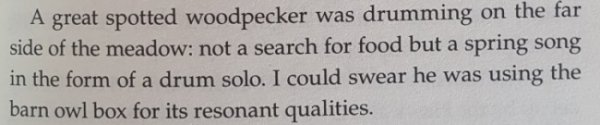
Oddly, although he had decided to do this he didn’t explain what he was doing to his family for several months, they must have assumed that he was having a rather strange reaction to being forced to go nowhere. He is actually quite fastidious about sitting out and noting whatever he sees which is why the book runs to 336 pages from Sunday 27th September 2020 to Monday 27th September 2021, the extra day signalling that he intends to continue sitting out and making notes whenever he can going forward. It isn’t an end to his experiment but a continuation of an experience he has grown to love regardless of the discomfort sometimes. I have included a couple more sample passages below so you can see the changes to the writing style as the year progresses. I think he gets more poetic as he sinks more and more into the communion with nature that his self imposed routine gives him.
There is humour and drama aplenty as he follows the lives of the various creatures he is observing, from the majestic marsh harriers swooping across his eyeline to the much bullied buzzards, which every bird seems engaged in driving away. The herons in the lakes and marshes just beyond the river flowing past his seat and the great flocks of corvids (rooks, jackdaws and crows mainly) that are often seen, to the gay pair of male swans that encroach into his garden and one morning had clearly been roosting overnight in his chair judging by the mess. Through the year we see the animals that live here all the time along with the seasonal visitors, them pairing off in the summer months and hopefully raising young although obviously not in the case of the gay swans the relationship between them only slowly dawns on Barnes as he watches them, initially trying to work out which was the female. We also get brief insights into his family life, especially his increasing frail father who is finding living alone in London through covid lock downs particularly difficult.

I was really looking forward to reading what he saw on my birthday, in early June, and was somewhat disappointed to find that he actually did manage to get away for a weeks family holiday boating on the broads which coincided with the day in question so there were no entries between the 8th and 14th June. I am always intrigued when reading diaries to see what the person was up to on my birthday, it adds something personal to the reading experience, however it wasn’t to be with this book. That however was the only slight let down in a book I have thoroughly enjoyed and definitely learnt from. His descriptions of birds, mammals, and in the later chapters insects as he starts to take more notice of them as well are really good especially as he explains how he determines which species he is actually looking at from bird calls, flight patterns, the shape of wings and other features and what they tell you about the way the bird looks for food or finds a mate. I am by no means a bird watcher although I do watch birds when they are around, a fine but important distinction I think. I no longer have a garden, but when I did I had numerous feeders up to attract birds, nowadays I am restricted to what I can see from my living room window although that does quite often include buzzards wheeling over the valley so it’s not all bad.
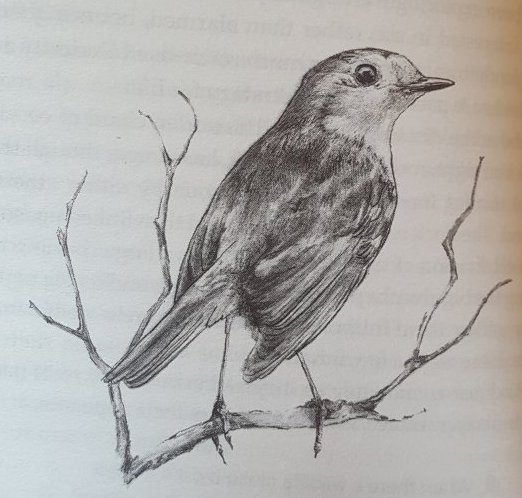
Each month starts with a beautiful pencil sketch of a bird that features in the chapter. These drawings were done by Simon Barnes’ wife, the artist Cindy Lee Wright. The one I have included above is the lovely picture of a robin which starts the chapter ‘February’. I have a certain fondness for robins, they are definitely the bird least bothered by human presence near them here in the UK and used to perch watching me as I worked in my garden in case I unearthed anything worth eating.
I can definitely recommend this book, the idea of just sitting in one place for a year and writing about what was seen from that vantage point could have been dull but I found myself racing through the pages totally drawn in by the gentle and engaging tone of the writing.
 Ramblings on my bookshelves
This is interesting to flip the idea of exploring new places to exploring the daily changes in a familiar place. I like that openness to a different kind of experience.
LikeLike