

Inspired by the eightieth anniversary of the D-Day landings which was marked earlier this month I thought I’d look back on a book covering the start of the war. This is not a review of Modern Battle by Major Paul W Thompson, although it is a surprisingly interesting book which studies actual engagements between German and Allied troops in the early years of World War II so I will talk about it later in this blog. Rather I am looking at the various editions I have of the book and what these tell us about the war. Starting with The Forces Book Club edition published in October 1942, which is the second most difficult of the four versions to find as it as not sold to the public but rather only as packs supplied under subscription to military units, as described below on the inside front cover of this book. This explains why my copy has “C” Mess handwritten on the cover, sadly there is no further indication as to which battalion the mess (a place where military staff would eat and socialise) was associated with. Several of the other books I have from The Forces Book Club are ink stamped with the battalion or ship which had subscribed.

The rear cover gives a list of the first twenty books to make up, what was intended to be a substantial library for isolated units who otherwise would have little to read. The project however was a failure, partly down to the poor information regarding the existence of The Forces Book Club disseminated by the Ministry of Defence and partly due to the overly worthy choice of titles. The mystery and crime editions such as ‘Panic Party’ or ‘The Murders in Praed Street’ would undoubtably have been voraciously read but I can’t imagine Thomas Sharp’s volume on ‘Town Planning’ would have been as popular. Penguin did produce the 120 books needed to fulfil original subscriptions taken out, but in far lower numbers than expected and a lot of the books were subsequently rebound, initially as books to go to prisoner of war camps in Germany and later in the ‘normal’ covers these books would have had for general sale to the public.

The POW versions have the normal front cover but on the inside of this there is a replacement of the description of The Forces Book Club with some information regarding The Prisoner of War Book Service. Again the overall cost is three pounds for 120 books but this time even the more esoteric titles would probably have been read due to serious shortage of other reading material in the camps. All the remaining FBC titles appear to have been rebound as POW editions but they are all incredibly rare, I have a couple that, whilst popular as reading for the forces would definitely not been acceptable to the Germans i.e. ‘The Escaping Club’ and ‘The Tunnellers of Holzminden’ both of which deal with escapes from POW camps in the First World War and would therefore not pass the censors which probably explains why they have survived. I suspect that the company doing the rebinding simply did all the books without consideration as to the material they contained.

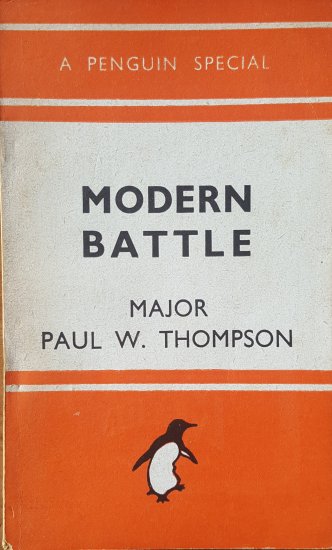
Books that didn’t make it out as FBC or POW editions were potentially rebound again as the main production run, so it is relatively common to find books that inside say they were printed for the Forces Book Club but in the ‘normal’ covers, rather than the one shown at the top of this blog. Speaking of which the first UK edition of the book in the Penguin Special cover from July 1942 can be seen below. All of the editions described so far have identical text inside with a foreword by Tom Wintringham, who had already written a couple of books published by Penguin including ‘English Captain’ and ‘New Ways of War’.
But we now come to a variant text as the book was also printed as a Penguin Special in America in association with The Infantry Journal, a company that already had distribution within the USA military and this has a new introduction by the editors of The Infantry Journal giving some background for their readership. This book was also published in July 1942, so just a few months after the Japanese attack on Pearl Harbour and the direct involvement of USA in the Second World War in December 1941. The original hardback first edition was published by W W Norton’s and Co. of New York earlier during 1941. A brief quote from the introduction to this Penguin American edition.
Modern Battle is based on a variety of source materials mainly from the professional military journals. Some of the accounts come from interviews with actual participants in the engagements described. Much of the background material is German, since the Nazi methods of warfare are those that have been most successful, and those that we need to know best as we work to find methods still better.
The copy I have is the third US edition from November 1942 by which time Paul Thompson had been promoted to Lieutenant Colonel. In the introduction there is an acknowledgement that the numerous included maps are drawn by Captain William H Brown of the US Army, who had also apparently been promoted, as in the July editions he is given as a Warrant Officer for the U.S. Coast Artillery Corps.

Now to the actual book. As alluded to above Thompson had access to German sources, presumably because America was not a combatant in WWII at the time he wrote the book, and these enable him to provide a comprehensive review of the various actions beyond anything available to a UK author. Of particular interest is the account of the aerial attack on Crete in May 1941 which is covered in the final chapter, which has a lot of information from German sources explaining how they went about the invasion which took just eleven days to complete despite the island being around 160 miles long. These alternative sources are evident throughout the book whether it be the German 10th army in Poland or the 1st Panzer division advancing on Aachen in 1940 and it makes the book a fascinating read as I have rarely come across information from outside Allied write ups.
 Ramblings on my bookshelves