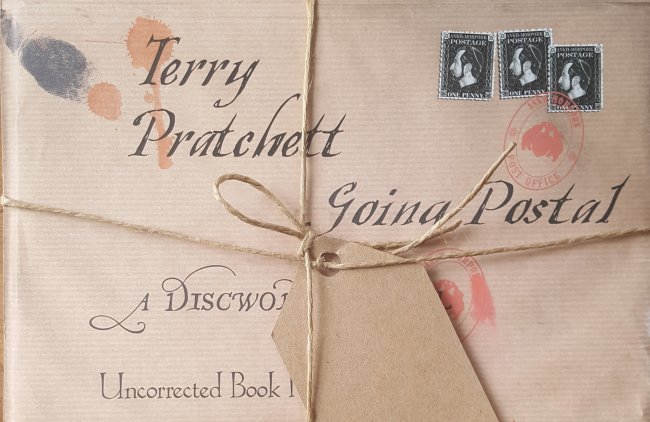
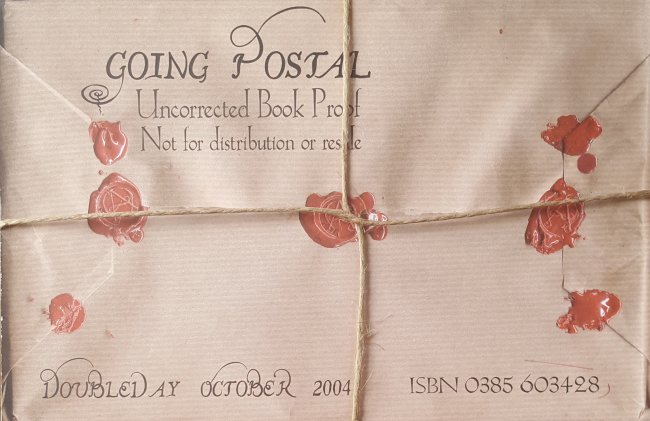
The 9th July 2004 saw the first appearance of stamps purportedly from Terry Pratchett’s Discworld and as I posted an entry on my Instagram account to mark the 20th anniversary of this and the book ‘Going Postal’ which had inspired them I got out my copies of the book of which I have three, the uncorrected book proof, and the first hardback and paperback editions. The cover of the book proof was designed by Bernard Pearson and made to look like a brown paper parcel tied up with string, just 727 copies were printed and sent to book reviewers on the 28th June 2004 with the instruction that they were not to be distributed or sold, the hardback was released on 1st October 2004 and the paperback followed on the 26th September 2005. I’ve never untied the string around my proof copy so had to read the first commercially available edition, see cover further down the blog. As you can see the front cover of the proof includes ‘stamps’ clearly based on the worlds first stamp, the penny black from 1840, but with Queen Victoria’s head replaced by that of Stephen Briggs in his guise as Lord Vetinari, the Patrician of Ankh Morpork, the largest city on the Disc. As I had got them off the shelves, probably for the first time in almost twenty years it seemed logical to read the book again.
Going Postal is the first appearance of a character who would play a major role in most of the remaining Discworld books , well those set in Ankh Morpork anyway, that Pratchett would write before his untimely death in 2015, i.e. Moist von Lipwig, who at the start is facing being hanged for forgery and embezzlement amongst other crimes. To his surprise, and undoubted relief, after being hanged he comes round in the office of Lord Vetinari who reveals that the hangman is an expert in almost hanging somebody such that those observing the event would believe that the prisoner had indeed been executed and instead his lordship wants to offer him a job. Recognising von Lipwig’s abilities and importantly expendability if it doesn’t work out, he wants him to resurrect the moribund Post Office, a branch of government which had failed and no longer delivered anything. The populace instead relying on ‘the clacks’, a primitive form of telegraph system in a world yet to discover electricity, which is increasingly expensive and prone to failure as the new money men who had taken it over fail to understand the importance of daily maintenance to fix small problems before they become much bigger ones.
Without giving the plot away von Lipwig succeeds in re-invigorating the Post Office but in the meantime what initially reads as a comedy fantasy also dissects the world of crooked finance where men just interested in making more money for themselves fiddle the books to project a business doing much better than it really is. The company is therefore able to take on large loans at preferential rates which will be used to enrich the directors whilst loading the company with debts they have no intention of paying back, simply waiting for it to collapse at which point they will buy what is left at a knockdown rate and do it all over again. Pratchett would have another go at the murky world of finance in the next Moist von Lipwig book ‘Making Money’ in 2007.
‘Going Postal’ is a highly entertaining book both for the ruses Moist von Lipwig makes use of in reinventing the Post Office and making it work again, demonstrating time and again the wisdom of Lord Vetinari in putting a conman and most significantly a showman in charge who along the way invents stamps as a means of getting money further up front for delivery of letters and parcels even though he doesn’t understand people who collect them and therefore simply hand over the money for a service they are never going to use. The climactic way he ultimately destroys the money men running the clacks is beautifully written and I highly recommend both this book and ‘Making Money’, something I probably wouldn’t have said at the time they were written when Moist von Lipwig simply didn’t appeal to me as a character but I have to say he has grown on me over the years as I better understood what Pratchett was trying to do with the books.
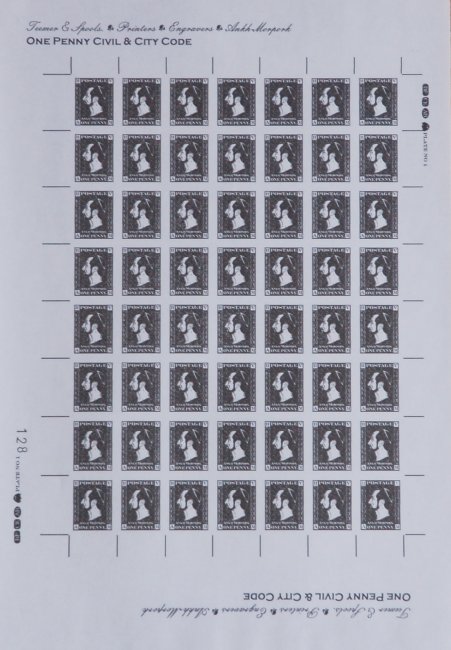
The sheet of stamps shown above replicates the original sheet described as being printed in the book by Teemer & Spools and just 250 sheets were produced by letterpress to be sold to lucky collectors who managed to get one in the couple of days before they sold out. Mine is number 128 as can be seen in the left hand margin. Discworld stamps have become a highly collectable product over the couple of decades they have existed and numerous examples have been produced with new designs coming out every year. For a brief history of the stamps and other postal artefacts see here.
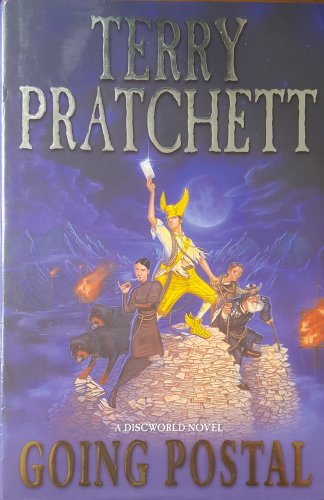
Below is the cover of the first hardback edition this time designed by Paul Kidby.
 Ramblings on my bookshelves