Artemis Fowl – Eoin Colfer

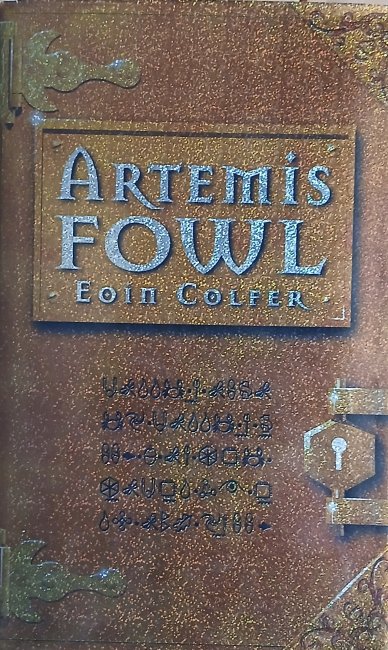
This is the first of an eleven book series written by Irish author Eoin Colfer, eight of which are about Artemis Fowl II and in the final three books, which are effectively a reboot, his twin younger brothers. My copy is a hardback from the first year of publication, 2001, and has a metallic, highly reflective dust jacket which made it very difficult to photograph. Later editions retain the gold colouring but are not metallic. At the start of this book is an introductory prologue which finishes as follows:

Artemis Fowl had devised a plan to restore his family’s fortune. A plan that could topple civilisations and plunge the planet into a cross-species war.
He was twelve years old at the time…

This last line, more than anything else in the prologue, establishes that we are in the literary genre known as young adult, which is not a area I have explored on this blog for a while so please be aware that this book is not aimed at me as a typical reader. Having said that I quite enjoyed this, and the next two books which I have also read, I have also discussed the series with other people who first read the books whilst they were within the target age range of roughly twelve to eighteen to obtain a more rounded viewpoint.

Artemis’s father is missing, presumed dead and his mother has become a barely functioning recluse in the attic triggered by her grief for her missing husband, this leaves Artemis without parental supervision in his parents large house in Ireland with only his mountainous bodyguard, deliberately confusingly called Butler and Butler’s younger sister Juliet. There are presumably servants but they don’t appear in the narrative. The family money was built upon criminal enterprises and Artemis is definitely a chip off the old block but he believes he has found a target for his genius beyond the jurisdiction of the Irish Gardaí or indeed any normal police force, his plan is to get money from the fairy world by obtaining their legendary supply of gold. And so we are entering the realm of fairies, elves, dwarfs, trolls and other magical creatures but not as imagined by Tolkein, Pratchett or others who have raided mythology for their characters modifying them to suit their plots. Here the changes are if anything more radical, dwarfs chew their way through the earth having first dislocated their jaws and expelling the residue via what can most delicately be called their opposite end having first dropped the flap in their trousers. That Butler at one point is in the way of a cataclysmic fart from Mulch Diggums. the kleptomaniac dwarf, is clearly there to appeal to the younger readers who by and large can never resist a fart joke. Elves are approximately a meter tall and one of the books major characters, Holly Short, is one of those, she is also part of LEPrecon, part of the police force for the fairy peoples who are now forced to live deep underground to avoid the Mud People as they refer to humans. Colfer explains that LEP stands for Lower Elements Police a somewhat tenuous forcing of the word Leprechaun into his plot line.

I’m not going to go into the plot of the book, suffice to say that Artemis has quite an ingenious plan to part the fairies from their gold which first involves deciphering their language, a sample of which is on the cover and which is also depicted on the base of each page of the novel, as far as I can tell differently on each page. The story moves on at quite a pace and I found myself at the end of the 280 pages far quicker than I expected. I mentioned at the beginning that I have read the first three Artemis Fowl books and talking to my friends who read them as teenagers I’m told I shouldn’t go much beyond about book five as they reckon that the plots get a bit similar as though Colfer was running out of stories to tell with these characters. One friend has read the first of the Artemis twins books but didn’t feel the urge to read the others, which I think says a lot, so by all means have a go at the early books as a bit of light reading between more weighty tomes but probably skip the later ones.

Hotel Splendide – Ludwig Bemelmans

Ludwig Bemelmans is nowadays probably best known as an artist or as the writer and illustrator of the Madeline series of children’s books. In total he wrote over forty books along with several plays and film scripts but my favourites are the three autobiographical memoirs dealing in a humorous way with his time working at the Ritz hotel in New York and when he ran his own restaurant of which this is the second, the first being Life Class and the final collection being Hotel Bemelmans. This book takes us from his first job there as a bus boy (the lowest of the low in the hierarchy of waiting staff) working at the worst tables in the restaurant facing the stairs, therefore draughty, and between the doors to the pantry, whose hinges needed oiling but never were, and the linen closet so waiters were constantly going to and fro serving other customers. The waiter assigned to these tables, Mespoulets, was probably the worst waiter imaginable, quite often ignoring his customers and eventually delivering cold or incorrect meals, sometimes both, to their table. Monsieur Victor, the maitre d’hotel regarded these tables as ideal for all the customers he didn’t like for whatever reason, complainers, poor tippers, anything that he didn’t approve of and so Mespoulets was allowed to continue for years with his appalling treatment of clients.

Gradually our narrator moves up through the ranks until at the end of the book he has made it to Assistant Banquet Manager and effectively moves into the best suite of the hotel which is permanently engaged, although seldom used, by a European multi-millionaire. He does this on the basis that he needs somewhere quiet to sleep as the job often doesn’t finish until six in the morning, even though he starts on duty during the mid afternoon so doesn’t have time to go home and come back and still get some proper rest. That he also works his way through fine wines and cigars is seen as a perk of the job, both by himself and the other staff on the banqueting team. Indeed a lot of the staff seem to make full use of the hotels food and drink especially that left over from banquets on the basis that it would be simply thrown away otherwise. One of the staff, named Kalakobe, even took to bottling the dregs from all the glasses in the dining room and drink this foul concoction the next day whilst resting from his strenuous role of the cleaner of the heavy coppers used in the kitchen.

The book ends with another story about Mespoulets, this time about him finally leaving the hotel but I particularly want to show one of the drawings that adorn the start of each chapter and also include the opening of this section where you can appreciate the word craft of Bemelmans in his description of this fallen figure. The image is a little bent as the book I’m reading is from 1947 and the spine is rather fragile so I was careful not to press too hard on the pages.

Mespoulets is suspected of being the author of death threats posted to Monsieur Victor and the chapter revolves round how best to safely get rid of him after a psychiatrist states baldy that he definitely should not be sacked as that could cause Mespoulets to carry out his threats. Needless to say that after managing to get him on a ship home to France the letters continue to arrive so nobody is any the wiser who the real culprit is.

I loved reading these short stories of the quite often disreputable life of the staff in a major luxury hotel although I doubt very much that I would want to stay there as they all had a ring of truth about them regardless of how outlandish some of them sounded. I’m glad to say that Hotel Splendide along with Hotel Bemelmans are both still in print eighty five years after they first appeared so the talent of Ludwig Bemelmans to entertain is still enjoyed by modern readers.

This has been my 350th weekly blog on the books I share my home with and I look forward to reading and writing about many more.

The Art of Floating – Melanie Marttila

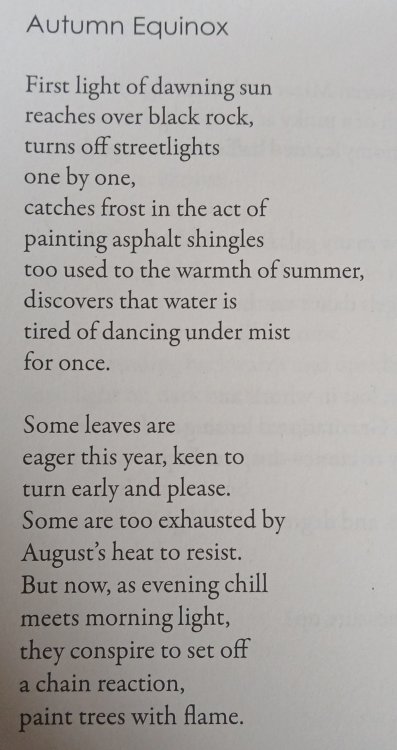
Melanie Marttila lives in Sudbury in Ontario, Canada north of Lake Huron and several of the poems in this collection are clearly inspired by her environment especially in the final section ‘Fire and Ice’. As someone who lived in Wisconsin, northern USA, for a while I appreciate the descriptions of the cold winters in this section especially the poem ‘Ice Storm’ the extreme effects of which has to be seen to be believed and her description of “temperature drops and for two days, the world is quicksilver bright in the sun”. My first exposure to rural Wisconsin was during an ice storm and I’ve never forgotten the experience, the beauty and yet the awe inspiring danger of trees whose individual branches are encased in brilliant ice making them far heavier than the tree would normally support. I loved being taken back to that winter of 1985/6 but this section also has poems that reflect the equally dramatic changes autumn brings such as the one below.

I now live back in England and from my window a wooded hillside does its best to emulate the sudden turns of seasons from Canada and Northern USA, especially round the Great Lakes or even Sweden where I also lived for a while. This collection brings back memories.

Yet to dwell on the poems recalling my familiar past is to leave out a lot of the other side of Marttila, this her first collection of poetry, published April 2024, is dedicated to her father who died in 2011 and the sense of loss comes through in many of the works. There are also unexpected poems where we suddenly delve into cosmology, apparently her partners subject, but we also explore aspects of her mental health, Marttila is autistic but is not willing to be brought down by her diagnosis, so along with the deeper poems there are highlights of beauty. Reading the conclusion of the blurb on the back cover “The Art of Floating is dedicated to the poet’s father who taught her how to surrender to and survive the rough waters of mental illness.” you might expect a depressing read but the collection is far from it. But I am always drawn back to her lovely depictions of the Canadian countryside especially in its most extreme, but even then I’m regularly surprised by the imagery she chooses such as the opening lines of ‘Compensation’

small blue spruce and
tender birch
are the foundation
upon which this
green world is built.
scantily clad tamarack,
waif like larch
towering jack-pine
branches twisted by
wind, reaching for
sun, like the arms of Lakshmi
or Saraswati

Lakshmi and Saraswati are Hindu goddesses, Saraswati is the goddess of knowledge whilst Lakshmi represents wealth, beauty and fertility. It seems odd to invoke their names in a world that is so clearly Canadian as the Tamarack is a species of larch native to the wilds of that country, Both of the goddesses however have four arms often depicted holding items in multiple directions so their appearance represents the spreading branches.

The Art of Floating is published by Latitude 46 Publishing, a company founded in 2015 that specialises in authors connected to northern Ontario, which you might think is overly restrictive but a glimpse of their catalogue shows the rich variety of works represented and there are so many more books I would love to explore.

Fairy Tales – Charles Perrault

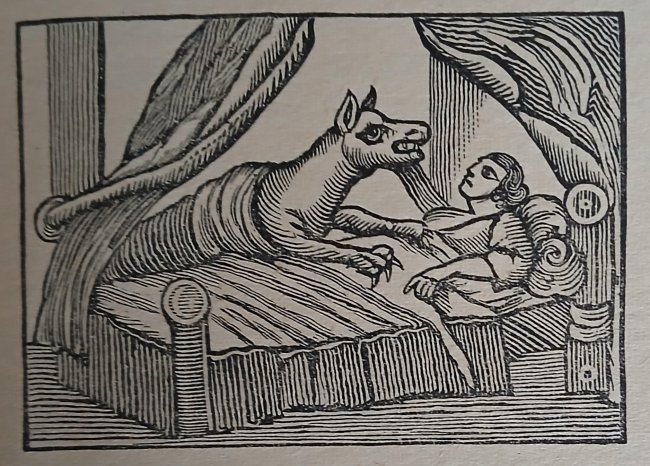
Frenchman Charles Perrault was one of the earliest collectors of fairy tales predating the German Brothers Grimm by over a century and these were well before the Danish Hans Christian Anderson and it is in this collection that we find some of the earliest published versions of such classics as Cinderella, The Sleeping Beauty, Little Red Riding Hood and Puss in Boots. Not that anyone brought up on the sanitised modern versions would recognise much of what they believe is in the story. A prime example of this is Little Red Riding Hood, which is much shorter than the tale I first read as a child, basically the wolf meets the young girl on her way to Grandmother’s house, establishes where she is going and gets there first. The wolf immediately eats the grandmother when he gets in the house and gets into the bed waiting for Little Red Riding Hood, when she arrives he tells her to undress and get into the bed at which point he eats her and the story ends just five pages after it starts with a moral that ‘plausible wolves are the most dangerous kind’ a clear warning to young ladies to beware of some men.

The most striking example of dangerous men preying on females is a story which I have never thought of as a fairy tale but it is included here and that is Bluebeard. I first came across this horror story in the opera by Hungarian composer Bela Bartok which is largely faithful to the Perrault version at least initially. A young woman visited one of the many fine homes of a wealthy man along with her family and they were all royally entertained for several days, so much so that she agreed to marriage. About a month after the wedding he has to go away on business but suggests she invites her family and friends round and gives her the keys to the house and the strong boxes, she can go and do anything but tells her never to enter the room at the end of a corridor. However she cannot resist and when she goes in finds dried blood on the floor and the bodies of his previous brides hanging on the walls, in her horror she drops the key which becomes coated with blood. Bluebeard unexpectedly returns that evening and finds blood on the key so knows she has been in the forbidden room and therefore determines that she has to die like the others. Fortunately for the young bride her brothers arrive and kill Bluebeard before he can kill her. Again there are morals to be learnt from the story at its conclusion the second of which says that the story is from long ago and nothing like this happens anymore indeed nowadays it is the wife to be afraid of not the husband.

Geoffrey Brereton as well as translating this book wrote a very interesting introduction going back to the even earlier Italian collections of fairy tales although they weren’t called that back then and taking the reader through the development of the stories such as Cinderella which in the Grimm version has the ugly sisters mutilating their feet to try to get the slipper on and having their eyes pecked out when they try to go to the castle after the wedding whilst Perrault has Cinderella forgive her sisters and invite them to live in the castle. Brereton was a freelance translator and writer specialising in French and to a lesser amount Spanish literature as such he was ideal for this 1957 translation and his erudition regarding the history of fairy tales is shown in his excellent introduction, which alone would make reading this book worthwhile. The book has reproductions of woodcuts from the first English edition of Perrault’s Fairy Tales dated 1719 before each story as in the example below for Little Red Riding Hood.