
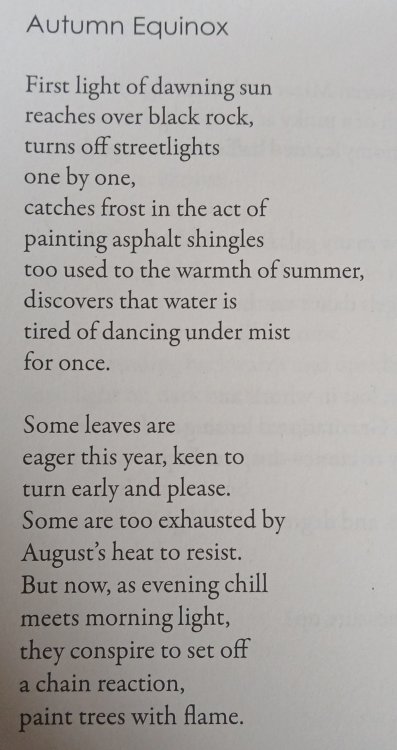
Melanie Marttila lives in Sudbury in Ontario, Canada north of Lake Huron and several of the poems in this collection are clearly inspired by her environment especially in the final section ‘Fire and Ice’. As someone who lived in Wisconsin, northern USA, for a while I appreciate the descriptions of the cold winters in this section especially the poem ‘Ice Storm’ the extreme effects of which has to be seen to be believed and her description of “temperature drops and for two days, the world is quicksilver bright in the sun”. My first exposure to rural Wisconsin was during an ice storm and I’ve never forgotten the experience, the beauty and yet the awe inspiring danger of trees whose individual branches are encased in brilliant ice making them far heavier than the tree would normally support. I loved being taken back to that winter of 1985/6 but this section also has poems that reflect the equally dramatic changes autumn brings such as the one below.
I now live back in England and from my window a wooded hillside does its best to emulate the sudden turns of seasons from Canada and Northern USA, especially round the Great Lakes or even Sweden where I also lived for a while. This collection brings back memories.
Yet to dwell on the poems recalling my familiar past is to leave out a lot of the other side of Marttila, this her first collection of poetry, published April 2024, is dedicated to her father who died in 2011 and the sense of loss comes through in many of the works. There are also unexpected poems where we suddenly delve into cosmology, apparently her partners subject, but we also explore aspects of her mental health, Marttila is autistic but is not willing to be brought down by her diagnosis, so along with the deeper poems there are highlights of beauty. Reading the conclusion of the blurb on the back cover “The Art of Floating is dedicated to the poet’s father who taught her how to surrender to and survive the rough waters of mental illness.” you might expect a depressing read but the collection is far from it. But I am always drawn back to her lovely depictions of the Canadian countryside especially in its most extreme, but even then I’m regularly surprised by the imagery she chooses such as the opening lines of ‘Compensation’
small blue spruce and
tender birch
are the foundation
upon which this
green world is built.
scantily clad tamarack,
waif like larch
towering jack-pine
branches twisted by
wind, reaching for
sun, like the arms of Lakshmi
or Saraswati
Lakshmi and Saraswati are Hindu goddesses, Saraswati is the goddess of knowledge whilst Lakshmi represents wealth, beauty and fertility. It seems odd to invoke their names in a world that is so clearly Canadian as the Tamarack is a species of larch native to the wilds of that country, Both of the goddesses however have four arms often depicted holding items in multiple directions so their appearance represents the spreading branches.
The Art of Floating is published by Latitude 46 Publishing, a company founded in 2015 that specialises in authors connected to northern Ontario, which you might think is overly restrictive but a glimpse of their catalogue shows the rich variety of works represented and there are so many more books I would love to explore.
 Ramblings on my bookshelves
Pingback: The next chapter: September 2024 update | Always Looking Up