Whatever Happened to Margo? – Margaret Durrell

Last weeks blog about Lawrence Durrell’s book ‘Bitter Lemons of Cyprus‘ was intended to be my last encounter with the Durrell siblings for a while having started with Gerald a couple of weeks ago, but here we go again with a memoir by their sister Margaret. This deals with her time starting a lodging house in Bournemouth just over the road from the home then belonging to her mother but which was sold soon after Margo got her business running. Quite when the book was written isn’t clear but it deals with the end of the 1940’s so coincides with Gerald’s ‘The Overloaded Ark‘ which I wrote about in the first of these linked blogs. ‘Whatever Happened to Margo?’ however wasn’t published until 1995, long after Gerald’s Corfu trilogy about his childhood on that island made the family household names and gave rise to the title as whatever happened to Margo, and presumably her other brother Leslie, became regular questions amongst readers. Margaret’s book also answers some of the questions about Leslie as he appears fairly regularly in here, as at the time he is also living in Bournemouth having returned to the family fold from a business failure when the fishing boat he had put his life savings and his share of his father’s inheritance into had sunk. But more of Leslie, just to round out the family, later.

Margaret has a writing style far closer to Gerald than Lawrence with a gentle humour enveloping the trials and tribulations of running a lodging house with no previous experience of doing such a thing, especially as a young (she was twenty eight when she bought the property) recently divorced mother of two boys. We are introduced to another member of the family, Aunt Patience, early on in the book and she encourages Margaret in her business plan whilst making regular suggestions as to how to keep the place running efficiently and with propriety. Margaret is somewhat subdued by her aunts overbearing personality and also by the need to keep her sweet as the potential source of investment funds but dreads her arriving to see the somewhat eclectic mix of people she has already had moving in. Margaret attracts oddballs the way her younger brother attracts unusual animals, her first lodger is Edward, an artist who has fallen out with his previous landlady over his liking to paint nudes, along with his wife who also poses for him. She also gains the downtrodden Mrs Williams and her fat son Nelson who would prove to be a lovable rogue; always getting into scrapes, he features in numerous tales often leading Margaret’s own children in ways she would never have thought of including breeding mice in the disused outside toilet. The lodgers increase rapidly including a pair of glamorous nurses whose trail of ardent male admirers gave rise to the suggestion in the neighbourhood that Margaret was in fact running a house of ill repute. The list of interesting characters just keeps going and keeping the peace between them whilst not upsetting the neighbours is a constant battle especially when Gerald arrives with a selection of animals whilst still looking for somewhere to set up his own zoo. The book is great fun, and whilst not a laugh out loud read keeps the reader thoroughly entertained throughout its just over 250 pages.

And so to Leslie, during the time this book covers he moved in with Doris, the landlady of a local off-licence for whom he was delivering beer, they married in 1952 and later that year moved to Kenya to run a farm. They swiftly left Kenya in 1968 after Leslie was accused of theft, probably accurately as he always sailed close to the wind as far as the law was concerned, this is implied right at the start of Margaret’s book. They briefly moved in with Margaret in Bournemouth before getting a job as caretakers to a block of flats in London and it was in London that he died. By this time he had so estranged relations with the rest of the family that none of his siblings attended his funeral.

Margaret would outlive all her brothers by quite a long way. Leslie had a heart attack in 1982 aged 65, Lawrence died after a stroke in 1990 aged 78, Gerald succumbed to septicaemia in 1995 aged 70 but Margo was 87 when she died in 2007. This meant that none of her siblings saw her book get published, Gerald died in January of the year the book came out but he did write the preface in November 1994 where he states that she is still in Bournemouth, although presumably no longer a landlady as she was 75 by then. He continues that he often visits her there, just as she comes out to his zoo in Jersey and home in Provence, they have even holidayed together in Corfu so bringing the whole saga full circle. I’ll leave the final word to Gerry (as he is called in his books about Corfu) :

From the beginning and every bit as keenly as the Durrell brothers, Margo displayed an appreciation of the comic side of life and an ability to observe the foibles of people and places. Like us, she is sometimes prone to exaggeration and flights of fancy, but I think this is no bad thing when it comes to telling one’s stories in an entertaining way.
Bitter Lemons of Cyprus – Lawrence Durrell

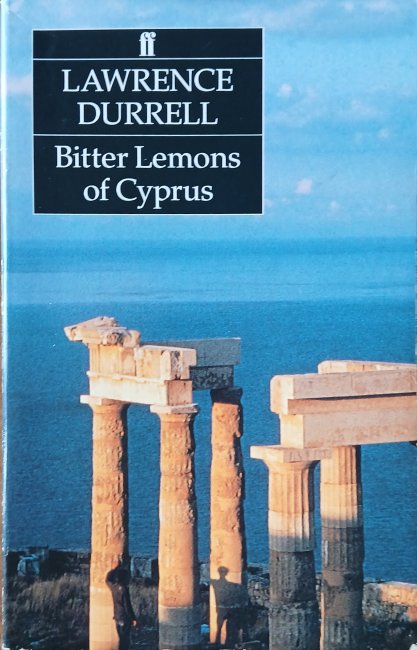
Following on from his brother Gerald’s book last week, this is one of Lawrence Durrell’s travelogues and covers the years he spent in Cyprus from 1952 to 1956 after he left the British Council in Belgrade and planned to restart his novel writing, hopefully inspired by returning to a Greek island. Although he was there with his very young second daughter Sappho, born 1951, and without his wife who had been hospitalised back in England with post-natal depression you wouldn’t really know it as he largely avoids his family problems in the book. Indeed apart from a brief mention of Gerald, whom he claims had died in Thermopylae fighting alongside the Greeks in order to calm down a somewhat drunk Greek in a bar there are very few family references.

Sappho makes her first (and unnamed) fleeting appearance on page 102 and then only to note that she could see Turkey from an upstairs window of the house Lawrence is having renovated. Lawrence’s mother even makes an appearance, mainly I suspect to look after Sappho whilst Lawrence is working away to support the renovations, and Gerald threatens to appear, which as Lawrence points out would be awkward due to his apparent death at Thermopylae. One odd thing did occur to me at this point, why could the brother who died fighting not be thought of as Leslie, anyone who has read Gerald’s accounts of growing up in Corfu knows that there is another brother but Lawrence seems determined to ignore his existence, much as Gerald left out Lawrence’s first wife Nancy whom he lived with throughout the time the family were in Corfu and not with the rest of the Durrell family as stated in the books, and with whom he had his first daughter, Penelope.

Back however to this book, chapters vary wildly from good humour and even hints of farce when considering the purchase of the house and the crazy driving from person to person to get the legal process complete before they are caught up with by the rest of the sellers family who don’t think she is getting enough money for the property; to extremely serious such as the chapter entitled ‘A Telling of Omens’ which deals with the issue of Enosis, or the proposed union of Crete with mainland Greece and thereby ending the British rule, which was still in place whilst Lawrence was there. You can tell when reading this chapter that Lawrence initially didn’t believe that this would such an issue and neither did the Cypriots he lived amongst. It is only from the older students he started teaching English to in order to raise money to complete the house that he starts to see the first flickering of the violent unrest that is less than a few months away. But from this point onwards the tone of the book changes, turning from gentle humour to deadly serious as the situation on Cyprus quite literally explodes.

Lawrence was also a poet and the book ends with his poem Bitter Lemons, as does this review, but the beauty of his text can be seen in this extract describing a beach at dawn.

In the fragile membranes of light that separate like yolks upon the cold meniscus of the sea when the first rays of the sun come through, the bay looked haunted by the desolate and meaningless centuries which had passed over it since the first foam-born miracle had occurred. With the same obsessive rhythms it beat and beat again on that soft eroded point with its charred looking sand: it had gone on from the beginning, never losing momentum, never hurrying, reaching out and subsiding with a sigh.

When Gerald and his wife arrive Lawrence is about to take on a new role as press adviser for the colonial government which would mean living in the capital rather than his out of the way village so he basically left the house in Gerald’s care during the week, only returning at weekends. This role also gives him an insight into the ramshackle government operation which is totally ill prepared for what is to come and it is this summary of the failings of the British administration that makes the book so important as a document of the times. The book changes tone roughly halfway through as Durrell leaves the realm of good natured village life and instead describes the slow disintegration of all that he had come to love about Cyprus and the introduction of thousands of British troops to try to put a lid on the bombings and shootings which would eventually lead to independence in 1960, long after Durrell had left the island.

The Overloaded Ark – Gerald Durrell

I remember reading lots of Gerald Durrell books as a child but this was the first I read as it is one of my father’s books, so it was sitting on the bookshelf for as long as I can remember. Published by The Readers Union, a book club run by Faber and Faber, who had first published the book, this volume dates from 1955. The odd thing is that I don’t remember any other books from this club at home although there were other book clubs represented on the shelves as that was probably the source of most of dad’s books. This was Durrell’s first attempt at writing a book and described his first ever collecting expedition which was to to British Cameroons and took place in 1947 with ornithologist John Yealland. He took to writing not because he particularly enjoyed it but because he needed the money partly to pay off debts from his first three collecting expeditions and also to finance his family life as he had married in 1951. He was fortunate to be able to get advice on writing from his elder brother the novelist and travel writer Lawrence Durrell and although their two styles are dramatically different they are both eminently readable.

The best way to illustrate Durrell’s style is to quote a section from the preface where they were loading the truck to get from Victoria to Mamfe where the two men were to part company to set up separate camps, Yealland to collect birds around the town of Bakabe and Durrell to go further into the bush to Eshobi searching for reptiles and mammals and also some birds not found near Bakabe. The truck was arranged for 7:30am and the plan was to be on the road by around 8:30am. The lorry however finally arrived at 11am and was full of a dozen of drivers relatives, friends and assorted goods that he was planning on getting a paid for ride up country with. The first job was therefore to get all these people and various items off the lorry as it would be fully needed to carry all the equipment.

After a prolonged altercation which for shrillness and incomprehensibility could not have been rivalled by any race on earth, they were removed, together with their household goods and livestock. The driver then had to turn the lorry for loading, and my faith in his abilities was rudely shattered when he backed twice into the hibiscus hedge, and once into the rest house wall. Our baggage was then loaded with a speed and lack of care that was frightening, as I watched, I wondered how much of our equipment would be left intact on arrival in Mamfe. I need not have worried. It turned out later that only the most indispensable and irreplaceable things got broken.

This diary like narrative, although without specific dates, is continued for the rest of the book as Durrell gets in and out of various scrapes, either attempting to collect animals himself or dealing with the numerous creatures brought to this strange white man that wants animals but not to eat them. Sadly it also covers animals that he obtained but which try as he could he couldn’t keep alive in the rapidly growing makeshift zoo he became in charge of, despite his time as a trainee keeper at Whipsnade Zoo before quitting to go animal collecting. These included the Giant Otter Shrews two of which he obtained and apparently successfully converted to a diet that could be more expected to be available in captivity only for them both to die overnight for no apparent reason and the lovely Duiker antelope fawns which eventually he put a stop to collecting as they always refused milk from a bottle and gradually starved to near death before being humanely killed, and he only ever had young as these were ones found after the hunter had killed its mother.

He does however put together an excellent collection in his time at Eshobi and transports what he has obtained to Bakabe to join Yealland and see what else he can find there which includes Cholmondeley, a large fully grown chimp that had been brought up with an English family and had gained quite a few idiosyncrasies including liking a large mug of sweet tea and cigarettes which he could light either with matches or using a lighter and sit there smoking away extremely happy. The funniest part of the book is probably the partly successful trip to the mountain of N’da Ali, the first attempt at which is interrupted by a hunter bringing an Angwantibo, a species of primate he was particularly keen to find. This means dashing back to Bakabe to look after his new prize and delaying his attempt at the mountain for a week.

To say that John Yealland was much happier with his bird only collection he had built up before Durrell joined him would be an understatement as the birds would rarely be in a position to kill him, unlike say the snakes and small crocodiles that came with Durrell, some of which made escapes from their cages, in this case abetted by one of the monkeys that had undone the door to all the cages that it could reach including the deadly Gaboon Viper’s so I’m going to include one final passage from the book:

John was seated near the table, in his pyjamas, he was busy cutting down some old fruit tins to make into water pots for the birds, and he was absorbed in his work. I was just putting the finishing touches to my toilet when I saw something move in the shadows beneath his chair. Putting on my dressing gown I went closer to see what it was. There on the floor, about six inches away from John’s inadequately slippered feet, lay the Gaboon Viper. I had always believed, judging by what I had read and was told, that at moments like this one should speak quietly t the victim, thus avoiding panic and sudden movement. So, clearing my throat, I spoke calmly and gently:

“Keep quite still, old boy, the Gaboon Viper is under your chair.”

On looking back I feel I should have left out my reference to the snake in my request. As it was my remark had an extraordinary and arresting effect on my companion. He left the chair with a speed and suddenness that was startling; and suggestive of the better examples of levitation.

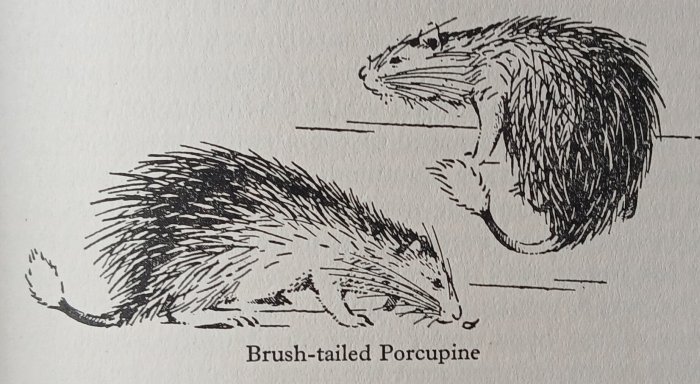
The numerous illustrations through the book are by Sabine Baur based on drawings and photographs by Gerald Durrell. Durrell wrote many books about his collecting experiences, the zoo he founded in Jersey and various conservation projects he became involved in but is probably best known for his series of three books about growing up with his family on Corfu just before WWII, especially the first ‘My Family and Other Animals’. I’m going to stay with the Durrell family next week with his eldest brother’s book ‘Bitter Lemons of Cyprus‘.

Short Stories – Fyodor Dostoyevsky

I’ve been meaning to read Fyodor Dostoyevsky for a long time but in common with a lot of other Russian novelists his books are somewhat daunting for a blog which appears every week, just checking my shelves I find:

  • ‘Crime and Punishment’ – 559 pages
  • ‘The Devils’ – 669 pages
  • ‘The Idiot’ – 661 pages
  • ‘The Brothers Karamazov’ – 2 volumes totalling 913 pages
  • and a volume containing two short stories and a novella ‘The Cossacks’ – 334 pages

It was then I spotted that I had two volumes from the Penguin Little Black Classics series which would give me an entry point to Dostoyevsky to see if I like him as an author. The first one is number 44 from this series ‘The Meek One’ which only has this one short story in it. The title is more usually translated as ‘A Gentle Creature’, and it is just 57 pages, still quite long for a short story, but a lot more approachable. Warning there are spoilers in this review if you want to read the stories first I cannot find ‘The Meek One’ but ‘White Nights’ is on Project Gutenberg here and ‘Bobok’ can be found here.

‘The Meek One’ begins with the un-named narrator contemplating the body of his equally un-named young wife laid out on a table in their home waiting for the undertaker to arrive the next day and we then go back over the story of how the two met and the short and largely unhappy marriage that they had. They had originally come into contact with one another as she would often come and pawn items in his pawnbrokers to raise money to advertise her services as a governess or more latterly almost any job to enable her to leave her two aunts. At the time of their marriage he was forty one and she just sixteen, however he regarded himself as her saviour from a planned marriage arranged by these aunts to a shopkeeper in his fifties who had killed his two previous wives whilst drunk and was looking for a third. The relationship between the couple seems to have deteriorated very quickly after the wedding and it is a sad story he tells of long silences and barely communicating through the winter including a time when she places a loaded gun to his head whilst thinking he was asleep but doesn’t pull the trigger. In the spring he makes an unexpected move to rescue the marriage suggesting a journey to France but it is whilst out getting the passports that she commits suicide.

Russian writing has an often undeserved reputation for gloominess and this short story doesn’t go any way to repudiate that impression, maybe the next book will have something more uplifting.

The second and third of Dostoyevsky’s short stories in volume 118 of the Penguin Little Black Classics series has ‘White Nights’ paired with ‘Bobok’. ‘White Nights’ is 86 pages long, ‘Bobok’ is the shortest at just 27 pages.

‘White Nights’ tells the story of a twenty something recluse in St Petersburg and yet again we don’t have his name, this lack of a name seems to increase the isolation of Dostoyevsky’s characters and this time he is pretty well the only un-named person in the story. He spends his days wandering around the city imagining having conversations with the people and even the houses he sees but in fact the only person he communicates with is his maid Matrona who is supposed to look after his apartment but hasn’t even removed the cobweb on the ceiling, mind you neither has he. One day whilst out on one of his aimless walks he sees a pretty young girl crying on a bridge and this time builds up the courage to approach her, however she evades him only to be threatened by an older passerby and our narrator steps in the save her. So begins the four days of happiness that he is to enjoy as they get to know one another, he explains that he is a lonely dreamer whilst she tells of a unhappy time living with her blind grandmother who pins their clothes together so that she can be sure Nastenka is not wandering off. She also tells of a lodger they had a year ago whom she fell in love with but who had to return to Moscow but promised to return and marry her when he left. The narrator rapidly also falls in love with her but agrees to carry a letter to a family who know the ex-lodger to see if he has returned and is still planning on restarting their relationship whilst secretly hoping that he has found somebody else in Moscow. The story is well written with the narrator regarding himself as the hero almost of a book of his life, indeed Nastenka rebukes him for telling his story almost as if he was reading it out. Sadly the ex-lodger does return and the narrator returns to his apartment downcast looking to another fifteen years of loneliness but Matrona does at least remove the cobweb.

‘Bobok’ is easily the strangest of the three stories and to my mind the best due to its originality, although it starts out normally enough with our narrator, this time with a name, Ivan Ivanych, going to the funeral of a distant relative and avoiding the lunch afterwards, takes to lying down on one of the long stones in the graveyard for a rest. All of a sudden he hears voices, muffled but intelligible, and wonders where they may be coming from. Gradually he realises that they are coming from the graves around him and it appears that the dead have a second short life in the grave where they can communicate with each other for two or three months, possibly up to six before they decompose too far. I loved this story as I hadn’t read anything like it before, The various conversations start off reflecting the status of the characters as they were before they died but gradually they decide to throw off their previous lives and simply talk to one another until they suddenly fall silent when they become aware he is listening. Another possible reason for our narrator hearing them is given in the opening lines of the story:

The day before yesterday Semyon Ardalyonovich suddenly comes out with: ‘And would you kindly tell me Ivan Ivanych will the day come when you’ll be sober?’

All three tales are taken from the Penguin Classics volume ‘The Gambler and Other Stories’ translated by Ronald Meyer which also includes the short stories ‘The Dream of a Ridiculous Man’, ‘A Christmas Party and a Wedding’ and ‘A Nasty Story’ along with its title novella ‘The Gambler’ which was actually written by Dostoyevsky in order to pay off his debts from losses at roulette.

The Good Soldier – Ford Madox Ford

This truly remarkable novel makes use of the ‘unreliable narrator’ literary style and is probably the best version of this particular method of slowly revealing the true aspects of the story I have read. Not for nothing did it come as high as thirteenth in the BBC poll of literary critics for the one hundred greatest English novels. But first let’s address the title, which is not the original given to it by Ford. The book was due to be first published by John Lane: The Bodley Head in 1915, in his later dedication appended to the book in 1927 Ford explains what happened:

The book was originally called by me The Saddest Story, but since it did not appear until the darkest days of the war were upon us Mr. Lane importuned me with letters and telegrams – I was by that time engaged in other pursuits! – to change the title which he said would at that date render the book unsaleable. One day, whilst I was on parade, I received a final wire of appeal from Mr. Lane and the telegraph being reply paid I seized the reply form and wrote in hasty irony ‘Dear Lane, why not The Good Soldier’… To my horror six months later the book appeared under that title.

That the new title was ironic certainly becomes obvious the more you read the book, although initially it appears to be highly suitable. The original title does make its appearance in a few places with Ford having his narrator say several times similar phrases to ‘I call this The Saddest Story’, which is actually the opening line of the final part or ‘THIS is the saddest story I have ever heard’ which is the books’ first sentence. When you start reading however there is no hint of the tragedies still to come as John Dowell, our unreliable narrator, starts off painting a happy friendship between the English couple Edward and Leonora Ashburnham and the Americans John and Florence Dowell set over nine years largely in the German spa resort of Bad Nauheim where the couples regularly meet. Captain Edward Ashburnham is the good soldier of the title and is apparently there for treatment of his heart condition that has effectively invalided him out of his regiment. Florence is also there for treatment of a heart condition, fear of which has prevented her from having sexual relations with John since their marriage began. Apart from that the couples seem ideal, independently wealthy so they can choose to live where they want and largely do what they want all is happiness in this small group of friends.

But that is what John initially wants you to think and it may be what he believes at least at the start of the narrative but gradually he reveals more, almost inadvertently, recalling details that turn the situation on its head and this is where reviewing this book becomes tricky because I really want to encourage you to read the book and discussing what happens is almost impossible without revealing too much. Suffice to say that almost nothing you are told in the first part of the book turns out to be true, instead there is a complex inter-relationship between the characters which is nothing like it first seems and even the reasons for them being in Germany at all is based on a tissue of lies.

The slow reveal of the various facts and of the other tragic characters associated with the ‘good’ Captain show a superb skill in the writing of the book as revelation after revelation come after the barest of hints that all is not right but remain believable and despite John’s bewildered insistence that he is the one steady rock in the narrative the fact that he keeps changing his story leaves the reader wondering just how much of what you come to understand by the end is really what happened and what is still John’s reinterpretation of the story. There is a good reason why this book has remained in print for almost 110 years so far so even if you have never heard of Ford Madox Ford I recommend that you get hold of a copy and read it.