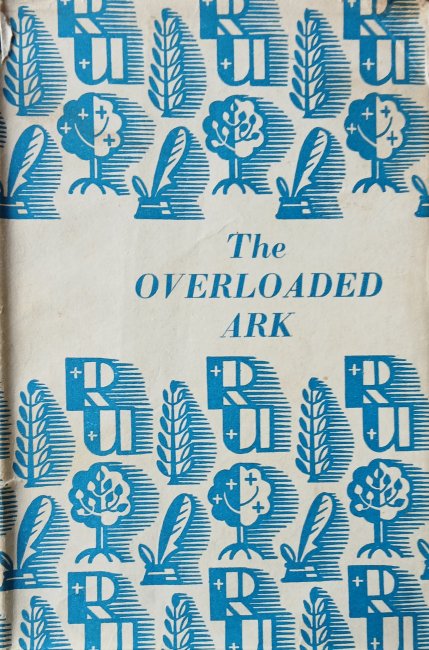
I remember reading lots of Gerald Durrell books as a child but this was the first I read as it is one of my father’s books, so it was sitting on the bookshelf for as long as I can remember. Published by The Readers Union, a book club run by Faber and Faber, who had first published the book, this volume dates from 1955. The odd thing is that I don’t remember any other books from this club at home although there were other book clubs represented on the shelves as that was probably the source of most of dad’s books. This was Durrell’s first attempt at writing a book and described his first ever collecting expedition which was to to British Cameroons and took place in 1947 with ornithologist John Yealland. He took to writing not because he particularly enjoyed it but because he needed the money partly to pay off debts from his first three collecting expeditions and also to finance his family life as he had married in 1951. He was fortunate to be able to get advice on writing from his elder brother the novelist and travel writer Lawrence Durrell and although their two styles are dramatically different they are both eminently readable.
The best way to illustrate Durrell’s style is to quote a section from the preface where they were loading the truck to get from Victoria to Mamfe where the two men were to part company to set up separate camps, Yealland to collect birds around the town of Bakabe and Durrell to go further into the bush to Eshobi searching for reptiles and mammals and also some birds not found near Bakabe. The truck was arranged for 7:30am and the plan was to be on the road by around 8:30am. The lorry however finally arrived at 11am and was full of a dozen of drivers relatives, friends and assorted goods that he was planning on getting a paid for ride up country with. The first job was therefore to get all these people and various items off the lorry as it would be fully needed to carry all the equipment.
After a prolonged altercation which for shrillness and incomprehensibility could not have been rivalled by any race on earth, they were removed, together with their household goods and livestock. The driver then had to turn the lorry for loading, and my faith in his abilities was rudely shattered when he backed twice into the hibiscus hedge, and once into the rest house wall. Our baggage was then loaded with a speed and lack of care that was frightening, as I watched, I wondered how much of our equipment would be left intact on arrival in Mamfe. I need not have worried. It turned out later that only the most indispensable and irreplaceable things got broken.
This diary like narrative, although without specific dates, is continued for the rest of the book as Durrell gets in and out of various scrapes, either attempting to collect animals himself or dealing with the numerous creatures brought to this strange white man that wants animals but not to eat them. Sadly it also covers animals that he obtained but which try as he could he couldn’t keep alive in the rapidly growing makeshift zoo he became in charge of, despite his time as a trainee keeper at Whipsnade Zoo before quitting to go animal collecting. These included the Giant Otter Shrews two of which he obtained and apparently successfully converted to a diet that could be more expected to be available in captivity only for them both to die overnight for no apparent reason and the lovely Duiker antelope fawns which eventually he put a stop to collecting as they always refused milk from a bottle and gradually starved to near death before being humanely killed, and he only ever had young as these were ones found after the hunter had killed its mother.
He does however put together an excellent collection in his time at Eshobi and transports what he has obtained to Bakabe to join Yealland and see what else he can find there which includes Cholmondeley, a large fully grown chimp that had been brought up with an English family and had gained quite a few idiosyncrasies including liking a large mug of sweet tea and cigarettes which he could light either with matches or using a lighter and sit there smoking away extremely happy. The funniest part of the book is probably the partly successful trip to the mountain of N’da Ali, the first attempt at which is interrupted by a hunter bringing an Angwantibo, a species of primate he was particularly keen to find. This means dashing back to Bakabe to look after his new prize and delaying his attempt at the mountain for a week.

To say that John Yealland was much happier with his bird only collection he had built up before Durrell joined him would be an understatement as the birds would rarely be in a position to kill him, unlike say the snakes and small crocodiles that came with Durrell, some of which made escapes from their cages, in this case abetted by one of the monkeys that had undone the door to all the cages that it could reach including the deadly Gaboon Viper’s so I’m going to include one final passage from the book:
John was seated near the table, in his pyjamas, he was busy cutting down some old fruit tins to make into water pots for the birds, and he was absorbed in his work. I was just putting the finishing touches to my toilet when I saw something move in the shadows beneath his chair. Putting on my dressing gown I went closer to see what it was. There on the floor, about six inches away from John’s inadequately slippered feet, lay the Gaboon Viper. I had always believed, judging by what I had read and was told, that at moments like this one should speak quietly t the victim, thus avoiding panic and sudden movement. So, clearing my throat, I spoke calmly and gently:
“Keep quite still, old boy, the Gaboon Viper is under your chair.”
On looking back I feel I should have left out my reference to the snake in my request. As it was my remark had an extraordinary and arresting effect on my companion. He left the chair with a speed and suddenness that was startling; and suggestive of the better examples of levitation.
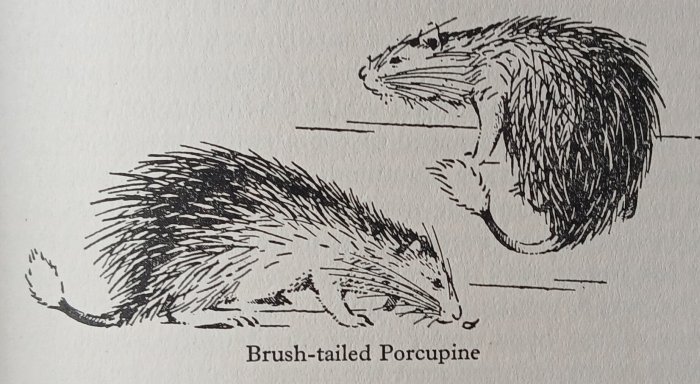
The numerous illustrations through the book are by Sabine Baur based on drawings and photographs by Gerald Durrell. Durrell wrote many books about his collecting experiences, the zoo he founded in Jersey and various conservation projects he became involved in but is probably best known for his series of three books about growing up with his family on Corfu just before WWII, especially the first ‘My Family and Other Animals’. I’m going to stay with the Durrell family next week with his eldest brother’s book ‘Bitter Lemons of Cyprus‘.
 Ramblings on my bookshelves
Lovely Faber edition. I just read my first Gerald Durrell – My Family and Other Animals and couldn’t believe I left it on the shelf for so long. His brother’s Alexandria Quartet is still on my TBR, along with Bitter Lemons. Looking forward to your review of that one.
LikeLike
Pingback: Bitter Lemons of Cyprus – Lawrence Durrell – Ramblings on my bookshelves
Pingback: Whatever Happened to Margo? – Margaret Durrell – Ramblings on my bookshelves