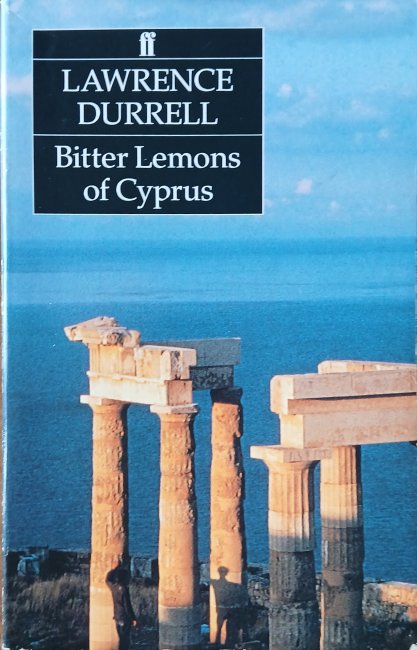
Following on from his brother Gerald’s book last week, this is one of Lawrence Durrell’s travelogues and covers the years he spent in Cyprus from 1952 to 1956 after he left the British Council in Belgrade and planned to restart his novel writing, hopefully inspired by returning to a Greek island. Although he was there with his very young second daughter Sappho, born 1951, and without his wife who had been hospitalised back in England with post-natal depression you wouldn’t really know it as he largely avoids his family problems in the book. Indeed apart from a brief mention of Gerald, whom he claims had died in Thermopylae fighting alongside the Greeks in order to calm down a somewhat drunk Greek in a bar there are very few family references.

Sappho makes her first (and unnamed) fleeting appearance on page 102 and then only to note that she could see Turkey from an upstairs window of the house Lawrence is having renovated. Lawrence’s mother even makes an appearance, mainly I suspect to look after Sappho whilst Lawrence is working away to support the renovations, and Gerald threatens to appear, which as Lawrence points out would be awkward due to his apparent death at Thermopylae. One odd thing did occur to me at this point, why could the brother who died fighting not be thought of as Leslie, anyone who has read Gerald’s accounts of growing up in Corfu knows that there is another brother but Lawrence seems determined to ignore his existence, much as Gerald left out Lawrence’s first wife Nancy whom he lived with throughout the time the family were in Corfu and not with the rest of the Durrell family as stated in the books, and with whom he had his first daughter, Penelope.
Back however to this book, chapters vary wildly from good humour and even hints of farce when considering the purchase of the house and the crazy driving from person to person to get the legal process complete before they are caught up with by the rest of the sellers family who don’t think she is getting enough money for the property; to extremely serious such as the chapter entitled ‘A Telling of Omens’ which deals with the issue of Enosis, or the proposed union of Crete with mainland Greece and thereby ending the British rule, which was still in place whilst Lawrence was there. You can tell when reading this chapter that Lawrence initially didn’t believe that this would such an issue and neither did the Cypriots he lived amongst. It is only from the older students he started teaching English to in order to raise money to complete the house that he starts to see the first flickering of the violent unrest that is less than a few months away. But from this point onwards the tone of the book changes, turning from gentle humour to deadly serious as the situation on Cyprus quite literally explodes.
Lawrence was also a poet and the book ends with his poem Bitter Lemons, as does this review, but the beauty of his text can be seen in this extract describing a beach at dawn.
In the fragile membranes of light that separate like yolks upon the cold meniscus of the sea when the first rays of the sun come through, the bay looked haunted by the desolate and meaningless centuries which had passed over it since the first foam-born miracle had occurred. With the same obsessive rhythms it beat and beat again on that soft eroded point with its charred looking sand: it had gone on from the beginning, never losing momentum, never hurrying, reaching out and subsiding with a sigh.
When Gerald and his wife arrive Lawrence is about to take on a new role as press adviser for the colonial government which would mean living in the capital rather than his out of the way village so he basically left the house in Gerald’s care during the week, only returning at weekends. This role also gives him an insight into the ramshackle government operation which is totally ill prepared for what is to come and it is this summary of the failings of the British administration that makes the book so important as a document of the times. The book changes tone roughly halfway through as Durrell leaves the realm of good natured village life and instead describes the slow disintegration of all that he had come to love about Cyprus and the introduction of thousands of British troops to try to put a lid on the bombings and shootings which would eventually lead to independence in 1960, long after Durrell had left the island.

 Ramblings on my bookshelves
Pingback: The Overloaded Ark – Gerald Durrell – Ramblings on my bookshelves
Pingback: Whatever Happened to Margo? – Margaret Durrell – Ramblings on my bookshelves
Pingback: Take a Break and Read a Poem: Durrell’s Bitter Lemons – Durrelliana