Holy Terrors – Arthur Machen

it’s a riff on Arthur Machen’s “The Great God Pan,” which is one of the best horror stories ever written. Maybe the best in the English language. Mine isn’t anywhere near that good, but I loved the chance to put neurotic behavior—obsessive/compulsive disorder—together with the idea of a monster-filled macroverse. That was a good combination. As for Machen vs. Lovecraft: sure, Lovecraft was ultimately better, because he did more with those concepts, but “The Great God Pan” is more reader-friendly. And Machen was there first. He wrote “Pan” in 1895, when HPL was five years old.

The above quote is by Stephen King and if anyone can judge a horror story then he is probably the man, it can be found on his website here as part of one of his ‘self interviews’. Sadly I don’t have a copy of ‘The Great God Pan’ as this is the only book I have by Arthur Machen, which is actually the pen name of Welsh fantasy and horror writer Arthur Llewellyn Jones. Even Lovecraft regarded Machen as a great in the horror story genre naming him amongst the four modern masters of the style and he was highly influential in the development of Lovecraft’s Cthulhu stories. This book consists of fourteen short stories which whilst none of them are of the horror genre give a glimpse of the abilities of this popular writer many of whose works are still in print almost eighty years after his death. Indeed several bear the mark of another writer who came later that of Roald Dahl and his ‘Tales of the Unexpected’.

As is often the case with collections of short stories the better examples are the longer ones, especially in this set, the final tale of which, that I will also come to last, is excellent. The stories range from a story about a clergyman who vanishes without trace from his home for six weeks only to re-appear exactly as he was last seen by his housekeeper working at his desk and with no feeling that he had stepped away for more than a few minutes. One story I particularly enjoyed is ‘The Tree of Life’ which tells of a seriously unwell man running the lands of his estate from his sick bed by communicating his wishes via his land agent. The ending of the tale completely upends the story so far but in a completely believable manner. ‘The Bright Boy’ and ‘The Happy Children’ are the closest we get to horror in this collection with the first story of a man with the appearance of a boy and the odd occurrences that happen in the vicinity of the house where he lives with his supposed parents. The happy children tells however of a journalist unexpectedly coming across the spirits of dead children in the streets of a Yorkshire town before they process up to the abbey ruins. There is also the story an unspecified ceremony being performed at a strange stone in the woods that I wish was longer as the atmosphere is so well created and then it stops leaving me wanting more and ‘The Soldiers Rest’ where it gradually becomes clear what sort of rest he is having. All of these are wonderfully written but it is the final story of this collection along with one that is sadly missing that cement Machen in his position as a truly great writer of short stories never mind his horror novels.

The one that is missing is ‘The Bowmen’ which was first published on 14th September 1914 and tells the story of a horde of phantom bowmen from the Battle of Agincourt, five centuries earlier, which came to the aid of British troops at the Battle of Mons. This story, as it was published in The Evening News newspaper which Machen worked for at the time became believed as true and is the foundation of The Angel of Mons and evidence of divine intervention on behalf of the British soldiers. No matter how often Machen tried to say that he made it up he was rarely believed and the tale was spread around the world as fact. The story that completes this set is however ‘The Great Return’ and this is the first published story telling of the existence of the Holy Grail in modern times and the miracles that occur along with its reappearance. The story which along with Machen’s novel taking the same theme ‘The Secret Glory’, which he had already written by then but which wasn’t published until 1922, would clearly influence writers such as Dan Brown in his Da Vinci Code and George Lucas with Indiana Jones amongst others.

You can find out more about Machen via ‘The Friends of Arthur Machen‘ an international literary society dedicated to the works of this remarkable author.

Memoirs From Beyond the Tomb – François-René de Chateaubriand

I was going to call this an autobiography, but it is so much more than the history of one man, for example there are over a hundred pages that detail the rise and fall of Napoleon from his early days in power when Chateaubriand was in various roles including Secretary to the Holy See until their split over the execution of the Duke of Enghien and then onwards to Moscow, exile to Elba, his return and ultimate defeat at Waterloo and final exile to St Helena. None of these later actions after his diplomatic roles ended involved Chateaubriand except as an observer on the impact in his beloved France. Chateaubriand is an excellent historian and writer but with considered views on the results of that history on himself, those around him and the wider public which add considerably to his narrative. But if you don’t know of him a section from his preface will give an idea of the breadth of his experience:

I have met nearly all the men who in my time have played a part, great or small, in my own country or abroad: from Washington to Napoleon, from Louis XVIII. to Alexander, from Pius VII. to Gregory XVI., from Fox, Burke, Pitt, Sheridan, Londonderry, Capo d’Istrias to Malesherbes, Mirabeau and the rest; from Nelson, Bolivar, Mehemet Pasha of Egypt to Suffren, Bougainville, La Pérouse, Moreau and so forth. I have been one of an unprecedented triumvirate: three poets of different interests and nationality, who filled, within the same decade, the post of minister of Foreign Affairs—myself in France, Mr. Canning in England, Señor Martinez de la Rosa in Spain. I have lived successively through the empty years of my youth and the years filled with the Republican Era, the annals of Bonaparte and the reign of the Legitimacy.

It should be pointed out at this point that this 2016 Folio edition is a reprint with some amendments of the abridged 1961 Hamish Hamilton Ltd. version, later a Penguin Classic, selected and translated by Robert Baldick and even at 367 pages doesn’t have room for Chateaubriand to encounter all the people listed above but it is still a substantial read covering an important part of French history from the Revolution through the entire time of Napoleon and beyond to the restoration of the Bourbons with Louis XVIII and Charles X and their subsequent fall. I have to admit that apart from the British view of Napoleon and the basic knowledge from school of the French Revolution I didn’t know much about this period of French history and Chateaubriand is in a unique position to expand my knowledge. As members of the nobility his eldest brother and wife were executed during the revolution and a lot of his family, including his mother were imprisoned, Chateaubriand was the tenth child, so as he was not seen as important at the beginning managed to escape France and lived in poverty in London, a time he writes about decades later in this book whilst a famous author and French Ambassador to the UK. The juxtaposition of his various positions through his life is one of the things that make the story so fascinating, he left the ambassadors role to become a member of the French government as Minister for Foreign Affairs in 1822.

I found myself constantly learning French history as I read Chateaubriand’s story of riches to rags, back to riches, obscurity to fame and a return to relative obscurity in his later life as he largely became a recluse trying to complete the four sets of volumes (there is a total of forty two ‘books’ each of which form part of a published volume) that this work became. as the range covered kept expanding and he was also busy with many other projects. Originally he planned for these books to be published fifty years after his death but in fact the first part appeared just a year after he died with the rest published the following year. This was to be his masterpiece and it is a fascinating read. It sealed his place as one of the founders of French romanticism and influenced French writers for decades.

Designing Terry Pratchett’s Discworld – Paul Kidby

Well I was halfway through the book that will now be the subject of next weeks blog when this arrived and was begging to be read. As regular readers of this blog will know I have been a reader of Terry Pratchett’s work since the very beginning of Discworld back in 1983 and have numerous pictures by Paul Kidby on my walls that attest to that interest, some signed by Paul, some by Terry. For Terry the art of Paul Kidby came the closest to what was in his mind of anyone who has illustrated his works so I was fascinated to read this book, indeed I had ordered it from Paul many months ago and whilst knowing it was to be published in November 2024 had lost track of the actual publication date so when this signed copy dropped through my door on Friday then it just leapt to the top of the to be read list and frankly I haven’t been remotely disappointed. The pages have a high gloss finish, entirely appropriate for the art book that this is, but making them extremely difficult to photograph.

The above picture is of Kidby in his surprisingly bare, and quite small, studio with his dog asleep under his desk. This is from a chapter where we look at the materials he uses to create his art, specific boards, brushes, pencils and paints that he prefers and this is interesting as he explains why he picks particular art supplies. But the vast majority of the book looks at the development of the various characters. All the major characters have at least a page discussing how Kidby came up with the their look and how they have changed over the years, so I’ll feature Lady Sybil Ramkin.

As you can see there is an original sketch which frankly looks more like the Clarecraft version of Lady Sybil than the later iterations by Kidby and there are often handwritten notes like the one featured above adding more details of the artistic influences to the illustrations. One thing I particularly liked was the inclusion of the original art when Kidby does one of his numerous parodies of famous paintings so that you can clearly see where his inspiration came from.

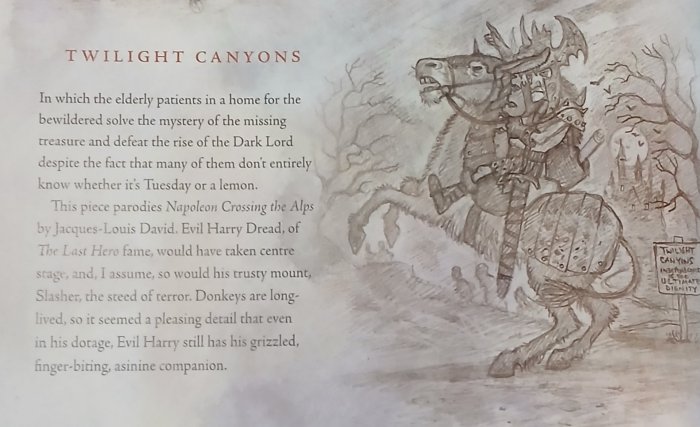
One of the joys of the book however is right at the end in a chapter called ‘The Road Not Taken’ where Kidby has produced a brief sketch for books that never were, Pratchett’s work in progress at the point of which he could no longer write and one of these is Twilight Canyons.

I was in the audience for ‘Bedtime Stories’ at the 2016 UK Discworld Convention, this section had always featured a reading from a book that hadn’t been published yet, initially read by Terry and latterly by his Personal Assistant Rob Wilkins. This was the first convention after Terry’s untimely death and seeing this on the programme had raised a definite buzz of anticipation, what would Rob do? Maybe just tell stories about how he and Terry had worked together and that indeed is how he started but suddenly he reached over for a sheaf of paper and started reading Twilight Canyons, a book that was clearly well in progress but which we would never get to read, the room fell even quieter as we all knew this was our only chance to experience this book.

Right after he finished the quite long extract he removed the On Air sign and the coat to reveal that the ‘table’ beside him was a shredder and he duly dropped the manuscript into the slot of the now working machine, continuing Terry’s wishes that all his unfinished work was to be destroyed. A sad but fitting end.

Rob wrote the afterword to this book where he explains that it is hoped that this will simply be the first in a series of volumes looking at various aspects of Pratchett’s work and I do hope there is more as this was a fascinating book.

Caught Short of the Boundary – Henry Blofeld

For those of you who don’t know of Henry Blofeld, or Blowers as he became known on the radio, but feel the name Blofeld feels familiar then you are probably thinking of the James Bond villain Ernst Stavro Blofeld whom Ian Fleming named after his fellow Etonian Thomas Blofeld, Henry’s father. Now I have always thought of Henry as a genial old buffer from his days broadcasting on the BBC and thoroughly enjoyed the other, and considerably more substantial, volume I have by him ‘It’s Just Not Cricket!’ so to say I was disappointed by this book would be an understatement. I picked it up in a charity shop expecting more of the same good humoured anecdotes interspersed with journalism and travel writing and yes there are snippets of what I anticipated but for such a short book it is massively padded out. The body of the book itself lasts just 100 pages and of that there are 15 full page cartoons taking it down to 85. Chapters are always stared on a new page so there is a lot of blank space at the end of the previous one which total roughly 6 complete pages meaning there is really only 79 pages of text to the actual book and seven of those are taken up with a chapter simply reprinting pretty poor quality jokes. You would hope therefore that the remaining 72 pages would be worth reading, sadly that is rarely the case.

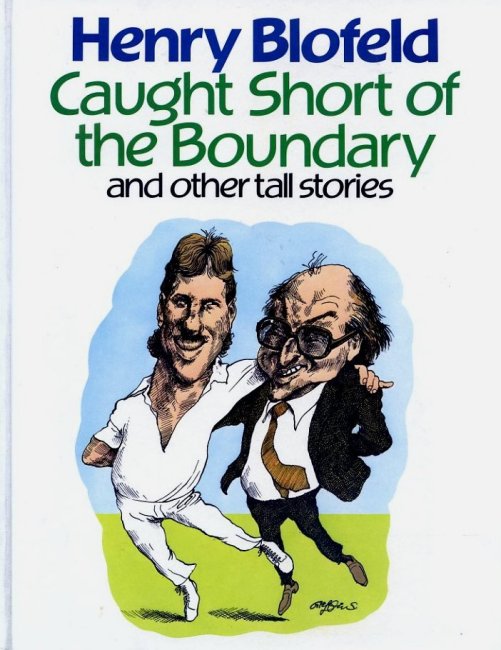
What comes over is a somewhat boorish character especially when he’s had a few glasses of wine, which appears to be most of the time, who was arrested for assault of his then girlfriend whilst visiting New York and describes visiting brothels whilst following cricket tours. The picture on the front cover shows him looking matey with England cricketer Ian Botham but the story inside concerns Botham’s indignation to a piece written by Blofeld which was highly critical of his abilities. Later on we discover that he also upset Dennis Lillee, the great Australian player, again through his highly critical writing, only to find himself booked as a speaker at one of Lillee’s testimonial dinners, he attempts to make this funny but fails miserably. I simply cannot recommend this book to anyone, indeed by the time you read this it will already be back in the charity shop and I hope that whoever picks it up next has a better time with it but at least the charity will make a little money each time it gets bought.

The cartoons are by Charles Griffin, then working as the political cartoonist for the newspaper The Sunday People, and frankly they are often the best part of the book.