The Nutmeg Tree – Margery Sharp

If Margery Sharp is known at all nowadays it is of the creator of The Rescuers in a series of nine children’s books started in 1959, although a lot of people familiar with the two Disney animations of her stories about heroic mice may well not even know of the original books. The Nutmeg Tree precedes these by over twenty years, being first published in 1937 when Sharp was a well known author of novels for adults and this one is a romantic comedy. The story starts with the rather surreal position of Julia singing in her bath but without the usual reverberations, as it turns out that she is sharing the bathroom with most of her movable furniture, up to and including a grandfather clock, so she is somewhat disappointed with the acoustics. Now the reason she is in there with the furniture, and intends to be there for some time, is that bailiffs are in the living room, the other side of the door, and are looking for items to seize that could be sold to recover the money she owes as she is completely broke. Julia ultimately persuades the bailiffs to fetch the man running the pawnbrokers down the street and agrees to sell him the furniture in the bathroom sight unseen leaving her with a few pounds after clearing her debts. She needs the money as she has had a letter from her daughter, Susan, whom she hasn’t seen for years and is now living in France with her grandmother inviting her over in order to hopefully approve of her choice of husband.

Julia’s own first husband, and the father of Susan, had been killed during the first world war and after Susan was born they both lived with his parents for a while until the call of the stage and her old life drew Julia back to London and away from the frankly dull country life she was living. She left Susan with her grandparents as she would undoubtedly have a much better life with them as they were quite rich. They gave her the enormous sum of £7,000 in government stock (around £400,000 in today’s money) to set herself up as an independent woman and her first task on arriving in France is not to let on that she had frittered it away. Her various adventures in trying to hide the fact that she is now penniless and the interactions with Susan, Mrs Packett and Bryan (Susan’s intended) are where most of the comedic elements ensue as Julia recognises in Bryan a bit of herself and therefore is determined that he is not suitable for Susan. To add to the general confusion Julia had met a troupe of trapeze artists on the boat over to France and the senior brother had rather fallen for Julia and had asked her to marry him so was writing to her and then ultimately arriving at the house in France so she needed to explain him as well.

The book was adapted into a play in 1940 and then a film in 1948, which changed the title to Julia Misbehaves and altered the story quite a lot. The film starred Greer Garson as Julia and Walter Pidgeon as her now separated rather than dead husband and the young Elizabeth Taylor (aged 16) as Susan.

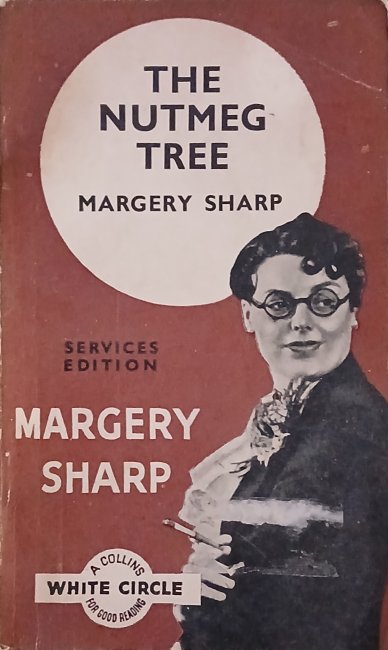
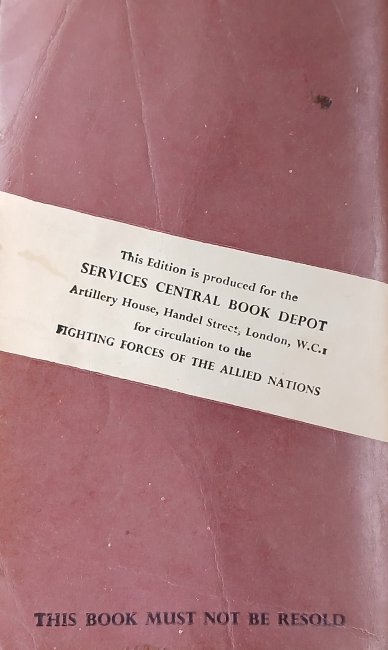
This edition was published by Collins in 1946 with a portrait of Margery Sharp on the cover as part of their short lived White Circle paperback range and is particularly notable as it is from the roughly 160 titles in this series also published as a Services Edition as explained on the rear cover, below. Most of the paperback printers during WWII printed Services Editions of books in their normal range, partly for patriotic reasons but also because doing so gave them access to more paper which was in short supply. None of them could be resold and should, in theory, be returned to the central book depot or passed on amongst the troops, as a consequence Services Editions are much sought after by collectors and when they are found are usually in fairly poor condition.
Vendetta for The Saint – Leslie Charteris

I reviewed the second ‘Saint’ book back in January 2019 and in that explained who Leslie Charteris really was, a Singaporean called Leslie Charles Bowyer-Yin, and said I’d keep reading the thirty books I had about The Saint and only review one if it strikes me as interesting and here it is. I explained six years ago that Charteris stopped writing the books after thirty six years, starting in 1928, and they were instead ghost written by various authors, well this is the first of these ghost written books from 1964, and as you can see by the cover it clearly claims that it is a work by Charteris indeed there is no mention that he didn’t produce it anywhere in the book and neither is there any mention of the real author, in this case American science fiction writer Harry Harrison. It may seem odd that Harrison wrote a Saint novel, and this is the only one he did, but he had been writing the American comic strip adaptation of The Saint for several years before he was let loose on a full blown work. In theory Charteris was now solely the editor of all the future Saint books and he said that he did a lot of work on them, but Harrison claimed he had minimal effect on this final work. I’m inclined to believe Harrison in this as the novel, despite being published by a UK company, Hodder & Stoughton Ltd, it is full of Americanisms which I’m sure Charteris would have replaced if he had actually done a proper editing job. The Saint is quintessentially English and certainly wouldn’t have referred to the fender or hood of a car or described driving down the pavement rather than the road as occurs in this book, just to give a few examples.

Quibbles regarding language aside this is actually a pretty good Saint story and the first one for many years that is a full length novel rather than a collection of shorter stories. The Saint is on holiday in Naples when he witnesses a violent altercation at a nearby table in a restaurant, stepping in to prevent further injury to the surprised English tourist, Mr Euston, who had simply greeted the person at the table as an old friend, although they claim he has made a mistake. The next morning he reads in the newspaper that Euston has been found dead and The Saint finds himself unwittingly caught up with the Mafia because the person Euston apparently recognised is a senior mafioso and they are determined to put him off following up Euston’s murder. Now The Saint isn’t about to be told what he can and cannot do and his holiday needed some excitement so this only increases his interest in trying to find out what is going on. and being a somewhat Robin Hood type character he isn’t above using criminal means to do so. I really enjoyed the story, which bowls along at quite a rapid pace with The Saint caught between the Mafia and the local Police Forces and it all comes to quite a satisfying end.

Incidentally when the book came to be filmed as part of the TV series starring Roger Moore it was made in Malta as the TV company thought filming a defeat of the Mafia story in Naples or Palermo wouldn’t have been a wise decision.

Siddhartha – Hermann Hesse

At first sight this is an odd book for a German author, who as a young man had sufficiently strong callings to the priesthood that he briefly attended a seminary. But in 1911, in his mid 30’s, Hesse visited India and was introduced to Hindu mysticism and this has undoubtedly influenced this novel written in 1922. The story is set in ancient India, around 2500 years ago, it follows Siddhartha, and to a lesser extent his friend Govinda, in their quest for spiritual enlightenment. At first this leads them as young men to abandon their family homes and all their belongings and live in the forests as ascetic samanas, training their bodies to need nothing, using extended fasting and lack of clothes apart from a loincloth to preserve decency. This was a life of meditation and a severe deprivation of the body. A sample of the thoughts of Siddhartha are shown below and give a flavour of the sometimes difficult to follow text as Hesse can get caught up in the tautological expressions that he uses to try to explain Siddhartha thought processes for pages as a time.

Siddhartha and Govinda live with other samanas for a long time, occasionally begging for scraps of food as the bare minimum to stay alive but eventually they hear of a great teacher called Gautama (Buddha) and decide to travel to hear him teach. They eventually reach Gautama and hear him speak but whilst Govinda immediately resolves to follow the Buddha, Siddhartha instead explains that he feels that such enlightenment cannot be taught but must be individually gained through experiences and solitary meditation so the two friends part company. Leaving Govinda, Siddhartha travels until he reaches a river and there meets a ferryman who will become a significant character later in the book but for now he simply gets him to the other side whereupon he walks on to the next town. It is here that Hesse completely threw me as I thought I understood the path to enlightenment that Siddhartha was going to follow, but instead, on entering the town he sees a wealthy courtesan and is filled with desire. She however is not interested in the half starved gaunt and long haired ascetic standing in front of her and tells him that if he wants to know her better he has to be wealthy, clean and well dressed and he duly throws over his calling, gets his hair cut and body cleaned and perfumed, becomes a merchant and eventually earns a place in her bed. Definitely not what I had expected.

I admit I was somewhat daunted when beginning the book, not helped by Hesse’s undeserved reputation as a not very approachable writer, but as I read on I got more engrossed by the story and by the time of Siddhartha’s sudden change in direction I was highly intrigued as to where the novel was going and loved the ultimate resolution. It’s probably not a book for everyone, but I thoroughly enjoyed it. This is another of the Penguin Drop Caps series and eventually I will read all twenty six of these books, an explanation of the concept can be found on my my blog introducing the series here where I am also including links to each of the books as I review them.

Crusader Castles – T E Lawrence

Originally written as Lawrence’s thesis for his Bachelor of Arts degree in Modern History at Oxford University in 1910 this was his first time in the Middle East, a part of the world that would become forever linked to him during the First World War as he became famous as Lawrence of Arabia. It doesn’t only deal with Crusader castles however as the year before he had cycled extensively in France exploring the castles there and this is also made use of in his paper. The basis of the thesis is exploring the differences and similarities of European castles with those constructed in the Middle East as part of the Crusades to determine if the castle builders in the East took their inspiration from Byzantine castles they found there, as was the belief of scholars at the time, or if they were more heavily influenced by the western European castles they had left behind. Lawrence was firmly of the opinion that the European castles drove the design of the Crusader castles and his thesis was instrumental in changing the opinion of academics in the subject as it was so well researched and full of examples making his case, most of which hadn’t been studied first hand before, that it ultimately resulted in his First Class degree. This sounds like it could be quite a dry subject but actually it is surprisingly well written and one of his tutors encouraged him to get it published soon after it was submitted, however the sheer number of photographs and drawings, none of which could sensibly left out, would have made such a project financially unviable in the 1910’s.

One interesting feature of the book is the addition of Lawrence’s notes alongside the text from his planned revisions in the 1930’s, these sometimes add to the text but quite often are almost his thought processes regarding what he has written. The section of the book reproduced below, which is discussing the fortifications at Carcassonne in France shows both these types.

Sometimes the notes are somewhat ironic, where he either no longer agrees with what he wrote or how he wrote it, or even the references he cites. I have long had an interest in castles and architecture mainly from having been taken to most of the extant castles in Wales as a young boy with my family. I do love the chance to visit castles I haven’t been to before and a trip to the Levant in 1996 allowed me to follow, if only briefly, in Lawrence’s footsteps.

Below is one of my photographs of Krak des Chevaliers in Syria, described by Lawrence “as a finished example of the style of the Order (The Order of Knights of the Hospital of Saint John of Jerusalem, commonly known as the Knights Hospitaller) and perhaps the best preserved and most wholly admirable castle in the world”. This castle is truly enormous, as can be appreciated from the barely visible person standing on top of the Warden’s Tower, a place I had been an hour or so earlier. Lawrence dedicates many pages to this castle in the thesis with extensive descriptions, plans, photographs and drawings, the result of spending five days intensively studying the castle.

The book concludes with several of the letters Lawrence wrote during his travels in the UK and Europe, almost exclusively to his mother but dealing more with the architecture and military history he was learning about. These were originally published, with a foreword by his mother, as the second volume of the Golden Cockerel first edition of this work printed in 1936, a year after Lawrence’s untimely death in a motorcycle accident. But nowadays they are normally included with the main text in one volume as in this lovely Folio Society edition from 2010.