The Stainless Steel Rat – Harry Harrison

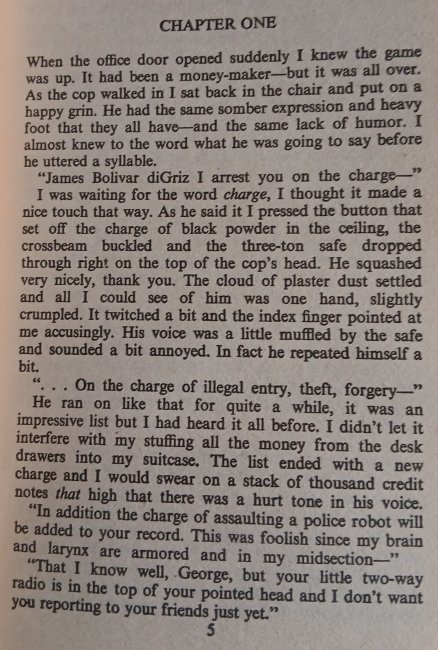
A few weeks back I featured a book written by Harry Harrison ghost writing as Leslie Charteris in the first ‘Saint’ book written by someone other than Charteris and that prompted me to look on the shelves for something where Harry Harrison was properly credited. That led me to a series of books I bought, and probably last read, back in the mid 1980’s and Harrison’s most famous creation The Stainless Steel Rat. There are a dozen books in the series and this was the first, it is based on a couple of short stories originally published in Astounding magazine in 1957 and 1960 which were linked and expanded to make the novel in 1961. The best way of introducing the character of Slippery Jim diGriz, alias The Stainless Steel Rat is to read the opening page of this book.

I like the way it is only revealed that the policeman is a robot after the safe is dropped on him, in fact The Stainless Steel Rat is proud of the fact that for all his criminal escapades he has never killed anyone. The stories are set in the distant future and on various planets far from our own, this is pure science fiction fantasy with a heavy dose of humour mixed in for good measure. As is stated in the page shown DiGriz is a career criminal, something of a rarity in this version of the future where children are scanned for any tendency to not be upright law abiding citizens and ‘corrected’ before adulthood. The crime he was committing at the beginning of the book was a simple one, rent a warehouse next to a government storage site, which is full of food but intended for emergencies so rarely visited, cut a hole in the wall and help himself to the goods, relabelling everything so it isn’t obvious it has come from the next door building. Using robots to do the work meant he could keep the money rolling in 24 hours a day without having to do any menial work himself.

Escaping from the police raid using a carefully planned route DiGriz soon starts another caper, this time the theft of an armoured car carrying the takings from a large department store, this is done in quite an ingenious way but this time someone was out thinking him every step of the way and he finds himself trapped. This is his first encounter with Special Corps, an interstellar police service headed by Harold Inskipp, who was a legendary criminal before DiGriz turned to crime and was assumed to be locked up somewhere as he hadn’t been heard of for years, instead he had been recruited to run Special Corps and now he wants DiGriz to add his special talents to the organisation.

I won’t go into too many details of the plot, it’s quite a short book, just over 150 pages, and can be read quite quickly, suffice to say that in the course of the novel DiGriz meets his future wife and mother of his twin sons although this won’t happen until the next book ‘The Stainless Steel Rat’s Revenge’, I have half of the Stainless Steel Rat books along with several other books by Harrison including one of his few books not to funny, Make Room! Make Room! which would be loosely adapted into the superb dystopian 1973 film Soylent Green, a very early warning on the dangers of the greenhouse effect and overpopulation. I have to admit that I prefer Harrison as a comedic writer with a strong streak of anti-authoritarianism thrown in.

Collection du Vieux Chamois

I have recently managed to complete my collection of these sixteen children’s books, most of which were printed in 1947 in cooperation between Penguin Books in England and Fernand Nathan in France. The last two titles VC15 and VC16 are translations of books that originally came out in England in December 1947 and August 1948 respectively so presumably the French versions were later. After the war Penguin were keen to restart their international publications and came up with the plan of altering the text for a small number of Puffin Picture Books into French and printing them in England to avoid having to ship the lithographic plates abroad. This would still require a considerable amount of work to blank out the existing English text and replace it with a translation as the whole page is printed as one unit. This would therefore have been difficult enough but there were also some illustrations altered, some of which were done for obvious reasons others are more obscure.

The books were printed in editions of 20,000 copies per book and none appear to have been reprinted. In the intervening, almost eighty, years this relatively small production number along with the fragility of books consisting of eight folded sheets stapled down the centre making a thirty two page book meant that few have survived to the present day. Although they are a reasonably practical series of children’s books to collect and it has only taken me around five or six years to accumulate them all mainly from French second hand book dealers online. Interestingly none of the books mention who did the translation, presumably somebody at Fernand Nathan, or who made the alterations to the pictures, possibly the original artists. It is also somewhat ironic that the French translations were created, as one of the original inspirations for the Puffin Picture Book series was the French series ‘Albums du Pere Castor’.

I am indebted to the Penguin Collectors Society for their invaluable Checklist of Puffin Picture Books which includes a full listing of these books so that I could check each one as I obtained it, and the checklist is the source of a lot of the information in this blog. Whilst this book lists most of the differences between the English and French illustrations it doesn’t show the variations, so below I will do so as I think it is interesting to see just what cultural differences were picked up in the changes. Firstly let’s list the seven books where it is simply a text translation difference and as you will quickly spot there are several obvious title changes:

  • VC2 – Les Animaux de notre hémisphère – originally PP7 Animals of the Countryside
  • VC5 – Vacances a la Campagne – originally PP33 Country Holiday
  • VC7 – Les Abres de mon pays – originally PP31 Trees in Britain
  • VC9 – Merveilles de la Vie Animale – originally PP44 Wonders of Animal Life
  • VC10 – Comment Vivent les Plantes – originally PP58 The Story of Plant Life
  • VC13 – Les Chiens – originally PP56 Dogs
  • VC16 – La Péche et les Poissons – originally PP53 Fish and Fishing

Now let’s look at the ones with illustration changes which will also give you a chance to see how lovely this series of books are, either in the original 119 titles in English or these 16 in French:

VC1 – Les Oiseaux du village – originally PP20 Birds of the Village

This one is a mistake rather than a deliberate change, but page eight has a number of birds each identified in the adjacent text by a number. However in the French version the numbers within the illustration have been removed which makes the text meaningless. The alteration is omitted from the checklist which regards this book as a translation only.

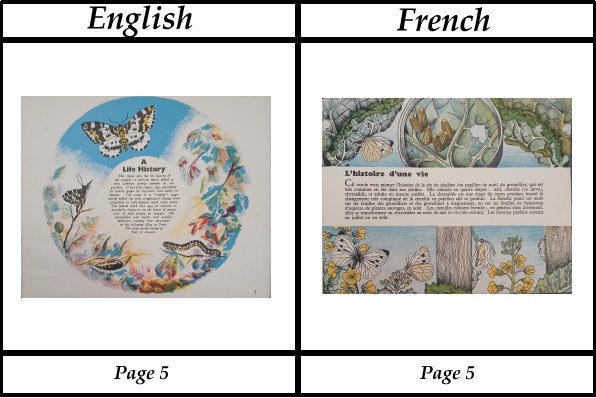
VC3 – Les Insectes – originally PP5 A Book of Insects

Two pages within this book are completely changed with totally new designs. The first one makes sense to change as the French text appears to be significantly longer than the English and therefore difficult to fit into the circular gap. The second one is less obvious why it was altered to a much more scientific form.

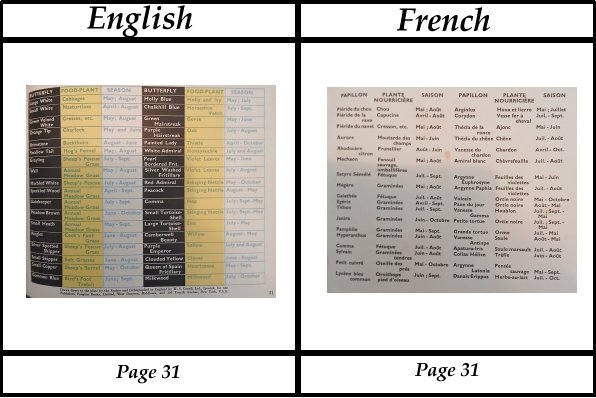
VC4 – Jolis Papillons – originally PP29 Butterflies in Britain

The change for this book is perfectly understandable as it is simply the table on the last page and changing all the text and replicating the original format is probably unnecessary. The deformation of the left hand side of the English text is simply because I didn’t want to force the page flat and possibly loosen the staples. This lack of formatting is not mentioned in the checklist which again regards this book as a translation only.

VC6 – A la Ferme – originally PP4 On the Farm

The biggest difference before the two versions is on the first page where the British farmer is replaced by a man more obviously at work.

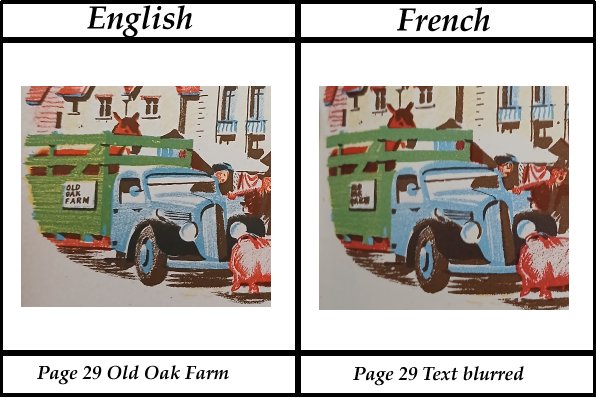
The other change is not included in the checklist and it is the amendment to the sign on the side of the lorry on the page dealing with going to the market, where the English text has simply been blurred out.

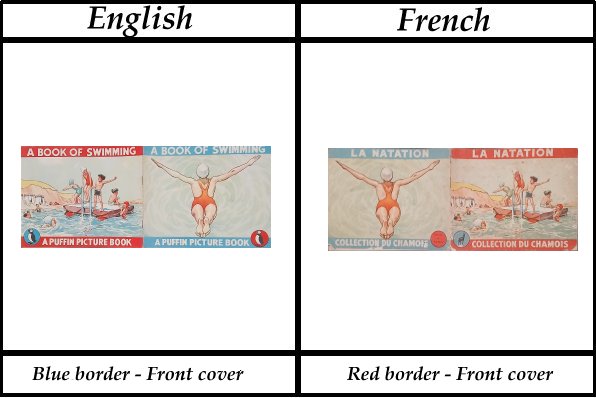
VC8 – La Natation – originally PP48 A Book of Swimming

Strangely this change isn’t in the checklist either although it is a pretty significant alteration, with the front and rear covers being transposed.

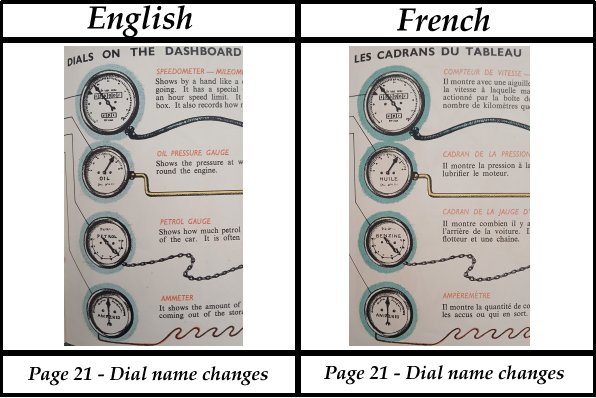
VC11 – L’Auto et son Moteur – originally PP38 About a Motor Car

The two small changes to this book are so small that they were ignored by the checklist, the first one is quite amusing and is a text alteration on the middle page spread where in the English version after the word chassis it points out that this is a French word, quite rightly the French edition doesn’t bother with this explanation. The other change is shown below and is an amendment to the text on the gauges.

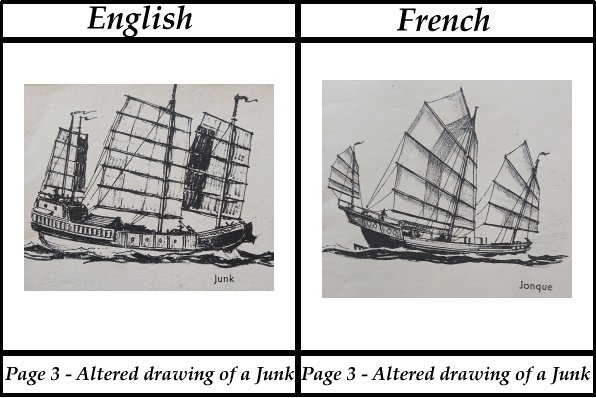
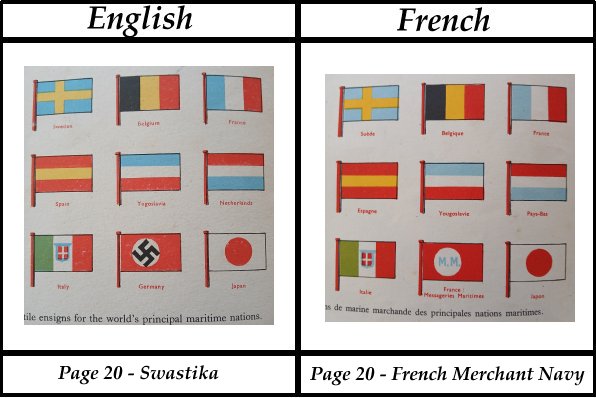
VC12 – Les Bateaux – originally PP11 A Book of Ships

Now we get to the book with the most changes between the two versions, all of which are included in the checklist and we start on page three with a new drawing of a Chinese Junk.

The very next page has the British naval flag, the Red Ensign, altered to be unrecognisable in the French version. This also occurs on page 24 but I’ve just included the one example here.

Next comes a change of headgear between two sailors

We then get a change that needed to be made from the original British edition, which was printed in June 1942, when the German flag would logically appear, to 1947 when it wouldn’t, or at least not in that form. The British book would be completely redesigned when it was reprinted in 1952 and no swastikas appear in that either.

Finally we come to page 27 where the illustration at the top of the page is reversed and indeed looks like it was completely redrawn.

VC14 – Les Merveilles du Charbon – originally PP49 The Magic of Coal

With this book only the front cover is amended to change both the helmet, the French version is more rounded and doesn’t have a lamp, and also the miner’s tattoo on his chest. This goes from St George and the dragon on the British miner to the symbol of France, the Gallic Rooster, in the French version. Whilst compiling this list I also realised for the first time that this book is slightly, but noticeably, larger than most of the other Puffin Picture Books or indeed the Vieux Chamois.

VC15 – Le Théatre – originally PP75 The Theatre at Work

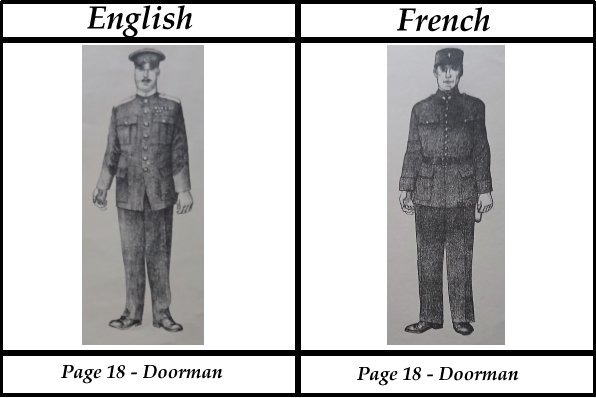
The final set of changes involve a couple of uniforms at the theatre both of which are in the checklist, firstly the doorman.

and finally the fireman who looks more prepared for disaster in the French version

That brings us to an end of this overview of the Vieux Chamois series, I’d love to know why they were called Old Chamois but I doubt that I’ll ever find out.
The Rule of Benedict

Another book on my shelves simply because I bought all 127 titles in the Little Black Classics series by Penguin Books and it is only now when I decided to take it off the shelf and have a look at what I had that I realised the importance of the work I had in my hands. Somewhat enigmatically entitled The Rule of Benedict this turns out to be the set of rules written down by St Benedict for the correct running of the monasteries in the order he founded, The Benedictines, and was originally written in Latin around 540AD. A book of rules doesn’t sound like a good read but surprisingly I really enjoyed it and the insights it gives into the life of what were for all their ‘simple’ lives actually the most educated of the populace in early medieval times. A monk after all was expected to be able to read the bible and give readings during the various services of the day and very few people at the time could read they were also expected to be able to perform various duties within the monastery which was intended to be as self sufficient as possible so there would be the obvious gardeners, cooks, herbalists for medicine but also tailors, carpenters and furniture makers to maintain the clothes for the monks along with the contents of the monastery. Each monk would be allowed a minimum of ‘personal’ items such as a knife, needle and thread for running repairs, and two habits and a pair of shoes from the communal stock, they were assigned underwear only if they were sent on a journey away from the monastery of more than a day.

The first example I have selected from this set of rules is part of the instructions on humility which actually run to twelve steps. This gives a good overview of the structure of the rules regularly quoting from scripture to back up the instructions:

There is also guidance as to the structure of the hierarchies within the monastery with suggestions on how deans, priors and even the abbot should be appointed and in the case of deans and priors how they should be regulated and punished if they stray from the righteous life expected of them. I hadn’t realised before reading this book that a dean was responsible for ten monks under them with a prior being considerably more senior as they would normally only be one although also under the abbot however Benedict warns specifically about priors becoming self important due to their seniority.

Other people mentioned specifically are monks that become priests, these again should be watched to make sure they don’t fall into the sin of pride and also the porter of the monastery who should be as follows ‘A wise old man should be placed at the monastery gate, who will know how to take a message and give a reply and whose age means they will not be tempted to wander about’.

The rules are very much of their time as can be seen below, particularly the final sentence, this punishment is several times stipulated for children, although not exclusively for the young depending on the severity of the offence, It is preferred to one of the various levels of excommunication that could be extended to the adults in the community as children as assumed to not be sufficiently conscious of their religious obligations to be able to understand the punishment of excommunication.

The book also includes instructions for the induction of a new monk into the community which explains that they should be initially turned away and if they persist then subjected to ‘harsh treatment’. If they continue to try to join then they may be admitted, but only into the guest house for a few days where they will be watched over by a senior monk to make sure they are really seeking God. If they continue in their wish to become a monk then they can then enter the novices centre and after two months they should have this full set of rules read to them and told if they will abide by all of it then they can stay otherwise they can leave. If they stay there is a further period of six months during which ‘their patience should be tested’ and then the rules read to them again to accept or not. There then follows another four months of effective probation after which the rules are read to them again and only after they accept the rules for the third time can they be finally admitted as a monk and from that day not permitted to leave the monastery for any reason unless instructed by the abbot. Frankly I’m amazed they had anyone join.

This serendipitous purchase has proved to be a fascinating read which I wouldn’t have had if I hadn’t bought the full set of books, along with other ones from this collection that I have reviewed earlier which you can find using the tag ‘Little Black Classics’ below.

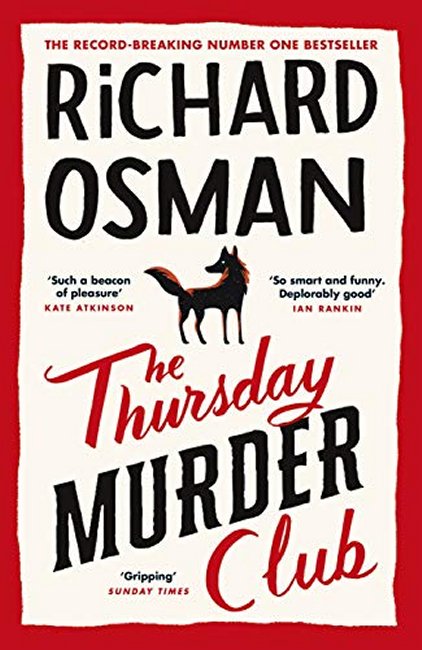
The Thursday Murder Club – Richard Osman

Whilst browsing the shelves of the local charity shop I spotted this book and picked it up immediately as I had been told several times that I would like it and the various people who recommended it were quite correct as I read the 377 pages over the space of two evenings. I probably would have read it in one go but there is a natural break point at page 172 and I decided to follow the structure of the book and reflect on what we had been told so far and the latest surprise murder that had just occurred.

Richard Osman himself helpfully summarised the four members of The Thursday Murder Club and what the club is all about in his notes for American reading clubs:

I am writing to you from England, home of Agatha Christie, Hugh Grant, and books about being murdered in quaint country villages.
Welcome to ‘The Thursday Murder Club,’ a group of very unlikely friends in their mid 70s. There is Joyce, a quiet but formidable former nurse; Ron, a retired Labour activist, still on the look out for trouble; Ibrahim, a psychiatrist and peacemaker, and Elizabeth, a . . . well no one is quite sure what Elizabeth used to do, but she seems to have contacts in very high places.
Once a week our four unlikely friends, all residents in a luxury retirement community, meet up to investigate old unsolved police cases—usually accompanied by friendly arguments and many bottles of wine.
One day the peace of their community is shattered by a real-life killing, and ‘The Thursday Murder Club’ decide they are just the people to solve the case.

For a murder mystery it’s quite funny with the interaction between the various characters being beautifully written as an example there is one murder where the victim was injected with Fentanyl whilst in close proximity to sixty odd residents of the retirement village and Joyce says ‘It would have to be someone with access to needles and drugs’ only to be told ‘That’s everyone here’ by Elizabeth, simply pointing out that due to age a lot of the residents are self medicating for diabetes amongst other conditions and what would normally be seen as a clue in this case definitely isn’t. But there is a lot of wisdom and experience in our team of self appointed detectives and with Elizabeth’s range of contacts all over the place they can do things the Police can’t either because they would be too obviously looking into things or because it would be either illegal or nearly so. Chris and Donna, the police officers assigned to the original murder gradually come to respect the Thursday Murder Club and their effective, if unorthodox, methods of getting information. The clues range from decades old gangland killings to links with Cypriot criminal families and always the club members are at least one step ahead of the police. I don’t want to say more in case I accidentally say too much but I heartily recommend The Thursday Murder Club and I suspect that recommendation would also apply to the subsequent novels that Osman has written about them.

This was Osman’s first novel, which he wrote over ten months whilst keeping the fact he was writing it a secret from most of the people who know him. But when he revealed its existence to publishers there was such a bidding war that he had a seven figure advance from Penguin Random House to get the book for their Viking imprint. Until the smash hit of his Thursday Murder Club series of books Osman was better known as a television producer, initially for Hat Trick Productions and then as Creative Director of Endemol. During which time he created the TV quiz Pointless for which he ended up the other side of the camera for the first time as the co-presenter after taking the role in the demonstration version for the B.B.C. and then worked with Alexander Armstrong on the programme for twenty seven series before quitting to concentrate on writing.