
This book, Rageh Omaar’s first, starts with him being the first BBC journalist allowed into Iraq after five years in September 1997. He had become the BBC Middle East correspondent that summer and had straight away applied for a visa for Iraq not really expecting it to be granted as anyone from the BBC was persona non grata in the country since the end of the Gulf War in 1991. But Omaar is not the white middle class reporter expected by the regime, rather he was born in Mogadishu, Somalia and speaks fluent Arabic so amazingly they let him in. The book would be fascinating enough if it just dealt with the next six years whilst Omaar gets to know Baghdad and develops friendships with not just his team but ordinary Iraqis, finds a regular tea shop and chats to locals providing an insight to daily life in a country few of us have had a chance to visit. Of course during that time Omaar only spent a few weeks or months at a time in Iraq, he had the entire Middle East to cover and in 2001 and 2002 he was in Afghanistan reporting on the fall of the Taliban, I’d love to read a book by him about that time as well. But at the end of 2002 he was back in Iraq as US President George Bush Jr and British Prime Minister Tony Blair falsely accused Saddam Hussain of having weapons of mass destruction that he would be willing to use and decided on regime change in Iraq as part of the Global War on Terror started following the attack on the Twin Towers in New York in September 2001, which Iraq had nothing to do with.
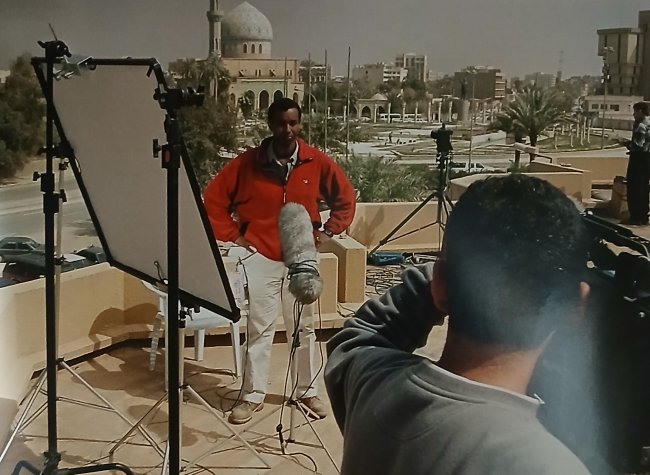
As 2003 began it became clear that despite the lack of a UN resolution supporting such action America was going to lead a coalition force including Britain in invading Iraq and journalists and their teams were given the opportunity to get out of the country. Despite it clearly being highly dangerous, especially for news teams from countries involved in the invasion, Omaar and a much reduced team decided to stay. The picture above is of them filming on top of the Palestine hotel in central Baghdad with the 14th of Ramadan mosque behind him during the invasion, just three days later they would be in the same place when the Americans bombed the hotel, the impact knocking them flat and killing at least one member of another news team. This is despite the much vaunted precision guided weaponry in use in the conflict and the location of the hotel and the use it was being made of by a lot of journalists still in the country being clearly flagged to the invading forces.
The descriptions of just how the news reports were made and transmitted from the middle of a conflict zone are really interesting and Omaar’s continuing ‘normal’ life in Baghdad interacting with ordinary people, still going to his favourite tea room etc. adds greatly to the story he is telling. I remember hearing him being interviewed from London on a satellite phone as bombs and missiles rained down around him but it is the calls made on the same phone to his wife and family afterwards to assure them he was OK that bring home the fragility of his and his crews existence at the time.
The book has an epilogue where he goes back to Iraq a few months after the invasion and speaks to Iraqi’s about how they are surviving after the conflict and the mismanagement of the country by the victors, who didn’t seem to have a plan for what to do afterwards, is well worth reading, as of course the whole book is.
 Ramblings on my bookshelves