Vietnam! Vietnam! – Felix Greene

This post is being published on the 29th April 2025, the day before the fiftieth anniversary of the surrender of South Vietnam and the ending of the Vietnam war, the Vietnamese by the way refer to it as the American war. The choice of this book amongst several that I have on the conflict was pretty well certain as over half the book consists of photojournalism and the balance a series of essays detailing in chronological order what led up to the war and the first ten years of the fighting. Even though Greene was a British journalist the book was first published in 1965 in America, with still eight more years of American involvement and beyond that two years of the slow push down the country by the North until they finally prevailed. That this book was written roughly half way through the war would have horrified its author who, at least partly, hoped that exposing just what was going on might have hurried the end. My copy is the 1967 British paperback edition by Penguin Books.

By going back to the French Indochina colonies pre WWII and taking the story of how America came to be fighting there the twenty two essays that make up the second half of the book largely follow a historical progression. So how did America get into this mess? Well it turns out that when the French were kicked out by the invading Japanese during WWII they were determined to regain control of their colonies just as the Vietnamese, along with the populations of Cambodia and Laos for that matter, saw an opportunity to gain independence at the end of the war. There was a short lived declaration of independence for all of Vietnam but the French did re-invade in 1946, however they needed American assistance, which was forthcoming as part of the anti-communist sentiment in American politics through the 1950’s and this led to them supporting the extremely unpopular puppet president Diem with ever increasing military power initially in the guise of ‘advisers’ and ‘trainers’. The French eventually gave up and left leaving the Americans, who by then were financing roughly three quarters of the military push and supplying arms despite the Geneva accords of 1954 which said that foreign forces should not be in Vietnam and there should be elections within two years leading to reunification of Vietnam. America and France, despite being signatories to these agreements had no intention of allowing them to happen.

Picture by Kyoichi Sawada – United Photo Industries (UPI)

And so we ended up with America fighting the Vietnamese under the guise of preventing North Vietnam gaining control of the south but in fact the National Liberation Front, known outside of the country as the Vietcong, set up in 1960 was entirely composed of people from the south who wanted the foreign forces out of their country and the weapons they used were almost entirely from deserters from the American backed Vietnamese troops.

I have been selective in which photos to use from the book as a lot of them are far more shocking than the example of American torture shown above and include the famous picture of the monk, Thich Quang Duc, sitting and burning in the road as he set fire to himself in protest at the ongoing conflict in June 1963. In truth the photographs are far more telling than the essays, especially when juxtaposed with quotes which clearly don’t match the images such as the destroyed houses below.

Photo by Felix Greene

There are clearly books that look back on the war with the benefit of hindsight which I could have reviewed but I was drawn to this work written during the middle of the conflict. It may not be the most dispassionate summary of what was going on but Greene was trying to make sense of what he witnessed whilst reporting and for that it is a fascinating book.

Top photo by Bob Ibrahim UPI, bottom photo un-credited UPI

I travelled the length of Vietnam in 2007-8 and was lucky to have three very different guides which could provide alternate viewpoints. Starting in the south the guide was an older gentleman who had lived through the defeat of the south a a civilian and could talk about the pulling out of the American forces and the advance of the troops from the north leading to the surrender. In central Vietnam our guide was an ex Vietcong fighter who still walked with a limp from a war injury sustained in Hue, whilst the north was explained by a man in his early twenties who had never known anything other than a unified country. I doubt it is possible to have such an interesting selection of guides nowadays fifty years on from the end of the conflict and I’m glad I went when I did.

Selected Works – Cicero

Cicero was a prominent statesman, lawyer and orator at a time of great turbulence in the Roman empire. Born in 106BC and elected one of the two consuls in 63BC, he was at his prime when Julius Caesar became dictator following his invasion on 49BC, and whilst not one of the group that ultimately assassinated Caesar in 44BC it was generally known that he supported them. He is one of the most prominent men of letters of his time with over eight hundred existing examples and many of his speeches were published. We don’t by any means have everything he wrote but what we have is still a substantial body of work. This book starts with his opening speech in the prosecution of Gaius Verres for mismanagement during his time as Governor of Sicily. the Roman legal system at the time expected a very long speech, normally over a day, in such matters but Cicero gave a ‘shortened’ version (still 23 pages long) as he was concerned that with various public holidays coming up the trial could be postponed for months. It’s a good introduction to Cicero’s style as are the selection of twenty three letters that follow which include one from Caesar.

It is in the third section that we really see Cicero in full flow in the second of his fourteen speeches mainly given in the Senate against Anthony, although this particular speech was never delivered there, being published instead. This massive fifty three page speech established Cicero as a major opponent to Anthony, who had seized control of Rome following the death of Caesar. The series of speeches were known as the Philippic’s after Demosthenes’s denunciations of Philip II of Macedon and were so powerful that Cicero eventually convinced the Senate to declare Anthony an enemy of the state as Cicero attempted to gather support for Anthony’s son, Octavian, to stand against his father. The section below is just a small part of the second Philippic against Antony but gives a feeling of the enmity between the two men:

For what was left of Rome, Antony, owed its final annihilation to yourself. In your home everything had a price; and a truly sordid series of deals it was. Laws you passed, laws you caused to be put through to your interests, had never even been formally proposed. You admit this yourself. You were an auger, yet you never took the auspices. You were a consul, yet you blocked the legal right of other officials to exercise the veto. Your armed escort was shocking. You are a drink-sodden, sex-ridden wreck. Never a day passes in that ill-reputed house of yours without orgies of the most repulsive kind.

The book concludes with two of Cicero’s best known works, the third part of ‘On Duties’ and all of ‘On Old Age’. ‘On Duties III’ consists of eleven sections where Cicero endeavours to explain the preference for actions seen as right as opposed to ones which are simply advantageous and why an action which may appear advantageous but cannot be seen as right is never the correct thing to do. This book, along with the first two parts is addressed to Cicero’s son Marcus who was then in Athens and is a guide to moral behaviour. ‘On Old Age’ is a lot more fun to read, it is written as an imagined conversation between Cato the Elder, who was 84 at the time it is set in 150BC, with Scipio Aemilianus, then 35, and Gaius Laelius, also in his thirties. Cato expounds on the advantages of old age and a reconciliation to the fact that death cannot be far away, in Cato’s case the following year.

Cicero was murdered in 43BC aged sixty three as he was attempting to escape the wrath of Anthony, now reconciled with Octavian, and his head and hands, specifically requested by Anthony as punishment for writing the Philippics, were nailed to the Rostra in the Forum Romanum.

The translation is by noted classicist Michael Grant, Professor of Humanity at the University of Edinburgh and was the first of several translations, mainly of Cicero, that he undertook for both Penguin Books and the Folio Society. This has been the first time that I’ve read Cicero although I can’t imagine it will be the last, there are several Penguin Classics that cover more of his writings and The Folio Society have recently published a massive single volume 664 page collection.

Professor Branestawm’s Treasure Hunt – Norman Hunter

And now for some nostalgia, I first read this book along with the first book in the series ‘The Incredible Adventures of Professor Branestawm’ when I was in Primary school aged about seven or eight years old. I never actually owned a copy of either book, simply reading the ones in the school library, but the other day I came across this copy, dated 1966, which is the same as the version I first read all those years ago at the end of the sixties. I had to have it and see if childhood memories of loving the books were anywhere near as good as with Elleston Trevor’s ‘Where’s Wumpus’. Sadly the adult me found the book a bit of a curate’s egg (good in parts) and some parts have not dated very well, but when it was good it was great fun.

For those unfamiliar with the absent minded professor and inventor of crackpot inventions Branestawm would be partly great fun to meet but also a complete danger to anyone around him as his inventions not only invariably go wrong but also quite frequently do so in catastrophic ways, often explosively. His jacket is fastened by safety pins, having lost its buttons many years ago, and he wears five pairs of spectacles, one set is specifically for looking for the other four whenever he loses them, which is frequently. His housekeeper, Mrs Flittersnoop, is often to be found residing at her sister Aggie’s house when the professor’s home has been rendered uninhabitable by one disaster or another. In this book one of the stories concerns the house burning down, amazingly not caused by one of Branestawm’s inventions but not helped by him trying to put the fire out by trying to smother the fire with a rug, which promptly caught fire, adding to the conflagration, and then throwing alcohol on the flames which of course made everything worse. This leads to him trying to invent automatic fire alarms which prove to be so sensitive that even the mayor’s cigar sets them off and the professor ultimately having to move in with Mrs Flittersnoop’s sister as well because so little of the house is still standing. Other regular characters are Colonel Dedshott of the Catapult Cavaliers who is always to be found in full regimental dress uniform complete with jangling medals, Mr Chintzbitz the owner of the furniture shop and Doctor Mumpzanmeasle, these names giving a hint of Hunter’s love of word play, which can sometimes get in the way of readability as you try to work out just what you have actually read.

‘The Incredible Adventures of Professor Branestawm’ was first published in 1933, whilst ‘Professor Branestawm’s Treasure Hunt’ originally came out in 1937, there then was a long hiatus before book three was released in 1970, with a further eleven being written between 1972 and 1983. I suspect the reprinting of the first two books by Puffin in 1947 and 1966 respectively and especially the subsequent 1969 television adaption did a lot to revive the character and prompt Norman Hunter to write more. I’ve never read any more than the first two and indeed didn’t even know they existed until I came to research this blog. Norman Hunter was born in 1899 and died, aged 95 in 1995

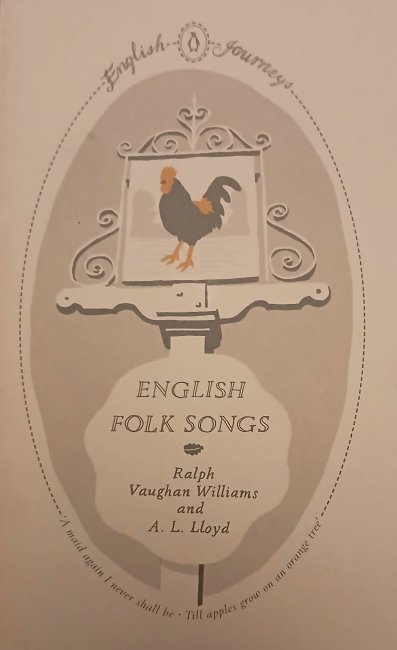
English Folk Songs – Ralph Vaughan Williams and A L Lloyd

Continuing the bucolic countryside and doomed love themes from last week’s ‘Far From the Madding Crowd’ I was drawn to this book of English folk songs, which was Vaughan Williams’ last book as sadly he died just before it was published. Ralph Vaughan Williams was of course one of the great English composers of the first half of the twentieth century, he died in 1958, and was heavily inspired by English folk songs although he also wrote nine symphonies and four concertos along with his numerous song cycles and choral works. He qualified as a Doctor of Music from Cambridge University and it is as Doctor Vaughan Williams that A L Lloyd refers to him in his ‘Note on the Presentation of the Tunes’ at the start of this book. The selection of songs is quite widespread, although biased toward tunes gathered in the south of England as that was where Vaughan Williams lived so it was easier for him to travel round collecting material in that part of the country although there are a small number from the north. Vaughan Williams was inspired to start collecting English folk songs by contemporaries such as Cecil Sharp and the collections he made helped to preserve a rapidly dying art form as well as influencing his own work.

If I have one criticism of this book it is not in the choice of songs, which provide a spectrum of styles but in the structure of the book itself with the songs in the first part and the accompanying text in the second half which means that you need two bookmarks to keep track of where you are as you continually skip to and fro to read the context and history of the song you have just read. I would have much preferred the descriptions to be interleaved with the music as that would have been far simpler to read.

Before the couple of examples I have chosen, I must explain that the copy I have has a very tight spine and to avoid splitting it I have been forced to hold it open as much as I dared but that has led to somewhat distorted photos of the pages.

Although listed as collected from Somerset, the earliest versions of this song are known from Newcastle Upon Tyne, so the opposite end of the country, and these date back to the late seventeenth century. The lyrics included are a mix of at least three versions into a harmonious whole presumably by Vaughan Williams when collating this book.

The Green Bed follows a theme common with other songs of the period of a sailor who arriving at lodging he has used before claims to have lost all his money in a disaster and is turned away but when he shows that actually he has plenty of money all of a sudden beer and bed are available and the landlady is quite happy to include her daughter in the bed. However the sailor spurns the offer as it is clear that both of them are only interested in the money he has. Again the example comes from the south of England but versions of this song are also known from Warwickshire, in the English Midlands and therefore a long way from the sea.

I really enjoyed this exploration of English folk song and I have various other collections of traditional music which would also be worth exploring at a later date.

Far From the Madding Crowd – Thomas Hardy

I have to admit that in the over three decades I have owned this book, as part of a set of six novels by Hardy from The Folio Society, I have attempted to read it at least three times. Initially when I bought it back in 1993 and then again probably ten years later, where according to the bookmark I found inside I made it to page 84 out of 413, this time I read and thoroughly enjoyed the book in just four days during the last week. I don’t know why I failed the first two times, some books you just have to be in the right frame of mind to appreciate them.

There are five main characters, I’ll tell as much of the start of the novel to set out how they stand with each other. Gabriel Oak who starts the novel as a farmer in good standing with two hundred sheep and a couple of sheepdogs, the younger of which would lead to his ruin by one night driving his entire flock over a cliff edge to their deaths, The sheep were not insured but by selling everything he owned he managed to cover his debts. Also appearing at the start of the book is Bethsheba Everdene, a young woman whom Oak falls in love with, pretty well at first sight, but she does not return his affection. She however soon leaves the vicinity, before Oak’s disaster with the sheep, and he knows not where she has gone. Oak, now penniless takes himself off to a hiring fair hoping to get a job as a bailiff (farm manager), failing to do so he reverts to his skill as a shepherd but still doesn’t get a job so decides to try the next fair in a nearby town. On his way he sees a hayrick on fire and endeavours to put it out, his bravery is soon noticed by the labourers on the farm as they race to his assistance and on the back of this he is offered the job as shepherd by Mistress Everdene who it turns out had inherited this very farm which is why she left the area where Oak was living. Still very much in love with Bethsheba but now so reduced in fortune as opposed to her meteoric rise he realises that he can never hope to gain her hand in marriage.

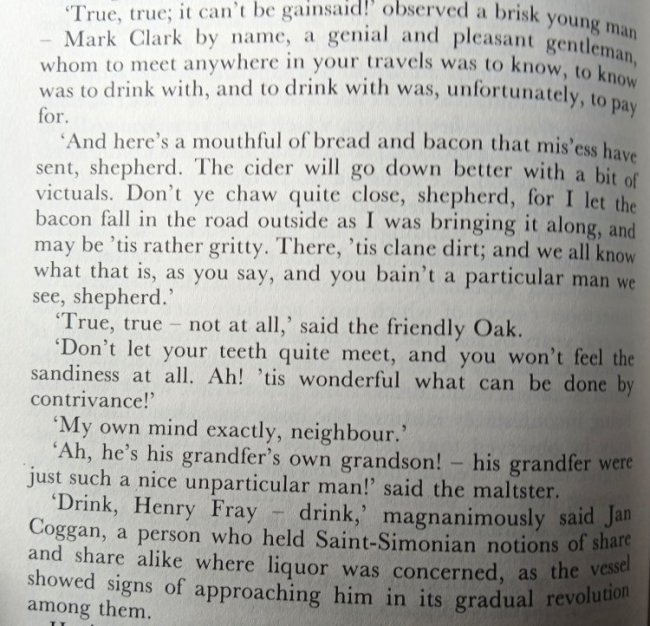
On coming into the village after the fire is extinguished he encounters the young Fanny Robin who it turns out has that night left the house where she was employed as a servant without telling anyone and is running away to her love, a Sergeant Troy in one of the local regiments who has promised to marry her. Troy however is an out and out cad as will become obvious as the book progresses. This leaves one more major character, the owner of the farm adjacent to Bethsheba Everdene’s, Mr Boldwood, I don’t think we ever find out his first name. In a moment of fecklessness Bethsheba sends Boldwood a valentine one year even though she doesn’t love him and this prompts the bachelor to look again at his neighbour and consider marriage for the first time in his life and this will lead to all sorts of problems as the book progresses. These five characters with their interrelationships drive the whole plot but around them the description of rural life and its nearness to poverty is brilliantly told by Hardy, take the following example, which also shows the expression of the local dialect which pervades the novel, this is just after Oak has been retained as shepherd after his heroics with the fire.

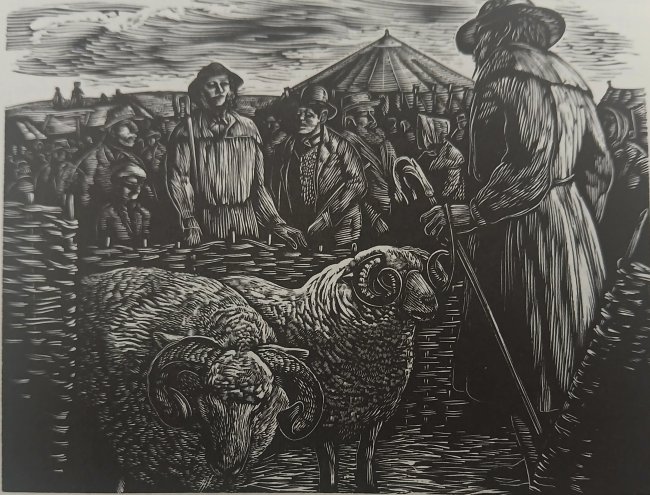
The book, like all Folio Society editions, is beautifully illustrated, this time with thirty one wood engravings by Peter Reddick who worked on all of their Thomas Hardy volumes, around twenty of them, making him the first artist to completely illustrate Hardy.

It was only at the end of the book that it dawned on me how young the major characters are, Gabriel Oak is one who is given a definite age, that of twenty eight at the start of the novel which covers the span of around four or possibly five years so he is thirty two or thirty three at the end of the story. There then becomes the slight problem of the age of Bethsheba Everdene caused by two statements by Gabriel which disagree. In chapter twenty nine – Particulars of a Twilight Walk he says he is six years older:

But in chapter fifty one – Bathsheba Talks with Her Outrider he says there is eight years between them and Bethsheba agrees:

As she agrees and she knows him better by now, as it is near the end of the book, I’m inclined to the eight year gap meaning she was twenty at the start of the novel and twenty four or twenty five at the end. Suddenly it dawned on me just how young she was when she inherited the farm and started running it by herself and that brings a new perspective to her fearlessness and possibly recklessness in deciding to do that. Mr Boldwood is described as ten years older than Oak so allowing for Oak’s approximations in the earlier passage we can say he is in his early forties by the end, which fits with his position as a confirmed bachelor early on in the narrative as he would hardly be described as such if much younger than his late thirties. Sergeant Troy is stated as twenty six at the end of the book and Fanny Robin is twenty, so she was just fifteen or sixteen when she started her relationship with Troy. However I can’t include a picture of where these ages come from without giving away a large part of the end of the book, which I don’t want to do.

I’m so glad I had another go at reading this book and I’m now not sure why it has taken me so long to finish it as I have greatly enjoyed this tale of Victorian life in south west England, so much so that I’m considering which one of the other six Hardy novels I own to tackle next.