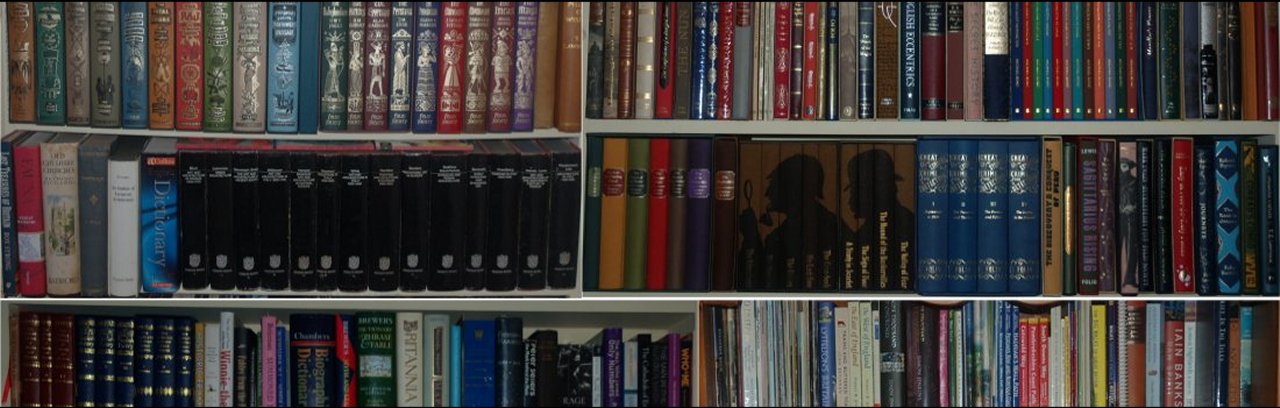

Michael Moorcock is a highly respected fantasy author, probably best known for his epic ‘Tales of the Eternal Champion’ which comprises 6,583 pages in the consolidated fourteen volume UK collection shown below from my own collection. Oddly due to copyright issues the UK set is missing two volumes which were only available in the USA whilst the fifteen volume USA set is missing one volume that was only available in the UK. As the design of the sets is very different I’ve elected not to seek out the two USA volumes and to stick with the UK set.

This book however is not part of one of his fantasy series but rather consists of six essays exploring the origins and development of epic fantasy, praising authors he likes and denigrating those that he doesn’t. A warning to fans of JRR Tolkien he doesn’t regard the Lord of the Rings as a serious piece of adult fantasy, the main clue is that the essay largely concentrating on this work is called Epic Pooh, but let’s get to that later on..
In the introduction Moorcock attempts to define his subject, tracing it’s sources back to Icelandic sagas, the Arthurian legends, Gilgamesh etc and the influences these had on the Romantic poets and Victorian novel writers such as Walter Scott and then leaping forward to HP Lovecraft. Personally I find both Scott and Lovecraft largely impenetrable, Moorcock also doesn’t rate Lovecraft describing him as “that somewhat inadequate describer of the indescribable”. The first essay is called Origins and as the title implies looks at the early days of epic fantasy. For me this was the least successful of the pieces in the book, largely because the authors and works he picks to illustrate his study are either ones I have never heard of let alone read, and from the descriptions they aren’t likely to be going on my reading list either. So whilst it added to my knowledge of the very early days of fantasy, we are talking the 1500’s to 1700’s here it largely felt as an exercise telling me what to avoid although the development of the Gothic novel was quite interesting.
However after this rather flat start the book improved dramatically as it started to deal with fantasy as I would more normally regard it. This is split into separate sections, looking first at fantasy landscapes and making the very reasonable point that if you don’t believe the lands that the characters inhabit you are far less likely to believe the stories they are involved in. Badly described geography can be a serious impediment to a readers enjoyment. Moorcock quotes extensively throughout the book picking good and bad examples of prose to illustrate his points. Having established the importance of somewhere for the heroes and villains to exist in he then moves onto character development looking at heroes and heroines in particular. The fourth essay deals with wit and humour, this is not just comedic fantasy or parodies but also introducing wit in the characters dialogue, an eternally dour character is probably going to be unlikable. It was at this point that I realised just how old this book is (1987) as he praises Terry Pratchett and says that Mort, the fourth Discworld novel had recently come out. This means that a lot of the ‘comic’ fantasy that has appeared in the last four decades are all after Moorcock wrote this work.
Now we get to ‘Epic Pooh’, Moorcock’s dissection not only of the works of Tolkien but also the Narnia books of CS Lewis and others of their ilk. I think I should start with a quote:
The sort of prose most often identified with “high” fantasy is the prose of the nursery-room. It is a lullaby, it is meant to soothe and console. It is mouth-music. It is frequently enjoyed not for its tensions but for its lack of tensions. It coddles, it makes friends with you; it tells you comforting lies. It is soft {here in the book is a quote from Winnie the Pooh} It is the predominant tone of The Lord of the Rings and Watership Down and it is the main reason why these books, like many similar ones in the past, are successful… The humour is often unconscious because, as with Tolkien, the authors take words seriously but without pleasure.
To be fair Moorcock does accept that at times Tolkien rises above his usual standard but quickly falls back in his failure to really explore the emotional background of his characters and almost completely ignores the character of Sauron seeing him simply as a force for evil with little explanation. But at least he is better then Lewis and here I have to totally agree with Moorcock. I find the Narnia books completely unreadable, and always have, mainly due to the ramming of the Christian message down the throats of its readers at every opportunity Lewis can find. It was only when I read this essay that I realised that I last read Lord of the Rings in my late teens so probably at the age that would most appreciate the work and before I read anything much better. I won’t go on, I do however suggest reading this book if you can find it as its been out of print for years.
A comprehensive, but witty survey… the perfect gift for any Tolkien fan you want to annoy
review in Time Out magazine
One fun bit to the book is the apparent source of the title, which is given at the start of the book as a line of poetry by a poet called Wheldrake in his poem The Elvish Rune from 1877.
And you love take my right hand,
Come from the faerie folks’ last dance:
And we’ll sleep and dream of Elfland,
Her wizardry and wild romance.
In fact Ernest Wheldrake was a creation of Moorcock’s and is regularly quoted by one of the characters in the novel ‘The End of all Songs’ which is the third part of ‘The Dancers at the Edge of Time’ the seventh compendium volume of The Eternal Champion series shown above. So the ‘inspiration’ for the title was a piece of poetry written for the book. This by the way is the only appearance of Moorcock’s own work in this volume, he deliberately avoids self reference.
 Ramblings on my bookshelves