The Game-Players of Titan – Philip K Dick

The book is set sometime in the 22nd century, we know this as the year 2095 is mentioned as occurring in the past. Earth has been involved in a terrible war which has led to massive depopulation to between one and two million people over the entire globe, and due to radiation poisoning a significant reduction in fertility of the survivors. The planet is now administered by the Vugs, a race of telepathic beings from Saturn’s largest moon Titan who ended the conflict and whilst not seen as occupiers of Earth they are always around. Amongst the survivors are the maybe a couple of hundred thousand Bindmen, owners of huge swathes of cities and states and their non-B residents. The Bindmen play The Game putting title deeds to their properties and even their wives as stakes in the game which is encouraged by the Vugs who both love gambling and recognise that constant swapping of partners enhances the chances of a fertile couple meeting. The story starts with Pete Garden loosing not only his favourite property, the city of Berkeley in California, but also his wife Freya and to top it off has failed to throw a three which would allow him to take another wife. To make things more on edge Pete is already a drug addict and known suicide risk having attempted to take his own life on four previous occasions.

When Pete recovers from his latest low after losing the game he visits the winner and asks to buy back Berkeley only to find it has already been traded to an American East coast player called Jerome Luckman, a man who having won most of that side of the country was looking for a way in to play on the west coast and Berkeley was to be his opening stake. Pete meanwhile moves to another of his properties where he meets a telepathic non-B female resident who has been surprisingly lucky and has three offspring and he hopes to seduce her or possibly her prettier eighteen year old daughter. That evening though Pete throws a three and is immediately married to another partner just before Luckman arrives to play the game with Pretty Blue Fox as the game group in California is known and wins so consolidating his position.

But then there is a murder and The Game is going to completely change with everything you know, or think you know drastically altered…

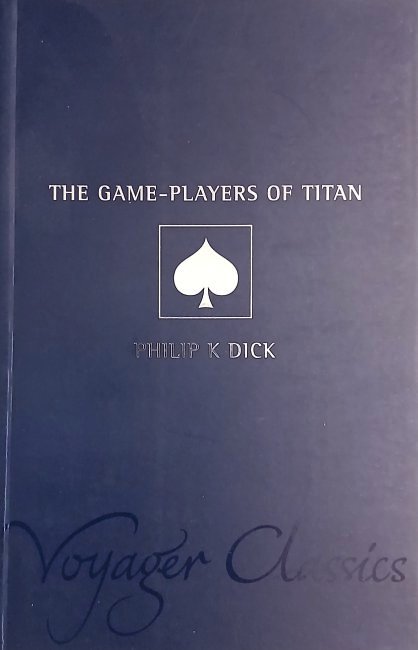
Voyager Classics was a relatively short lived series of science fiction and fantasy books from Harper Collins all with the same blue and silver cover design, with French flaps and a different small, but sort of appropriate, image in the box on the front along with the spine. In this case the ace of spades even though the game they play in the book, Bluff, is clearly a board game. At the time of writing Harper Collins still list two titles in this series on their website, however only one of these has this rather attractive cover design. The Game-Players of Titan is book ten of the thirty six listed titles at the start of the book and they must have all been released, or at least announced, simultaneously in 2001 as this is the first edition. The initial set includes the three Lord of the Rings novels along with The Silmarillion making Tolkien the most represented author, but Ray Bradbury, Stephen Donaldson, David Eddings and Kim Stanley Robinson each appear three times. Philip K Dick has one other titles in the first thirty six, ‘Counter-Clock World’.

As you can see from the title image the cover is rather glossy and difficult to photograph so I did a search on Google to see if I could find another image of the Voyager Classics edition. I did, but the title is subtly different, missing the ‘The’ and also the hyphen in Game-Players. I have no idea if this is a later erroneous edition or what but it is an interesting oddity.

Sophia Scrooby Preserved – Martha Bacon

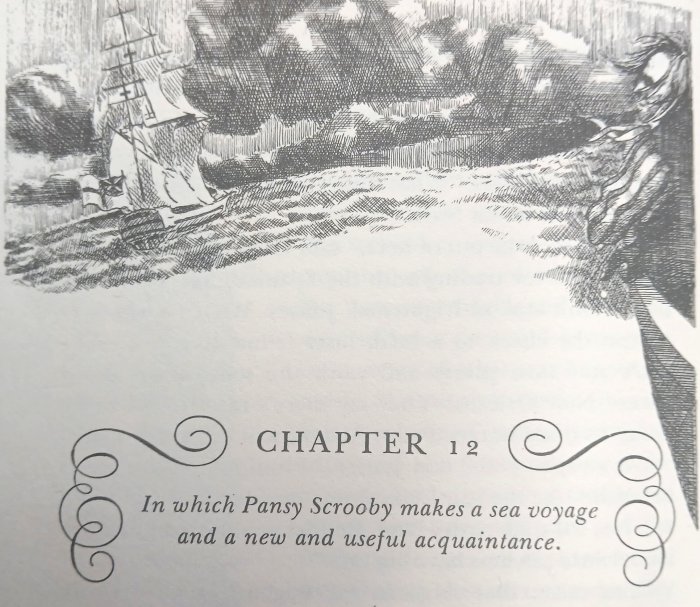
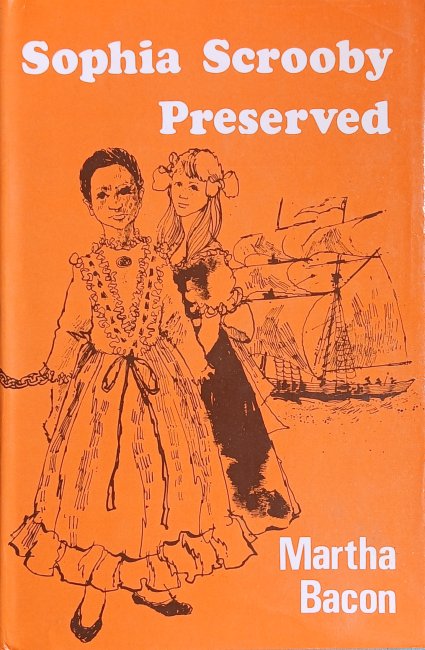
Another of the small number of books I still own from my membership of the Children’s Book Club in the early 1970’s, this one has a rather unusual subject for a book for children as Sophia Scrooby is a child slave in Connecticut around the time of the American War of Independence. Captured in Africa at the age of about six years old after her entire tribe were wiped out in a Zulu raid, she was transported to New England and sold for three pounds (around £500 today) to be trained as a lady’s maid and companion to Prudence, the young daughter of the Scrooby family. Pansy, as Sophia is normally called lives a somewhat unusual life as a slave being treated by the family more as the companion than a servant and is taught embroidery to work on a sampler and whilst working on the letters comprising the border she learns the alphabet and thence by looking through Squire Scrooby’s library secretly slowly teaches herself to read. This ability she reveals after she has been there a year, Squire Scrooby is blind and on his birthday she picks up a book and starts to read to him astonishing the entire family, especially Prudence who hasn’t managed to learn to read yet, Pansy is then tutored along with Prudence in the skills of a young lady, playing music, singing, painting etc. a far different life to that normal for a slave.

This pleasant existence is cut short however by the failing of the Squire’s fortune during the war and his house and goods are seized along with Pansy, who as a slave is simply another chattel to be sold to offset the debts. From this point of the book the narrative speeds up dramatically with Pansy sold to another slaver and pirate intending to take her to New Orleans but she escapes along with two other child slaves and the English captain of a ship captured during a pirate raid. He takes them all to England where Pansy uses her musical talents entertaining his aunt and her friends and then on the London stage. Frankly reading it now for the first time in probably fifty years it’s all rather far fetched but I remember fondly first reading the book (probably at the age of nine) which is why it stayed in my library when a lot of the other books from my Children’s Book Club collection are long gone. I’m glad I came across it again and reread it, it’s not as good as ‘Mortimer Also‘ or ‘The Ghost of Thomas Kempe‘ which are also survivors from that series on my shelves but it was a pleasant read with a satisfying, if rather predictable, ending after 225 pages.

Martha Bacon Ballinger died of cancer in 1981 at the age of sixty four. At the time she was associate professor of English at Rhode Island College and had published several books including two volumes of poetry. Sophia Scrooby Preserved was originally published in 1968 and was her first book for children. After the initial hardback editions by Little, Brown and Company and Atlantic Monthly Press in America and Victor Gollancz in the UK, this Children’s Book Club version was probably published around 1971/2 (it isn’t dated) and finally there was a 1973 paperback by Puffin Books which doesn’t appear to have been reprinted. I can find no further examples and it has remained out of print for over fifty years. All the editions, regardless of publisher, were illustrated by David Omar White.

Frankenstein – Mary Shelley

If anyone had asked me before last week if I had read Frankenstein I would have replied “yes” as I was certain that I had done so although many years ago. Yet when I started reading a few days ago it became clear that I had never read this thoroughly enjoyable book before as it was completely unfamiliar. I have of course seen several of the largely terrible films and memories of those must have blurred my recollections but the book is so very different to the various ‘adaptations’ and is well written especially bearing in mind this was the twenty year old Shelley’s first work of fiction. I was particularly keen to read the book this week as next month I will be reading the first four Penguin books to mark ninety years of Penguin and the first of those is Ariel by André Maurois, which is his biography of Mary’s husband the romantic poet Percy Bysshe Shelley.

I think a lot of people know the story of how Frankenstein came to be written, but if you don’t then Mary Wollstonecraft Godwin as she was then, was away in Geneva in 1816 with her soon to be husband, whom she had run away with at the age of sixteen despite the fact that he was already married, she was eighteen by now. Also in the group was Lord Byron and his private doctor John William Polidori and there came an evening with poor weather so they were ‘trapped’ inside and it was suggested that each person present should write a horror story. Byron started a tale but didn’t get very far, it was later published as ‘a fragment’, Shelley wrote what would ultimately be five short ghost stories, Polidori didn’t get anywhere with his own story, but would later pick up Byron’s fragment and write ‘The Vampyre’, the first ‘modern’ vampire story, published almost eighty years before Bram Stoker’s classic, Mary of course started Frankenstein. Two years later in 1818 it was finished and published, by which time Mary and Percy were married, at the end of 1816 just days after the suicide of his wife.

It was immediately apparent to me that I hadn’t read the book before from the unfamiliar opening, which consists of four letters from Robert Walton to his sister Margaret as he embarks on an Arctic voyage from Archangel in northern Russia to attempt to reach the North Pole. Not where I expected the book to begin. In the fourth letter however there was a hint of what I had anticipated.

a strange sight suddenly attracted our attention and diverted our solicitude from our own situation. We perceived a low carriage, fixed on a sledge and drawn by dogs, pass on towards the north, at the distance of half a mile; a being which had the shape of a man, but apparently of gigantic stature, sat in the sledge and guided the dogs. We watched the rapid progress of the traveller with our telescopes until he was lost among the distant inequalities of the ice.

Undoubtedly it’s the monster, but what is he doing on a dog sledge in the high Arctic? The next morning another sledge is spotted, this time in a bad way with just one dog still living and trapped on a shrinking ice floe. Its badly frostbitten occupant is encouraged to board the ship and collapses soon afterwards, however as he slowly recovers he starts to tell his story to Walton, who each evening writes down what the stranger has told him, eventually revealing his name as Victor Frankenstein and how he came to create the creature they had spotted earlier.

It was on a dreary night of November that I beheld the accomplishment of my toils. With an anxiety that almost amounted to agony, I collected the instruments of life around me, that I might infuse a spark of being into the lifeless thing that lay at my feet. It was already one in the morning; the rain pattered dismally against the panes, and my candle was nearly burnt out, when, by the glimmer of the half-extinguished light, I saw the dull yellow eye of the creature open; it breathed hard, and a convulsive motion agitated its limbs.

How can I describe my emotions at this catastrophe, or how delineate the wretch whom with such infinite pains and care I had endeavoured to form? His limbs were in proportion, and I had selected his features as beautiful. Beautiful! Great God! His yellow skin scarcely covered the work of muscles and arteries beneath; his hair was of a lustrous black, and flowing; his teeth of a pearly whiteness; but these luxuriances only formed a more horrid contrast with his watery eyes, that seemed almost of the same colour as the dun-white sockets in which they were set, his shrivelled complexion and straight black lips.

The different accidents of life are not so changeable as the feelings of human nature. I had worked hard for nearly two years, for the sole purpose of infusing life into an inanimate body. For this I had deprived myself of rest and health. I had desired it with an ardour that far exceeded moderation; but now that I had finished, the beauty of the dream vanished, and breathless horror and disgust filled my heart.

This is where I struggled somewhat with the plot as Frankenstein simply runs away into the night rather than confronting and possibly destroying his creation which would have been the most logical outcome, although shortening the book somewhat. Instead when he returns to his lodging he discovers the monster is gone and he doesn’t see or hear of it again for the next two years. For a year of that time the creature improbably lives undetected in a small room attached to a cottage occupied by probably the least curious family imaginable for it never occurs to them to go round the back of the house and look at the outbuilding and its eight foot tall inhabitant. We are further asked to believe that just by observing this family he learns from scratch to not only understand their spoken language but also to read with no tuition. However if we discard my objections to this plot device then when the tale is picked up again the creature has found the Frankenstein home in Geneva having walked from Ingolstadt (roughly halfway between Munich and Nuremburg) a distance of some 400 miles (650km) although again it is not clear how he has managed this feat. To say that the crossing of paths between the creator and his creation after all this time does not go well is an understatement but it is from here that the book becomes more enjoyable again leading up to the fateful denouement on the Arctic Sea.

If you haven’t read Frankenstein then you should, there is a lot more going on both in the plotting and social commentary, which is only appropriate from the daughter of radical thinker and novelist William Godwin. My copy is from the new Penguin Vintage Collector’s Classics series, which included this book in its first ten titles published in March 2025. They are a lovely series of books with foil embossed covers and marbled end papers along with matching sprayed edges. The first ten titles were split evenly between ‘Gothic’ and ‘Romantic’ novels and a great selection they are too.

Closely Watched Trains – Bohumil Hrabal

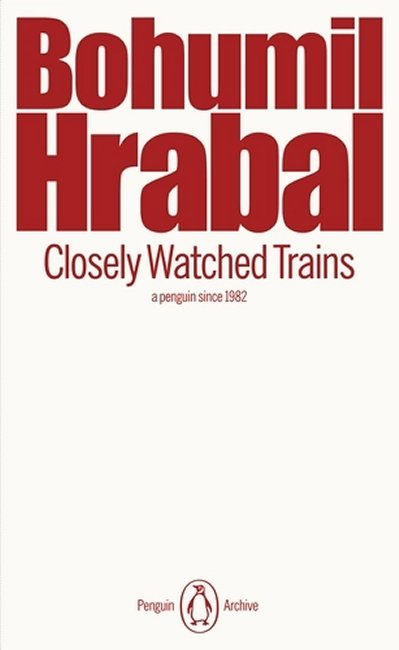
The first book to be featured on my blog of the ninety volumes published as Penguin Archive to mark the ninetieth birthday of Penguin Books on 30th July 2025 and oddly I have chosen this one because of the translator rather than the author. The book was translated into English from the original Czech by Edith Pargeter, better known by her pen name Ellis Peters and the author of the medieval mystery books featuring the monk from Shrewsbury Abbey called Brother Cadfael. Pargeter was born and brought up within a few miles of where I live now and died just a couple of miles away so I’m always intrigued when I come across anything different she worked on and until reading this book I didn’t know that Pargeter became fluent in Czech following her time in the country in 1947. The original Czech title is ‘Ostře sledované vlaky’ and in some English translations is given as ‘Closely Observed Trains’. The 1966 film that was based on the novella also seems to switch titles between the two options depending on where it was released. The film won the 1968 Oscar for best foreign film and was nominated for the 1969 BAFTAs in the best film and best soundtrack categories. The line on the cover ‘A Penguin since 1982’ refers to the first year one of Hrabal’s works was published by Penguin Books.

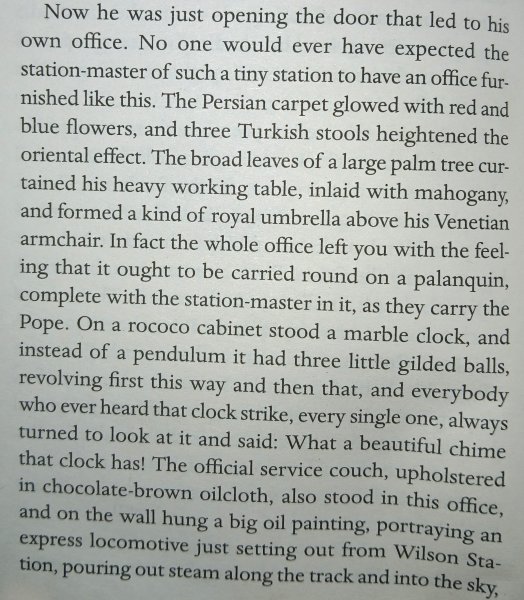
Hrabal worked as a railway labourer and train dispatcher during WWII, whilst waiting to complete his law degree in Prague as the university was shut down during the German occupation. The knowledge he gained from this experience is fully used in this 1965 novella which is set at a somewhat eccentrically run small railway station during 1945 as the Nazi troops were being forced back across Czechoslovakia. The main protagonist of the book is twenty two year old apprentice dispatcher Miloš Hrma, who at the beginning is about to start his first shift back at the station after attempting suicide by slitting his wrists three months previously. The eccentricity of the station can best be emphasised by the description of the Station Masters office:

The station master is as unconventional as his office, keeping his pigeons, which he exchanged from a German to a Polish breed at the start of hostilities, in the roof of the station and when upset shouting profanities into the ventilation ducts in his office. Miloš may be the apprentice dispatcher and his suicide attempt after failing to perform in his first foray into lovemaking with his girlfriend does mark him out but his senior dispatcher is also a man to be reckoned with. During Miloš’s time recovering Výpravcí Hubicka had had a bet with the telegraph operator and when she lost had used all the station’s ink rubber stamps to decorate her naked behind. Something that she simply finds as funny but has greatly upset not only the station master but the railway inspector who unexpectedly arrives to perform a disciplinary. As you can imagine the operation of the station is somewhat chaotic and that’s without the interaction with the occupying German troops.

The fighting on the Eastern Front and the subsequent traffic with trains containing fresh troops going east and injured and dead troops going west along with ammunition and equipment heading into the conflict seems to provide most of the movements through the station. These are presented as stark contrasts to the craziness at the station which flips between the wildly funny and the tragic, especially in the brilliant and unexpected denouement. I greatly enjoyed this book and will now try to search out the film.

Jorrocks’ Jaunts & Jollities – RS Surtees

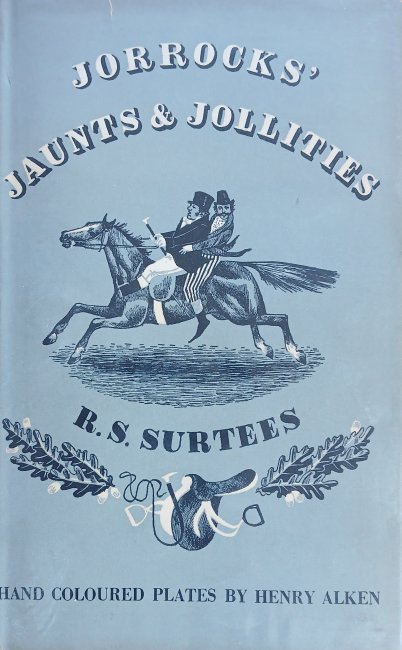
In 1949 The Folio Society decided to have a go at resurrecting the works of Robert Smith Surtees who had sadly dropped out of fashion since his heyday in the Victorian period with an edition of his first book, indeed his books used to be so well known that Virginia Woolf referred to this very title in the 1925 novel ‘Mrs Dalloway’ as her eponymous character was searching for a book suitable to take to a nursing home.

This late age of the world’s experience had bred in them all, all men and women, a well of tears. Tears and sorrows; courage and endurance; a perfectly upright and stoical bearing. Think, for example, of the woman she admired most, Lady Bexborough, opening the bazaar.

There were Jorrocks’ Jaunts and Jollities; there were Soapy Sponge and Mrs. Asquith’s Memoirs and Big Game Shooting in Nigeria, all spread open. Ever so many books there were; but none that seemed exactly right to take to Evelyn Whitbread in her nursing home.

Frankly if I was in a nursing home then Surtees may well be just the right author for my convalescence as the books are well written, with excellent observations on country life and Jorrocks is one of the great comic characters of the early Victorian age. This book was printed in only the third year of The Folio Society’s existence and was intended as a one off from this author in companion with a similarly designed edition of The Compleat Angler by Izaac Walton. However it was so popular that they subsequently published the remaining seven books by Surtees at the rate of one a year, making Surtees the first author to have their complete works published by the society.

John Jorrocks is described as a grocer in the book but as he operates out of his own warehouse rather than a shop he is probably a fairly wealthy wholesaler based in London. He is a keen fox hunter, riding with the Surrey hounds based at the small country town of Croydon about ten miles from central London. Anyone who knows Croydon nowadays, it has a population of around two hundred thousand and has been largely subsumed by Greater London, will find the rural descriptions of the place in the 1830’s difficult to imagine but this really was the case back then. Jorrocks’ regular companion is Mr Stubbs who is normally simply referred to as The Yorkshireman and one of the funniest passages in this book describes a ride from the middle of London by both of these gentlemen to join the hunt on a particularly foggy day in the city with the chaos they cause or get involved in. As Surtees is not well known nowadays I’m going to include a couple of examples of his style. The Yorkshireman never seems to have any money but is quite happy to live off Jorrocks as in this plan for a weekend trip.

“Now to business—Mrs. J—— is away at Tooting, as you perhaps knows, and I’m all alone in Great Coram Street, with the key of the cellar, larder, and all that sort of thing, and I’ve a werry great mind to be off on a jaunt—what say you?” “Not the slightest objection,” replied the Yorkshireman, “on the old principle of you finding cash, and me finding company.” “Why, now I’ll tell you, werry honestly, that I should greatly prefer your paying your own shot; but, however, if you’ve a mind to do as I do, I’ll let you stand in the half of a five-pound note and whatever silver I have in my pocket,” pulling out a great handful as he spoke, and counting up thirty-two and sixpence. “Very good,” replied the Yorkshireman when he had finished, “I’m your man;—and not to be behindhand in point of liberality, I’ve got threepence that I received in change at the cigar divan just now, which I will add to the common stock, so that we shall have six pounds twelve and ninepence between us.” “Between us!” exclaimed Mr. Jorrocks, “now that’s so like a Yorkshireman. I declare you Northerns seem to think all the world are asleep except yourselves;

Jorrocks also loves his food and drink and there are long descriptions of meals and consuming numerous bottles of wine and port in one sitting. I particularly enjoyed the contrast between the eating manners of the English and French when Jorrocks takes The Yorkshireman with him on a trip to Paris and the slow appearance of course after course in France confuses him rather than the everything on the table to start with which was then the preference in England and he assumes he is going to starve due to the lack of visible food. Early on in the book he invites The Yorkshireman round for breakfast before heading out to the hunt.

About a yard and a half from the fire was placed the breakfast table; in the centre stood a magnificent uncut ham, with a great quartern loaf on one side and a huge Bologna sausage on the other; besides these there were nine eggs, two pyramids of muffins, a great deal of toast, a dozen ship-biscuits, and half a pork-pie, while a dozen kidneys were spluttering on a spit before the fire, and Betsy held a gridiron covered with mutton-chops on the top; altogether there was as much as would have served ten people. “Now, sit down,” said Jorrocks, “and let us be doing, for I am as hungry as a hunter. Hope you are peckish too; what shall I give you? tea or coffee?—but take both—coffee first and tea after a bit. If I can’t give you them good, don’t know who can. You must pay your devours, as we say in France, to the ‘am, for it is an especial fine one, and do take a few eggs with it; there, I’ve not given you above a pound of ‘am, but you can come again, you know—waste not want not. Now take some muffins, do, pray. Batsey, bring some more cream, and set the kidneys on the table, the Yorkshireman is getting nothing to eat. Have a chop with your kidney, werry luxterous—I could eat an elephant stuffed with grenadiers, and wash them down with a ocean of tea; but pray lay in to the breakfast, or I shall think you don’t like it. There, now take some tea and toast or one of those biscuits, or whatever you like; would a little more ‘am be agreeable? Batsey, run into the larder and see if your Missis left any of that cold chine of pork last night—and hear, bring the cold goose, and any cold flesh you can lay hands on, there are really no wittles on the table.

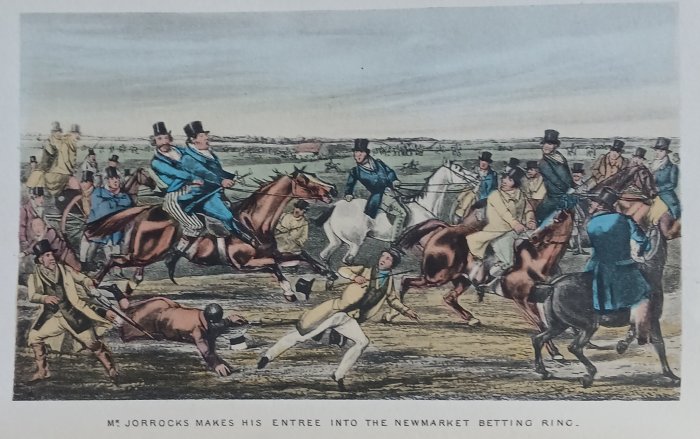
A note should be made regarding the fifteen colour plates included in the book as they were done by a technique that had largely disappeared by 1949. The plates, which are those by Henry Alken originally included in the book back in 1838, were in fact printed in monochrome and individually hand coloured by Maud Johnson who went on the do the same for the further seven volumes Folio printed of Surtees’ works. The Folio Society doesn’t include printing numbers for their books in the various bibliographies they have published but it can be imagined what a huge amount of work this involved for one person, but the effort was worth it as these illustrations really stand out. The pages for the prints are noticeably thicker and stiffer than the pages of text presumably to allow for Johnson’s use of watercolours to do the colouring without distorting the paper. Other than special very limited editions these eight volumes are the last books with hand coloured plates printed in England that I am aware of although I’d love to know of any others. The Folio Society continued to use the original plates throughout the series of reprints which was finally complete in 1956 with this being the only one illustrated by Alken, most of the others are done by John Leech.