Strata – Terry Pratchett

I have done several blogs about Pratchett but always tried to emphasise some of the less well known aspects of his work and this time I’m going back to his third novel, and the last before he created Discworld, which was to make him rightly famous. My copy is a signed first edition published by Colin Smythe Limited on the 15th June 1981 in a print run of just 1,001 copies, 850 of which were sold to Reader’s Union, and it is in this book that Terry first explored the concept of a flat world although not in this case borne on the back of a giant turtle; as he wrote at the time:

I am also working on another ‘discworld’ theme, since I don’t think I’ve exhausted all the possibilities in one book! 

That theme would result in ‘The Colour of Magic’ first published on 24th November 1983 and it, along with the subsequent forty plus books, proved that he definitely hadn’t exhausted all the possibilities. But back to Strata which I must admit I hadn’t reread for at least thirty years, the story starts with a fake quote from an equally fake book that sets up the premise for the beginning of the plot:
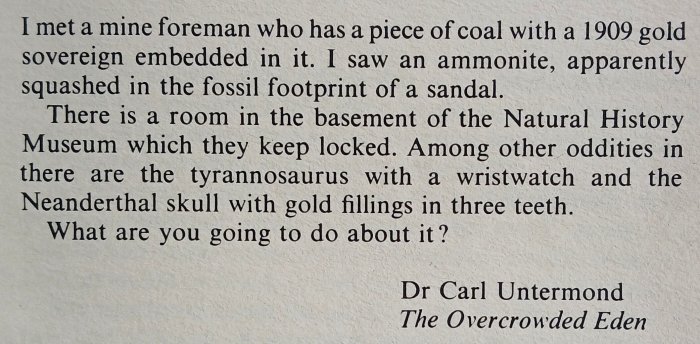
Whilst it would undoubtedly fun to have developed more on this idea, instead Pratchett abandons the dubious fossil record concept quite quickly after explaining it was done via a huge device called a strata machine. This was invented to form fake sedimentary layers and their accompanying embedded fossils on newly created planets by a race known as the Spindle Kings who predated mankind by several million years and had also built Earth. A small number of these machines had been found buried on other planets and humans were now using them to terraform new planets for ongoing colonisation. There has been other galaxy wide races before the Spindle Kings such as The Wheelers and these had died out in turn leaving the present day to Humanity along with a few other sentient and space travelling races, specifically for this book, Kung and Shand. The main human character in the story is Kin Arad who had written a book called ‘Continuous Creation’ giving the history of the various galaxy creating races and this had made her famous so that she was approached by a man who claimed to have found a flat Earth out in a largely unvisited part of the galaxy and wanted to put together a small crew to explore it, this crew would consist of Kin Arad, Marco a representative of the Kung along with Silver a Shand. I can explain all this because it is dealt with in the first forty pages of the book and gives away nothing of the main story.

Anyone who has read Pratchett’s Discworld books will keep seeing references throughout the book, for example our three protagonists first meet in a bar called The Broken Drum and when we get to the flat world there is a rimfall, a continuous flow of the oceans off the edge, amongst other similarities. However the flat planet is recognisably the Earth with much the same continental pattern unlike Discworld and it works using technology, such as matter transference to replenish the seas, rather than magic which drives The Disc in the later books. Anyone who has read Discworld and wants to get an inkling of Pratchett’s ideas in creating it should probably read Strata, it is by no means as an accomplished work as certainly the Discworld novels from the fourth one onwards where Pratchett had more fully developed his skill as a storyteller but it is definitely worth a go and the twist at the end is a good one. It is definitely a science fiction story rather than a fantasy and is probably closer to Larry Niven’s Ringworld than to Pratchett’s Discworld series.

The Ring of the Nibelung – Richard Wagner

Back in March 2021 I reviewed a book about the trials and tribulations of staging the magnificent four opera series of the Ring Cycle by Richard Wagner, see here. Soon after that I purchased this magnificent cloth bound volume from The Folio Society, which is the full libretto in parallel text with Wagner’s original German alongside the superb translation by Stewart Spencer. This was first published by Thames and Hudson back in 1993 as ‘Wagner’s Ring of the Nibelung; A Companion’, but the Folio version, published in 2020, is much larger at 289 × 205 × 41 mm, and has added illustrations by John Vernon Lord. As can be imagined as the four operas in the 1991 Barenboim recording I have play for a grand total of 15 hours and 5 minutes the libretto runs for well over three hundred pages with an extra seventy pages of authoritative essays on the development of the opera cycle at the beginning along with extensive notes at the end making a total of over four hundred pages of text with seventeen unnumbered leaves of plates. All in all a comprehensive guide to this greatest of Wagner’s operatic works. It should be pointed out that whilst the words sung are all in both languages the stage directions are only in English, this didn’t bother me but if you were looking for a ‘full’ parallel text then bear in mind that these parts are missing.

Wagner is unusual in writing his own libretto, it is much more common to either set an existing work or work with a librettist. For the most part he combined Norse with Old German mythologies in developing his story, these are closely related anyway with much the same characters only with different names, Odin becomes Wotan and Thor becomes Donner for example, but there are also echoes of the ancient Greek especially Homer’s Iliad. Occasionally he merges two characters from different origins into one such as Freia (this is how Wagner spells her name, more usually Freya or Freyja) a Norse goddess of fertility and in this version also the one who looks after the golden apples that confer everlasting life to the gods; she is also referred to as Holde, a similar but different character from German folk tales. Wagner also adds to the mythology with his own concepts such as carving important contracts in runes on Wotan’s staff, the staff exists in the mythologies but not the binding contracts. This melding of the various myths and new ideas make the reading of the libretto so fascinating, especially if you have a reasonable knowledge of the original mythologies, and whilst I have picked up some of this whilst listening to the operas it was only when reading the text at my own pace rather than moving rapidly on as you do in a performance that I more deeply appreciated the complex weaving of stories that Wagner achieved. Certainly the librettos can be read as a long poem without any deeper knowledge of the operas but I found myself adding the music in my mind as I read the words especially in parts I knew well.

The book is really lovely to read, as can be seen above in this section of the third opera ‘Siegfried’ shown with an engraving of the sword Northung being repaired by Siegfried. The sword had belonged to his father Siegmund but was shattered by Wotan during Siegmund’s fight with Hunding in the previous opera ‘Die Walkure’ (The Valkyrie) as Wotan’s wife, Fricka, had demanded that he die as punishment for his incestuous relationship with his sister Sieglinde which had left her pregnant with Siegfried. The illustrations deliberately do not include any of the characters but are rather of important objects within the opera cycle, which I think is an interesting choice as John Vernon Lord explains in his note on the illustrations:

I thought that the words and music together would be best for conveying the ‘appearance’ of the various characters. At the outset, I felt that the inclusion of people would detract from the symbolic nature of what I wanted to express.

It is later in this opera, in fact in the final scene, that we get one of the few ‘humorous’ lines although this was not intended as such by Wagner but I always smile when we reach the ‘This is not a man’ line when Siegfried discovers and wakes the Valkyrie Brunnhilde from where she has been left in a magical trance by Wotan.

It should be realised that Siegfried has never seen a woman before, being brought up by Mime in a secluded location away from all others, but even so ‘Das ist kein Mann!’ is not Wagner’s finest hour.

I have really enjoyed having a deeper dive into the text of the operas and will have a much greater understanding the next time I listen to or watch them, being able to look back over previous sections to refresh my memory has proved to be well worth the cost of purchasing the book especially as it is such a fine edition.

Guerrilla Warfare – Che Guevara

I have known of the existence of this book for many years and was somewhat confused that a book first published in the USA in 1961 and then in the UK by Pelican Books in 1969 was so elusive. I wanted it because I thought it would be a logical follow up of ‘The Motorcycle Diaries’ which I reviewed back in June 2022 and which very entertainingly covered a trip around South America by Guevara and his friend Alberto Granado whilst Guevara was studying to become a doctor. This book I assumed would cover his time as part of the Cuban revolution leading to his promotion as second in command below Fidel Castro and the ultimate overthrow of the Batista regime, But no I have since found out that a book I hadn’t previously heard of ‘Reminiscences of the Cuban Revolutionary War’, also written by Guevara and published in Pelican along with this book in 1969, performs that function. So what is ‘Guerrilla Warfare’ about? Well here we are probably coming to the reason it is so difficult to find, as it is basically a handbook on how to run a popular insurgency, from recruiting fighters to how to actually run a guerrilla band, feeding and clothing them, obtaining arms and proposed combat methodology. A look at the contents list gives an idea as to what to expect.

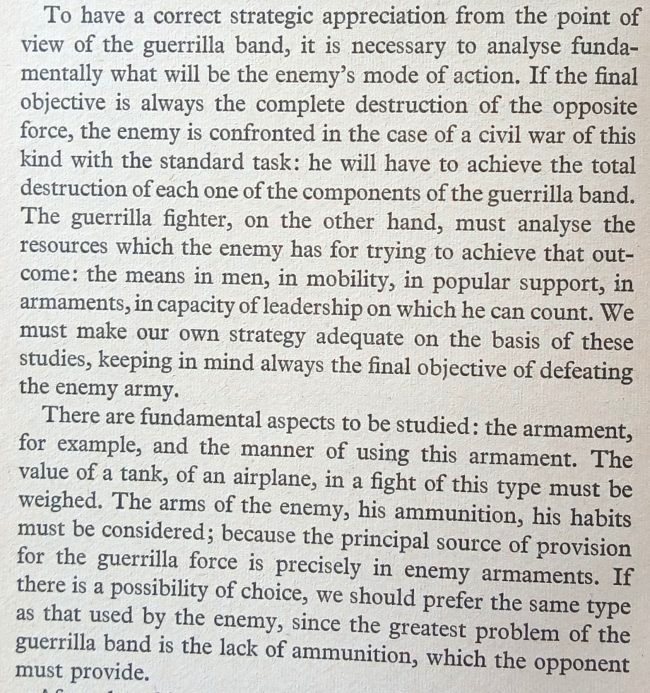
Despite not being what I expected the book is fascinating and gives an insight into the way a guerrilla band operates with some of the problems which come from operating in a secret way and some things that are different with a regular army. For example the chapters on warfare on favourable and unfavourable ground are diametrically opposite to a ‘normal’ army in that favourable ground for the guerrilla is the mountains and jungle where they can easily melt away or establish defensible positions whilst a regular army likes more open country where their heavy vehicles can move easily and this is precisely what a guerrilla army counts as unfavourable. Likewise armaments for a guerrilla fighter is largely restricted to rifles, preferably not fully automatic, and hand guns with homemade grenades or Molotov cocktails. The army on the other hand can utilise aircraft, tanks and tripod mounted machine guns which are too heavy to be easily moved by hand, which is usually how a guerrilla band would need to move them and quickly use far too much ammunition, which is always in short supply until they manage to capture more. Guevara explains that should a heavy machine gun be captured by all means use it but be prepared to abandon it if pressed as it is simply not worth the effort of carrying it away during combat. Guevara also says that a bazooka is an excellent guerrilla weapon let down by its size and the fact than a man can only just carry three shells any distance due to their weight and even then someone else has to carry the shoulder mounted launcher.

The need to capture ammunition also applies to most of the guns and rifles used by a guerrilla band, it is far easier to obtain these from the enemy than try to smuggle armaments in from outside, it also means that the ammunition is the same thus largely getting round the difficulties of supply. The section I have included below makes the distinction between a revolutionary and a terrorist in that a terrorist is indiscriminate in his targets unlike the more focused revolutionary. In another section Guevara also dismisses gangs of bandits as preying on the poor population whilst the revolutionary is there to support them, although he admits that the guerrillas will need food and clothing which the peasant agrarian economy must provide as they are the only practical source. But he explains that whenever possible this should be paid for either with cash or promissory notes which should be honoured as soon as possible. How likely this is to actually happen isn’t explained.

It should be pointed out that Guevara had a reputation as a ruthless fighter and unforgiving disciplinarian, executing deserters from his troops. But none of this is mentioned in this work which, whilst not glorifying Guevara as he isn’t mentioned by name, is more a guide on how to operate a revolutionary force at least in the context of 1950’s/60’s South American environment, which is almost certainly why it is no longer in print and copies are so difficult to come by. It was an unexpectedly interesting read and I have deliberately not included some of the more specific sections on armaments and tactics in this review.

I Who Have Never Known Men – Jacqueline Harpman

This deeply disturbing novel has a group of women held in an underground bunker, none of whom knew one another before they arrived there and who don’t have any memory as to how they got there. Our narrator is the youngest, all the others were adult when put in the cage and have memories of life before, working, having children, living normal lives, but the unnamed narrator was a small child when incarcerated and this is all she knows.

There were forty of us living in that big underground room where no one could hide from the others. At five-metre intervals, columns supported the vaulted ceiling and bars separated our living area from the walls, leaving a wide passage all around for the guards’ relentless pacing up and down. No one ever escaped scrutiny and we were used to answering the call of nature in front of one another. At first – so they told me, my memories didn’t go back that far – the women were most put out, they thought of forming a human wall to screen the woman relieving herself, but the guards prohibited it, because no woman was to be shielded from view.

Other things were also forbidden such as physical contact, the women may not touch each other, suicide or self-harming were also banned, any attempt at escaping from the relentless monotony of their existence in the cage by killing or injuring themselves would instantly cause the guards to crack their whips close to the prisoners. The guards never entered the cage or spoke to the women even in the early days when they would cry out to try to find out what had happened to them and why they were there. Apart from constantly watching the women, the guards delivered the food, meat and vegetables with occasional pasta, which had to be boiled as that was the only means of cooking available. The knives the women needed to prepare the vegetables were blunted, they were not allowed to sharpen them in case they were used to injure and they had to be returned after use. The cage is large enough for the tables for food preparation, two toilets, a water supply and on the remaining floor just enough room to spread out forty mattresses for the women to sleep on, these would then be stacked to make something to sit on during the ‘day’. It is clearly costing somebody a lot of money to supply electricity and food and sometimes scraps of material to repair or fashion rudimentary tunics for clothing and pay for the constant guards over the dozen or so years the women have been held here but why?

Around a third of the way through the book everything changes. During the time of food serving a siren suddenly goes off and the guards simply run away leaving the keys in the serving hatch lock in their panic to get away. When the women realise they are alone the narrator, known only as ‘the child’ although by now she is probably fifteen years old, retrieves the keys and manages to unlock the main door to the cage. Exploring the rest of the bunker reveals a vast food store, enough for many years, but no guards or indeed much in the way of indication that they had ever been there. A staircase rises to a cabin and then to the outside. It has taken eleven minutes from the siren to the first women setting foot on the surface but there is no sign of the guards, where are they and how have they vanished from a vast open plain so quickly?

They decide to explore to find anyone else who might be there and eventually after four weeks they discover another cabin with stairs down. This also has the same layout as their prison with a cage but this time with forty corpses as these women had not been so fortunate when the guards left them. Eventually they come across hundreds of similar bunkers all with forty or maybe slightly fewer dead prisoners always unisex sometimes female sometimes male, a huge store of food and no guards. Just what was going on and where are they, is this even Earth?

The development of the relationships between the women is one of the driving themes of the book along with the increasing authority of ‘the child’ as she ages and develops useful skills. There is also the mystery as to what is going on. Jacqueline Harpman was born in Belgium in 1929 and as part of a Jewish family escaped to Morocco when the Nazis invaded at the start of WWII and the isolation of that time possibly influenced the isolation of the women. Returning to Belgium after the war she eventually trained as a psychoanalyst and this knowledge of how the mind works can be seen throughout the novel. ‘Moi qui n’ai pas connu les hommes’ published in 1995 was her tenth novel and the first to be translated into English, although it didn’t achieve major success in English until being reprinted in 2022 with a literal translation of its title rather than ‘Mistress of Silence’ which it was called in 1997. I loved this short book and cannot recommend it enough.

12 Books that Changed the World – Melvyn Bragg

This is the 400th post on my blog so I have chosen this book to mark the occasion. It was written to accompany the 2006 ITV television series of the same name that was presented by Bragg and consisted of twelve hour long episodes looking at each work in depth, I have the first edition of the book published by Hodder and Stoughton also in 2006 but I do feel that Bragg cheated a little as he admits in the introduction.

From the beginning I wanted to enjoy a range. Leisure and literature would, if I could make it work, figure alongside science and the constitution; changes in society as well as changes in technology would be addressed. This has meant taking a risk and, now and then, elasticating the strict meaning of the word ‘book’.

Bragg certainly stretched the definition as can be seen from the list of books and documents he chose:

  • Principia Mathematica by Isaac Newton – 1687
  • Married Love by Marie Stopes – 1918
  • Magna Carta – 1213
  • The Rule Book of Association Football by a group of former English Public School men – 1863
  • The Origin of Species by Charles Darwin – 1859
  • On the Abolition of the Slave Trade by William Wilberforce – 1789
  • A Vindication of the Rights of Women by Mary Wollstonecraft – 1792
  • Experimental Researches in Electricity by Michael Faraday – 1839, 1844 & 1855 (3 volumes)
  • Patent Specification for Arkwright’s Spinning Machine by Richard Arkwright – 1769
  • The King James Bible by William Tyndale and others – 1611
  • An Inquiry into the Nature and Causes of the Wealth of Nations by Adam Smith – 1776
  • First Folio by William Shakespeare – 1623

Of these Magna Carta is definitely not a book but I can see why he included it as eight hundred years later parts of this remarkable document are still in place in the legal systems of not just the UK but America and large parts of the British Commonwealth. The Rule Book of Association Football is also barely a book, more of a pamphlet, as there are just thirteen rules and these would comfortably fit on a sheet of A4 paper. There is presumably a quantity of text surrounding these few bare lines but that isn’t made clear in Bragg’s write up. I enjoyed this choice immensely though, even though I have little interest in football, mainly for the history of the game and how the rules came to be codified combining the various versions that existed at the different public schools where the game was mainly played. I would particularly like the re-introduction of rule three which states that the the teams should change ends after each goal rather than at half time, what do football fans think of this idea? The third ‘book’ that isn’t really a book is Arkwright’s patent as it is just three pages long and as Arkwright wasn’t the actual inventor just the man who got the patent passed and then made millions (in today’s money) from other peoples ingenuity I struggle with it’s inclusion here amongst writers who did genuinely change the world.

Beyond those niggles, apart from Arkwright and the Marie Stopes book, which I must admit I have never read and therefore hadn’t thought of as a ground breaking publication, these are works I could have largely come up with myself if asked to list 12 Books that Changed the World. although like Bragg I would probably have listed far more and then had to trim the list. I think Bragg makes a good case for ‘Married Love’ though, but far less for the intellectual property theft embodied in Arkwright, you can sort of admire him as one of the first major industrialists, although his working conditions were horrific by today’s standards, but definitely not for the patent which he used to gain a monopoly for years.

But let’s look at the books that stand out in this list initially examining how Bragg has presented each one. You get a well thought out essay stating not only his case for the books’ consideration but also the history as to how it came to be written, it’s reception at the time, and the impact of the work from then until now. This is followed by a two or three page timeline of major events up to the present day associated with the ideas within the book. As an example Principia Mathematica, in which Newton not only sets out major advances in mathematics but also in the first volume created calculus and what it could do and how to do it. The book is intended for the intellectual elite of the time and as implied by the title is written in Latin so that it could be read around Europe as anyone sufficiently educated to follow what Newton was writing about could read Latin, it wasn’t translated into English until 1729, two years after Newton died. We get a summary as to how Newton worked pretty well in isolation from others and the slow appreciation that Principia had when it was published, largely due to its subject matter rather than the way it was written which was excellent for such a massive leap in mathematical study. Bragg then looks at how the modern wolrd depends on Newtons three laws of motion and the powerful mathematical tools that he defined in Principia. Then the timeline includes such momentous events as the discovery of infrared and ultraviolet light although these are more related to Newtons work on optics published in 1704 rather than the Newtonian physics of Principia.

As I write this Melvyn Bragg is still very much writing and broadcasting at the age of eighty five and is a member of the Upper House of Parliament, The House of Lords, where he sits as a Labour peer. Until he retired from the show at the beginning of September 2025 his regular broadcasting slot was the excellent radio show and podcast In Our Time which he had presented since 1998, The show picks a wildly different subject each week and discusses it with a panel of experts, it is currently on its summer break and due to start again on 18th September 2025 with a new presenter, there are over a thousand episodes available online.