
I have known of the existence of this book for many years and was somewhat confused that a book first published in the USA in 1961 and then in the UK by Pelican Books in 1969 was so elusive. I wanted it because I thought it would be a logical follow up of ‘The Motorcycle Diaries’ which I reviewed back in June 2022 and which very entertainingly covered a trip around South America by Guevara and his friend Alberto Granado whilst Guevara was studying to become a doctor. This book I assumed would cover his time as part of the Cuban revolution leading to his promotion as second in command below Fidel Castro and the ultimate overthrow of the Batista regime, But no I have since found out that a book I hadn’t previously heard of ‘Reminiscences of the Cuban Revolutionary War’, also written by Guevara and published in Pelican along with this book in 1969, performs that function. So what is ‘Guerrilla Warfare’ about? Well here we are probably coming to the reason it is so difficult to find, as it is basically a handbook on how to run a popular insurgency, from recruiting fighters to how to actually run a guerrilla band, feeding and clothing them, obtaining arms and proposed combat methodology. A look at the contents list gives an idea as to what to expect.

Despite not being what I expected the book is fascinating and gives an insight into the way a guerrilla band operates with some of the problems which come from operating in a secret way and some things that are different with a regular army. For example the chapters on warfare on favourable and unfavourable ground are diametrically opposite to a ‘normal’ army in that favourable ground for the guerrilla is the mountains and jungle where they can easily melt away or establish defensible positions whilst a regular army likes more open country where their heavy vehicles can move easily and this is precisely what a guerrilla army counts as unfavourable. Likewise armaments for a guerrilla fighter is largely restricted to rifles, preferably not fully automatic, and hand guns with homemade grenades or Molotov cocktails. The army on the other hand can utilise aircraft, tanks and tripod mounted machine guns which are too heavy to be easily moved by hand, which is usually how a guerrilla band would need to move them and quickly use far too much ammunition, which is always in short supply until they manage to capture more. Guevara explains that should a heavy machine gun be captured by all means use it but be prepared to abandon it if pressed as it is simply not worth the effort of carrying it away during combat. Guevara also says that a bazooka is an excellent guerrilla weapon let down by its size and the fact than a man can only just carry three shells any distance due to their weight and even then someone else has to carry the shoulder mounted launcher.
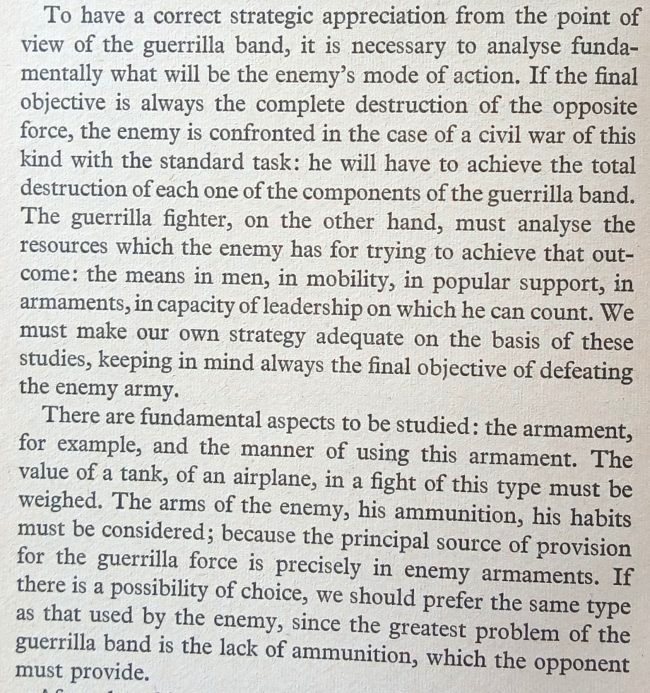
The need to capture ammunition also applies to most of the guns and rifles used by a guerrilla band, it is far easier to obtain these from the enemy than try to smuggle armaments in from outside, it also means that the ammunition is the same thus largely getting round the difficulties of supply. The section I have included below makes the distinction between a revolutionary and a terrorist in that a terrorist is indiscriminate in his targets unlike the more focused revolutionary. In another section Guevara also dismisses gangs of bandits as preying on the poor population whilst the revolutionary is there to support them, although he admits that the guerrillas will need food and clothing which the peasant agrarian economy must provide as they are the only practical source. But he explains that whenever possible this should be paid for either with cash or promissory notes which should be honoured as soon as possible. How likely this is to actually happen isn’t explained.

It should be pointed out that Guevara had a reputation as a ruthless fighter and unforgiving disciplinarian, executing deserters from his troops. But none of this is mentioned in this work which, whilst not glorifying Guevara as he isn’t mentioned by name, is more a guide on how to operate a revolutionary force at least in the context of 1950’s/60’s South American environment, which is almost certainly why it is no longer in print and copies are so difficult to come by. It was an unexpectedly interesting read and I have deliberately not included some of the more specific sections on armaments and tactics in this review.
 Ramblings on my bookshelves