The Seventh Voyage – Stanislaw Lem

Polish author Stanislaw Lem is probably best known for his 1960’s science fiction masterpiece Solaris which has been adapted into a couple of films, in 1972 there was a Russian version and then fifty years later in 2002 James Cameron produced another in America. The Russian original is generally regarded as the better film although the latter is supposedly closer to the original book. This collection produced as part of Penguin Books 90th birthday celebrations consists of the short story ‘The Seventh Voyage’ (27 pages) along with a couple of short novellas, or longer short stories depending on how you define the categories, ‘Terminus’ (63 pages) and ‘The Mask’ (68 pages). I’ll review each one separately.

The Seventh Voyage

Well that was great fun, the story comes from a 1957 collection entitled The Star Diaries and despite being called The Seventh Voyage it is the first one in the collection which are different numbered journeys through space by Ijon Tichy as told by the equally fictional Professor Tarantoga. In this one Tichy encounters time loops after his spaceship is damaged and needing two people to effect the repairs decides to team up with one of his alternate selves to do the work. However all the various versions of himself seem to be a cross purposes and start fighting amongst themselves over who should have the one spacesuit to ensure that a future version can also have a suit on and also who can eat which bits of the limited rations.

Terminus

From Lem’s Book of Robots this story from 1961 is much more a ghost story rather than the humour of the first story although it is also clearly a work of science fiction. Pirx has just received command of an old spaceship and on first arrival at the spaceport was less than impressed with his ship with it’s visible rust internally and obvious patch jobs all over the place. Intrigued as to its history he searches for the ship’s log and finds out that the agent was not kidding when he said it was historic. In fact notorious would be closer to the mark as the ship was originally called Coriolanus and every space traveller knew that name and the disaster that befell it when it was caught in a meteor storm and so badly damaged that the crew were trapped in separate sections as the oxygen slowly ran out. All nineteen crew members died and the ship was assumed to be scrapped, but it was here, with its slapdash repairs to save money and barely capable of the run to Mars that Pirx had been assigned to do. Whilst exploring the ship after take-off Pirx notices that a pipe is vibrating and what is more it is doing so in Morse code and passing messages between the now dead crew calling for help as they slowly suffocate…

The Mask

This 1974 story can originally be found in the collection of Lem’s stories entitled Mortal Engines and we are this time in the realm of science fiction horror and it is a very strange but engaging tale. It is however very difficult to review without giving away the twists in the story, which is what the Wikipedia entry does within the first paragraph, you have been warned. The story starts with a nightmarish sequence where our first person narrator has no real idea what is going on or even who they are. This very quickly segues into what appears to be a regency royal ball, all crinolines and lace, but our narrator has no idea as to why she is there and still no clue as to their identity, is she recovering from amnesia, is she mad, or is there some other explanation? She is drawn to a mysterious stranger sitting alone in a window, but why and how can she know him better when she doesn’t even know herself? The explanation to these various questions is slowly revealed and the true horror of both their situations is a total surprise, unless that is you have sneaked a peek at Wikipedia, which I’m glad to say I only did to verify when this was first published after completing the story.

Although I knew the name Stanislaw Lem I have to admit that I hadn’t read any of his work before this book which was the main reason I bought a copy from this anniversary collection. I’m definitely going to read more, starting with Solaris of which I have seen the original Russian film version but never read the book.

Jonathan Wild – Henry Fielding

Born in 1707 Fielding was a barrister from 1740 and later as Chief Magistrate in London where he helped found The Bow Street Runners, the first British police force in 1749. Despite his legal career he was never good with money and had lived largely off his earnings as first a playwright, since 1728 and then as one of the first novelists in English. His first two published novels, ‘An Apology for the Life of Mrs. Shamela Andrews’ (published 1741) usually known just as ‘Shamela’ and ‘The History of the Adventures of Joseph Andrews and of his Friend Mr. Abraham Adams’ (published 1742) were both parodies of fellow early novelist Samuel Richardson’s ‘Pamela’ and also show his weakness for overlong titles, indeed this, his third novel is more properly entitled ‘The Life and Death of the Late Jonathan Wild, the Great’ and was first published in 1743. His most famous work is ‘The History of Tom Jones, a foundling’ (published 1749), which I also have but thought I would start with this earlier, and shorter, work as writers from this period can often be somewhat hard work.

Jonathan Wild was a real person and was officially paid as a ‘thief taker’ or someone who found and handed over criminals and their illicit gains to the authorities in return for a substantial reward. But in reality he was a criminal mastermind himself who would simply hand over those who had got on his wrong side or who didn’t pay a big enough bribe. The majority of the returned goods were from thefts Wild had himself either taken part in or had organised using his large gang, as it was simpler to get the reward than dispose of the goods any other way. Wild was eventually exposed and hung in 1725 and was almost immediately satirically fictionalised by writers such as Daniel Defoe and John Gay in his ‘The Beggars Opera’, the target of the satire was not Wild but the Prime Minister Robert Walpole with Wild taking his place in the various works and this was widely understood by the public. This is also the case in Fielding’s novel with Wild taking the title of The Great Prig (slang for thief) which would be immediately understood as Walpole as he was sometimes known as the Great Whig (the political party he was part of) and particularly desired the epithet ‘the Great’ to be applied to his name. The image below is of the judge sentencing Jonathan Wild to his execution.

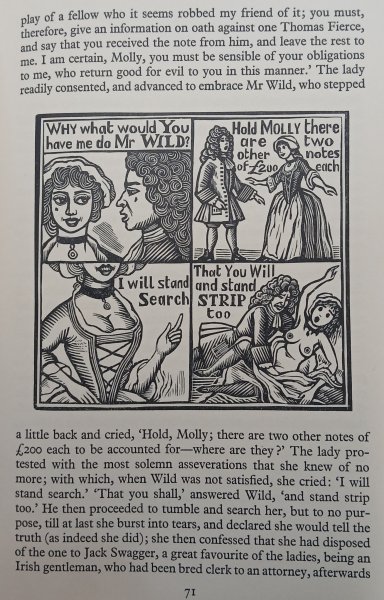
As explained above, the book is a satire of Robert Walpole but frankly after 275 years the allusions are lost on the modern reader, I for one have no idea as to what Walpole was getting up to that so upset so many writers at the time. It therefore is worth pointing out that after a slow start the plot fairly rattles along and you don’t need to know the intricacies of mid eighteenth century politics to enjoy the book. The version of Wild depicted in the book is a thoroughly unpleasant character to all that encounter him whilst appearing law abiding and pleasant to their face, as indeed was the real person, but Fielding did make the point that he invented a lot of the interactions to suit the plot. I have included one of the illustrated pages below to give you an idea of the story.

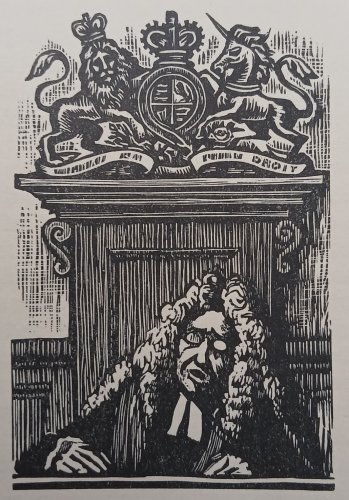
My copy is the 1966 Folio Society edition, which as it is a book with a slipcase rather than a dust wrapper, has attractive but somewhat nondescript covers, which is why I have used the frontispiece as the initial image. The wood engravings by Frank Martin have the feel of eighteenth century illustrations and fit beautifully with the book and with the bawdiness of the period. If you want to read the book for free in various different versions such as HTML online, as a Kindle file or as a PDF it can be found on Project Gutenburg here.

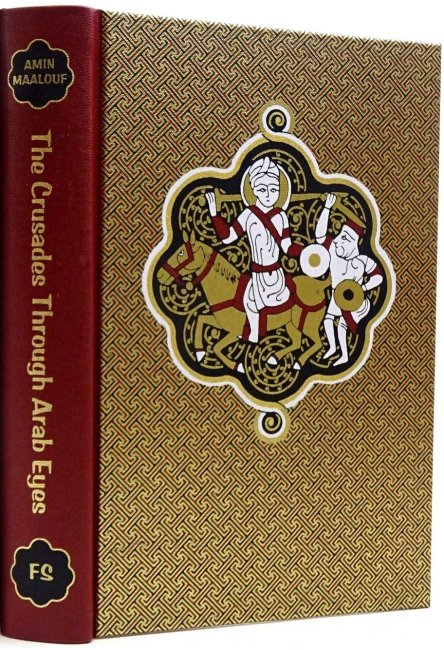
The Crusades Through Arab Eyes – Amin Maalouf

I’ve read several accounts of the Crusades but all from the perspective of the Christian west so it was fascinating to read this version from the Islamic side. The first thing you discover is that the invaders were not taking on established states, but rather what was mainly individually controlled cities and towns which were sometimes in loose alliances but more often were warring amongst themselves making them relatively easy prey for the more organised crusader forces. Certainly for the first hundred years or so of the crusader conflicts whenever an Islamic ruler died there would invariably not be a clear successor so internecine warfare would break out making the city and its surrounding territory ripe for conquest by not only the crusaders but also the neighbouring city states that were, in theory at least, on the same side. What the Islamic forces lacked was a leader that most of them would follow and this was why the crusaders found the invasion of the holy lands relatively easy in the beginning and with a couple of short lived exceptions this would be the case until the rise of the Kurdish officer Salah al-Din Yusef known in the west as Saladin, who had gone to Egypt with his father in 1173 as a young man despite having no appetite for warfare and ended up the effective ruler of Egyptian lands but still nominally under the control of Nur al-Din from Syria who had sent the army in the first place. The complex interrelationships between the various states and warlords with the added mix of a fanatical sect founded in the 1070’s by Hasan Ibn al-Sabbah who became known as the Assassins. Although these killers would operate independently they were often paid by various rivals, or even other family members to remove people in the way of their own rise to power. How these original assassins operated is described in the book.

Although the preparation was always conducted in the utmost secrecy, the execution had to take place in public, indeed before the largest possible crowd. That was why the preferred site was a mosque, the favourite day Friday, generally at noon. For Hasan, murder was not merely a way of disposing of an enemy, but was intended primarily as a twofold lesson for the public: first the punishment of the victim, and second, the heroic sacrifice of the executioner, who was called fida’I or ‘suicide commando’ because he was almost always cut down on the spot.

This constant warfare amongst the various states and cities lasted long into the Crusade period and the various parties rarely agreed on alliances to take on the invaders and when they did, at least initially had nothing that would allow them to ambush knights in armour as they had no equivalent defences so hadn’t developed weapons to defeat them. But the book is not all negative regarding the Islamic resistance there were leaders who could push back the Crusaders, at least temporarily, before Saladin and he had a bad habit, at least in a war leader, of being too merciful to those he defeated often simply sending them away, along with their armaments, leaving them free to attack again at a later date or surrendering territory in the hope of achieving a more lasting peace

The book is fascinating, especially if you have read any of the various western accounts of the period, I will be reading The Chronicle of the Crusades by Geoffrey of Villehardouin and Jean de Joinville at some point next year, the book is already on my shelves, and this will round off the overview of the Crusades I started with T.E Lawrence’s book on Crusader castles which I read at the start of this year. It’s a period of history I remember reading a lot about whilst at school both as set texts and independent study and this book has certainly given me a lot to think about with its alternative viewpoint.

The Man Who Died Twice – Richard Osman

Earlier this year I read Richard Oman’s first novel and thoroughly enjoyed it, so it really was only a matter of time before I got to the second one. This continues the story of the four residents of a senior citizens residential village who originally got together to discuss unsolved murders and have now moved on to solving various current crimes, invariably including murder but not exclusively. One of the things I really liked about this book was the development of the characters from their first adventure, we gain quite a lot of new information on everyone, especially former spy Elizabeth who we now know as Dame Elizabeth Best, the title implying that she was even more senior in the service that previously suggested and from other comments that she had a reputation as one of the finest in her field. Fiery ex trade union leader Ron gets to show his gentle side as his grandson comes to stay, as well as becoming a highly effective ‘field operative’ for the Club and Joyce is braver and more intuitive than previously expected, although still so innocent that she chooses a combination of an old nickname and the year her daughter was born giving @GreatJoy69 as her Instagram user name, fortunately she can’t work out how to access her private messages. Her diary is again used as a mean of filling in story as she can review the days occurrences it’s a clever use of first person narrative in largely alternating chapters throughout the book. Ibrahim, the semi-retired psychiatrist, gets seriously mugged and kicked in the back of the head early on in the book and this puts him off leaving the retirement complex, or even his flat there, for a large part of the book. But it also drives the others to come up with a way of exacting revenge on his mugger in a way only they, and certainly not the police, could.

The remaining three have their work cut out dealing with £20 million worth of diamonds, the American mafia, an international crime go-between, a drug dealer, Elizabeth’s old employer MI6 or possibly MI5 it’s not made clear, and even Elizabeth’s ex husband whom he hadn’t seen for twenty years amongst others. Like the first book the plot is fast paced, full of twists and turns and the body count is surprisingly high for a book about four pensioners. We also find out more about the two local detectives who seem to have been seconded by the Club, Donna and Chris; along with the ever useful Polish builder Bogdan who has certainly gone up in the world since he killed off his main local rival in the first book and therefore got a lot more lucrative work. The book is full of humour as well, again not laugh out loud jokes, but humour nevertheless, it really is a fun read which is probably why less than twenty four hours after starting a 444 page book (I have the Waterstones edition with the extra chapter) I have finished it and am writing this blog.

The fifth book in the series came out last month and is of course already a bestseller, it seems that Osman can do no wrong with his septuagenarian detectives, although Ibrahim at least is now in his eighties and I hope to read many more books about them all. By the way I checked out the Instagram account and it is registered as belonging to Joyce Meadowcroft from the book, well done Richard Osman or possibly Penguin Books for not only having the account but posting pictures of her dog Alan and trips out exactly as I would expect Joyce to do. Much more sensible than Douglas Adams who used his own phone number in the first Hitch-hikers Guide to the Galaxy book and had to get his phone number changed when people started ringing it.