
Born in 1707 Fielding was a barrister from 1740 and later as Chief Magistrate in London where he helped found The Bow Street Runners, the first British police force in 1749. Despite his legal career he was never good with money and had lived largely off his earnings as first a playwright, since 1728 and then as one of the first novelists in English. His first two published novels, ‘An Apology for the Life of Mrs. Shamela Andrews’ (published 1741) usually known just as ‘Shamela’ and ‘The History of the Adventures of Joseph Andrews and of his Friend Mr. Abraham Adams’ (published 1742) were both parodies of fellow early novelist Samuel Richardson’s ‘Pamela’ and also show his weakness for overlong titles, indeed this, his third novel is more properly entitled ‘The Life and Death of the Late Jonathan Wild, the Great’ and was first published in 1743. His most famous work is ‘The History of Tom Jones, a foundling’ (published 1749), which I also have but thought I would start with this earlier, and shorter, work as writers from this period can often be somewhat hard work.

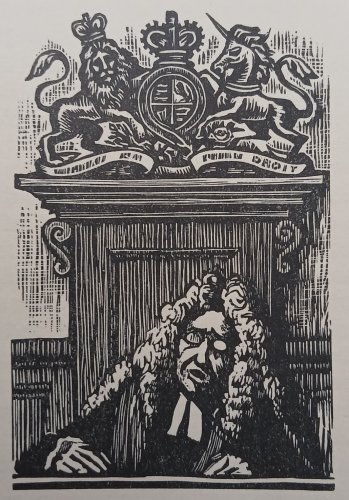
Jonathan Wild was a real person and was officially paid as a ‘thief taker’ or someone who found and handed over criminals and their illicit gains to the authorities in return for a substantial reward. But in reality he was a criminal mastermind himself who would simply hand over those who had got on his wrong side or who didn’t pay a big enough bribe. The majority of the returned goods were from thefts Wild had himself either taken part in or had organised using his large gang, as it was simpler to get the reward than dispose of the goods any other way. Wild was eventually exposed and hung in 1725 and was almost immediately satirically fictionalised by writers such as Daniel Defoe and John Gay in his ‘The Beggars Opera’, the target of the satire was not Wild but the Prime Minister Robert Walpole with Wild taking his place in the various works and this was widely understood by the public. This is also the case in Fielding’s novel with Wild taking the title of The Great Prig (slang for thief) which would be immediately understood as Walpole as he was sometimes known as the Great Whig (the political party he was part of) and particularly desired the epithet ‘the Great’ to be applied to his name. The image below is of the judge sentencing Jonathan Wild to his execution.
As explained above, the book is a satire of Robert Walpole but frankly after 275 years the allusions are lost on the modern reader, I for one have no idea as to what Walpole was getting up to that so upset so many writers at the time. It therefore is worth pointing out that after a slow start the plot fairly rattles along and you don’t need to know the intricacies of mid eighteenth century politics to enjoy the book. The version of Wild depicted in the book is a thoroughly unpleasant character to all that encounter him whilst appearing law abiding and pleasant to their face, as indeed was the real person, but Fielding did make the point that he invented a lot of the interactions to suit the plot. I have included one of the illustrated pages below to give you an idea of the story.
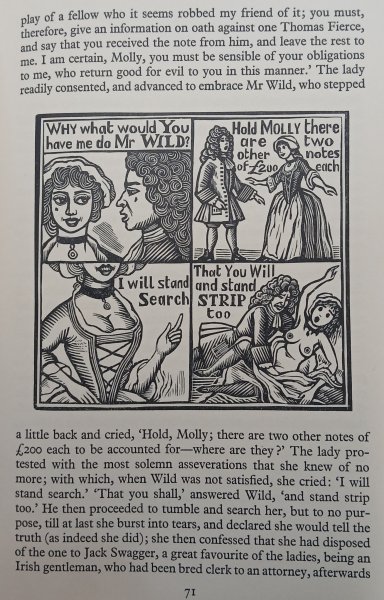
My copy is the 1966 Folio Society edition, which as it is a book with a slipcase rather than a dust wrapper, has attractive but somewhat nondescript covers, which is why I have used the frontispiece as the initial image. The wood engravings by Frank Martin have the feel of eighteenth century illustrations and fit beautifully with the book and with the bawdiness of the period. If you want to read the book for free in various different versions such as HTML online, as a Kindle file or as a PDF it can be found on Project Gutenburg here.
 Ramblings on my bookshelves