A series of essays inspired by books that I own, talking about their history, some reviews and also how they came to be on my shelves. With over 6,500 books here and several more arriving each week I doubt I'll ever be short of a topic.
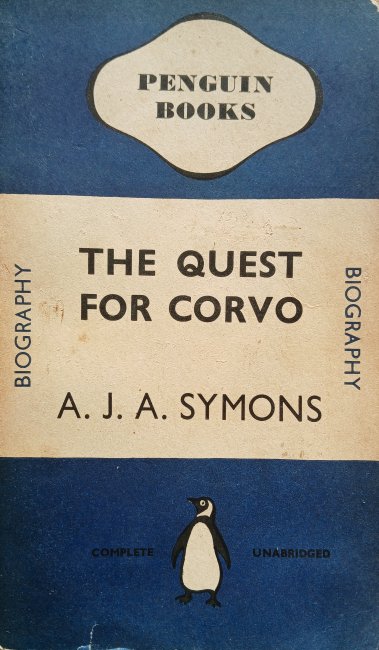
Following on from last weeks Christmas book of a hundred letters from the somewhat mysterious Frederick Rolfe, who styled himself as Baron Corvo, to publisher John Lane, this book tries to get to understand the man as much as is possible. Symons had developed his interest in Corvo following a visit to Christopher Millard in 1925 when Millard asked him if he had read ‘Hadrian the Seventh’, a book that Symons had never heard of by an equally unknown author Fr. Rolfe. Unusually Millard lent him his copy, he rarely let his books out of his home, and Symons read the novel and then in astonishment read it again. How could such an extraordinary book have escaped his attention and why had he never heard of the author, presumably a Catholic priest by his name, writing about a poor Englishman who unexpectedly rises to the papacy after the cardinals are unable to agree on a candidate amongst them at the conclave. This is theoretically possible as there is nothing in the rules around the selection of a Pope that says he has to be one of the cardinals tasked with making the choice. I haven’t yet read ‘Hadrian the Seventh’ myself but Symons’ enthusiasm for it suggests that I will hunt down a copy and read it before long, just checked and it is available as a Penguin Classic with the author given as Frederick Baron Corvo (Fr. Rolfe) and here we get to one of the problems with Symons study of the author, his regular changing of the name he is known as depending on circumstance. For consistency I’m going to normally refer to him as Corvo as that is how I first came across him and it is the name he is nowadays best known as.
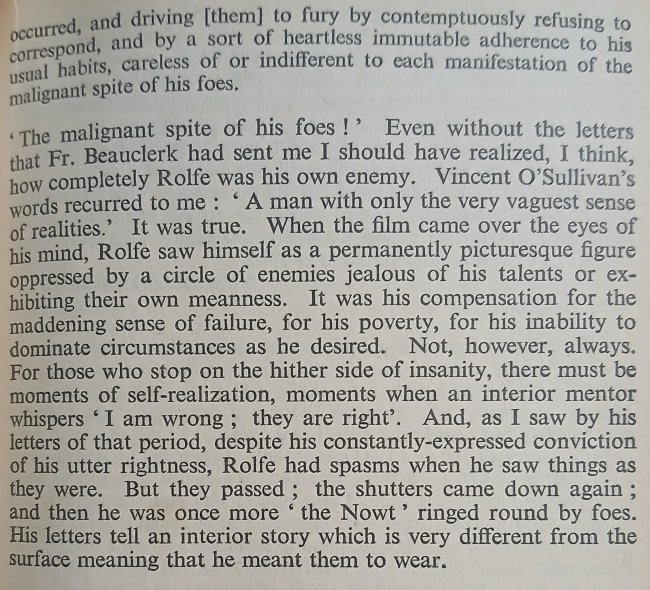
It soon became clear to Symons that Corvo was dead but not long ago and many of his correspondents and also his brother were still alive and this is where Symons starts. The biography is unusual in that for the first two fifths of the narrative it is told as almost a detective story with Symons following leads and describing how he progressed from one to another rather than a finished biography where we would get a fully researched story from the beginning. I rather enjoyed this style and missed it when it was abandoned around the time Corvo first met John Lane, but as Symons explains it was getting rather too complex by then with more sources becoming available and a fuller picture appearing of the strange Baron Corvo a man who seemingly cultivated enemies everywhere, usually from the very people who were trying to help him and indeed had helped him until he took umbrage at some perceived slight or other. The following passage gives some idea of the man Symons was starting to reveal.
The picture you get from the numerous letters included in this book is a man probably suffering from an un-diagnosed persecution mania, nothing that happens is ever his fault it is entirely caused by malignant outside influences and his ever growing list of enemies who are determined to keep him down. He also has a gross overestimation of his own works worth, for example whilst living rent free in Wales he starts work on a series of paintings and banners for the local catholic church, originally as payment for his free lodging but gradually he ‘forgets’ the charity he is living off and demands payment for his work and what’s more the sum required is far above the value of what he has done at £1,000 (well over £100,000 today) when he is offered far less, the still generous £50 (£5,300) he refuses and starts spreading malicious stories regarding his then benefactor in the local press. The sum of £1,000 occurs several times in this book regarding Corvo’s valuation of his works and sometimes he manages to convince others and uses this figure as surety against loans which he has no means of paying back. To know Corvo even for a short time would often prove expensive and end up at the receiving end of vitriolic usually libellous letters.
This paints the man in a negative way, and he regularly deserves it, but by all accounts before the inevitable break down of a friendship he would be a fascinating companion with much apparent erudition whilst not able to understand the limits of his own learning. For instance he once agreed to work on a Greek translation whilst having little knowledge of the language and intended to drag the work through textbooks and piece together what he understood to be the meaning. The Rubaiyat mentioned in the previous blog entry apparently did actually appear but sold badly as it was a poor translation, unsurprisingly as Corvo knew absolutely no Persian and yet still undertook the translation.
Corvo died in Venice in 1913, where he was living on credit and piling up even more debts, a lot of which were settled by his brother when he came out to oversee his burial. He was without doubt a fascinating character which I would have loved to have met, whilst remembering to never lend him money, and this book by Symons does its best to be fair to the man showing his positive aspects whilst not shying away from his self destructive negative features.
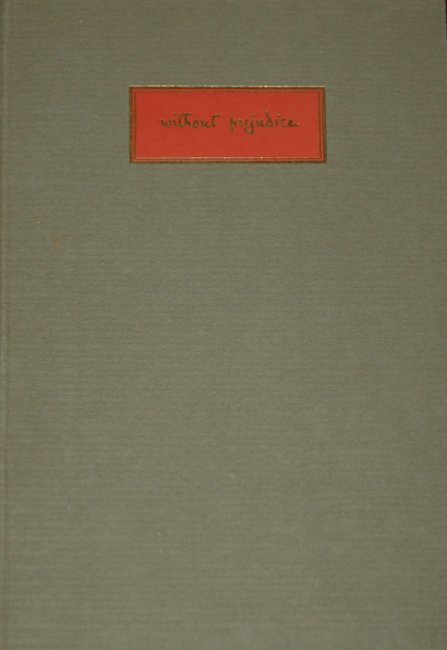
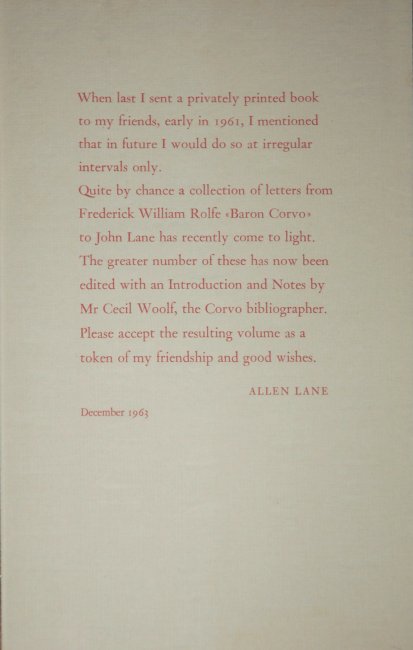
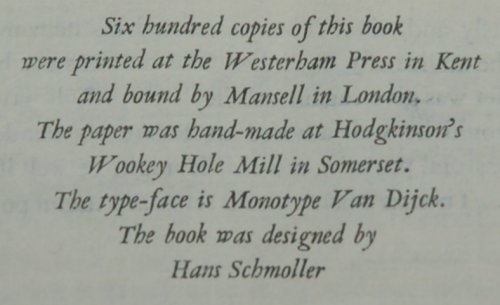
Another of the Allen Lane Christmas books is my featured work for Christmas week. This time the book consists of one hundred letters from the self styled Baron Corvo to John Lane, the founder of The Bodley Head Press. It was sent as a very limited gift of just six hundred privately printed copies in 1963 as can be seen from the enclosed sheet of paper from Allen Lane which is reproduced below.
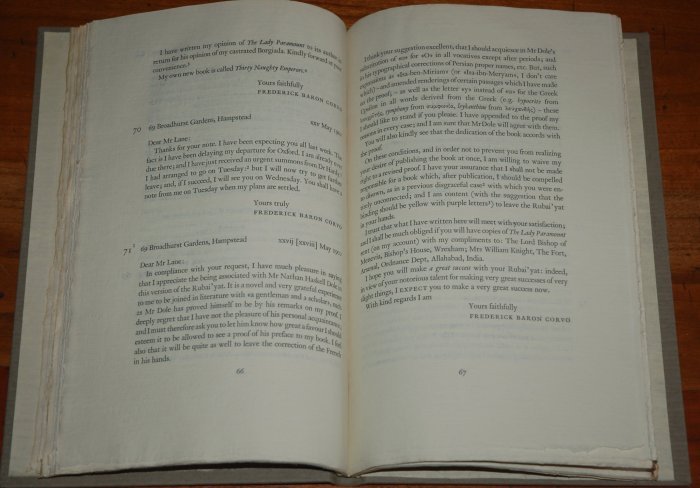
The paper for the book is hand-made with the distinctive ragged edges that such sheets often have if not trimmed which gives the book a lovely look and feel and it would be a pleasure to read is it wasn’t for one issue which I have mentioned before about another book. That is that the very helpful notes are all combined at the end so the reader is forced to use two bookmarks or repeatedly thumb through the pages looking for information. That these notes are necessary is due to the elusiveness of Corvo himself and the fact that what he did write about himself is not to be trusted, so you are regularly searching for context within the letters.
Frederick Rolfe aka ‘Baron Corvo’ was a strange and difficult to pin down person. He claimed the title from time he spent in Italy with an Italian nobleman who apparently granted him the name Baron Corvo but this is probably not true. That he had talent as a writer and artist is however undisputed but often his abrasive and wildly changing personality caused conflicts with those whom he most needed for support and he definitely endured considerable periods of hardship. Looking back over more than a century he is fascinating but not somebody I would have wanted to have anything to do with.
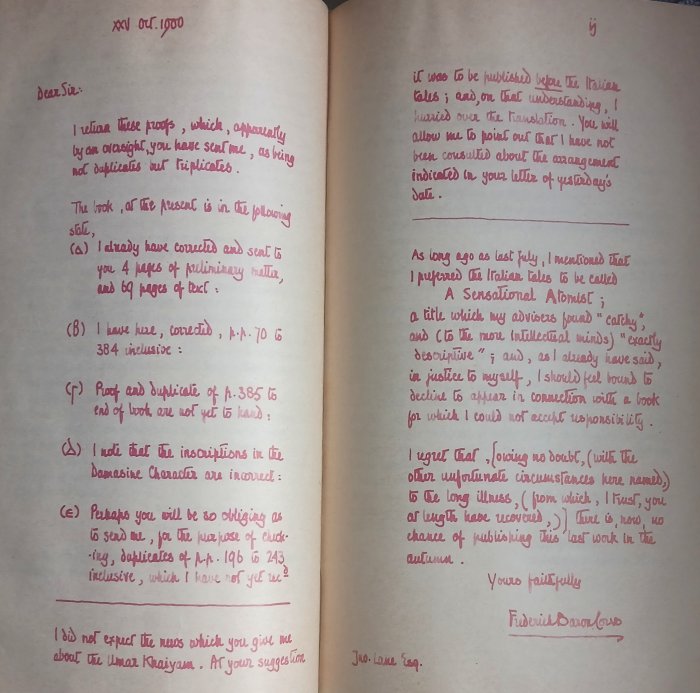
The book includes two of the letters as facsimiles, including the example below where you can see his bold handwriting but also his odd choice of red ink for correspondence. Indeed Corvo used a wide selection of coloured inks for his letters and if all the letters had been in facsimile the book would have been a positive rainbow.
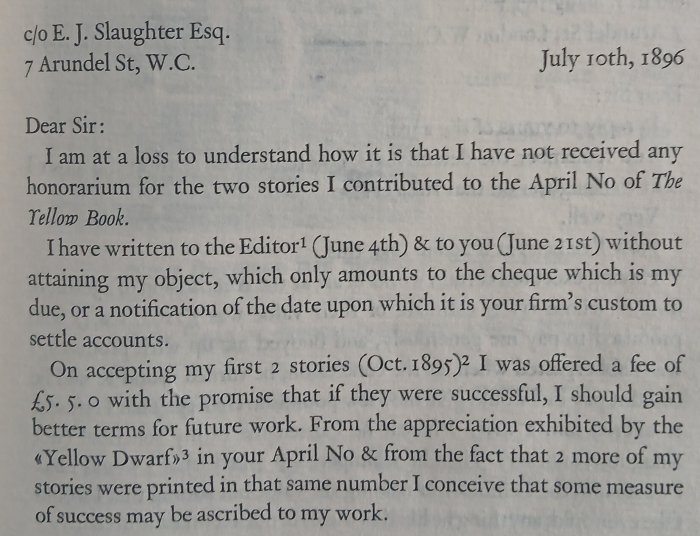
But let’s get to a proper selection of the letters which concern initially possible printing of more of Corvo’s ‘Stories Toto Told Me’ tales, several of which had been well received when published earlier in volumes seven and eleven of ‘The Yellow Book’, which was a Bodley Head i.e. John Lane publication. Over the years a possible illustrated edition of the Rubaiyat of Omar Khayyam was also mooted and the letters become more concerned with that. As the book is rare I have included a few letters so you can get to have a feel for the man, beginning with this letter chasing payment, and all too familiar theme in all of Corvo’s correspondence, from July 1896.
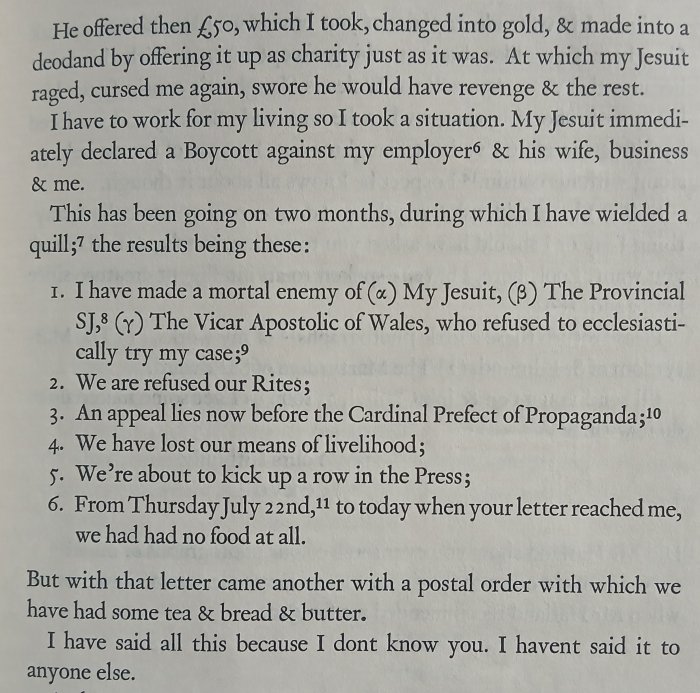
A year later, July 1897, and this is the second half of a letter which is happier in that he had received payment, which he had then given away principally in order to annoy the priest that gave him the money. I will go into more about what had happened here and some of the basis of his feuding with religious authorities next week when I dig more into the man behind these letters.
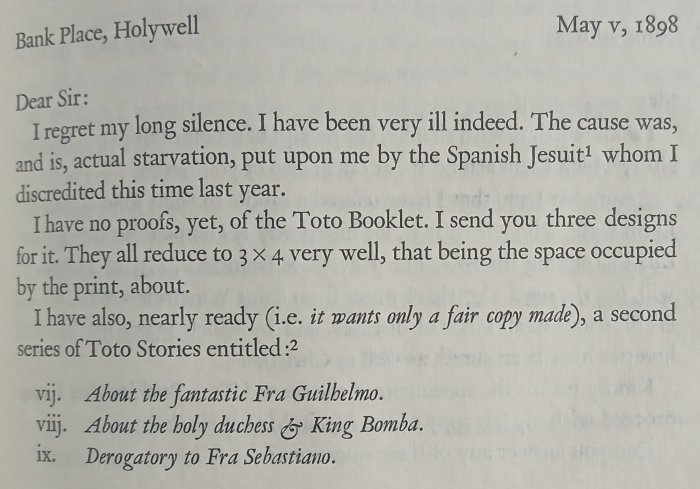
By May the following year Corvo was still in dispute with the church in Wales, but is also still trying to follow up what is happening with his Toto stories and is getting increasingly frustrated with Lane’s lack of replies to his numerous letters. It should be noted that a long silence from Corvo would only be a matter of weeks as he was a prolific sender of letters.
The next letters I have chosen from the hundred in the book are three years later, from 1901 where we see the first of numerous chases for what is happening with the Rubaiyat but also in the second one here a firm statement of his intention to remain private. It is this secrecy, and indeed the choice of different names he would use not just in print but whilst living in locations where he wasn’t already known, that makes tracking down Corvo and what he was actually doing from time to time so difficult.
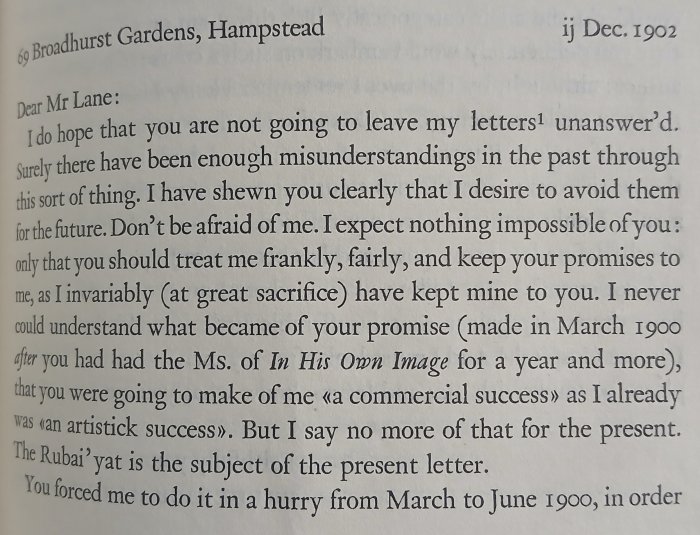
The start of the next letter, December 1902 has the familiar complaints of lack of response and more chasing of the Rubaiyat, I don’t think this was ever published however. In Lane’s defence he was known to be poor at replying to letters and the sheer number he was getting from Corvo was likely to make him even less prone to keep up a two way correspondence.
Finally I have chosen this letter from 1903 which is one of the sources of the title of this book, he uses the phrase ‘without prejudice’ several times whilst in disputes on various occasions.
So there it is, an unusual book for Christmas giving an insight into a distinctly unusual person published fifty years after his death. But who was Frederick Rolfe, aka Baron Corvo, aka Frank English, aka Frederick Austin, aka Fr Rolfe (giving the deliberate impression he was in the priesthood), aka ‘A Crab Maid’ etc. well more will be revealed next week when I review ‘A Quest for Corvo’ by AJA Symons.
As I’ve covered before, 2025 marks the ninetieth birthday of Penguin Books, and regular readers of this blog have no doubt realised I am a keen collector of this publisher. There are many different ways to collect Penguin books and one popular way is to collect the first five hundred, or first thousand, or if you really have the space then the first three thousand main series titles (those generally recognised as Penguins). This co-incidentally is pretty well all the main series books published by them from when they started in July 1935 up to the introduction of ISBN and the loss of the distinctive numbering system so it is a satisfying, if bulky, target to aim at. There are problems with this though as quite a few of the wartime titles, especially the crime fiction, are now very expensive, so I’ve been thinking about what I would do if I was starting now and one possibility is the Penguin Millions. These are a subset of the Penguin titles and importantly the first ‘million’ came out in 1946 so the scarce wartime crime titles can be avoided. But what is a Penguin Million and how many are there?
The first million has an explanation of the concept on the inside, in this case George Bernard Shaw had reached his ninetieth birthday in July 1946 and to mark the occasion Penguin simultaneously printed a hundred thousand copies of each of ten books. Nine of these were new to Penguin (books numbered 500 along with 560 to 567) and there was one reprint, Pygmalian (numbered 300 and originally printed in September 1941). Nowadays I doubt a million books by Shaw would sell very well but back then he was still a popular author and his works are regularly found in early Penguin lists and these titles were soon being reprinted again..
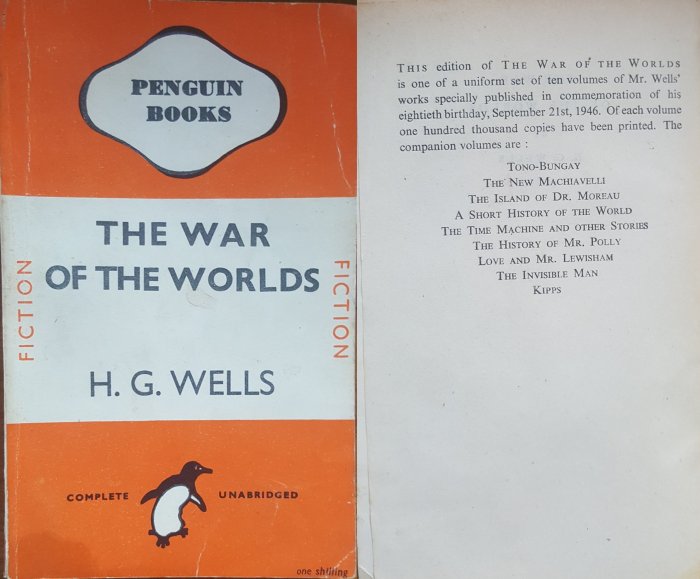
The idea obviously sold well enough for somebody at Penguin to decide that this was a good idea and the second million soon followed a couple of months later in September 1946 and this time the author featured was H.G. Wells
This time there were three titles reprinted as part of the set, A Short History of the World (Pelican A5 original May 1937), The Invisible Man (151 original August 1938), Kipps (335 original November 1941), with the remaining seven books being numbered 570 to 576 and coming out together in September 1946. Maybe these didn’t do as well as Penguin though they would as there was then a gap of a couple of years before they had another go and this time it was the sure fire winner Agatha Christie,
Published in August 1948, this time all ten books were new to Penguin so they had the consecutive numbers 682 to 691. Considering that a hundred thousand copies of each were printed Murder on the Orient Express as part of the Christie Million is surprising awkward to find and is probably the only book featured in this list that would be a real challenge to locate. Although tracking down some of the correct reprints for other titles can also be tricky, as they are rarely advertised as being part of their respective ‘millions’ when searching online but you can always tell if it is correct edition as it will have the page explaining about its part of the set.
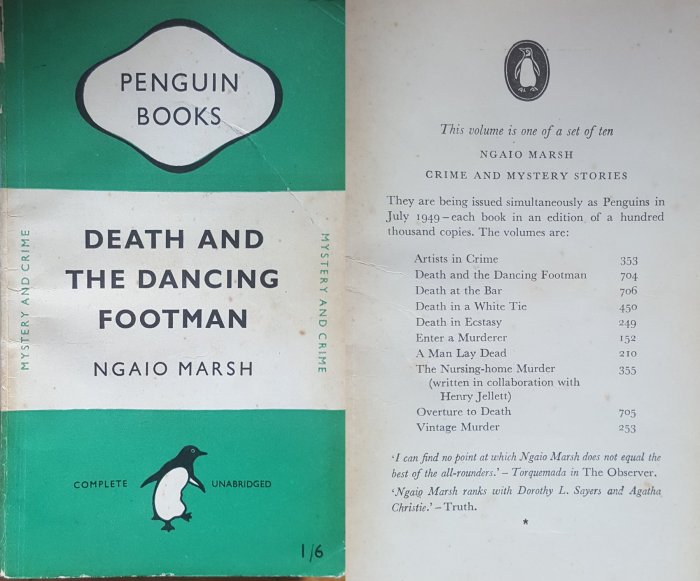
Another eleven months passed and it was time for another crime writer to be featured, this time New Zealander Ngaio Marsh.
This time Penguin have made it easy for me and given the respective numbers in the Penguin catalogue in the listing. As you can see only three titles were new to Penguin (numbers 704 to 706 published July 1949) with the others going back as far as Enter a Murderer (152 – August 1938). This is where the financial advantage of collecting the ‘millions’ editions comes into its own as Death in a White Tie would sell for well over £500 and possibly getting on for £1000 as the March 1945 Penguin first edition whilst the reprint for the ‘million’ is only a few pounds. This reprint is also a Penguin oddity as the floor plan of the house where the murder took place is missing from this edition and was incorrectly included in 704 Death and the Dancing Footman. Both books are therefore somewhat confusing for readers, one for the lack of the diagram which makes placing the action more tricky, and the other for an included plan of a house that bears no relation to the plot.
The next million was in March 1950 and we leave the world of crime in favour of a somewhat more challenging read, D.H. Lawrence to mark the twentieth anniversary of his death.
As can be seen five of the books chosen were ‘double volumes’ marked with an asterisk in the list above, i.e. books of significant length and were therefore more expensive than the standard paperback at the time, which retailed at one shilling and sixpence (7½ pence), these longer books were two shillings and sixpence (12½ pence). Kangaroo for example is 594 pages. All of the books were first printings by Penguin nine of which are 751 to 759. The original plan was for 760 The White Peacock to be included in the ten books but production issues meant that this wasn’t ready for publication until August 1950 so the collection of poems (D11) was issued instead, which, along with the separate volumes of letters and essays, I think gives a wider overview of D.H. Lawrence’s work as part of this collection.
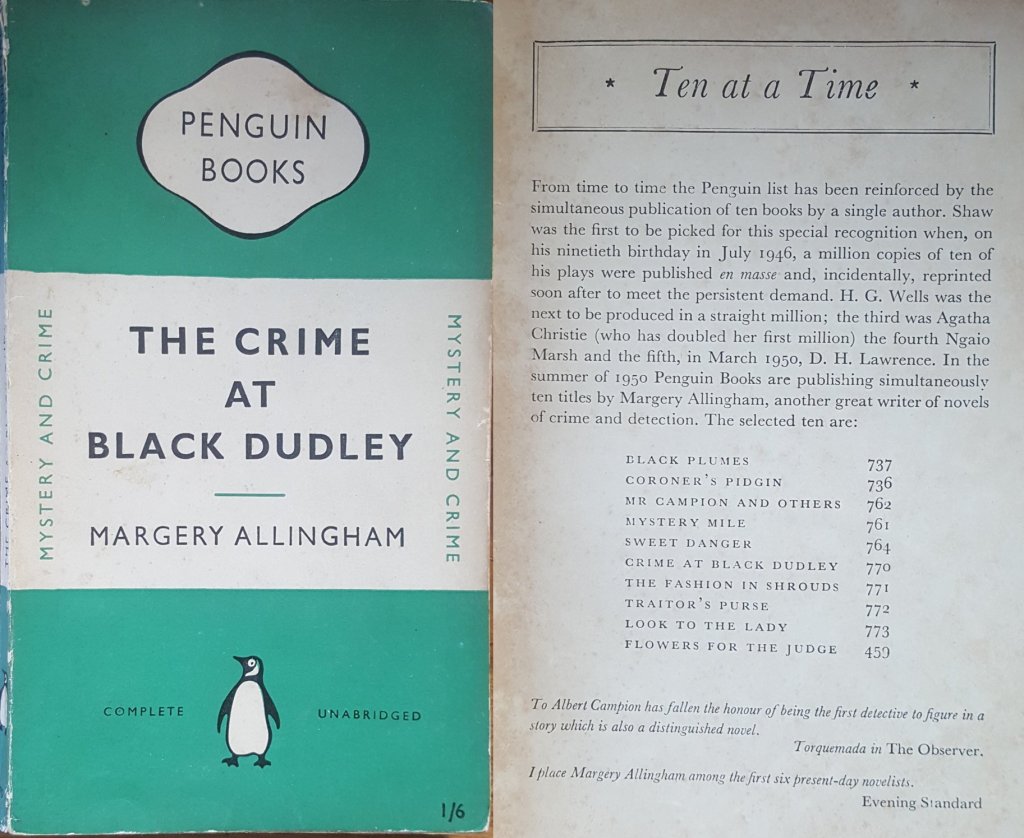
After the erudite literature of Lawrence it was back to crime for the next Penguin million. This time Margery Allingham in June 1950.
The only reprint is another wartime crime rarity 459 Flowers for the Judge (originally June 1944) all the others, despite the apparently random numbers, all first appeared as a UK Penguin in June 1950. The one oddity is 737 Black Plumes which had first been printed by Penguin USA Inc as number 534 in December 1943 and is another difficult to find wartime first Penguin printing, especially on this side of the Atlantic.
Next comes Evelyn Waugh whose ‘million’ came out in May 1951.
This time there are five titles new to Penguin (821 to 825) with five reprints Decline and Fall (January 1937), Vile Bodies (April 1938), Black Mischief (November 1938), Put out More Flags (October 1943) and Scoop (March 1944). There’s a nice potted bibliography along with the list of books in the listing. I’ve always quite liked Evelyn Waugh although he does seem to be a lot less well known nowadays. I also like the fact that his first wife, although only for one year as she had another relationship with John Heygate at the time, was also called Evelyn, just imagine the confusion when guests called.
We then start a run of three crime novelists before the ‘millions’ peter out and next comes Carter Dickson in June 1951.
Again we have ten new titles, consecutively numbered 811 to 820 and all by Carter Dickson, who also wrote under his real name John Dickson Carr as well as Carr Dickson and as a real wildcard once as Roger Fairbairn. Fortunately his ingenuity with plots is far better than his imagination with pseudonyms and the missing photograph on the back cover with it’s accompanying blurb regard anonymity fooled nobody. However regarding the use of the back cover here, I have had to do this as, due to a compilation error, all ten of the books actually have the Evelyn Waugh ‘millions’ description inside them instead of one for Carter Dickson. Almost all the books he wrote under the name Carter Dickson feature the elderly amateur detective and barrister Sir Henry Merrivale and that is certainly the case with the ten books in this collection. I personally prefer the Dr Gideon Fell stories he wrote under his actual name although that possibly because I came across him first. Each of these detectives have around a couple of dozen books dedicated to them and the Merrivale books certainly have much to recommend them.
The next million goes to Belgian George Simenon and his legendary detective Maigret and these were published in January 1952.
Simenon is invariably though of as French like his most famous creation Jules Maigret, as Penguin do so in the introduction above, and he did live for a lot of his life in France along with a decade or so in America after WWII. There are seventy five Maigret novels and numerous short stories but even the novels are quite short so Penguin tended to publish two per book. The collection came out as two blocks of numbers 826 to 830 and 855 to 858 which count for the nine new to UK Penguin Simenon titles in the ‘million’ there was also a reprint 739 A Battle of Nerves & At the ‘Gai-Moulin’ (originally January 1950). Yet again we have a book that was first printed in America as a Penguin Inc publication, Maigret Travels South which first appeared under the Penguin logo in New York as 564 (September 1945). The works of Simenon have a very chequered history with Penguin with many volumes being announced but never actually being published.
Where do you go after the classic Maigret novels well there can only be one choice and the only author to have multiple ‘millions’ it’s Agatha Christie again, this time in May 1953.
This time Agatha Christie chose the ten titles herself and oddly one of them had already appeared in the first Christie million so we have nine books (924 to 932) printed by arrangement with Collins which are first appearing in Penguin along with The Murder of Roger Ackroyd which had first been printed by Penguin as 684 in the first Christie million in August 1948. Technically all ten of these books are a first edition as each includes a new introduction written by Agatha Christie for this printing.
And that was it for the printing of ‘millions’ but there was one final addendum and that was for Arnold Bennett
This time there were only six books issued at the same time and no suggestion that a hundred thousand copies of each were being printed. Two were reprints Anna of the Five Towns (33, March 1936) and The Grand Babylon Hotel (176, November 1938) along with four that were new to Penguin (996 to 999) and as can be seen there were various issues with copyrights in Canada and the USA.
So where does that selection of eleven sets of publications within the first thousand bring us, well there are 106 (105 if you don’t want Roger Ackroyd twice) books to search for, eleven largely readable authors, both Bennett and Shaw I have to be in the mood for, and a pretty decent fiction library from the end of the 19th century through the first half of the 20th. Plenty of easy reading crime and other novels with some more taxing works but none that should put off a dedicated reader. It is also a manageable task to accumulate all of these without the bank account straining issues that can face a collector of a complete numeric run. I have been collecting Penguin for over thirty years, although I only really started taking the main series seriously in the last dozen or so as I mainly concentrated on the more obscure aspects of their output. But I’m still missing fourteen books out of the first six hundred even after twelve years and I’m only very very slowly filling in the gaps.
There are many more blocks of books by one author after number 1000, but as I don’t collect them I cannot pull them off the shelves to check to see if any of these are designated as ‘millions’. Examples include six books by Aldous Huxley numbered 1047 to 1052 published in April 1955, eight books by C.S. Forester numbered 1112 to 1119 published in January 1956 (1111 is also by Forester but came out two months earlier), and nine books by John Buchan numbered 1130 to 1138 which were published in May 1956. Maybe collecting the ‘millions’ is the way ahead.
Snorri Sturluson (1179–1241) was born in western Iceland, the son of an upstart Icelandic chieftain. In the early thirteenth century Snorri rose to become Iceland’s richest and, for a time, its most powerful leader. Twice he was elected law-speaker at the Althing, Iceland’s national assembly, and twice he went abroad to visit Norwegian royalty. An ambitious and sometimes ruthless leader, Snorri was also a man of learning, with deep interests in the myth, poetry and history of the Viking Age. He has long been assumed to be the author of some of medieval Iceland’s greatest works, including the Prose Edda and Heimskringla, the latter a saga history of the kings of Norway.
This version of the Prose Edda is not complete. as although The Prologue is all there, as is Gylfaginning, only a selection of ten tales from Skáldskaparmál are included and the lists giving word definitions and origins at the end of this section are omitted entirely as is The Háttatal which is a discussion on the composition of traditional poetry, which is more of a technical handbook on this verse structure and is quite commonly left out of translations. This abridgement of the Prose Edda is therefore a more readable text than the full scholarly manuscripts believed to be composed by Sturluson. The name ‘The Prose Edda’ is used to distinguish this work from the earlier verse forms of similar material known as ‘The Poetic Edda’.
It is probably best to look at the three sections separately beginning with ‘The Prologue’. This was a real surprise to me as it initially reads like a variant of the Old Testament with Adam and Eve along with Noah’s ark referred to in the first page and there is a lot of naming of sons of sons of sons to illustrate how the generations have passed. We then suddenly leave the Old Testament in favour of Homer as Odin is named as coming from Troy and travelling north from that city and Asia or at least that part of the continent known at the time and specifically Turkey is seen as the origin point for the Norse gods and name of the Æsir, which is the main group of these that reside in Asgard, is implied to be derived from Asia which is a concept I have not come across before. ‘The Prologue’ is short but full of surprising elements like this.
On to the Gylfaginning (Old Icelandic for ‘The tricking of Gylfi’). This is in the style of a conversation between the Swedish King Gylfi and three men on thrones in Asgard called High, Just-As-High, and Third. Gylfi asks many questions of the three men on the history and future of the Æsir and from this we learn the names and attributes of the gods and goddesses with tales of their exploits, some of which I knew and others were new to me. The tales start with the creation of the Earth and all that live on it along with the rise of the gods and take us right through to Ragnarok, the great battle and the death of most of the Æsir along with those that had opposed them such as the world girdling Midgard serpent. The text quotes extensively from The Sybil’s Prophesy which I take to refer to Völuspá, a Norse poem which forms part of The Poetic Edda, and there are other poetic sections quoted in Gylfaginning which are also to be found in this ancient collection of verse.
Then finally the Skáldskaparmál (Old Icelandic for ‘The language of poetry’), The ten stories included in this selection are extremely bloodthirsty with barely a page between the death of one or more characters but it was interesting and unexpected to find the basis for Wagner’s retelling of the Ring of the Nibelung which I read recently. There is the Valkyrie Brunhilde, the fire surrounding her which could only be crossed by a hero and Sigurd who is clearly the basis of Siegfried. There is also Fafner, although here a serpent rather than a dragon although these are largely interchangeable in Norse sagas, the Rhinegold hoard and a ring which brings doom to all that possess it.
Anyone interested in the Icelandic Saga tradition should definitely read ‘The Prose Edda’ and I’m surprised it has taken me so long to get round to doing so. This book is from the Penguin Archive collection of ninety books to celebrate Penguin Books ninetieth birthday in 2025.
By writing this book, which was published in 2010, Ben Collins effectively called an end to his time as The Stig on BBC television’s Top Gear as his contract required him to be anonymous. He was quietly replaced by Phil Keen after the end of series fourteen and Keen continued to set lap times and coach celebrity drivers whilst wearing the white suit until Top Gear came to an end in 2023. To be fair to Collins his identity was becoming known through 2009 and was being hinted at in newspapers just as Perry McCarthy had been revealed as the original ‘Black Stig’ (so called as he wore an all black racing outfit) in 2003 but that didn’t stop the BBC pursuing a legal case to try to stop publication of this book.
The first chapter details Collins’ ‘interview’ for a role he hadn’t been told about, just being asked to go to Dunsfold Aerodrome and do some circuits. He had no idea that Dunsfold was where Top Gear was filmed, as that didn’t become general knowledge until much later, and he didn’t know the shows producer, Andy Wilman, who did the timings so it was a very strange day for a racing driver, just driving a not very good car around an airfield and not being told why. He didn’t hear anything for several months so assumed that whatever it was for hadn’t happened. The book then leaps backwards with Collins growing up and his father was always attracted to fast cars and driving although never as a racer so you can see where he got his love of speed. The story continues with his first forays into racing and the fact that he never raced in Formula 1, but got as close as being offered a test driver role but the team wanted him to put up £1.5 million as his way in which he clearly didn’t have access to. Instead he raced at Le Mans and Daytona in various formats including the GT championship, ASCAR (the European answer to NASCAR) which he won the championship in 2003 in his first year as The Stig and competed in Formula 3.
Collins was also a member of the British Army and interestingly the book covers his training and physical endurance testing to become a member of the Parachute Regiment in parallel with his early days as The Stig, eventually after four years in the army he had to quit as his work as The Stig and racing at circuits around the world didn’t allow for his time in the forces. He then increased his time racing and also became a stunt driver, particularly for the James Bond films although I was quite surprised that quite a few of the segments for Top Gear where The Stig appeared but didn’t actually do any driving were still filmed by him as frankly anyone could have stood in for him on the episode where they raced across London using different modes of transport with The Stig using the Underground and buses. It’s a really good autobiography and the 323 pages flew by but the paperback is rather annoying as at the back it includes acknowledgements for the photographs which were presumably in the hardback but which were removed for the paperback edition.
On the 30th November 2025 Collins and Wilman appeared in a Youtube video where they are talking about Wilman’s new autobiography but they keep hinting that they are going to deal with the publication of ‘The Man in the White Suit’ and finally at about 38 minutes in they address the various issues and the court case. However the entire video is well worth watching and can be seen here.
If the title feels familiar then you are remembering an Ealing Studios satirical comedy film made in London and Burnley in 1951 starring Alec Guinness as a scientist who invents a pure white fibre that never wears out or gets dirty, in fact it cannot even be dyed. To promote the material he has a suit made but eventually it dawns on people that an indestructible garment that doesn’t need to be cleaned would bankrupt the textile industry as nobody would need to buy any more clothes once they had a few items and he is pressured to abandon the invention. Even the book jacket reflects the aesthetic of the original film poster with its red and black background.







 Ramblings on my bookshelves