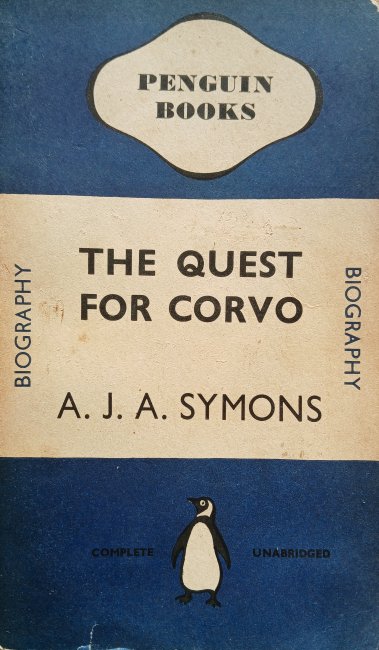
Following on from last weeks Christmas book of a hundred letters from the somewhat mysterious Frederick Rolfe, who styled himself as Baron Corvo, to publisher John Lane, this book tries to get to understand the man as much as is possible. Symons had developed his interest in Corvo following a visit to Christopher Millard in 1925 when Millard asked him if he had read ‘Hadrian the Seventh’, a book that Symons had never heard of by an equally unknown author Fr. Rolfe. Unusually Millard lent him his copy, he rarely let his books out of his home, and Symons read the novel and then in astonishment read it again. How could such an extraordinary book have escaped his attention and why had he never heard of the author, presumably a Catholic priest by his name, writing about a poor Englishman who unexpectedly rises to the papacy after the cardinals are unable to agree on a candidate amongst them at the conclave. This is theoretically possible as there is nothing in the rules around the selection of a Pope that says he has to be one of the cardinals tasked with making the choice. I haven’t yet read ‘Hadrian the Seventh’ myself but Symons’ enthusiasm for it suggests that I will hunt down a copy and read it before long, just checked and it is available as a Penguin Classic with the author given as Frederick Baron Corvo (Fr. Rolfe) and here we get to one of the problems with Symons study of the author, his regular changing of the name he is known as depending on circumstance. For consistency I’m going to normally refer to him as Corvo as that is how I first came across him and it is the name he is nowadays best known as.
It soon became clear to Symons that Corvo was dead but not long ago and many of his correspondents and also his brother were still alive and this is where Symons starts. The biography is unusual in that for the first two fifths of the narrative it is told as almost a detective story with Symons following leads and describing how he progressed from one to another rather than a finished biography where we would get a fully researched story from the beginning. I rather enjoyed this style and missed it when it was abandoned around the time Corvo first met John Lane, but as Symons explains it was getting rather too complex by then with more sources becoming available and a fuller picture appearing of the strange Baron Corvo a man who seemingly cultivated enemies everywhere, usually from the very people who were trying to help him and indeed had helped him until he took umbrage at some perceived slight or other. The following passage gives some idea of the man Symons was starting to reveal.
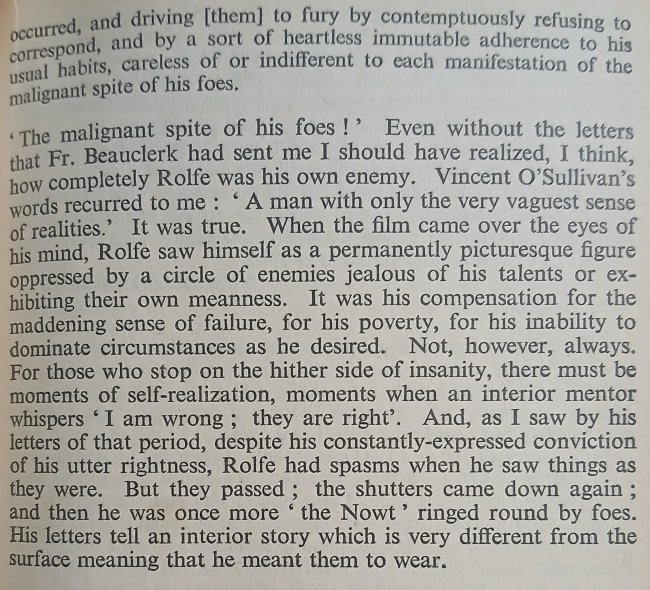
The picture you get from the numerous letters included in this book is a man probably suffering from an un-diagnosed persecution mania, nothing that happens is ever his fault it is entirely caused by malignant outside influences and his ever growing list of enemies who are determined to keep him down. He also has a gross overestimation of his own works worth, for example whilst living rent free in Wales he starts work on a series of paintings and banners for the local catholic church, originally as payment for his free lodging but gradually he ‘forgets’ the charity he is living off and demands payment for his work and what’s more the sum required is far above the value of what he has done at £1,000 (well over £100,000 today) when he is offered far less, the still generous £50 (£5,300) he refuses and starts spreading malicious stories regarding his then benefactor in the local press. The sum of £1,000 occurs several times in this book regarding Corvo’s valuation of his works and sometimes he manages to convince others and uses this figure as surety against loans which he has no means of paying back. To know Corvo even for a short time would often prove expensive and end up at the receiving end of vitriolic usually libellous letters.
This paints the man in a negative way, and he regularly deserves it, but by all accounts before the inevitable break down of a friendship he would be a fascinating companion with much apparent erudition whilst not able to understand the limits of his own learning. For instance he once agreed to work on a Greek translation whilst having little knowledge of the language and intended to drag the work through textbooks and piece together what he understood to be the meaning. The Rubaiyat mentioned in the previous blog entry apparently did actually appear but sold badly as it was a poor translation, unsurprisingly as Corvo knew absolutely no Persian and yet still undertook the translation.
Corvo died in Venice in 1913, where he was living on credit and piling up even more debts, a lot of which were settled by his brother when he came out to oversee his burial. He was without doubt a fascinating character which I would have loved to have met, whilst remembering to never lend him money, and this book by Symons does its best to be fair to the man showing his positive aspects whilst not shying away from his self destructive negative features.
 Ramblings on my bookshelves