A series of essays inspired by books that I own, talking about their history, some reviews and also how they came to be on my shelves. With over 6,500 books here and several more arriving each week I doubt I'll ever be short of a topic.
The second book in the ‘Cemetery of Forgotten Books’ series by Zafón is mainly set in 1929 in Barcelona just a few of weeks after the World Fair had been held there and several of the passages refer to the fair, with the cable car up to the top of Montjuic hill, which was built to get people to the events, being featured several times including in the final fight between David Martin and Inspector Victor Grandes. I really enjoyed ‘The Shadow of the Wind‘, Zafón’s first novel and so was greatly looking forward to reading this but sadly I didn’t enjoy it as much as the first book, I felt that the plot was more than a bit muddled, especially at the end where a new twist appears to happen every other page, although having said that I still got through the five hundred pages quite quickly, so if I hadn’t read ‘The Shadow of the Wind’ and knew what Zafón was capable of I may well have enjoyed it more. There is an enormous body count in the book as well, very few significant characters make it to the end and a lot of the deaths are quite gruesome which also wasn’t particularly to my taste. I now have a dilemma, do I give up here with Zafón or try his third book ‘The Prisoner of Heaven’ and hope that his undoubted literary skill shown in his first book hadn’t been abandoned after that?
The book is difficult to summarise because by the end you’re not sure that even Zafón knows what is going on. With all the twists and turns and contradictions throughout the story you are left with the abiding thought that despite the tale being told mainly in the first person by David Martin he may well be an ‘unreliable narrator‘. Early on we are told that he has an inoperable brain tumour which will kill him in a matter of months but mysteriously this is ‘cured’ and he goes on to have a series of bizarre experiences and encounters with a strange character who may or may not exist; but whom nevertheless apparently commissions him to create a religion and write the book of that belief system. But it is highly possible that the whole thing is a manifestation of the delirium caused by his medical condition and the final epilogue reads more as a hallucination rather than a satisfactory culmination of the strange gothic horror plot so who knows.
Over all reading this book was an unsatisfactory experience, which was sad after the genius of the first novel but it was good to revisit the booksellers Sempere & Son and The Cemetery of Forgotten Books even if we don’t spend much time there. The various aspects of Barcelona were also interesting, that Park Güell, which I visited with friends back in 2020 was intended to be a luxury housing estate which failed financially and was turned into the Gaudi inspired park it has become, but at the time this book was set was a largely abandoned and a dangerous place to be at night. Several other places I recognised from travelling around the city with Anna which made the often ridiculous plot seem more believable as at least it was grounded in reality somewhere.
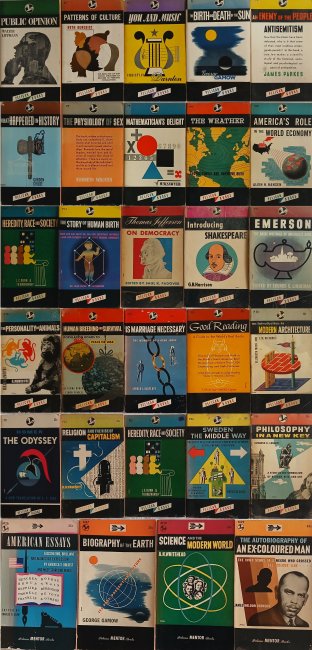
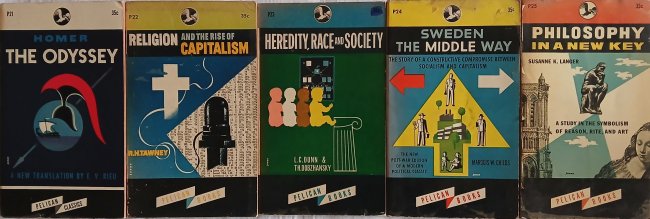
This month marks the eightieth anniversary of the first books that became the Mentor imprint, which would grow to be a major factual book publisher in America. Stepping forward a couple of years we see in 1948 two new paperback imprints first appear in the USA, Signet and Mentor, at first sight these series closely resemble the UK Penguin main series and Pelicans with Signet largely being fiction and Mentor for the most part factual. This is due to them both growing out of the wartime Penguin books printed in America to avoid shipping across an increasingly dangerous Atlantic Ocean. In 1948 Penguin decided to pull out of American publishing and their assets were purchased by Victor Weybright and Kurt Enoch both of whom had been running Penguin Books Inc based in New York since 1942 when the American Penguins were launched . Enoch had previously been head of Albatross Books, so knew how to run a publishing business, and was already in New York, having escaped Nazi Germany in 1940, whilst Weybright had been recruited by the owner of Penguin Books, Allen Lane, from the US Office of War Information back in London and returned to America to help Enoch. The two men formed New American Library of World Literature (NAL) in 1948 when they bought the American Penguin operation, but crucially not the name, and gained, at least in theory, 164 titles to start Signet and 24 to get Mentor going. I’d like to concentrate on Mentor as this grew out of a far less well known series in America which had taken the name of its UK equivalent, Pelican and which began eighty years ago this month in January 1946. The full list of titles, with their first published dates, as at the time of the takeover were:
P1 Public Opinion by Walter Lippmann – January 1946
P2 Patterns of Culture by Ruth Benedict – January 1946
P3 You and Music by Christian Darnton – January 1946
P4 The Birth and the Death of the Sun by George Gamow – January 1946
P5 An Enemy of the People: Anti Semitism by James Parkes – March 1946
P6 What Happened in History by Gordon V Childe – March 1946
P7 The Physiology of Sex by Kenneth Walker – March 1946
P8 Mathematician’s Delight by W.W. Sawyer – March 1946
P9 The Weather by George Kimble and Raymond Bush – May 1946
P10 America’s Role on the World Economy by Alvin H Hansen – April 1946
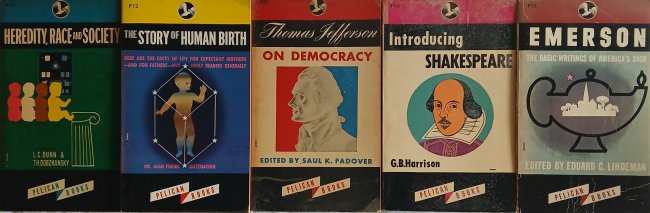
P11 Heredity, Race and Society by Theodosius Dobzhansky and L.C. Dunn – November 1946
P12 The Story of Human Birth by Alan F Guttmacher – January 1947
P13 Thomas Jefferson on Democracy edited by Edward C Linderman – January 1947
P14 Introducing Shakespeare by G.B. Harrison – February 1947
P15 Emerson – The Basic Writings of America’s Sage edited by Eduard C Lindeman – March 1947
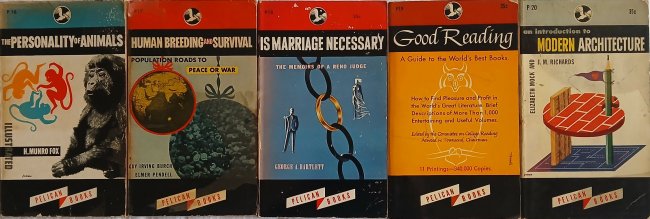
P16 The Personality of Animals by H Munro Fox – April 1947
P17 Human Breeding and Survival by Gut I Burch and Elmer Pendell – June 1947
P18 Is Marriage Necessary? By George H Bartlett – July 1947
P19 Good Reading edited by The Committee On College Reading – September 1947
P20 An Introduction to Modern Architecture by E.B. Mock and J.M. Richards – September 1947
P21 The Odyssey by Homer – trans E.V. Rieu – October 1947
P22 Religion and the Rise of Capitalism by R.H. Tawney – November 1947
P23 Heredity, Race and Society by Theodosius Dobzhansky and L.C. Dunn – November 1947
P24 Sweden: The Middle Way by Marquis W Childs – January 1948
P25 Philosophy in a New Key by Susanne K Langer, – February 1948
It’s an interesting mix of subjects, much like the UK originals. I said earlier that there were 24 titles to form the basis of Mentor yet the list above has 25 books, however careful checking will reveal that P11 and P23 are in fact the same book issued a year apart, yet inside both claim to be the first time this title was published. It is almost as if the publishers had forgotten they had already printed this book in 1946 so simply did it again exactly a year later in 1947. Of the twenty four titles ten had been originally printed in the UK, mainly as Pelicans, whilst the remaining fourteen were originals to the American Pelican imprint, the ten reissues are as follows:
P3 – Originally UK Pelican A68 – July 1940
P5 – Originally UK main series 521 – August 1945
P6 – Originally UK Forces Book Club – November 1942 then Pelican A108 – December 1942
P7 – Originally UK Pelican A71 – July 1942
P8 – Originally UK Forces Book Club – April 1943 then Pelican A121 – August 1943
P9 – Originally UK Forces Book Club – September 1943 then Pelican A124 – November 1943
P14 – Originally UK Pelican A43 – May 1939
P16 – Originally UK Pelican A78 – December 1940
P21 – Originally UK Services Edition SE18 – 1945 then Classic L1 – January 1946
P22 – Originally UK Pelican A23 – February 1938
Bizarrely two of the above had also passed through the American Penguin numbering before reappearing as American Pelicans, P7 had already been 507 (1942) but this change seems highly sensible as it is not a work of fiction, whilst P21 had first appeared in the USA as 613 (November 1946). Quite why The Odyssey moved from the fiction main series to the factual Pelicans, becoming by the way the only American Pelican Classic almost twenty years before the UK business came up with this series name is a mystery as it seems to make no sense. After 1948 the rights to the EV Rieu translation of The Odyssey were not part of the transfer of intellectual property so when Mentor came to reprint the now renumbered M21 they used a different translator, W H D Rouse, where it became the first Mentor Classic and went through 47 reprints by 1976 including at least one renumbering ending up as ME2519. All the other P series Pelicans were simply reprinted unchanged apart from the P becoming an M for Mentor although later on Mentor introduced sub categories so for example P13 ‘Thomas Jefferson on Democracy’ became M13 when first reprinted and then this was later changed to MD13.
The first four books published as Mentor from March 1948 were actually initially indicated on the cover as Pelican Mentor to help inform the general public regarding the change of name before dropping the Pelican part when they came to be reprinted. Enoch and Waybright also did this with the much more prolific main series as it morphed into Signet only in this case seventeen new books and a small number of reprints bore the imprint of Penguin Signet for a few months. I haven’t yet found any evidence of reprinted American Pelican titles being listed as Pelican Mentor, only the four new books appear to have had that designation. It is worth noting that the few books originally published as Penguin but reprinted as Penguin Signet and then later simply as Signet, which include 615 Lady into Fox, command far higher prices as the Penguin Signet reprint version than as either the Penguin or Signet versions alone. The four Pelican Mentor titles are:
M26 American Essays by Charles B Shaw – March 1948
M27 Biography of the Earth by George Gamow – April 1948
M28 Science and the Modern World by A.N. Whitehead – May 1948
M29 The Autobiography of an Ex-Coloured Man by J.W. Johnson – June 1948
As can be seen the covers feature bold designs, so much more enticing to their target American audience than the simple blue and white that would be the trademark of the UK Pelicans for decades. It was the use of full colour laminated covers, especially on the main series, that would be one of the primary falling out points between Penguin Books Inc in the USA and Allen Lane back in the UK, where typographic covers would reign supreme as the Penguin identity for many years to come. Although it was almost certainly tax difficulties between the two countries that ultimately prompted the split in the end.
Interestingly New American Library was bought out and became part of Penguin Publishing Company in 1987 neatly bringing the whole enterprise full circle. But confusingly there is also an Irish publishing company that calls itself Mentor Books which started in 1979 and specialises in educational works but has nothing to do with the American company which predates them by thirty one years and was well established by the time the Irish firm started
Very little is known about Shen Fu other than what he said in his book ‘Six Records of a Floating Life’ written in 1809 in China, of which only four sections were ever actually published in the 1870’s, the other two were either lost in the intervening decades or were never actually completed. Nothing definite is known of him after his book was written but he is believed to have died around 1825. What is known is that he was born in 1763 and married in 1780 to a cousin Chen Yun and earned his living as a governmental private secretary. The extract I have, entitled ‘The Old Man of the Moon’ by Penguin for this book, is largely from the first of the four surviving sections ‘Wedded Bliss’ and covers his life with Yun from their first meeting to her tragic death twenty three years later. The title of the complete book is presumed to come from the works of the Tang Dynasty poet Li Bai—“Ah, this floating life, like a dream…True happiness is so rare!” Whilst the title chosen by Penguin for this selection is a quote from about halfway through the book itself:
“People say that marriages are arranged by The Old Man of the Moon”, “said Yun. “He has already pulled us together in this life, and in the next we will have to depend on him too. Why don’t we have a picture of him painted so that we can worship him?”
What comes out most if the enduring love between the couple and his admiration for her skill in embroidery amongst other things. Initially their marriage was happy and they had two children and the book is full of simple pleasures that they enjoyed together such as sitting watching the moon at night whilst drinking wine and talking about poetry and art. But money worries overtook them especially after Shen Fu lost his job and resorted to opening up part of their house as a shop to sell his paintings and when that was not enough their possessions also were sold. Unfortunately Yun managed to get on the wrong side of her parents in law and they determined not to see her again, which along with the poverty the couple had been reduced to meant they had to move away leaving the children behind. Yun already had been ill, probably due to the stress she was in, and whilst she did make somewhat of a recovery in their exile in a better environment than they had living near Shen Fu’s parents she would relapse and die by the end of the book.
It’s a sad tale, lifted by the evident joy they had with each other before Shen Fu lost his job and difficulties engulfed them and I’m really glad I read it. Apparently the other surviving parts of ‘Six Records of a Floating Life’ are happier, and it is really good that the manuscript was discovered on a second hand book stall and recognised as a significant work by the brother in law of Wang Tao, who ran Shen Bao (a newspaper in Shanghai). Wang Tao published the manuscript in 1877 and it was an immediate hit.
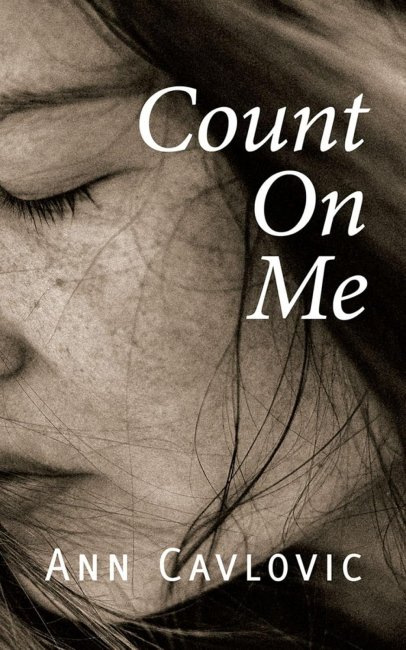
This, the first novel by Canadian author Ann Cavlovic, is something I’ve been reading as effectively a book proof although it doesn’t have any indication that it is a copy from before the official release date printed within it. The book was published on 1st October last year in its native Canada and I’ve had a copy since September, but most of us here in the UK have to wait until the 8th January 2026 to be able to get a copy. Originally I planned to write this blog before the book was released in Canada but as that would have been four months before its availability in the UK it has been delayed until now, a few days before its release here.
I initially struggled to get into the book, probably as the scenario is so far from my own experience but as the story developed I came to enjoy the book more and more. Without giving too much away we learn of brother and sister Tia and Tristan whose mother really needs to go into a care home and their father isn’t far off being incapable of looking after himself. Tia has problems of her own, recently divorced and with a one year old daughter she is struggling to look after her child and hold down her job and dealing with her parents problems as well just becomes too much. Tristan in the guise of caring for their parents is actually pushing their father out of the family home so that he and his partner can take over and is financially abusing the joint bank account which he has access to via power of attorney. He has also taken and/or sold various items from the family home along with his mothers jewellery which had been promised to Tia and taken out a $20,000 loan against their security. How Tia confronts him about this and starts to put things right whilst still managing to look after her daughter as a single mother and all the issues that position alone puts her into is the plot of the book. Reading that back it sounds like a dark nightmare but the book has enough lightness and humour to make the plot still enjoyable as you watch Tia struggle and ultimately get legal and personal assistance to counteract her brother’s attempt to grab everything including the house.
The book is written in the first person from Tia’s perspective as she tries to make sense of what is going on and protect their parents from Tristan and his girlfriend, who seem determined to gain as much a possible and get the parents out of the way into homes as soon as he can without regard for the best outcome for them, only the way that suits him the most. After initially having problems getting into the book I’m glad I persevered and by mid way I was cheering Tia on as she fought for the best resolution for her parents and to stop Tristan riding roughshod over not only their wishes but the rest of their lives as he tried to get them into the cheapest possible home regardless of the awful reviews the place had received and the general manipulation that he has imposed over them. It is Cavlovic’s first novel, although not by any means her first piece of fiction, you can find more about her at her website.
Many thanks to River Street Writing for supplying my review copy.





 Ramblings on my bookshelves