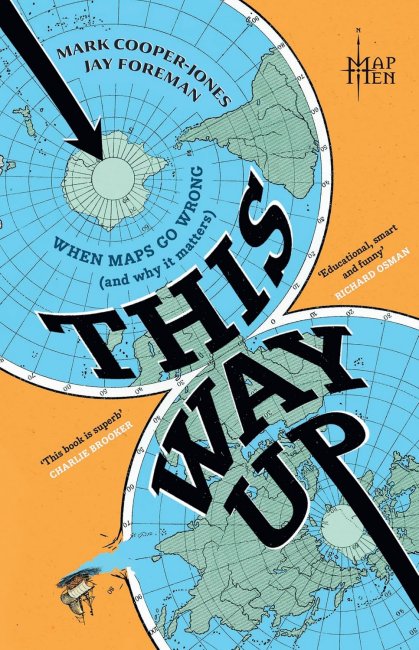
This Way Up – Mark Cooper-Jones & Jay Foreman

This largely highly entertaining book looks at maps and what happens when they are wrong for any of a multitude of reasons. It is written by Youtube creators Mark Cooper-Jones and Jay Foreman aka MapMen. If that first sentence appears to be hedged somewhat, that is because it is, and I will come back to why towards the end of this blog but first let’s look at the good bits which is the vast majority. I’ve read books on the same theme before, notably Edward Brooke-Hitching’s The Phantom Atlas, which is listed as a source in the bibliography of this book and was clearly the basis of the section on The Mountains of Kong (Chapter 4 The Map That Made Up Mountains) and which I covered in my review of The Phantom Atlas.

There are many map stories that I hadn’t come across before including the story of the remarkable navigation feats of the people of the Marshall Islands who can travel between the vastly spread out islands and atolls simply by noting the movement and pressure of the waves, well we think that’s how they do it, it’s probably a lot more complicated than that. Another fascinating story is of The Situationists, a small French anti-capitalist organisation who rejected traditional maps replacing them with diagrams indicating relationships between places. That Cooper-Jones and Foreman decided to illustrate this by trying to meet for lunch in London using maps of Paris is a suitably surreal experiment that failed but admirably made the point. The story of the television station map of the UK was informative and odd at the same time. I remember the various regions but had never really thought about how strange they were before now. Another tale I sort of knew was the IKEA world map that left off New Zealand but I wasn’t aware of just how common this is, to the point that maps with this geographical mistake have a dedicated reddit group. It should be noted here that chapter 3, where the authors use maps of Paris in London, starts with a QR code which links to a Spotify playlist to be listened to whilst reading, an idea I’ve never seen before in a book.

But let us look at a couple of places where the writers rather than the maps go wrong, the first one I spotted is a straight factual error. Chapter twelve, which ironically is about places being mis-located on maps, states that CNN produced a map that put the Libyan capital Tripoli in Syria for a piece about Colonel Gaddafi. and then later that chapter explains the mistake as:

Take for instance CNN’s map that misplaced the Libyan capital Tripoli in Syria. There is a Tripoli in Syria but it definitely wasn’t where Gaddafi was hiding at the time, and nor were CNN intending to suggest so.

Despite this assertion, in fact there isn’t a Tripoli in Syria, there is however the coastal city of Tripoli in the adjacent country of Lebanon which is presumably where CNN placed their map reference, not Syria at all. I must admit I picked up on this because I’ve been to both Tripoli’s, both in Libya and in Lebanon and whilst I liked both I wouldn’t recommend going to either currently for various geopolitical reasons.

For me though the biggest fault in the book is the longest chapter ‘The Deadliest Shortcut’ and it’s not for a factual error but rather for the badly misjudged tone of the chapter. Now I know this is supposed to be a humorous book, and yes it is very funny, whilst making excellent and quite serious points regarding maps and their use. But this chapter, written as a podcast, descends into almost slapstick jokes with people talking over one another, whilst describing the horrific ordeal of the 19th Century American settlers known as The Donner Party. For those people unaware of this story The Donner Party refers to a group of 87 settlers, including children, heading for California in 1846 who start falling behind the main groups and decide to take a shortcut shown on a map they had, but which crucially had been put there by somebody who had never actually made the journey. The group of families became trapped in the snow by what is now known as Donner Lake in the Sierra Nevada mountains and by the time they were rescued the following year only 48 out of 87 made it to California and the trapped group had largely survived by eating the dead, two of which were guides who were killed to supply food. Clearly a subject that should be handled with care and compassion, not with jokes and especially not in the cack handed manner exhibited here.

All in all I greatly enjoyed the book and with the exception of the aforementioned chapter ten I heartily recommend it.
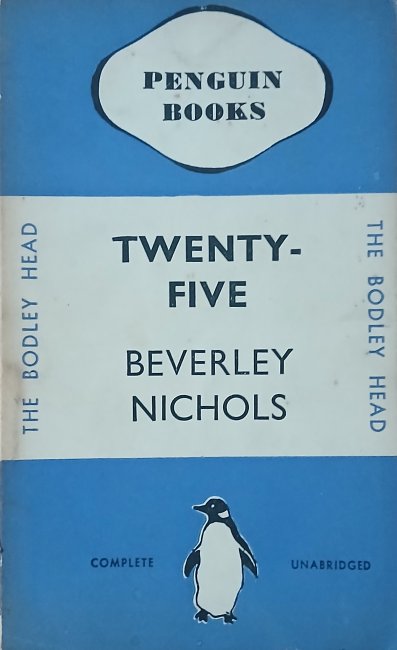
Twenty-Five – Beverley Nichols

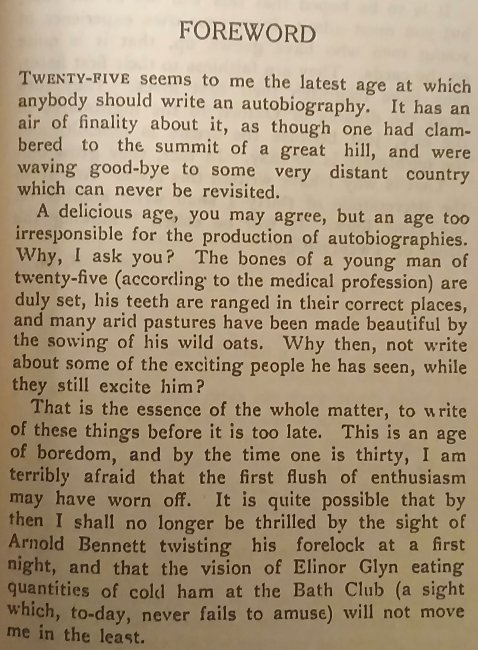
Continuing my plan to read the first ten Penguin Books during the twelve months after their ninetieth anniversary of when they were published, I have now reached book seven and the second one in the blue covers of biography in that initial set after book one ‘Ariel‘. We wouldn’t see a new colour until book thirty one in March 1936 when the purple of Essays and Belle Lettres first appeared on HG Wells’ ‘A Short History of the World’ and there wouldn’t be another book classified as Essays until number 444 ‘The Times Fourth Leaders’ in July 1945. However back to this book, and I have to admit I knew nothing of Beverley Nichols, to the point that I was surprised to discover that he was male despite the more usually female first name. I was also not inspired by the idea of a twenty-five year old writing their autobiography, so was not particularly looking forward to the book, but I’m so glad I read it. Nichols started to win me over even in the foreword:

And meet interesting people he certainly did, by page fifty we have encountered US Presidents Wilson and Taft, along with poets John Masefield, Robert Bridges and WB Yeats and are about to have conversations with both GK Chesterton and then Minister of War, Winston Churchill. Nichols was born in 1898 and the narrative runs up until 1924, he was therefore involved in World War I, but luckily was not called up to the front rather his Oxford University education was interrupted by working in the intelligence section of the War Office and then as Aide-de-camp to Arthur Shipley on the British University Mission to the United States, which is how he met the two Presidents. On return to the UK he resumed his delayed time at Oxford and became president of the Oxford Union, which is how he subsequently met so many other people of note at the time and as it was normal for the president to take people to dinner before the evening debates he would spend several hours in their company. He also ran a student magazine, which Masefield, for instance, contributed to, so even in his early twenties Nichols was remarkably well connected. This is the joy of the book, it is not so much an autobiography but a series of reminiscences regarding the various people he met, you learn far more aout them than you do Nichols himself.

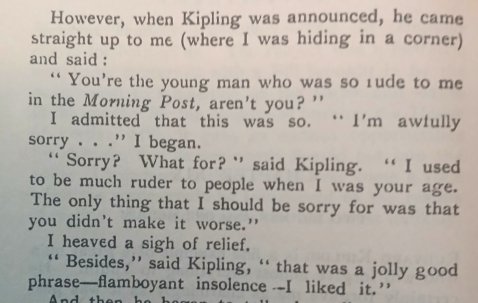
After leaving university Nichols eventually became a theatre critic giving him access to even more people but before that he spent some time as secretary to Australian opera star Dame Nellie Melba and there are numerous stories relating to those experiences included in the book, which like a lot of his anecdotes are really quite funny. One I particularly like has Melba taking a dislike to the position of some stone vases in a hotel and deciding to move them to a more ‘artistic’ formation which she duly did by strenuously pushing them up towards a wall much to the confusion of the staff. Typically for the lack of significant information about himself Nichols doesn’t mention that he was Melba’s secretary he just seems to spend quite a bit of time with her in Australia with no context given. Nichols also met Rudyard Kipling whom he had disparaged in a letter a couple of years earlier and then to his horror saw Kipling enter a room he was in:

The book is great fun and if I did have to look up a few people whose fame has somewhat died down in the intervening century there wasn’t many of them and it was worth the reference time but it is well written, amusing and far better than I expected it to be. Let’s leave the final words to Nichols, who did go on to have a long life as an author of over sixty books, using the final sentences of the book:

Again – I have done. Twelve o’clock strikes. There really should be slow music playing outside my window, so that I might work myself into a frenzy of pathos at the thought that another day has arrived to carry me on to middle-age. I should rather like to stay, just a little longer. But then – better not. Accept the joke of life for what it is worth. It is not such a very brilliant one, after all. And was there not a man called Browning, who wrote. “Grow old along with me, the best is yet to be.”

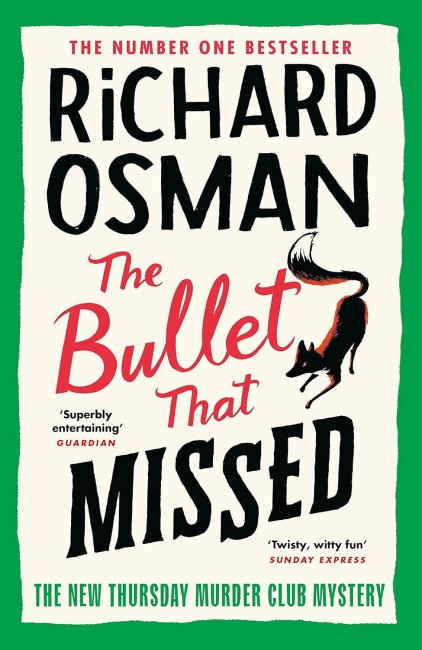
The Bullet that Missed – Richard Osman

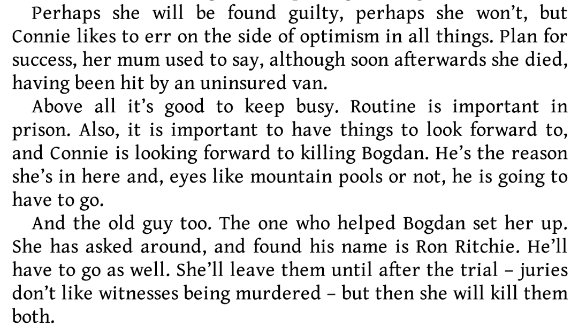
I wasn’t planning to review another of Richard Osman’s excellent crime novels but there was so much in this, the third title featuring The Thursday Murder Club, that I felt I had to write something. If you want to read my reviews of the first two you can find them here and here, but I really recommend that you read the books especially if you like your mystery reading to feature well thought out plots doused with a sprinkling of often quite dark humour, whilst also being beautifully written. A quick example from page twelve of this book featuring Connie Johnson, the drug dealing villain from book two.

One of the things I like most is the re-appearance in subsequent books of not just the main characters but others that you thought had been specific to an earlier work and Connie gets to be a significant player in this story as well even though she spends the entire time in prison. At first reading the main theme of the book appears to be the Thursday Murder Club deciding to investigate the ten year old cold case of the death of TV journalist Bethany Waites whose car was found at the bottom of a cliff with blood stains and some clothing although her body was missing. Elizabeth doesn’t find that surprising, as she says “I once had to push a Jeep with a corpse sitting in the front seat into a quarry, and it popped out almost immediately”. That is one of the things that I love so much about this book, because as a parallel plot we get to find out so much more about Elizabeth as she is first kidnapped, along with her husband, and then set the task of killing Viktor Illyich, the ex head of the KGB in St Petersburg by a very tall but, at the time, anonymous Swede. The impression we get then is that Illyich was her opposite number as she was quite clearly very senior in MI6, we had established in book two that she is Dame Elizabeth, although doesn’t use the title, which was another nod to her seniority but equally that Viktor and Elizabeth know and like one another very well although haven’t met for twenty years so she has no intention of killing him.

Of course despite the quite disparate plot lines Osman finds a way of tying them together into a cohesive whole whilst also providing ongoing character development for not only the four members of the Thursday Murder Club but also the two police officers who have ended up working with them, Donna and Chris, both of whom are settling into new, and to them at least, surprising relationships. One of the great features in the book revolves around Elizabeth’s husband, Stephen, who is clearly undergoing fairly late stage dementia and is often struggling, although of course he doesn’t realise this. But whilst in the Swede’s library following the kidnapping spotted the very rare books surrounding them and from this, with help from a dealer friend, manages to work out who the Swede is as only one person is known to have accumulated such a selection. As a book collector myself it’s the little details that really make this observation and the fact that it was a first edition of Wind In The Willows that gave the first clue as I know this book is distinctive as I have owned a copy in the past, the other books mentioned are worth in the millions of pounds but Wind in the Willows even now is just a few thousand and my copy, which wasn’t in the greatest of condition, cost me in the late hundreds. Another thing about the tall Swede is that Chief Constable Andrew Edgerton estimates him as six feet six inches tall and I can’t help but feel that the references to height and difficulty in scale are there for the private enjoyment of six feet seven inches tall Richard Osman.

The Thursday Murder Club books are maturing nicely with Osman coming up with new and surprising adventures for his protagonists. I just hope that this isn’t the last we hear of Viktor Illyich or even the very tall Henrik Mikael Hansen.

Notes from an Island – Tove Jansson & Tuulikki Pietilä

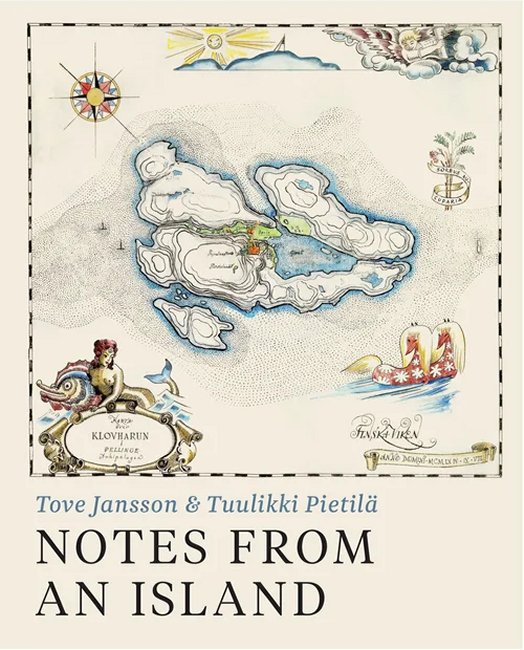
For twenty six summers from their late forties until their early seventies Tove and her life partner Tuulikki retreated to the small island of Klovharun in the Gulf of Finland where they could escape from city life and work and relax in relative peace and quiet. This book tells the story of the building of their cabin and some aspects of their life on the island with extracts from Tove Jansson’s diary, log entries from Brunström, a fisherman who with a couple of colleagues did most of the actual construction of the cabin including the dynamiting of a huge boulder out of the way, and of course Tuulikki Pietilä’s (Tooti) beautiful aquatints mainly done in the 1970’s. Originally published in 1996 in Swedish this is the first English translation, published by Sort Of Books in 2021. The lovely cover is a map of the island drawn by Tove’s mother Signe Hammarsten Jansson (Ham) who was a frequent visitor well into her eighties and was the inspiration for Moominmamma. Tooti was also to be immortalised in Jansson’s Moomin books as Too-Ticky; who has a lot of the characteristics of the real Tooti including practicality and a love of the sea.

This short book is an absolute delight, the first section deals with the decision of Tove and Tooti to seek another island as their own hideaway after Tove had shared the family retreat on the island of Bredskär with her parents, brother and eventually her niece. The construction of a cabin was done without formal permission as Brunström had pointed out that getting agreement from everyone who could be involved would almost certainly never happen but if they just built it and then asked the fait-accompli would probably just get passed, and so it turned out. Building on such a remote skerry which up until then had only been home to seabirds proved to be difficult and there are numerous log entries where Brunström (his first name is never given) couldn’t get materials out to the island due to the bad weather and high seas. Life on the island is covered more deeply in Tove’s work for adults, especially her best known ‘The Summer Book’, where Brunström is renamed Eriksson, but this is, as the title suggests, ‘Notes from an Island’ rather than the complete stories, with a blend of fiction and fact, found in the more famous book.

Tove introduces herself as a lover of rocks as is fitting for a sculptor’s daughter and many a tale is told of moving stones from one place to another throughout a summer to improve some aspect of the island only to find, when returning the next year, that everything had simply been moved back by the sea. Tooti is the daughter of a carpenter and her love is wood so maintaining the jetty and boat fell to her with less good wood being chopped up by Tove as firewood and the best pieces that floated by the island being saved for use in Tooti’s art. She was also more practical especially with the generator they would take a day coaxing into life or the temperamental propane fired refrigerator which was mainly used to store fish to feed their cat. Tove was also determined to have flowers growing on the island and cleared a small meadow for sea grass and also looked after that most Finnish of home features the rowan tree against one corner of the cabin.

I’ll close with a small section covering the time that Tove and Tooti made it out to the island before the surrounding ice broke up which will give a flavour of the narrative and the sheer joy these two ladies took in each others company:

The cabin had that closed in chill that Brunström would have called “cold as a wolf’s parlour”, and someone had burned all the firewood. We found a couple of wooden crates in the cellar and got them to burn and dragged in the sawhorse and some ice-covered timbers to thaw.

We were exhilarated by change and expectation and ran headlong here and there in the snow and threw snowballs at the navigation marker. Tooti made a toboggan out of thin strips of wood and we rode it again and again from the top of the island far out across the ice.

When we tired of that game, we sat down and took stock. The sea was chalk white in every direction as far as the eye could see. It was only then that we noticed the absolute silence.

And that we had started whispering.