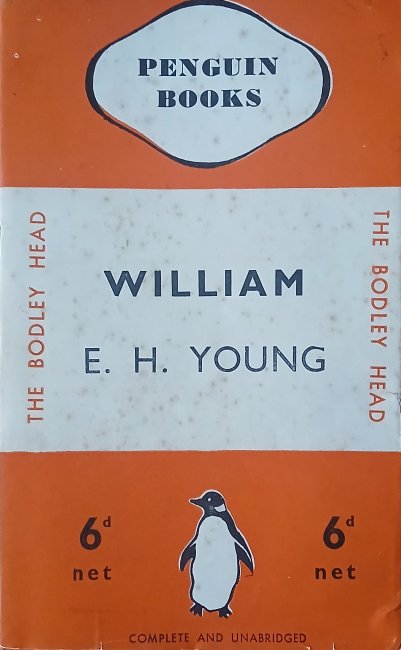
Continuing with my project to read the first ten Penguin books in first edition to mark the 90th year of Penguin publications I have now reached book eight, William by Ethel Hilda Young. Now almost completely forgotten Young was a popular writer in the 1920’s and 30’s indeed this book, first published in 1925, made its eighteenth edition when published by Penguin in 1935 which is a considerable number of copies produced in just ten years so she clearly had a readership. I continue to be surprised by how good the first ten Penguins are, obviously Allen Lane was trying to start off his new venture with as good a selection as he could put together but he struggled to get reprint rights from a lot of the existing publishers, this one was from Jonathan Cape who were co-operative. Like Susan Ertz and Beverley Nichols I had never heard of Young, but also like those I have greatly enjoyed reading the book and being introduced to a sadly neglected author. I have heard of both of the two remaining writers that make up the first ten Penguins, but haven’t read anything by either of them, so this voyage of discovery will be continuing for another couple of months yet.
William and Kate Nesbitt have five grown up children, one son and four daughters, and by the time of the book all apart from the youngest daughter have married and left the family home in Upper Radstowe, a fictional town but which appears to be based on Clifton, with the docks of Radstowe below being based on the city of Bristol and the foundation of William’s wealth with his flotilla of vessels providing goods shipping along with passenger carrying pleasure steamers. They met when he left the Merchant Navy and set up on his own gradually growing his fleet as the family grew. As the book was written in 1925, the Nesbitt’s clearly met and were married in the late Victorian era and it becomes clear as the book progresses that although William has embraced the changing times Kate’s moral compass is firmly stuck in the straight laced Victorian era and this would result in conflict between the couple that have grown comfortably familiar with each others routines and mannerisms over the decades. The first half of the book introduces all the characters and their inter-relations and builds up a happy prosperous family with each person having their own quirks and William as the father and grandfather to a largely adoring and expanding group of people. Indeed by about half way through I was thinking that yes I like these characters who are so well fleshed out by Young that you really feel you know them but what is going to happen as something must as it is too much happy families.
Then daughter Lydia made a surprising move, she upped and left her husband in London and moved in with an aspiring writer in an out of the way place in Somerset. The book then takes a dramatic turn with William, who has always had a particular soft spot for Lydia beyond his other children, defending her right to live her life as she chooses being against Kate whose Victorian upbringing cannot consider one of her daughters ‘living in sin’ and who attempts to turn the whole family against Lydia. The upsetting of the quiet life of the Nesbitts and the gradual resolution of the ructions within the family is beautifully drawn by Young and the reader is pulled in all directions as first one side and then the other takes precedence as Kate gradually works through her outrage at both Lydia and her lover and also at her abandoned husband who seems to be making insufficient effort to win her back.
Whilst attempting to do some research on Young for this blog I came across this article by Rebecca Hutcheon, Research Fellow at the Faculty of Business and Creative Industries, University of South Wales, which I totally agree with and I’m pleased to see that my guess that Radstowe was based on Bristol is confirmed. I don’t have any other books by Ethel Hilda Young, indeed none of her other works were published by Penguin so although this title presumably sold well enough they weren’t inspired to print any others. The most recent published retrospective of her works was in the 1980’s and was printed by the feminist publisher Virago, however they only have ‘Miss Mole’ still in their catalogue but did have several more including ‘William’. If you can find a copy I do recommend the novel, it is very much of its period, but so are the Brontë sisters and Jane Austen and as Hutcheon points out in her article Young has much to recommend her amongst those great writers of relationships and family tensions, yet is closer to our own time so the characters are somewhat easier to relate to.

 Ramblings on my bookshelves