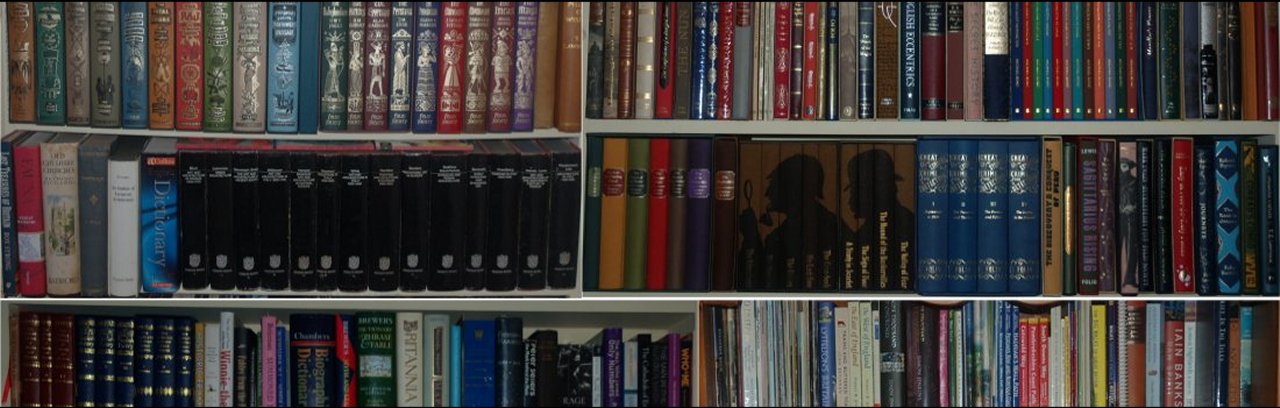
A series of essays inspired by books that I own, talking about their history, some reviews and also how they came to be on my shelves. With over 6,500 books here and several more arriving each week I doubt I'll ever be short of a topic.
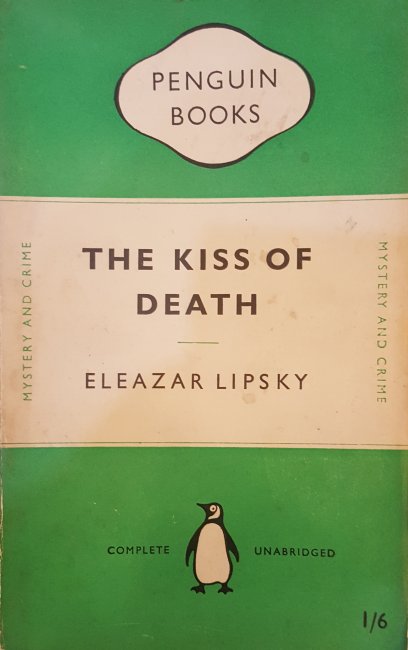
A 100-page manuscript by Mr. Lipsky was the basis of the 1947 film “Kiss of Death,” starring Richard Widmark, and the full novel was published by Penguin that same year.
New York Times obituary – Eleazar Lipsky – February 15, 1993
This is that first edition, published by the USA division of Penguin in August 1947, I also have the first UK Penguin edition, with a significantly less garish cover, from December 1949. see image at the end of this blog. Lipsky was by trade a lawyer and served as an assistant district attorney for Manhattan in the 1940’s, he later had a law practice in Manhattan and amongst other jobs served as legal counsel to the Mystery Writers of America. He was still practising law up to three weeks before his death at the age of eighty one from leukaemia. This solid background in law shows itself in his writing and you can be certain that the trial scenes and interactions with the Manhattan assistant district attorney in the book are procedurally accurate.
It’s an unusual crime novel as it is less concerned with the crime undertaken by Vanni Bianco and his mob then the repercussions of the act. Vanni is quickly captured and in the lead up to his trial D’Angelo, the assistant D.A. tries to persuade him to turn in the other members of his gang to avoid the mandatory thirty year jail sentence he faces for a fourth offence and this time involving a gun although it wasn’t fired during the robbery. Bianco refuses due to a code of honour and determines to do his time leaving his wife and children to be looked after by his gang. This however they fail to do and four years into his sentence word reached Bianco that his wife has died of tuberculosis brought on by cash shortages so she was looking after their daughters as well as she could to the detriment of her own health. The children were admitted into a home. This terrible situation strikes home at Bianco who determines to testify against his fellow criminals in an act of recrimination.
This is where the story totally changes tack as we follow Bianco into a new ‘career’ of stool pigeon being placed in prison cells with criminals where the D.A.’s office had insufficient evidence to see if he could get them to talk to him, an extremely dangerous role which could easily have got Bianco killed if he was suspected. It’s a very interesting aspect to the way of working of the District Attorney’s office and presumably is based on real life examples that Lipsky had during his professional career. I don’t remember reading a book dealing so specifically with the way the District Attorney would handle an informant of the type of Vanni Bianco. However I certainly didn’t see the final twist in the plot coming and it transforms the whole story in a completely believable but totally unexpected way.
As for the film mentioned in the obituary, it doesn’t really star Richard Widmark as claimed, as it was actually his debut. The film actually stars Victor Mature as Bianco and Brian Donlevy as D’Angelo with Widmark playing one of the criminals D’Angelo hopes Bianco will manage to get some more information on. I tried watching some of the movie and frankly wasn’t particularly impressed, unlike the book which was fast moving and a delight to read. It is nowadays sadly out of print but is pretty easy to track down on the second-hand market in either the USA or UK Penguin editions.
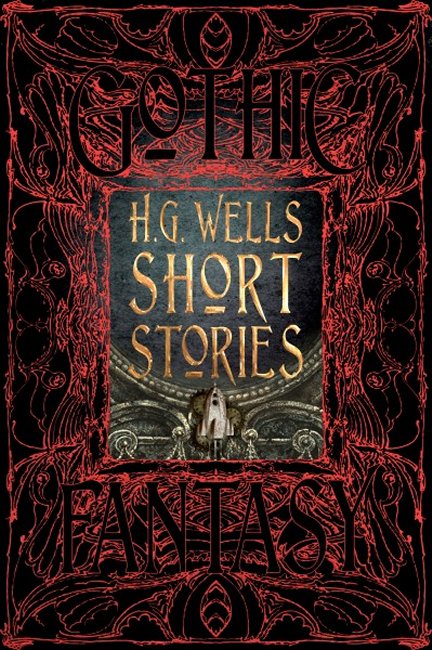
At 474 pages this is an excellent selection of the short stories and three of the short novels from the pen of H G Wells, a man most people think of as a Victorian science fiction writer but who was much more than that not only in output but also his timeline as he survived until after WWII, dying in 1946 at the age of seventy nine. So why is Wells so popularly thought of as being earlier than he truly was, well his best known works were certainly written during the Victorian era, such as ‘The Time Machine’ (1895), ‘The Island of Doctor Moreau’ (1896), ‘The Invisible Man’ (1897), and ‘The War of the Worlds’ (1898) however at the turn of the century he largely moved away from science fiction towards more contemporary novels such as ‘Kipps’ and ‘Tono-Bungay’ and later almost abandoned fiction altogether and produced his ‘A Short History of the World’ which attempted to summarise all of history into a single volume, I also have the earlier ‘The Outline of History’ in two illustrated volumes and the odd ‘Crux Ansata’ from 1943 which is basically a polemic against the Catholic Church.
This book was published by Flame Tree Publishing in 2017 and was the first of their Gothic and Fantasy series of books to be dedicated to just one author, closely followed by H P Lovecraft. Along with what would normally be regarded as short stories the collection includes three short novels, or novellas, ‘The Invisible Man’, ‘The Time Machine’ and ‘The Story of the Days to Come’. I have previously reviewed The Invisible Man as part of the August 2018 review of the first set of ten Penguin crime novels, and it was the inclusion of The Time Machine that prompted me to pick up this collection after last weeks ‘The H-Bomb Girl’ including as that does a time travelling character called Miss Wells which is clearly a reference to H G Wells. Along with these three novellas are thirty three short stories which vary from a simple crime caper ‘The Hammerpond Park Burglary’ through murder ‘The Cone’ amongst others and but the majority fall into the loose category of intriguing fantasy but I wouldn’t describe many of them as Gothic in the way that Lovecraft is definitely Gothic Fantasy, the one significant exception is ‘The Red Room’ which reads like a ghost story with a great twist at the end. I also have The Folio Society collection published in 1990 and which is based on the selection published by J.M. Dent and Sons in 1927 although that only has twenty two stories But even that shorter collection has seven stories not included in the Flame Tree edition and that still leaves over fifty short stories that I don’t have. as Wikipedia lists 94 short stories and the same number of novels or novellas.
That Wells was a prolific author is not in doubt and the quality of his writing can also not be underestimated, he was nominated for the Nobel Prize in Literature four times although never won it, frankly I suspect the judges regarded him as insufficiently high brow to be properly considered. But he was undoubtedly a popular writer from his earliest works and still sells well. I’ve really enjoyed reading some of the stories that I didn’t know and revisiting the ones I read many years ago. If you haven’t read Wells’ short stories then I heartily recommend them, no matter which collection, and there are many, that you manage to pick up.
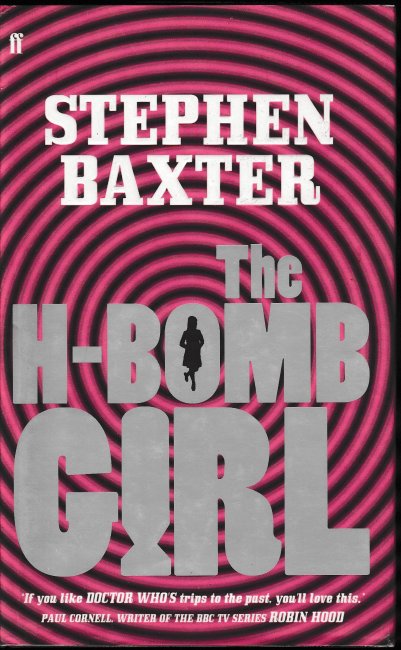
First up, the quote by Paul Cornell on the cover gives away a lot of the plot, immediately you are on the look out for a time travel angle in a book ostensibly about a fourteen year old girl moving to Liverpool after the collapse of her parent’s marriage and having to start again making new friends at a time of international tension, for it is October 1962 and Russia is moving nuclear missiles to Cuba in order to be able to have a shorter strike time against the USA and match the American missiles based in Turkey. Therefore when the somewhat creepy Miss Wells at Laura’s new school appears to know more than she should and also has a resemblance to what an older Laura might look like and Agatha at the cafe the school friends go to also looks similar and furthermore has what appears to be a tattier version of Laura’s diary in one pocket the reader is considerably less surprised than they probably should have been.
Laura is given the nickname of The H-Bomb Girl after the very unusual item she has hanging round her neck is spotted by her school friends. Not many teenage girls walk round with the priming key for a Vulcan bomber hanging on a chain. Her father is a senior RAF officer in charge of the UK nuclear warheads, and in a slightly convoluted plot line has decided that a good way to keep his daughter safe in the event of a nuclear war is to give her the key and get her to memorise a phone number to ring and the arming codes so that if things go badly, which he suspects may well be the case, she can call and be whisked away to a safe place. I’m more inclined to believe that both father and daughter would be more likely to be taken to prison than to a place of safety but a certain amount of leeway has to be given here as the plot has more holes than a colander and the more you think about it the less believable it becomes. After all Miss Wells and Agatha must have been hanging around for some time waiting for Laura to move to Liverpool as Miss Wells at least appears to have a senior role in the school and is not mentioned as a new arrival.
It’s a pity that Baxter didn’t do more research into the period, if he had then the three anachronisms that I spotted immediately, there may well be others, wouldn’t have appeared. The first is minor in that in the introduction by way of explaining pre-decimal currency to modern readers he mentions the farthing which had ceased to be legal currency in January 1961 almost two years before the book is set. The second is more significant as during one of the versions of the post missile crisis where the world descends into nuclear war he refers to the first strike on Liverpool which led to the melting of the glass crown on Paddy’s Wigwam aka the Catholic Metropolitan Cathedral of Liverpool. Unfortunately this building only started construction in October 1962, the same month as the crisis occurred, it wasn’t completed until 1967 and gained it’s nickname soon afterwards, so it wasn’t there to be destroyed in October 1962. If you don’t know why it got the nickname see here. Finally in a book about time travel which also has a character mention Doctor Who starting soon he got the year wrong as it was the 23rd November 1963 when the show was first broadcast, nobody would have known about the show in 1962 as the BBC didn’t even start referring to Doctor Who internally until the summer of 1963. Finally as somebody who studied nuclear engineering the positioning of the open nuclear pool in the main control room hall, whilst needed for the plot, is simply ridiculous. These obvious errors, especially to someone born in 1962, as I was, were mildly annoying but apart from them and the dubious plot holes the story was a fun read.
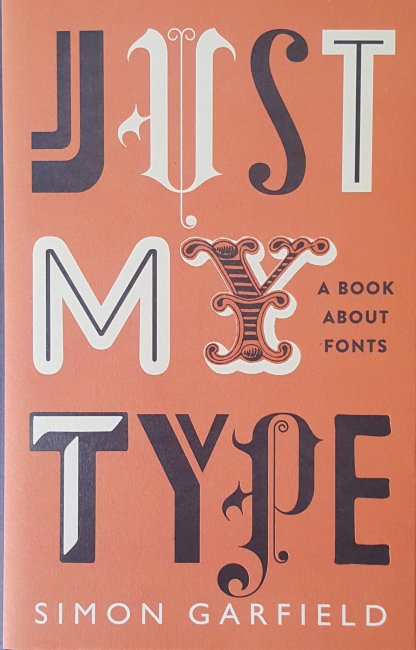
This fascinating book delves into the almost six hundred years of typesetting from Gutenberg with his introduction and popularisation of movable type on the printing press that he invented in the late 1440’s to the modern computer generated pages; whilst discussing the history and development of typefaces and fonts which have grown to well over 100,000 different styles over the centuries. One particular feature of the book is the use of the font referred to for most occasions that a specific font is discussed. This has led to almost two hundred different fonts being used in the book from the black lettering used by Gutenberg and Caxton which looks like the letters produced by monks in handwritten documents and books from the previous centuries to surprisingly recent classic examples which have become ubiquitous such as Helvetica (1957) which has become the font of choice for American transport systems, to its near copy Arial (1982). Arial was deliberately created by the Monotype Corporation to be very similar to Helvetica owned by their rival Linotype and owes its spread to being bundled by Microsoft from Windows 3.1 because the license was cheaper than Helvetica. There is also a chapter on the font developed by Herbert Spenser and Margaret Calvert for British road signs in the 1960’s and which has now spread across Europe, the name of the font is appropriately Transport.
I think anyone with an interest in books develops a parallel interest in fonts especially when the publisher, such as The Folio Society, always includes a reference to the chosen font at the start of the book. We don’t always notice when the choice is done well but certainly do when it is done badly. This is sadly the case with a book I am struggling with currently despite the contents being really interesting the poor paper quality, which is a little grey, along with the faint small thin font utilised makes reading more than a dozen or so pages in one go impossible due to the eye strain resulting from the attempt, Papyrus by Irene Vallejo published in paperback by Hodder & Stoughton is going to have to wait for it’s time on this blog, the subject is great but the reading experience is painful.
Garfield refers to many books about printing in this volume, several of which are now on my wants list including an interesting double book by Paul Felton which started from one direction is called ‘The Ten Commandments of Typography’ but turn it round and start from the other end it becomes ‘Type Heresy’. Amongst the commandments is “Thou shalt not apply more than three typefaces in a document” something that ‘Just My Type’ breaks for excellent reasons. But in ‘Type Heresy’ there is a full page rebuttal to this argument.
Oddly Profile Books who published this volume categorise it as ‘Reference/Humour’ which I think is simply down to the inclusion of this cartoon.
Vincent Connare who created Comic Sans whilst working for Microsoft as a font designer in 1994 is used to the criticism of his best known font design, but all he was trying to do was come up with an approachable design which resembled simple handwriting and was based on the handwritten lettering used in comic books by Marvel and DC at the time hence the name. It is worth noting that Comic Sans, the Sans indicating that it doesn’t have serifs (a small addition to the lines making up the character) on the letters, is particularly popular with teachers of dyslexic children due to its simple nonthreatening style.
The book covers a wide spectrum of fonts and typographical examples from histories of specific fonts in short chapters interleaved within the main text and each entitled Fontbreak, which starts with Eric Gill’s best known font Gill Sans (1928). Through to The John Bull Printing Outfit which I’m pretty certain I never owned although I do remember using something similar as a child to typeset short documents and print my own items. There is also a chapter on the worst fonts in the world which includes the truly awful font designed for the 2012 London Olympics.
So what font am I using for this blog? Well it’s the now somewhat unfashionable Times New Roman, chosen for the same reason that it was developed, to be clear and easy to read even down to small sizes, after all you may well be reading this on your phone. Times New Roman was created by Stanley Morrison in the early 1930’s to improve the legibility of The Times newspaper in Britain which up until then had used the somewhat spindly letters standard across most newspapers since the 19th century. The thickening of the very narrow letters also improved the robustness off the cast metal type, particularly useful given the high speed rotary presses in use.
This collection of Yeats’ early works is split roughly 50/50 between his poems and other works including the play ‘The Land of Hearts Desire’ and selections from ‘Irish Folk Tales’, ‘The Celtic Twilight’, John Sherman and Dhota’ and ‘Stories of Red Hanrahan’. There are eighty eight poems split into four categories by subject including the work that gives this collection its title, ‘When You are Old’.
When you are old and grey and full of sleep, And nodding by the fire, take down this book, And slowly read, and dream of the soft look Your eyes had once, and of their shadows deep;
How many loved your moments of glad grace, And loved your beauty with love false or true, But one man loved the pilgrim soul in you, And loved the sorrows of your changing face;
And bending down beside the glowing bars, Murmur, a little sadly, how Love fled And paced upon the mountains overhead And hid his face amid a crowd of stars.
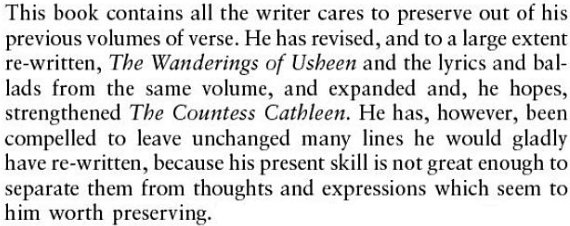
Yeats would come to look back on his early works with distaste as he regarded his more mature works as far superior and in the original preface of this collection he made clear that he thought the works that were cut were not worth retaining.
The first poem mentioned above ‘The Wanderings of Usheen’, more commonly titled ‘The Wanderings of Oisin’ is the longest poem included in the collection and takes up 35 of the 158 pages dedicated to poetry. I love the rhythm of this poem and despite its length it is actually quite an easy read and takes the form of a conversation between the legendary hero Usheen/Oisin and Saint Patrick, the patron saint of Ireland, although it is somewhat one sided with Saint Patrick barely managing to get a word in. It tells the story of Oisin’s journey into the land of Faerie and his wanderings with the fairy princess Niamh there for the last three hundred years. A small extract from the first section of the poem will give some idea of the work.
But now the moon like a white rose shone In the pale west, and the sun’s rim sank, And clouds arrayed their rank on rank About his fading crimson ball: The floor of Emen’s hosting hall Was not more level than the sea, As full of loving phantasy, And with low murmurs we rode on, Where many a trumpet-twisted shell That in immortal silence sleeps Dreaming of her own melting hues, Her golds, her ambers, and her blues, Pierced with soft light the shallowing deeps. But now a wandering land breeze came And a far sound of feathery quires; It seemed to blow from the dying flame, They seemed to sing in the smouldering fires.
One thing I didn’t realise until I read this collection and recognised the words, is that one of my favourite tracks by Irish band The Chieftains uses one of Yeats’ poems for the lyrics, beautifully read by Brenda Fricker, ‘Never give all the heart‘.
Leaving the poetry behind and delving into the second half of the book took me to totally unfamiliar territory as I had only read Yeats’ poetic works before. The one play included here has us yet again dealing with a character from the land of Faerie, this time the fairy is tempting a newly married woman to join her and leave the mortal realm. Following that is a very short and disappointing because of that, extract from the 1891 ‘Irish Fairy Tales’ which seems to just consist of an introduction and the enjoyable ‘Appendix: Classification of Irish Fairies’ this starts off with the largely friendly Sociable Fairies and then goes deeper into the mainly disagreeable Solitary Fairies. The brevity of this section makes me want to hunt out the complete book and read the actual folk tales told within it.
The next extract from a book, this time ‘The Celtic Twilight’ is at over forty pages quite a bit more representative than the handful of pages given to ‘Irish Fairy Tales’, it consists of a series of essays dealing with fairies, ghosts and other such supernatural characters and their encounters with humans. These essays are quite short, often just a single page but explore the myths of the Irish people with tales either told to Yeats or experienced by him. The selection from ‘John Sherman and Dhoya’ is again very short being just concerned with the story of Dhoya a giant mortal living alone who attracts the attention of a fairy lady who decides to become his companion until she is taken away by a male of her own folk leaving him alone again and inconsolable. Like ‘Irish Fairy Tales’ I’d like to read more of these stories as the taster is too brief. The final selection is actually complete and includes the six short stories concerning Red Hanrahan that were published together in 1897. These tell tales of Hanrahan’s, often ill-fated, encounters with women and supernatural beings.
If you want to get a representative overview of early works by William Butler Yeats then this collection would be a great place to start and like myself you will probably end up wanting more, especially of the prose works. This is the fourth book from the Penguin Drop Caps series I have written about along with a general overview of the series. There are twenty six in total, one author per letter of the alphabet and previously I have covered Ellery Queen, John Steinbeck and Xinran.
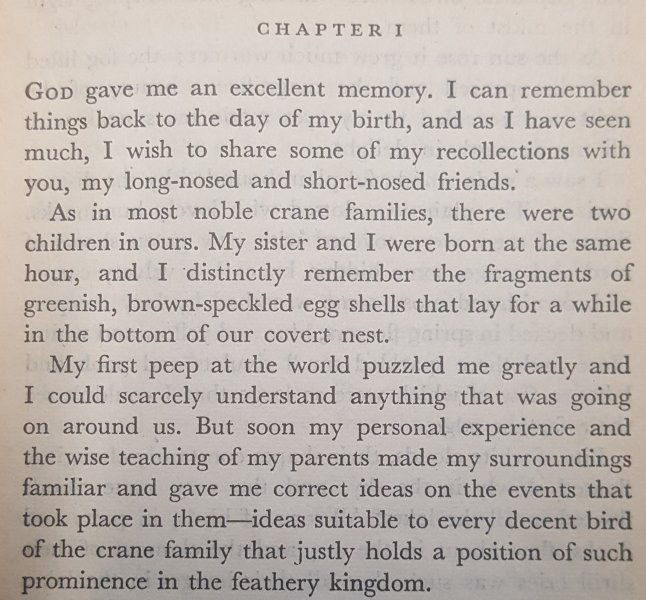
I knew nothing of this book or indeed its author before I picked up this copy a few days ago and there are no biographical details within the book either so onto the internet. Nikolay Karazin was a Russian soldier, artist and author of several books who was born in 1842 and died in 1908, he wrote and painted after retiring from the army and it is for his artwork that he is probably best known nowadays. I suspect the cover illustration is by him although no artist is credited. The English translation, by M.Pokrovsky, of his children’s book Cranes Flying South was first published in 1936 and this is the 1948 Puffin first edition. The book tells the story of the crane’s migration from the Ostashkovo marshes in north western Russia about halfway between Moscow and St Petersburg all the way over eastern Europe and Egypt following the Blue Nile to beyond Khartoum in Sudan, told from the point of view of a bird making his first long distance flight, as the book starts with him and his sister hatching.
His father, Clarion Trumpeter, is quite senior in the military like hierarchy supposed by Karazin to be normal in a colony of cranes especially during the migrations and in this he imposes his background. The story has them flying in structured triangles, which indeed they do, but regarding the stops on the way as camps with posted sentries and the discussions between senior cranes as to the best way to advance is rather more fanciful but does make for a good story. Amongst the other major characters is the Trifler, a crane known for his outrageously tall tales of his adventures and the leader of the colony Longnose the Wise. We never learn the name of our narrator or his sister, or indeed their mother but we are introduced to some of the cranes from another colony based in the Urals who join up as part of the massive flock taking part in the migration. On the way they also meet herons and storks both of which are regarded as inferior to the cranes, herons for their appetite as they will eat pretty well anything unlike the largely vegetarian cranes and storks for their relationship with man whilst cranes regard men as dangerous.
The journey south is full of incidents both with men hunting and also with bad weather which causes the loss of several cranes over open water when they get so exhausted by the buffeting winds but can find nowhere to safely land as cranes cannot swim. The descriptions of the route are also fascinating both the long slow journey over Russia and Ukraine then onto the mouth of the Danube before deciding to either cross the Mediterranean via a rest stop on Cyprus or skirting the coast from Turkey, Syria and Lebanon on their way to the Nile delta. Karazin had clearly read up on the ornithological knowledge at the time regarding the routes taken by cranes which seems to be largely correct according to the data I can find online. One particularly fun bit is near the end:
There are unimaginative persons unable to rise above the commonplace, who are generally very fond of ‘investigating’ things. I am quite certain that several such persons, on reading of my travels will say: ‘How could he write it, when cranes have no ink and no paper?’ Such a remark will show, to say the least, a total lack of humour.
The book follows the full migration both to and from Sudan back to the breeding grounds in the Ostashkovo marshes and we get the full circle of life with our narrator pairing up with Blackneck, a crane originally from the Ural colony, and them having their own chicks. Sadly the book appears to be out of print but is quite easy to find second hand, it’s a lovely children’s story and worth seeking out.
Canadian author Soltani’s first novel takes us to her Iranian heritage with a powerful story exploring the life of the fictional Zulaikha (pronounced Zuli-ka), born in 1945 and therefore exposed to the various changes that have overtaken Iran in the last seventy plus years including the suppression of female rights since the Islamic Revolution at the end of the 1970’s. Not that Zulaikha’s life had been particularly rosy even before the revolution and the subsequent Iran-Iraq war in the 1980’s. From being pulled out of school in 1958 at the age of thirteen because as her mother, Madineh, saw it “no man would marry a girl with an education”, her role was to get married and her wishes were seen as unimportant. The book however starts in December 2007 and in Amsterdam rather than Iran. Sixty two year old Zulaikha has been visiting her son, who now lives in The Netherlands and at Schiphol airport on the way back to Tehran she meets Kia, a man she hasn’t seen since the 1960’s. There is no hint as to the relationship between them other than he used to know her missing brother Hessam, in this opening chapter, we slowly find out more as the book progresses but the two of them meeting triggers a postponement of their flight and security take Zulaikha away for questioning. Who is this man and why should their chance meeting be seen as a cause of concern? We find out the who eventually but we are left in suspense as to what will happen to Zulaikha when she returns to Iran the next day as the book leaps backward to 1958 and begins a chronological narrative until we eventually get back to the plane landing.
Soltani gives her protagonist a difficult time, from being a child bride as the second wife of a merchant in Bahrain whom she only meets just before the wedding, to becoming a widow whilst still only seventeen and returning to Iran where she ends up having an abortion after a doomed illicit relationship. Zulaikha grows up in Abadan, home to what was at one time the largest oil refinery in the world and crucially close to the border with Iraq which made it a prime target in the 1980’s Iran-Iraq war, so much so that the population plummeted from around 300,000 in 1980 to just 6 in 1985 and Zulaikha along with her family and most of the population of the city became refugees in Tehran and it is in 1985 that Hessam vanishes, presumed killed on the front line. She also spends time in the notorious Evin prison but despite the hardships piled onto Zulaikha the narrative drive of the story keeps you reading, indeed it’s a difficult book to put down you just want to know more of her story. It is also a book that is clearly well researched with many real events explored, such as the Abadan Cinema Rex fire in 1978 which killed over four hundred people and became one of the turning points in the overthrow of the Shah with rumours blaming his secret police force despite the barring of the doors and subsequent arson actually being perpetrated by Islamic militants. I learnt so much more Iranian history through reading this novel.
The book first came out at the end of 2023 in Canada although it is now available more widely and it is definitely worth seeking out, it is beautifully written and the story of the ups and downs of Zulaikha’s life is engrossing with the various threads largely tied up by the end but you still want to know more about Zulaikha which is a good place to leave her story. This blog is being published on Tuesday 19th March and the Iranian new year is marked on the first day of Spring, this Thursday 21st March so Happy New Year to any of my readers whom are celebrating this, or in Farsi Nowruz Mobarak.
William Earl Johns is best known as the creator of James Bigglesworth, better known as Biggles, who featured in ninety eight books of adventure stories. Joan Worralson, aka Worrals, on the other hand appeared in just eleven books and the first three were finally republished in 2013 by Indiebooks after a long period out of print. Whilst it’s good to see these stories back in print I think it’s a pity that the cover illustrations are so childish with Worrals and Frecks depicted as apparently far younger than their actual age in the book which is eighteen and seventeen respectively. With that in mind I think I prefer the original dust wrapper from the first edition in 1941, although in that picture Worrals looks more in her early twenties.
W E Johns adopted the title Captain for his writing career although he never achieved that rank during actual service as a fighter pilot and later a flying instructor during WWI. Remaining in the R.A.F. after the war he was promoted to Flying Officer in 1920 whilst working as a recruiting officer, ultimately transferring to the reserves in 1927 before finally relinquishing his commission in 1931. The following year he wrote his first Biggles book ‘The Camels are Coming’, the title referring to the Sopwith Camel biplane rather than the bad tempered quadruped. His long career in the air force obviously informed his detailed descriptions of flying and the aircraft used, and you can be pretty sure that if Johns says a plane handles a specific way then it really did. The Women’s Auxiliary Air Force which had both Worrals and Betty Lovell, aka Frecks due to her freckled face, as members was founded in 1939 and during WWII it’s members performed various support roles to the R.A.F. including transferring aircraft between airfields and repair sites although this was a relatively uncommon function, most were employed in far more mundane duties. Worrels is therefore highly unusual in performing this task as this was actually a job for the Air Transport Auxiliary which eventually did employ around 100 women, but as a recruiting agent she apparently worked well.
The story begins with Worrals receiving a dressing down by the Squadron Leader for having gone out on a short training flight in a Reliant in contravention of standing orders which did not permit females to fly combat aircraft and she is to be punished along with the Flying Officer who flew with her by loss of leave and in his case a transfer to a forward airfield. Shortly afterwards the Squadron Leader rather shamefacedly asked her to fly the same plane as it needed moving and apparently with the transfer of Bill he had nobody left who had previously flown that make. All rather unlikely but it is really just a device to get Worrals, and Frecks as a passenger up in the air where they spotted a mysterious aircraft and received a general all planes message on the radio that it needed stopping. As the only plane in the vicinity Worrals engaged the other plane and luckily shot it down but not before seeing it swoop low over what appeared to be a golf course. If flying a combat aircraft without specific authorisation wasn’t bad enough before, then actually partaking in combat was very much forbidden, however Worrals managed to talk herself out of further punishment by pointing out that she was flying the only combat plane that had seen the mystery aircraft and otherwise it might have escaped. Worrals not only avoids further censure but gets her weekend leave reinstated.
Worrals decides to use her leave to do some unofficial investigation as she doesn’t think she was taken seriously over the activity at the golf course so taking Frecks with her they head off to the property only to be captured by German spies and the plot unfolds as they slowly work out what is happening during bouts of freedom as they alternatively escape and get recaptured a few times. The plot is well thought out and Johns certainly provides plenty of tension as the two women engage in a battle of wits with the Germans and although a few escapades somewhat stretch the readers credulity I had to remember that I was not the target readership which was largely teenage girls and young women during the war. Having said that I nevertheless enjoyed my first experience of Worrals, but I doubt I’ll read another. I read a lot of Biggles at around the age of ten and I can’t see me rereading any of those either. It was fun though and if you like what is now called Young Adult adventure stories then W E Johns has a lot to recommend him. Please be aware though that the books are very much of their time and although Worrals is largely UK based in all her books, Biggles travelled the world and often had a very 1930’s/40’s attitude to the people he found there.
With thanks to The Ironbridge Bookshop for the loan of the book so that I could try a Worrals rather than reading my extremely delicate and worryingly rare Penguin edition of Biggles Flies Again
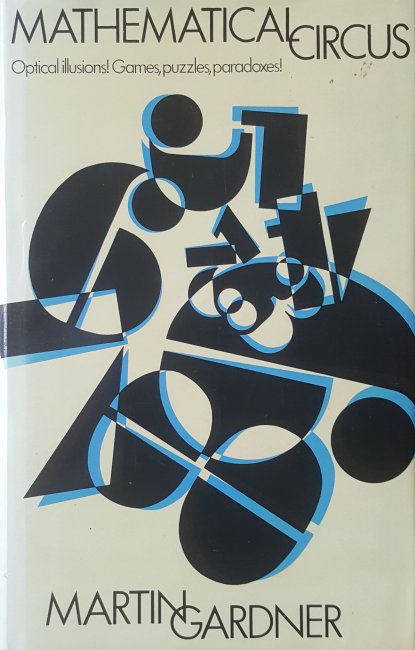
This week I’m going to cover not one but five books, all of which started life as articles in Scientific American under the heading of Mathematical Games. This column was originated by Martin Gardner in 1956 and I first came across it in my school library in the early 1970’s and became hooked, looking forward to the next monthly issue, which fortunately the school subscribed to. Eventually Gardner compiled fourteen books based on the column, five of which I own.
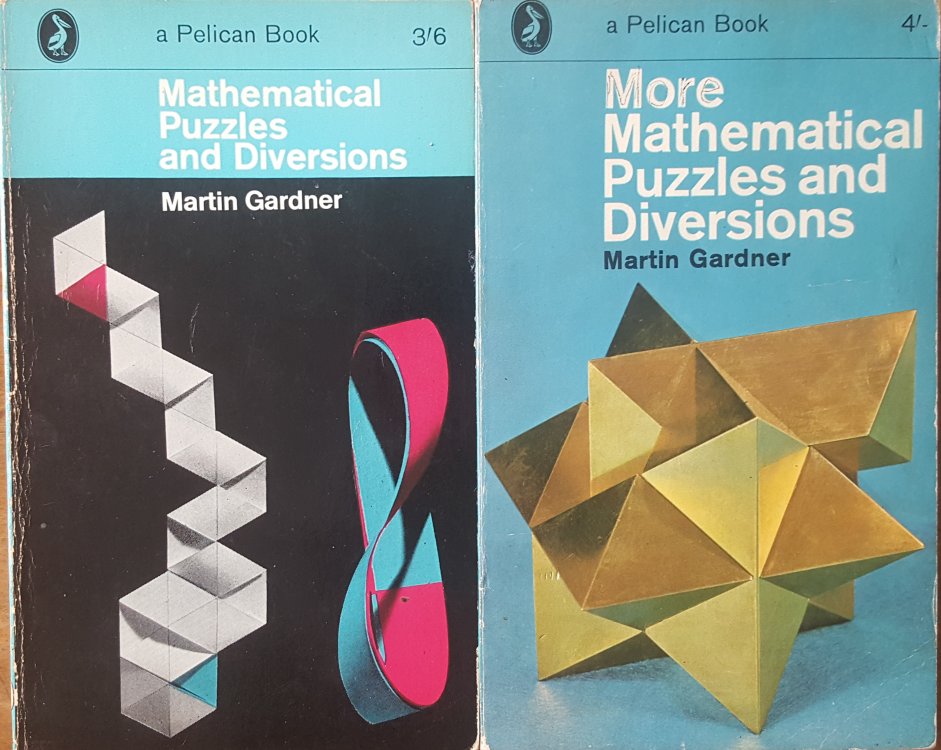
The first book has an unfolded flexagon alongside a mobius strip and immediately highlights the cover design issues with the Pelican editions in that although flexagons are the subject of the first chapter, the curious single-sided mobius strip is not referenced in this book. Flexagons were in fact the subject of the very first article Gardner wrote for Scientific American and are constructed by folding a strip of paper in a triangular pattern until you create a hexagon which when manipulated, or flexed, opens out and then returns to a hexagon shape but with different sides displayed. So if the user had coloured the original two visible sides these would disappear and new blank faces appear. It is possible to create flexagons with large numbers of faces but the number is always divisible by three. The book describes how to make a couple of different variations and I remember having great fun playing with them. Other chapters include the mathematical game of Hex, an overview of the puzzles created by American Sam Loyd, card tricks (Gardner was a keen magician as well as mathematics writer) and random collections of short puzzles which would be a staple of Mathematical Games columns and their successors in Scientific American.
The second book has a cover that is entirely from the imagination of the designer, in this case Denise York, as it has nothing to do with anything in the book which does however have an article about the five platonic solids one of which this definitely isn’t. Again we have an article about a great historical puzzle maker in this case the English near contemporary of Sam Loyd, Henry Ernest Dudeney, there are also discussions of three dimensional tangrams, magic squares, recreational topology and even origami. Like all the books I have each chapter is reprinted in the book and an addendum is added covering items that were raised after the publication of each column, sometimes pointing out things that were incorrect. Gardner surprisingly wasn’t a mathematician, or an academic, he was just fascinated by mathematical puzzles. Two of the people that continued the mathematics column in Scientific American after he retired in 1979 were professors Douglas Hafstadter and Ian Stewart.
The first two books were published by Pelican in the mid 1960’s but the next time they printed one of Gardner’s books was another pair, this time in 1977 and 1978. Again the the covers are not relevant to the text with the ancient puzzle of the Tower of Hanoi on the cover of Further Mathematical Diversions although this was in fact covered in the first book ‘Mathematical Puzzles and Diversions’ but this third Pelican title does have some of my favourite columns in it starting with the paradox of the unexpected hanging where the judge pronounces on the Saturday of the judgement that:
The hanging will take place at noon, on of of the seven days of next week but you will not know which day it is until you are informed on the morning of the day of the hanging.
The prisoner is despondent but his lawyer is pleased as he reasons that the sentence cannot be carried out because he cannot be executed on the Saturday as that is the last possible day and therefore he would know on the Friday that he was to be executed that day. Likewise it can’t be the Friday as Saturday is impossible so Friday is the last day and so on working back through the week. The logic is fine and worked right up until Thursday when the man was unexpectedly hung. The discussion on why the logic fails is quite entertaining.
Also in this book are articles on the transcendental number e, the properties of rotations and reflections, gambling, chessboard problems and numerous other subjects including the inevitable sets of nine short problems, but my favourite, because it prompted me to attempt to build one was about a ‘computer’ built of matchboxes and beads which could ‘play’ noughts and crosses (ticktacktoe) in fact the original article that this chapter was based on first appeared in Penguin Science Survey, a publication I was unaware of at the time I first read this article. The machine is more of a simple learning machine than a true computer but using three hundred matchboxes it is possible to have something that gradually optimises how to play the game and in the example described it was winning, or at least not losing the majority of games after just twenty goes.
The fourth book again doesn’t seem to have anything to do with the cover illustration but does have various articles including Pascal’s Triangle, infinities that are bigger than other infinities, the art of Dutch artist M.C. Escher, random numbers and a ‘simple’ proof that it is impossible to trisect an angle using just a compass and ruler although bisection is extremely easy. There are again many other subjects covered although unlike the other volumes there isn’t a chapter of nine short puzzles. I remember being fascinated by aleph-null and aleph-one infinities when I first read this piece as a teenager, the concept of ‘countable’ and ‘uncountable’ series resulting in differing ‘sizes’ of infinities was so different to what I was being taught in mathematics at the time that I needed to read it a couple of times to get my head around what was being explained and I have of course come to love the art of M.C. Escher.
The final book I have by Gardner is a hardback published by Allen Lane rather than paperback Pelicans although both are imprints of Penguin Books. It follows much the same format as the other four with twenty chapters based on articles from Scientific American but this time I don’t remember reading many of these before but topics include such diverse subjects as Fibonacci and cyclic numbers, the Turing test, devised by Alan Turing to determine if a machine could fool a human into believing they were conversing with another human. The smallest cyclic number is one that I have always remembered and it is 142,857, what makes it cyclic well just multiply it by 1 to 6 and see that the digits remain in the same order just starting from a different place i.e.
142857 x 1 = 142857
142857 x 2 = 285714
142857 x 3 = 428571
142857 x 4 = 571428
142857 x 5 = 714285
142857 x 6 = 857142
I’ve thoroughly enjoyed the mental workout reading these books again this week and remembering oddities of mathematics that have stuck with me since my teenage years and if you have any liking for puzzles I heartily recommend searching out Martin Gardner’s extensive output.
Spike Milligan’s memoirs of his time in D Battery of the 56th Heavy Artillery during World War 2 are as he says in the preface accurate “All the salient facts are true, I have garnished some of them in my own manner, but the basic facts are, as I say, true”. I would say that most of the ‘garnishing’ is down to hindsight allowing more humour to come through than was probably the case at the time. Milligan kept a diary right trough his service years and kept in touch with many of the men he served with over the following years, not just at the annual D Battery dinner which he attended regularly, but also to cross-reference his own memories. He therefore used to get very annoyed with critics who, especially in the later volumes, accused him of making things up. The preface also says that it was planned to be a trilogy although ultimately he wrote seven volumes, of which I have the first four which cover his active service and were all written in the 1970’s. The remaining books “Where Have all the Bullets Gone?” (1985), “Goodbye Soldier” (1986) and “Peace Work” (1991) deal with his time being hospitalised after being wounded at Monte Cassino through to eventually being demobbed and the early days of his career in entertainment building on his skills honed as a trumpeter and guitar player in the battery, and later the NAAFI, bands.
This volume deals with the events from the outbreak of war in September 1939 through joining his regiment in June 1940 to his arrival in Algiers in January 1943. As you can tell from these dates he spent a large part of the war at various camps along the south east coast of England before finally being posted to North Africa to see active service where he worked as a signaller for the battery. As you would expect from a comedy writer of Milligan’s ability the stories of his military experiences are told with humour as are his various attempts at relationships with the opposite sex, some successful others less so, never rising above the dizzy heights of lance bombardier, and that only whilst in Europe, somewhat cramped his style with the ladies whom tended to prefer the officer class if available but he does document a few successes and their aftermath, the following section covers a couple of those successes and also gives a hint as to the style of the rest of the book.
“have been having it off in the back of a lorry, and I got carried away”. He doesn’t explain how Sergeant Hughes managed to get back from Hastings, presumably he didn’t care.
There are also a lot of descriptions of the banality of life in camp and the things that were done in order to relieve the boredom all of which are highly entertaining to read about. Milligan got jankers (disciplined for breach of regulations, usually being confined to barracks and assigned various menial jobs) on more than one occasion and describes his first punishment in the book. He was attempting to get coal up to his first floor barrack room by means of a bucket on a rope with the assistance of his good friend Harry Edgington, who loaded the bucket from the stores however this was on a day when fires were not permitted when there was a surprise inspection. Spike therefore stopped hauling on the rope but Harry misinterpreting this sudden pause yanked on the rope and pulled Spike backwards out of the window which was a bit of a giveaway.
A later section, on board the troop ship approaching Algeria gives a hint of the sort of humour that would make Spike Milligan famous whilst writing The Goon Show scripts for the BBC in the 1950’s with their lunatic extensions of logic.
It has been great fun reading this memoir again and I’m now inspired to read the other three that I have. I suspect the three final post active service volumes will be quite a bit darker as they will have to deal with his ongoing problems with mental health which saw him hospitalised several times.









 Ramblings on my bookshelves