A series of essays inspired by books that I own, talking about their history, some reviews and also how they came to be on my shelves. With over 6,500 books here and several more arriving each week I doubt I'll ever be short of a topic.
A long time ago I read Ulysses by James Joyce and for decades considered that was enough Joyce to last a lifetime; but I also had this book, and at 199 pages it was a lot shorter, maybe it was time for another go? Well I finished it this morning and if anything it was the tougher read of the two books. A series of disjointed episodes with several characters appearing seemingly at random but treated as though they had been there all the time however lacking context to place them within the tale, such as it is. It was also, to my considerable surprise, a book about Stephen Dedalus, the main character for the first third of Ulysses and here more clearly as a fictional representative of James Joyce himself. The book starts with the earliest memories of Stephen as a very small child and finishes with him deciding to leave Ireland just as Joyce did, and on the way Stephen attends the same schools and university as the author and his family has the money problems not helped by his father’s alcoholism. So is it a work of fiction or is it a disguised autobiography? It’s a bit of both, a fictionalised autobiography and with no way to separate the two parts, it also has several issues which made it a more difficult read even than the famously difficult Ulysses; the biggest of which is the twenty odd pages in the middle of the book that is basically a religious screed on life, death, heaven and hell which in places reads like a sermon from the more hellfire branch of the Catholic church and in others like an interminable list of confusing arguments, see below for a random sample of this section.
What you eventually get from this huge section is Stephen Dedalus’s slow retreat from the Catholic doctrine that he has been immersed in from childhood, first at home and then at the Jesuit boarding school of Clongowes Wood College and after a year there, when his father ran out of money to pay the fees for that place, on to the Christian Brothers O’Connell School in Dublin. This was exactly as Joyce himself did. By the end of the book as he is graduating from university Dedalus admits to his friend that he doesn’t want to take holy communion as his mother wishes because he has largely lost his faith “I will not serve that which I no longer believe”. Joyce himself had a somewhat more complicated relationship with Catholicism, certainly by the time he left Ireland he was not a practising Catholic but he attended church services during his self imposed exile on the continent, largely in Paris and Trieste, which lasted from 1904 until his death in 1941.
My other problem with the book is the regular use of Latin in the text, which I have never studied, and in this version of the book is not translated in footnotes which I suspect more modern editions do. My copy is from May 1948 during the crossover from Penguin Books in America to them going independent as Signet which explains the somewhat confusing references to Penguin, Signet and even New American Library (NAL) on the front cover. There is also Irish slang and several words that I didn’t recognise so that much like the Dean in the passage below I found myself putting the book down to look up a word.
A tundish by the way is nowadays a plumbing term for a device placed close to the pressure release valve that allows people to see if water has escaped the system due to excessive water pressure rather than a means of getting liquid into something but a century ago when ‘A Portrait of the Artist as a Young Man’ was written it was more usually a funnel used in the brewing industry.
All in all you are left with the impression that Joyce was more concerned with showing off his own perceived brilliance than telling a coherent story and at times I was tempted to give up but by then I was half way through so kept on going. Fortunately the final chapter, of the five, did read more like the book I was expecting so it was worth ploughing on. Will I read more Joyce? Probably not; but then again I said that after finishing Ulysses. I don’t have any more of his works on the shelves though so it would have to be a new purchase.
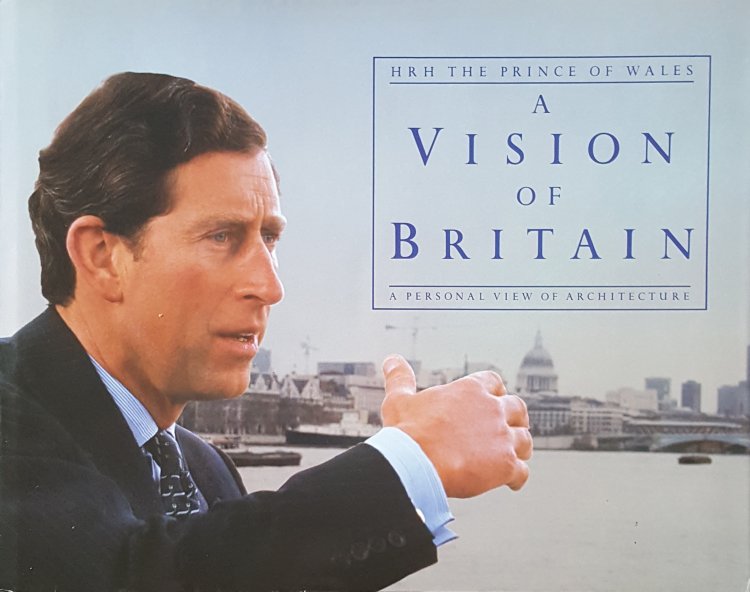
No prizes for guessing what put Prince Charles on my mind this week of his coronation as King Charles III and I knew I had a copy of this book on the shelves where it has been since I bought it new in 1989. The original version of this was a television programme broadcast by the BBC on the 28th October 1988 as part of the a documentary series called Omnibus, the script for this was then expanded and somewhat re-arranged to make the book. The main theme of the book is what Prince Charles sees as the destruction of the built landscape with modernist construction replacing beautiful old buildings especially in London although he does occasionally step outside the capital memorably describing the brutalist central library in Birmingham as
It looks to me like a place books are incinerated, not kept!
Page 32
I must admit that I tend to agree with Charles on that one and it wasn’t much loved by most people in the city which meant that although it was only built in 1973 it has since been demolished, although quite what Prince Charles thinks of the replacement I have no idea. It’s definitely an improvement and I really like the inside which is light and airy rather than the gloomy previous building.
Charles is often regarded as having a rather twee view of architecture, a classic example of which is Poundbury which as it says on the town website.
Poundbury is an urban extension to the Dorset county town of Dorchester, designed in accordance with the principles of architecture and urban planning as advocated by His Majesty, King Charles III, in his book ‘A Vision of Britain’.
Not many books can claim to have been the basis for an entire town of 4,600 people, planned to rise to 6,000 when development is completed in a couple of years. And whilst it is rather fake looking in places it is a viable community with businesses, schools and other civic amenities created within it rather than thought about afterwards which seems to be the current process for new built large developments. Charles is still involved in the overall design plan for Poundbury and whilst I don’t think I would want to live there I can see what he tried to do.
The book is particularly scathing about architectural developments in the UK since WWII and whilst he does find much to praise this is invariably where the architect has looked backwards in history for inspiration. The book is heavily illustrated both of buildings he likes and those derided and you quickly get the feeling for his ten principals for good buildings and design. In summary these are:
The Place – respect for the existing landscape
Hierarchy – the importance of a building should be obvious
Scale – size of buildings in relation to the buildings surrounding them
Harmony – buildings should not be jarringly different from their neighbours
Enclosure – public squares and enclosed spaces rather than row upon row of similar houses
Materials – use local materials where possible, the beauty of our ancient towns and cities constructed of local stone and brick
Decoration – there should be some, not the all too common featureless brick walls
Art – again have some
Signs and Lights – these are necessary but need not be overwhelming and should be well designed
Community – building a community with spaces for people to gather is essential
All in all the book definitely expresses a vision for the future even if a lot of it is deeply rooted in the past. Thirty five years after he made the documentary Charles still very much believes in what he said then. There are buildings he hates in the book which I quite like and as I said I wouldn’t want to live in Poundbury but there is a lot to agree with him. There have been some truly awful buildings created and a lot of really lovely ones lost in the last eighty years.
This book contains all eighteen short stories Arthur C. Clarke wrote in the 1960’s, including one set in his beloved Sri Lanka where he had moved to from England in 1956 and resided there until his death at the grand old age of ninety in 2008. Although all the stories were written in the 1960’s the last two didn’t actually get published until the early 1970’s including probably the strongest of the works in the book ‘A Meeting With Medusa’. The title story ‘The Wind From the Sun’ is also one of my favourites from this, the sixth collection of short stories by Clarke, it’s original title was ‘Sunjammer’ and it is still occasionally published under that name but Clarke explains in the preface that he changed its title as fellow SciFi author Poul Anderson used the same title, and indeed the same concept of sailing the solar wind, almost simultaneously in early 1963. To add to the confusion, and this time not mentioned by Clarke, another SciFi writer, Jack Vance, also had the same idea and published a similar story ‘Gateway to Strangeness’ also known as ‘Sail 25’ although that came out in late 1962. All three men had come up with the same idea independently and had no idea of each others work and the time taken to get things into print more than allows for the disparate publishing dates.
Perhaps inspired by the co-incidences around ‘Sunjammer’ there is another short essay included in this book entitled ‘Herbert George Morley Roberts Wells Esq.’ which describes Clarke’s absolute conviction that a story called ‘The Anticipator’ was written by H.G. Wells and he had written as such in his single page short story ‘The Longest Science-Fiction Story Ever Told’ which precedes the Roberts/Wells essay in the collection. In fact ‘The Anticipator’ was written by Well’s contemporary Morley Roberts and in the essay he explains that the story is about a high quality writer who keeps having the plots of his stories hijacked by a hack writer and published just before his version comes out so that the general public assume that he is constantly plagiarising the less good author so it is somewhat appropriate that Clarke didn’t get the true authors name right. It happened again to Clarke in 1979 when his book ‘The Fountains of Paradise’ was published at the same time as Charles Sheffield’s ‘The Web Between The Worlds’ both of which are about the construction of a giant tower all the way up to geostationary orbit which would operate as a space elevator therefore removing the need for rockets to reach space. Both novels have a similar construction method using a robot called Spider, both towers are built by a engineer who had previously constructed the longest bridge in the world and there are several other identical, or near identical features including the engineers name beginning with M. Again neither author knew about the others work it was simply an idea whose time had come.
All but two of the stories in this collection take place within the Solar System, the exceptions being ‘Crusade’ and ‘Neutron Tide’ and most occur on the Earth or Moon. This is another feature of Clarke’s science fiction writing, not for him universe wide adventures or galaxies at war which a lot of his contemporaries wrote about. Clarke, for the most part, is a more grounded writer. That doesn’t mean they are less fantastical just less space opera and more extensions of the readers understanding. ‘Maelstrom II’ for example has a man on his way home from the Moon when the, normally freight carrying, railgun that he is using as a cheaper way to get back malfunctions so he doesn’t have enough speed to achieve escape velocity. Yes it’s science fiction but everything in the story is valid science.
Arthur C. Clarke had a first class degree in mathematics and physics from King’s College London and used his scientific training in his writing, always making sure, as much as possible, that any concepts he came up with had a valid scientific basis. This makes him one of the strongest writers of science fiction as opposed to fantasy, when Clarke describes the fall into the atmosphere of Jupiter in ‘A Meeting With Medusa’ or the astronomical observations in ‘Transit of Earth’, which has an astronaut on Mars watching Earth cross The Sun you can be sure that the figures used are as accurate as 1960’s science allowed. Clarke didn’t come up with the idea of geostationary orbit but he did write the first scientific paper describing how satellites placed there would be perfect for telecommunications.
It’s a fun set of short stories and I was surprised how well I remembered several of them from when I first read the book in the mid to late 1970’s.
The Struggles of Brown, Jones & Robinson, as the book is properly titled, is one of Trollope’s less well known and even lesser read novels. I don’t know why The Folio Society in their complete Trollope novels series decided to drop ‘The Struggles of’ from the title other than the probable difficulty of fitting all the words into the standard spine layout for the series. That this is a relatively unknown work can be judged by its sporadic printing history and the fact that even The Trollope Society themselves largely dismiss it in a single paragraph write up and that the list of primary characters on that web page fails to mention any of Mr Brown, Mr Jones or Mr Robinson. I mentioned the printing history because it is so odd for a novelist of the stature of Trollope, Longman along with Chapman & Hall both declined the novel and it first appeared in eight monthly parts in The Cornhill Magazine in 1861/2. Despite being written in 1857 it didn’t appear as a book until American publisher Harper’s Library issued a copy in 1862, the first British edition was Smith, Elder’s (who also published The Cornhill Magazine) copy in 1870, there then followed another American edition in 1882 and then nothing for ninety nine years!
It largely seems to have been reprinted since 1981 as part of sets of complete works with no publisher judging it sufficiently commercial to make it a stand alone book in its own right. Indeed even The Folio Society, whose copy I have, left it to the last to be printed of the forty seven Trollope novels in their complete set which they started in 1989 with ‘Can You Forgive Her?’ and finally finished in 1999 with this book and then topped off the collection with Trollope’s autobiography. There isn’t even a Wikipedia entry for the novel. With all that in mind it was with some trepidation that I decided to see if it was really that bad.
Happily the answer is no, and whilst it isn’t a great novel I definitely enjoyed it both as a satire of the advertising industry and a tale of intertwined relationships. To set the scene Mr Brown becomes a widower at the start of the book and gains control of his wife’s butter business which he has no interest in so subsequently sells. He has two daughters Sarah Jane who had married Mr Jones and Maryanne who is single but has promised marriage to Mr Brisket, the butcher. Mr Robinson has fallen in love with the flighty Maryanne to the extreme annoyance of the much larger butcher who several times threatens him with violence if he doesn’t stay away from her. Oddly the three title characters subsequently start a business together selling haberdashery which none of them know anything about, with Brown putting up the money, Jones being the floor manager and Robinson in charge of advertising, he also takes charge of the decor and uniforms in the shop which is themed around the recently invented colour, magenta. The original capital in the business is stated as £4,000, which is the equivalent of around £365,000 today, a massive sum to start a small business with, but right from the off the partners, encouraged by Robinson, planned big with significant premises at 81 Bishopsgate Street and a significant amount of staff to match. What they didn’t have was much stock as Robinson was convinced that spending a lot on advertising would bring people in and then you could sell them what you had, rather than what you had promised you had.
It is not only Robinson’s extremely expensive advertising ploys, which range from horse riding knights in armour, to liverymen handing out leaflets but Jones’s dodgy selling which involved putting high quality items in the windows with low prices then actually selling similar looking but lower quality items to the customers for the same price which leads to the reputation of the business starting to fall away. Brown meanwhile is still dealing badly with his two daughters who see their inheritance frittered away in the business whilst he banks less than the actual takings and salts some away from himself. It’s difficult to find a single likeable character in the book with the possible exception of Robinson who is more naive than criminal, Brown’s two daughters are truly horrible and I rejoiced when Maryanne, after playing Brisket and Robinson off one another throughout the book ends up with neither of them and both count themselves lucky to be rid of her.The firm needless to say burns through the large amount of capital it started with in about a year and goes bust, a story that could be applied to numerous businesses that have more ideas than plans or solid foundations. It would have been interesting to see what Trollope would have made of the various overinflated dotcom and IT companies and dodgy banks built on loans to them over the last twenty years but ‘The Struggles of Brown, Jones and Robinson’ is an excellent primer on dubious companies living well beyond their means but believed to be sound right up until they crash. It may not ever have been rated highly but it should be read by anyone looking to start, or invest, in a company in the present day.
The forty eight Trollope books in the complete works set by the Folio Society.
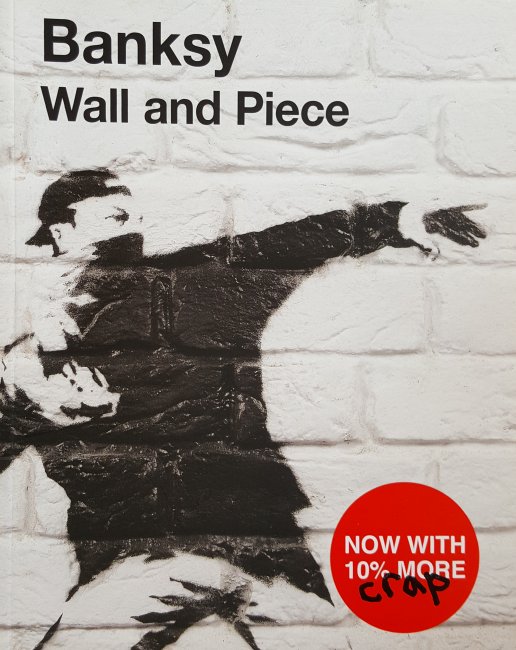
Iconic and famously anonymous graffiti artist Banksy first wrote about his works in three small books just 148mm x 105mm (5.8″ x 4.1″) Banging Your Head Against a Brick Wall came out in 2001, Existencilism in 2002 and Cut it Out in 2004. I bought Banging Your Head Against a Brick Wall when it came out but unfortunately missed the other two which were also published by Banksy’s own Weapons of Mass Distraction publisher. I say unfortunately because you cannot pick up any of these for less than £100 each nowadays. Far easier to find is the subject of this weeks blog Wall and Piece first published in 2005 by Century, part of the Random House group, and much larger at 257mm x 210mm (10.1″ x 8.3″) and 240 pages and which is in full colour unlike the small black and white only books which are just 48 pages long.
As for the ‘Now with 10% more crap’ sticker on the cover, my edition is the 9th impression and talking to a friend who has an earlier version, without the sticker, she confirmed that my copy is noticeably thicker than hers. We haven’t done a page by page comparison to establish the additional material but it was clearly an evolving project and I would have expected this to be a second edition rather than the 9th impression of the first. Wall and Piece, as a mass produced book running into multiple print runs is unsurprising quite cheap to find second hand, costing just a few pounds although I bought it new from a book shop and paid full price (£12.99) for mine.
The art is roughly in chronological order, starting with his chimp wearing a tabard with assorted messages on it to his rats which is when he really started to be noticed with his instantly obvious style and sense of humour. It is probably the fun in what he does that makes him so different to the vast majority of graffiti artists and which makes him so collectable with one of his works recently selling for £18.5 million, including premiums at auction. But this book takes us back to the beginning and he explains where the idea for the stencils came from, he was trying to paint ‘LATE AGAIN’ on the side of a train and taking far too long about it so that the police arrived and he only avoided being caught by escaping through thorn bushes and then hiding under a dumper truck. Looking up he saw the stencilled plate on the base of the fuel tank.
I got home at last and crawled into bed next to my girlfriend. I told her I’d had an epiphany that night and she told me to stop taking that drug ‘cos it was bad for your heart.
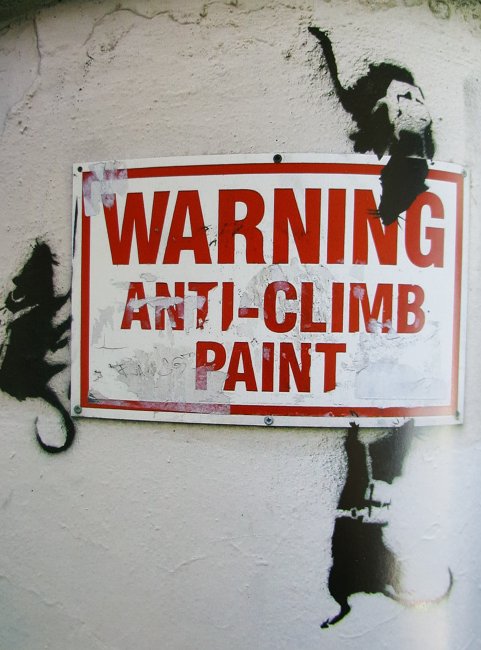
More rats, and this shows how he makes use of existing things on the walls he paints on either because it’s funny as in this example or because he is trying to make a more serious point. The vast majority of his works in the past have been either painted over or simply cleaned off the wall involved so it is the photographic records that are his lasting legacy. Most recently, due to the considerable value of his authenticated works, huge sections of wall have simply been removed and presumably sold such as the seagull art in Lowestoft taken earlier this month, see here.
The newest works in the book are from 2005, which is when the book was first published, and feature the works that Banksy, and a team of helpers, painted on the segregation wall illegally built by Israel through the occupied West Bank, the one above is near the checkpoint in Ramallah. They mainly appear to be holes in the wall with attractive views, one has a mountain range, another a tropical beach although one looks simply like the dotted line with scissors used to surround items to be cut out from printed items, this particular image is over twenty feet high. Although the paintings are largely appreciated by the inhabitants Bansky describes the wall in the book as something that “essentially turns Palestine into the world’s largest open prison.”
Old Man You paint the wall, you make it look beautiful Me Thanks Old Man We don’t want it to be beautiful, we hate this wall, go home
One section I particularly like deals with his re-interpreted art such as Sunflowers (from a Petrol Station) seen above. Banksy has managed to hang his parodies in numerous famous galleries by simply walking in and putting them up usually with explanatory cards in the form used by the gallery itself. These establishments include The Tate Gallery in London, The Louvre in Paris, The new York Metropolitan Museum and the Natural History museums in both London and New York amongst others. In the book these works are often accompanied with various photographs of Banksy hanging the ‘fake’ painting, the pictures normally survive on the walls for a few hours before being removed after which they have been discarded by the gallery or more recently added to their own collections.
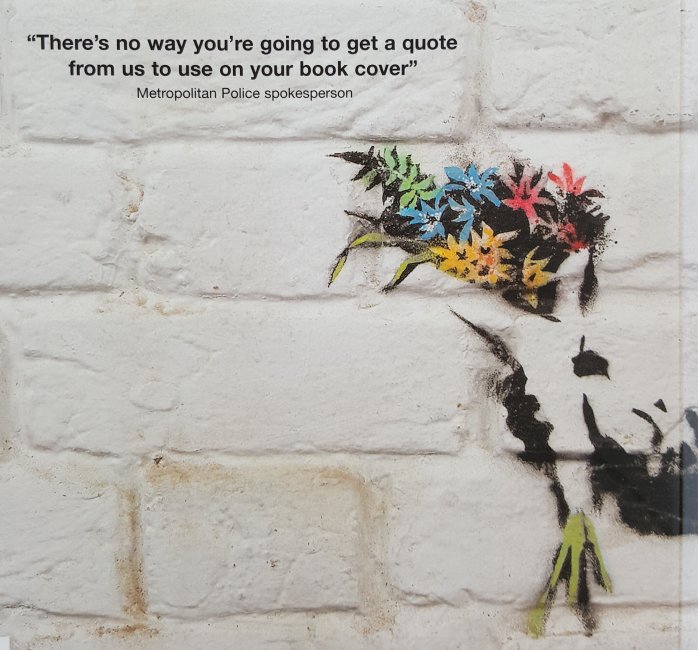
Above is part of the rear of the book which not only completes the image on the front where the masked man is shown to be throwing a bunch of flowers rather than the Molotov cocktail that might have been expected from first impressions but also includes a quote from the Metropolitan Police, London’s police force, which may or may not be genuine.
Finally below is the book that started it all, a lot of the images from ‘Banging Your Head Against a Brick Wall’ are also in Wall and Piece but in colour and much larger than could be achieved in such a small book. Surprisingly though there is a quite a lot of text in this small volume whilst Wall and Piece is largely a picture book, although it does include quite a bit of information about the various styles he has used and little bit of biographical detail but not enough to come any where near identifying him. There are also hints for how to do your own stencil graffiti in a few pages at the back and some introductory paragraphs at the start of each section.
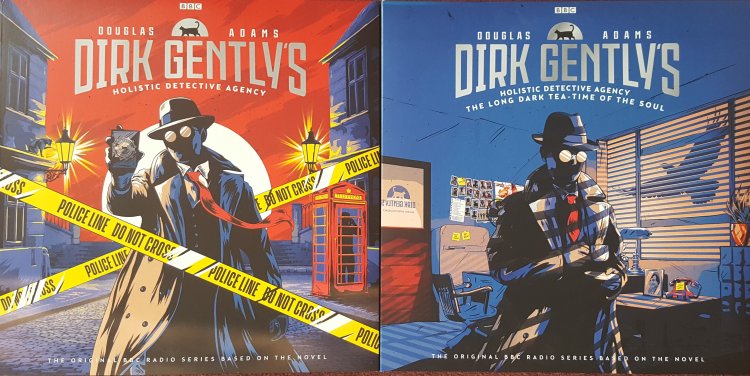
This is the 275th entry in this blog so by way of something different this is not so much a ramble along my bookshelves as a wander through my record collection. But it does concern two books, specifically the two Dirk Gently novels by Douglas Adams in the form of the wonderful adaptations done by Dirk Maggs and John Langdon for B.B.C. radio in 2007 and 2008 and first released on vinyl by Demon Records in 2020 and 2021. Each is a triple album with an episode a side so a total of six hours of listening pleasure and boy is it a pleasure. Dirk Gently is a Holistic detective in that he uses apparently unrelated objects and experiences in order to solve his cases, the stories are also very funny. The pressings are high quality coloured vinyl which along with the design of the sleeves and liners add considerably to the joy when I first unpacked them.
The cast is also superb with Harry Enfield playing Dirk Gently, Olivia Colman is Janice his long suffering secretary, Billy Boyd is Richard MacDuff and Jim Carter is Detective Sergeant Gilks. These four appear on both sets of records with other cast members including Andrew Sachs, John Fortune, Jan Ravens and Peter Davison to name just a few. There are also several stalwarts of the Hitch-Hikers Guide to the Galaxy radio series, the original scripts of which I reviewed here, such as Stephen Moore, Michael Fenton Stevens and Philip Pope who also wrote the incidental music for both Dirk Gently series. By the very nature of cutting both books down to three hours each when the Audible recordings of the books being read are just short of eight hours each clearly a lot has been lost, but this is true of any dramatisation and frankly I largely prefer the audio dramatisations to the books, especially The Long Dark Tea-Time of the Soul for reasons I will explore when I get to that section.
Dirk Gently’s Holistic Detective Agency
This was probably originally Douglas’s attempt to get some use out of a script he had written for Doctor Who called Shada which had been abandoned shortly after filming had started due to a strike by B.B.C. technicians. The similarities between the two works are obvious and whilst Douglas removed the specific Doctor Who references and merged in part of the plot of City of Death, another Doctor Who serial he wrote, the central character of Cambridge professor Chronotis having a time machine and living for centuries remains the same. In Shada he was a Time Lord, in Dirk Gently it is never explained who or what he is but they do use his time machine, which is actually his rooms in college, to travel to an ancient spaceship orbiting the Earth and back in time four billion years to the start of life on the planet. The new material concerns a character Gordon Way who is killed right at the start but continues to appear as a ghost trying to contact the living and explain what happened and it is his death that Dirk Gently ultimately solves in proving that his client Richard MacDuff didn’t do it and Way was actually killed by an ancient and malfunctioning robot from the orbiting spaceship.
This adaptation is pretty faithful to the original book, which can not be said of the second recording for reasons explained below.
The Long Dark Tea-Time of the Soul
The title of this book comes from another of Douglas’s works, the third of the Hitch-Hikers books, and is said of Wowbagger the Infinitely Prolonged, an immortal character who was not born to immortality and was therefore not prepared for it.
In the end, it was the Sunday afternoons he couldn’t cope with, and that terrible listlessness which starts to set in at about 2:55, when you know that you’ve had all the baths you can usefully have that day, that however hard you stare at any given paragraph in the papers you will never actually read it, or use the revolutionary new pruning technique it describes, and that as you stare at the clock the hands will move relentlessly on to four o’clock, and you will enter the long dark teatime of the soul.
Life, The Universe and Everything – Douglas Adams
The original book is somewhat complicated and jumps around rather a lot as Douglas keeps track of the various characters and this meant that Dirk Maggs had to do a severe rewrite in order to produce something that would work in six episodes without completely confusing the listener. He also brought back Richard MacDuff, who doesn’t appear in the book, and made him a character in this version, there are also a lot of added Hitch-Hikers Guide to the Galaxy references as Dirk had recently adapted books three, four and five of that series into radio productions. It also features a fridge that has not been cleaned for months and eats the person who first tries to do so. A client for Dirk is later found ‘listening’ to an album but unfortunately it is jumping mainly because the arm is bouncing off his severed head which is now on top of the turntable. There are also major character appearances for Odin and Thor and the explanation as to where Asgard can be found in modern London and how Janice, now an innocent Heathrow airport check in clerk, became cursed and turned into a drinks machine.
Douglas Adams had been working on and off on a third Dirk Gently book intended to be called The Salmon of Doubt up until he died, and this work, along with other unfinished pieces was eventually published as The Salmon of Doubt in 2002. Dirk Maggs originally intended to dramatise this as well but plans were shelved by the B.B.C. before any work was done on this.
This book is a lot of fun, especially if you know the film well as it contains the forty five page first draft, which was used for pitching for funds to make the film, along with the much longer final draft. The original version actually bears little relation to what was actually filmed and even in the final versions there are a lot of sections crossed out with pen amendments alongside so it was clearly a work in progress even whist being filmed. Alongside these two scripts are sketches of possible titles and posters, lots of stills from the film, a statement of accounts as to how much the film cost to make, a total of £229,575 for those of you who are interested and a letter from the producer to Michael Palin.
I feel this tells anyone who hasn’t seen the film quite a lot about it and it is very funny for those of us who have seen the film numerous times and can quote large sections.
It’s the ephemera and the pen amendments that for me make the book so interesting you can see the Python team improving the work as things are going on and they spot opportunities to tighten the humour, such as the section below. This is part of the fight between the three headed knight and Sir Robin which in the original final draft takes 3½ pages of typescript but is replaced with 1½ pages of handwritten alterations which got rid of a lot of the bickering between the heads and speeded up the arrival of the punchline “He’s buggered off” which isn’t even on this page of the script.
On his way to this fight, which as alluded to above Sir Robin ran away from, his minstrels had been singing songs of his bravery but written in such a way as to terrify the knight, which can be seen below. I have included this double page spread to give some idea as to how the book is formatted. On the left, which would have been blank in the original script are all sorts of interesting items such as the Daily Continuity Report seen here, but it could be snapshots from the set, notes on possible improvements, sketches by Terry Gilliam etc. In short anything at all that the editors of the book and Derek Birdsell, the designer, thought would be fun to include. It makes a wonderful mish mash of ideas about how the film is, or should, be progressing and adds a huge amount to what could have been a simple reproduction of the script.
I just had to include one of my favourite sections from the first part of the film where Arthur and his knights have arrived at the French castle, not riding horses but banging coconut shells together in the classic sound effect method to simulate horses hooves. This then leads to a side discussion as to where they had got the shells which comically keeps interrupting the main flow of the text. It is particularly fun as the swallow has become so iconic when attached to this section of the script to see that they originally intended a whole selection of different birds including a gannet, plover or a merlin which would have been a funny preshadowing of later in the book when they do encounter a parody of Merlin in the form of Tim the Enchanter.
The film ends on the shore of a lake where the knights are preparing to embark on their last great adventure but by this time the budget had largely run out and the Python’s decided to simply end the film there with a modern day police raid which stops filming. A truly surreal end to the film in a truly Monty Python way.
The rear cover has lots of suggested advertising slogans all in the form of obviously fake quotes including the then Prime Minister, Margaret Thatcher, her predecessor Edward Heath, and Richard Nixon who had resigned the American presidency following the Watergate scandal just four days after Mark Forstater’s letter the Michael Palin reproduced above. As can be seen I have the first edition of the book published by Eyre Metheun in 1977. Later editions drop the cut out folder format of the cover for a more ‘normal’ binding.
A five thousand year old story rediscovered on cuneiform tablets in the ruins of Nineveh in what is now Iraq back in the nineteenth century, this epic series of poems is probably the oldest piece of literature we have available to us today. This Penguin Classics edition is described as an English version rather than a translation because N.K. (Nancy Katharine) Sanders didn’t go back to the original cuniform or even later Assyrian texts but rather compiled the story from existing translations to provide a ‘readable’ rather than scholarly interpretation. The original tablets are damaged with a lot of them broken in bits with parts in different museums around the world and several sections are missing altogether, which makes the task of translating even more difficult that it should be. What Sanders has achieved is a knitting together of the various existing versions, which by definition also have large gaps or variant approximations as to what could have been the meaning of damaged sections. She also wrote an excellent introduction which is roughly as long as the surviving parts of the epic itself and which is highly necessary if the reader is to understand anything of the background to a story from 3000 BCE. This book is an original piece of work for Penguin Classics and my first edition is from 1960 and is a prose version of the original epic poem.
This version of the Epic of Gilgamesh is in seven parts and whilst they are mainly linked it cannot be called a continuous narrative, there may well be other sections still to be discovered even now on the tens of thousands cuneiform tablets or fragments thereof spread around the world in various museums, quite a few of which have yet to be translated, but let’s take the sections we have one by one.
The Coming of Enkidu
At the start of the tale Gilgamesh is the all powerful ruler of the city of Uruk (now Warka in Iraq) situated on the Euphrates river and his people were frightened of him because he had nobody to challenge him so he took everything and everyone he wanted.
But the men of Uruk muttered in their houses, ‘Gilgamesh sounds the tocsin for his amusement, his arrogance has no bounds by day or night. No son is left with his father, for Gilgamesh takes them all, even the children; yet the king should be a shepherd to his people. His lust leaves no virgin to her lover, neither the warrior's daughter nor the wife of the noble; yet this is the shepherd of the city, wise, comely, and resolute.'
A tocsin is an alarm bell and should only be used in emergencies to rouse the defences of the city, but clearly Gilgamesh found it amusing to just raise panic amongst his population. To counteract him the gods decided to create an equally powerful being, Enkidu, who would provide sufficient distraction for Gilgamesh so that his people were safer from his excessive desires. This they duly did and almost at first sight Gilgamesh and Enkidu became firm friends and the plan by the gods worked as they spent a lot of time together mainly outside of the city so peace largely reined in Uruk.
The Forest Journey
This is a tale of Gilgamesh and Enkidu heading off to a mighty forest in search of huge cedar trees for building materials in Uruk. The forest is guarded by the giant Humbaba and he several times intervenes to try to stop them cutting down the trees but without success. Eventually seeing that he cannot prevent the felling of the cedars he offers himself as the servant to Gilgamesh and will cut down the trees for him. Gilgamesh is all for this proposal but Enkidu insists that Gilgamesh should kill Humbaba instead and this he duly does before sailing away back down the Euphrates with his cargo of sweet smelling wood.
Ishtar and Gilgamesh, and the Death of Enkidu
Ishtar is the goddess of love, but also the goddess of war in the Sumerian mythology, an interesting combination and also why Gilgamesh is not particularly enamoured by her approach to him at the very start of this section
Gilgamesh Washed out his long locks and cleaned his weapons; he flung back his hair from his shoulders; he threw off his stained clothes and changed them for new. He put on his royal robes and made them fast. When Gilgamesh had put on the crown, glorious Ishtar lifted her eyes, seeing the beauty of Gilgamesh. She said, ‘Come to me Gilgamesh, and be my bridegroom; grant me seed of your body, let me be your bride and you shall be my husband.
Whilst it is clearly an honour for a man to be approached by a goddess in this way Gilgamesh is all too aware of the fates of previous mortals who had dallied with Ishtar which were not good and he doesn’t want to end up as a bird with a broken wing or transformed into a mole to give just two examples. In her rage at rejection Ishtar sends a mighty Bull of the Heavens to destroy Gilgamesh and his city but Gilgamesh kills it and in petulance she then persuades other gods to kill Enkidu and so deprive Gilgamesh of his companion.
The Search for Everlasting Life
In his despair at the death of his friend Gilgamesh takes to the wilderness, living off what he can hunt and wearing animal skins whilst determining to seek for the secret of eternal life. He has many adventures but is generally shunned due to his unkempt appearance until he finds a way to get to a man who already has to power to live forever. This section is somewhat confused either because sections of the story are missing or there is another story, which would have been well known five thousand years ago when this tale was first transcribed, which fills in gaps in the narrative and explains important details.
The Story of the Flood
We suddenly get a lurch away from the stories of Gilgamesh and deal instead with an ancient story of inundation at the instigation of the gods who are annoyed with the noise made by the humans on Earth. This section was the most fascinating to me as it is clearly the basis for the tale of Noah in the Bible only in this version the boat builder was Utnapishtim, a man of Shurrupak, son of Ubara-Tutu and it was the wrath of gods rather than god that caused the floods to exterminate the human race. There is also a proper crew rather than Noah and his family on their own looking after all the animals on board
Then was the launching full of difficulty; there was shifting of ballast above and below till two thirds was submerged. I loaded into her all that 1 had of gold and of living things, my family, my kin, the beast of the field both wild and tame, and all the craftsmen. I sent them on board, for the time that Shamash had ordained was already fulfilled when he said, "in the evening, when the rider of the storm sends down the destroying rain, enter the boat and batten her down." The time was fulfilled, the evening came, the rider of the storm sent down the rain. I looked out at the weather and it was terrible, so I too boarded the boat and battened her down. All was now complete, the battening and the caulking; so I handed the tiller to Puzur-Amurri the steersman, with the navigation and the care of the whole boat.
They sailed for many days and to determine if the flood waters were subsided set free birds to see if they returned, just as Noah does in the biblical version. In all the two stories align extremely well so Noah is clearly a rewriting of this more ancient tale which was itself lifted from a still more ancient Babylonian story.
The Return
Having found Utnapishtim, Gilgamesh is finally told that the reason he has eternal life is that he saved mankind and all the animals in his boat and was so rewarded by the gods who had regretted sending the floods when they saw the devastation. This means that he cannot tell Gilgamesh how to live forever because it was a gift of the gods not some potion or magic. Disappointed Gilgamesh decides to return to Uruk which he does without incident in a matter of two or three paragraphs.
The Death of Gilgamesh
This is by far the shortest section, and far from a heroes death in battle which you may have expected from the epic so far Gilgamesh appears to simply die of old age worn out by his travels.
Nancy Sanders was primarily an archaeologist and was involved in digs across Europe and the Middle East. She was born in 1914 and died, aged 101 in 2015, still living in the house she was born in. There is an interesting web site dedicated to her, which can be found here.
Following the controversy around the patchy rewriting of the James Bond novels announced last month, see here, and this coming so soon after the furore concerning a similar ‘sensitivity driven rewrite’ of the Roald Dahl stories; which resulted in Penguin Books announcing they would issue the original texts in parallel so that people could chose which version they wished, I decided to have a look to see what the fuss was about. I was never a fan of Dahl as a child but I did buy two or three Bond books whilst at school and they have languished unread on my shelves for almost fifty years as it rapidly became clear that I wasn’t a fan of these either. So it is Ian Fleming that I am going to have a look at as at least I have examples. My Pan paperback of You Only Live Twice is the fifth printing from 1974 which I bought new. The book was first published in 1964.
Almost the entire book is set in Japan and straight away I hit some stereotypes of Japanese women as submissive and largely there to be decorative or as sexual playthings but these initial impressions were offset near the end of this book with the introduction of Kissy Suzuki who is definitely not submissive, or just there to be decorative, and whilst she does end up in bed with Bond it is largely at her initiative not his. There are other stereotypes presented regarding Japanese men, the high work ethic, obedience to their superiors and pertinent to the plot of the book the high suicide rate. Now I don’t know what the suicide rate was in the early 1960’s when this book was written but according to World Population Review the suicide rate is still a significant concern to the Japanese government and suicide is the leading cause of death in men between the ages of 20-44 and women between the ages of 15-34.
My main problem with the book however is that for what I expected to be an action adventure tale there is surprising little of either. That is probably due to Bond’s mission in the book which is not as a 00 agent but rather in a more diplomatic role given him as an attempt to get him back to work after the murder of his wife, of just one day, at the end of the previous novel ‘On Her Majesty’s Secret Service’. At the start of this novel Bond is a wreck, unable to concentrate on his job, drinking far too much and convinced that he is about to be fired but has no idea what he would do next. His boss ‘M’ is indeed thinking Bond is washed up but is persuaded to give him this final job to see if it can shake him back into usefulness. This means that the plot is largely Bond and Tiger Tanaka, a senior member of the Japanese secret service, having endless meetings usually involving the consumption of lots of sake whilst Bond tries to negotiate British access to a high level source of intelligence from Moscow. It is only when it becomes clear that Britain has nothing of suitable significance to offer that the main story is revealed and that is not until page 109 of what in this edition is a 190 page book and even then Bond doesn’t really do anything until page 141 when he starts to swim over to the castle and by page 171 we are reading Bond’s obituary in The Times.
But I am getting ahead of myself, Tiger comes up with a job that would do as payment and that is to eliminate Dr. Guntram Shatterhand who has established a politically embarrassing ‘Garden of Death’ filled with poisonous plants and deadly animals which has become a major draw for suicide attempts. The Japanese cannot move against him as he has presented the garden as a major resource area for biologists so has gained much honour in Japan for his apparent generosity but the sheer number of bodies returned from the grounds is worrying to the government. When Bond is shown a photo of Shatterhand he recognises that he is in reality Ernst Stavro Blofeld, Bond’s major enemy and the person who killed his wife so he is very keen to finally exact revenge however he can. I’m not about to spoil any potential readers enjoyment of the little action that takes place but suffice to say that the obituary is somewhat premature, after all Fleming wrote two more Bond books after this one.
But getting back to the language used, which was after all the reason I read this again after so many decades. Yes there are outdated stereotypes in the book, but it is a product of its time. I didn’t see anything grossly offensive in the text although a Japanese reader may find more than I spotted. ‘Sensitivity Readers’ are almost by definition overly sensitive in looking for terminology to justify their position and are determined to heap modern norms on a book which is after all almost sixty years old and which simply betrays the attitudes of its period. Quite what they would make of Chaucer’s Canterbury Tales or other classics I dread to think, let’s just hope they never pick up a copy.
These two novellas by David Garnett include his first published work, Lady into Fox from 1923 with A Man in the Zoo coming out the following year. They are both fairly short, Lady into Fox being 24,514 words whilst A Man in the Zoo clocks in at 24,133 words. This undoubtedly explains why Penguin USA decided to combine the two in a book that is still only 135 pages long. Interestingly despite Garnett being English and several other later books by him being printed by Penguin UK I cannot find either of these stories in a UK released edition from Penguin Books. My copy is the Penguin USA first edition from December 1946 and it was later reprinted by Signet.
Garnett was a member of the Bloomsbury Group and indeed married Virginia Woolf’s niece Angelica Bell although she was then 23 years old and he was 50 which caused a considerable scandal. Although not as much as if it had been known at the time that in his twenties, and indeed during the time Angelica was born, he had had an, at that time illegal, homosexual relationship with her father, the artist Duncan Grant. As well as being a novelist he was heavily involved in the publishing scene in England being an original partner of the famous private press Nonesuch Press as well as being Literary Editor of the New Statesman for six years and a director of publishing house Rupert Hart-Davies. Along with his novels I have several of his factual works, of which he wrote many, including The Battle of Britain, written during WWII, and his edited collection of the letters of T.E. Lawrence, better known as Lawrence of Arabia. From what little I have read of his fiction though he tends to the surreal and this is especially the case in his best known work Lady into Fox. ‘Aspects of Love’ which he wrote in 1955 was subsequently turned into a hit musical by Andrew Lloyd-Webber with lyrics by Don Black and Charles Hart in 1989 although I doubt that many people know that David Garnett wrote the original work even though he is credited on the posters.
Lady into Fox
Right, this is definitely an odd story about a woman who spontaneously turns into a fox whilst out for a walk in the country with her husband. This happens within a few pages of the beginning and the tale concerns how she initially retains her personality and intelligence but that both of these gradually fade away as she spends more time as a vixen. Immediately after the transformation it is almost as if she doesn’t realise what has happened to her and when her husband takes her home she tries to dress herself and wants to sit at the table when eating, they even find a way for her to play cards together. He dismisses their servants so that they won’t find out what has happened and explains that she has had to go to London for some urgent reason, he even shoots their two dogs as they just howl and bark all the time as they are aware of a fox being in the house. The deterioration of her humanity is expressed most strongly by her sleeping arrangements, for the first few days she sleeps in the bed with her husband but gradually she moves to the foot of the bed and then to the floor, before refusing to go to the bedroom at all. It is quite clear that she is becoming wilder and that he cannot keep her even as a pet tame fox. She also starts trying to escape from the house and garden until realising that she cannot be happy in captivity he lets her loose into the countryside to exist as best she can. I won’t go into the rest of the story but suffice to say that although he eventually regains contact with her it doesn’t have a happy ending.
A Man in the Zoo
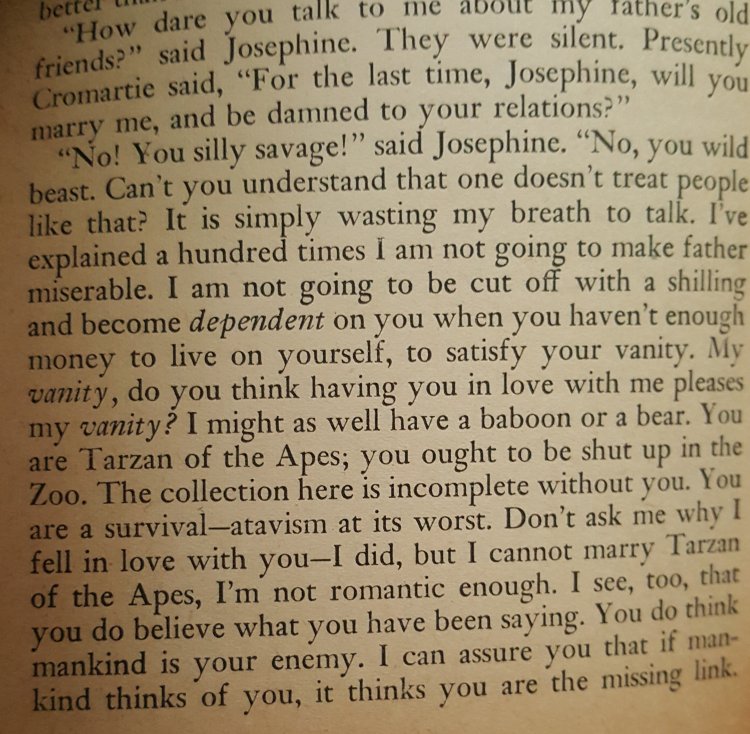
Another strange tale, but no metamorphosis is required this time. The story begins with Josephine Lackett and John Cromartie walking around London Zoo as they were wont to do on a pleasant weekend. The pair had been dating for some time and John was keen to marry Josephine but they are having a row about it as her father didn’t approve, presumably due to the lack of money on John’s behalf. I have selected below the salient part of this argument which becomes the turning point in the whole story.
The next morning John Cromartie wrote to the head of the zoo with the proposal that he should be exhibited in the great ape enclosure and thereby complete the collection. This suggestion was received by the committee running the zoo with considerable disagreement as to whether this would be appropriate but ultimately, because the main objector was disliked by a large part of the rest of the group, they agreed to the idea and a meeting was arranged with Cromartie. It was decided that he should be exhibited in ‘his natural state’ i.e. dressed in his own clothes and with a simply but well furnished living room with his books and a bedroom and bathroom both not on view to the public and that this should be laid out in the cage between an orangutan and the chimpanzee enclosure and so Cromartie moves in with the following written on the sign attached to his cage.
Homo Sapiens MAN This specimen, born in Scotland, was presented to the Society by John Cromartie, Esq. Visitors are re- quested not to irritate the Man by personal remarks.
The astonishment in the visitors later that day on finding a human displayed at the zoo was palpable and this started considerable debate not only amongst the public but in the newspapers as to the probity of the exhibit, which led to huge crowds coming to see him much to the irritation of the orangutan and chimpanzee on either side who suddenly found themselves largely ignored and without the extra titbits it was common to feed the animals at the time. The story progresses with Josephine coming to visit him several times, initially with fury in case she should be identified as his former girlfriend and determination that he had gone mad but gradually things develop and unlike Lady into Fox this does have a happy if somewhat unexpected ending.
Of the two novellas I definitely recommend ‘A Man in the Zoo’ as worth a read, less so ‘Lady into Fox’ although if you like tragedies that one might appeal. Both stories are now pretty well out of print (I have found some print on demand editions and they are also available on Kindle) however they can be read on Project Gutenberg. Lady into Fox is here, and A Man in the Zoo can be found here.










 Ramblings on my bookshelves