A series of essays inspired by books that I own, talking about their history, some reviews and also how they came to be on my shelves. With over 6,500 books here and several more arriving each week I doubt I'll ever be short of a topic.
2005 was Penguin Books seventieth anniversary and to mark the occasion they published seventy books at £1.50 each which were largely extracts from other works in their vast back catalogue as is this one although this is collated from several collections of short stories. With Borges though, as he is mainly a writer of short stories, you ended up with seven complete works in the book and as an introduction to his literary output this book is excellent. The art of writing a short story is extremely difficult as in a short space you must not only have a beginning, a middle, and an end but also express an idea or indeed several which will leave the reader satisfied and in all seven of these Borges has proved himself well able to meet those aims. Knowing that he was Argentinian I was expecting South American themes but instead the first two ‘The Mirror of Ink’ and ‘The Lottery in Babylon’ are set in the Middle East, the third ‘The Library of Babel’ could frankly be anywhere and everywhere. The fourth ‘The Theme of the Traitor and the Hero’ is in Ireland, ‘The Witness’ is probably medieval England, ‘Ragnarok’ could also be anywhere, whilst the final story ‘Blue Tigers’ is based in rural India. A linking theme, if there is one, is the somewhat mystical and fantastic ideas behind all of these stories, that and the definite quality of the prose. I hadn’t read any of Jorge Luis Borges before this slim volume and indeed this is the only book of his work that I possess but I definitely need to read more.
Sadly Borges suffered from fading eyesight for many years and became blind at the end of the 1950’s however he continued to write, dictating stories initially to his mother who took on the role of his secretary until her death. The last two stories in this book were written after his blindness and there is certainly no diminution of the power of his writing. I just want to pick out a couple of the stories that I particularly enjoyed:
‘The Library of Babel’ is an exploration of the concepts of infinity in that the library described contains all possible books that are exactly 410 pages long with a fixed format of forty lines per page and eighty characters per line where a character is one of twenty two letters of the alphabet, a full stop, a comma or a space and all combinations of these appear at least once in one of the infinite series of books stored in the apparently infinite number of replicating hexagonal galleries that make up the library. The concept of a library that because it has all combinations of the twenty five characters and therefore contains books of apparently complete nonsense but must also due to randomness have every book that could possibly exist expressing every theme and also arguing both for and against every idea is beguiling. The impossibility of ever finding a specific work is also clearly spelled out along with some of the oddities of infinite series in that a revolution in the past had destroyed countless volumes but that this didn’t matter because books survived elsewhere in the library which differed from the vandalised editions by as little as a punctuation mark somewhere within them.
‘Blue Tigers’ also drew me in with a weird mathematical theme, the tigers are not flesh and blood but a collection of odd blue disks that the narrator finds on top of the plateau of a sacred hill. These discs are uncountable, initially he thought he had around ten of them but when examining them found far more. Sometimes there would be as little as three but holding these few and then letting them fall could reveal hundreds. The narrator spends nights trying to find a pattern to the ever increasing, and decreasing, quantities without any success and eventually, to save his sanity, he gives them to a blind beggar who seems to understand in someway that he is the fitting custodian.
Naturally the four mathematical operations – adding, subtracting, multiplying and dividing – were impossible. The stones resisted arithmetic as they did the calculation of probability. Forty disks, divided, might become nine, those nine in turn divided might yield three hundred. I do not know how much they weighed, I did not has recourse to a scale, but I’m sure their weight was constant, and light. Their colour was always the same blue.
As 2005 was the seventieth anniversary it is clear that this year (2025) is the ninetieth and again Penguin have marked their birthday with a set of books, this time ninety of them at £5.99 each, some of which will be featured in this blog as the year goes on. The actual anniversary is the end of July so I am dedicating my August theme this year to the first four Penguin titles, which I will be reading in their first Penguin editions something I don’t do often due to the fragility of these ninety year old paperbacks.
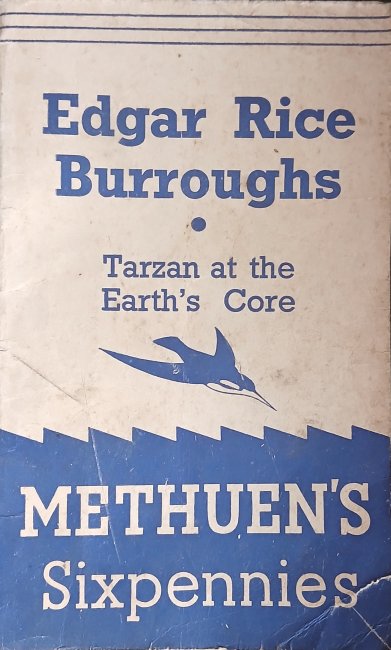
Inspired by last week’s book and author Michael Moorcock’s evident liking in that volume of the work of Edgar Rice Burroughs, along with my recent purchase of my first book by that author the intriguingly titled Tarzan at the Earth’s Core I just had to take it off the shelf and give it a go. I’ll come to why I bought the book at the end of this blog, it wan’t because of any particular interest in Burroughs or indeed Tarzan though.
I knew Burroughs had created Tarzan along with the science fiction works featuring John Carter of Mars but that was as far as my knowledge of him went. It turns out Burroughs was rather more prolific than I had imagined and amongst his vast output there were twenty six Tarzan titles of which this is the thirteenth and he also wrote seven books about Pellucidar, his name for a land hidden inside a hollow Earth and this crossover book is the fourth of those. Unlike Jules Verne’s ‘Journey to the Centre of the Earth’ or Bruce Carter’s ‘The Perilous Descent’ Burroughs has his Earth interior concave on an interior surface of the Earth five hundred miles below the surface we know with a central sun so it is always noon regardless of where you are. He does however have it populated by dinosaurs and primitive man like Verne does.
It was odd starting with Tarzan thirteen as the character is nothing like the one I remember watching as a child in films on television played by Johnny Weissmuller forever swinging through the trees and having little to do with civilisation. The Tarzan in this book is just as happy back in England as Lord Greystoke as he is in the jungle he grew up in, indeed when he sets off on the adventure he is sharply dressed in a suit and tie. The book however starts with Tarzan in the jungle coming across an expedition which was actually designed to find him and try to persuade him to join the plan to rescue the Emperor of Pellucidar from the hands of the Korsars, first though he has to have Pellucidar explained to him which is useful for those of us reading about this series of books for the first time. Needless to say he does go and brings along ten of the native warriors who regard him as chief and these along with numerous engineers and other staff set off on a huge experimental airship nine hundred feet (275 metres) long to fly to the north pole and find the entrance to Pellucidar. The hole is so large that they fly the airship down to Pellucidar and land to reconnoitre and the next morning Tarzan is seen leaving the ship dressed as he would normally be in the jungle and heading for the nearest trees.
This is of course where the whole plan starts to go wrong. Tarzan feels at home in the trees, so much so that he isn’t paying full attention to his surroundings, steps into a trap and is captured by a group of gorilla people. After a couple of days the crew of the airship are concerned that he hasn’t returned and a search party is organised consisting of officers from the ship and the native people Tarzan brought with him, these however get caught up in a ambush by sabre tooth tigers on the various prey species in the jungle. After the massacre has finished all the crew and native people appear to be OK but are now no longer together and they cannot find their way back to the ship due to the un-moving sun which ruins their sense of direction. Eventually those left at the ship, after a period of several more days decide to use the light aircraft they brought with them to search for the others but this ends up crashing so stranding yet another member of the party. The book tells the stories of the various groups as they survive and search for each other and the airship with the help and hindrance of various Pellucidar inhabitants and is a great adventure story if you allow for the errors regarding the prehistoric animals they meet. Unfortunately this searching for each other takes up so much of the book that the final denouement of the rescue of the Emperor is a bit of a rushed let down. That said I enjoyed the book, not enough to search out any more Tarzan or Pellucidar books, but it was a pretty good if rather dated read.
So why did I buy the book? Well it is all the fault of Jules Burt and an Instagram post of his where he talked about the difficult to find Methuen Sixpence’s, a very short lived attempt at being a competitor to Penguin Books, and that he had bought a complete run of the thirty seven titles from the Eric Gadd collection. This meant he had some spares which I then bought off him as I only had one example in my collection. Now I have enough to justify trying to complete the set myself even though I know they are rare due to poor quality wartime paper, they were published between 1939 and 1941, and not many of each title being printed in the first place. This explains the somewhat tatty condition of this example but frankly getting them in any condition is tricky.
Michael Moorcock is a highly respected fantasy author, probably best known for his epic ‘Tales of the Eternal Champion’ which comprises 6,583 pages in the consolidated fourteen volume UK collection shown below from my own collection. Oddly due to copyright issues the UK set is missing two volumes which were only available in the USA whilst the fifteen volume USA set is missing one volume that was only available in the UK. As the design of the sets is very different I’ve elected not to seek out the two USA volumes and to stick with the UK set.
This book however is not part of one of his fantasy series but rather consists of six essays exploring the origins and development of epic fantasy, praising authors he likes and denigrating those that he doesn’t. A warning to fans of JRR Tolkien he doesn’t regard the Lord of the Rings as a serious piece of adult fantasy, the main clue is that the essay largely concentrating on this work is called Epic Pooh, but let’s get to that later on..
In the introduction Moorcock attempts to define his subject, tracing it’s sources back to Icelandic sagas, the Arthurian legends, Gilgamesh etc and the influences these had on the Romantic poets and Victorian novel writers such as Walter Scott and then leaping forward to HP Lovecraft. Personally I find both Scott and Lovecraft largely impenetrable, Moorcock also doesn’t rate Lovecraft describing him as “that somewhat inadequate describer of the indescribable”. The first essay is called Origins and as the title implies looks at the early days of epic fantasy. For me this was the least successful of the pieces in the book, largely because the authors and works he picks to illustrate his study are either ones I have never heard of let alone read, and from the descriptions they aren’t likely to be going on my reading list either. So whilst it added to my knowledge of the very early days of fantasy, we are talking the 1500’s to 1700’s here it largely felt as an exercise telling me what to avoid although the development of the Gothic novel was quite interesting.
However after this rather flat start the book improved dramatically as it started to deal with fantasy as I would more normally regard it. This is split into separate sections, looking first at fantasy landscapes and making the very reasonable point that if you don’t believe the lands that the characters inhabit you are far less likely to believe the stories they are involved in. Badly described geography can be a serious impediment to a readers enjoyment. Moorcock quotes extensively throughout the book picking good and bad examples of prose to illustrate his points. Having established the importance of somewhere for the heroes and villains to exist in he then moves onto character development looking at heroes and heroines in particular. The fourth essay deals with wit and humour, this is not just comedic fantasy or parodies but also introducing wit in the characters dialogue, an eternally dour character is probably going to be unlikable. It was at this point that I realised just how old this book is (1987) as he praises Terry Pratchett and says that Mort, the fourth Discworld novel had recently come out. This means that a lot of the ‘comic’ fantasy that has appeared in the last four decades are all after Moorcock wrote this work.
Now we get to ‘Epic Pooh’, Moorcock’s dissection not only of the works of Tolkien but also the Narnia books of CS Lewis and others of their ilk. I think I should start with a quote:
The sort of prose most often identified with “high” fantasy is the prose of the nursery-room. It is a lullaby, it is meant to soothe and console. It is mouth-music. It is frequently enjoyed not for its tensions but for its lack of tensions. It coddles, it makes friends with you; it tells you comforting lies. It is soft {here in the book is a quote from Winnie the Pooh} It is the predominant tone of The Lord of the Rings and Watership Down and it is the main reason why these books, like many similar ones in the past, are successful… The humour is often unconscious because, as with Tolkien, the authors take words seriously but without pleasure.
To be fair Moorcock does accept that at times Tolkien rises above his usual standard but quickly falls back in his failure to really explore the emotional background of his characters and almost completely ignores the character of Sauron seeing him simply as a force for evil with little explanation. But at least he is better then Lewis and here I have to totally agree with Moorcock. I find the Narnia books completely unreadable, and always have, mainly due to the ramming of the Christian message down the throats of its readers at every opportunity Lewis can find. It was only when I read this essay that I realised that I last read Lord of the Rings in my late teens so probably at the age that would most appreciate the work and before I read anything much better. I won’t go on, I do however suggest reading this book if you can find it as its been out of print for years.
A comprehensive, but witty survey… the perfect gift for any Tolkien fan you want to annoy
review in Time Out magazine
One fun bit to the book is the apparent source of the title, which is given at the start of the book as a line of poetry by a poet called Wheldrake in his poem The Elvish Rune from 1877.
And you love take my right hand, Come from the faerie folks’ last dance: And we’ll sleep and dream of Elfland, Her wizardry and wild romance.
In fact Ernest Wheldrake was a creation of Moorcock’s and is regularly quoted by one of the characters in the novel ‘The End of all Songs’ which is the third part of ‘The Dancers at the Edge of Time’ the seventh compendium volume of The Eternal Champion series shown above. So the ‘inspiration’ for the title was a piece of poetry written for the book. This by the way is the only appearance of Moorcock’s own work in this volume, he deliberately avoids self reference.
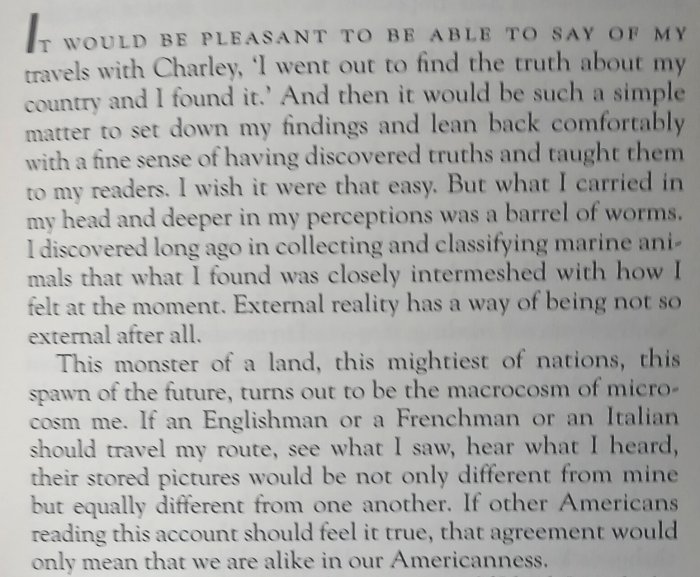
Towards the end of his life Steinbeck felt the need for one last adventure, this was 1960 and he would die of heart failure in 1968 aged just 66. His wife had long been concerned about his health and his heart condition, brought on by his heavy smoking had flared up several times in the preceding years and she was worried about his plans to travel right round the country in a converted camper van with his standard poodle, Charley, as theoretically his only companion. But Steinbeck wanted to reconnect with America, as he says at the beginning of the book:
The plan was to drive up from New York into Maine and explore the back roads of that sparsely populated state before heading along the Canadian border and into Canada by Niagara Falls, before coming back into the USA and travelling up through Illinois, Wisconsin and Minnesota then along the northernmost border to the coast, trying to stay off interstate freeways as much as possible. The first stumbling block was going into Canada with Charley, the Canadians were fine but, as is still the case, the USA border patrol were not, so Canada was dropped from the route. The less busy roads were also too slow so freeways appear more and more as the journey went on, but those kept him away from the people he wanted to talk to to see how their lives were changing so a sort of compromise was decided on where open countryside was driven through as often as practical.
The book when it came out in 1962 was a hit although it soon became clear that although Steinbeck had genuinely driven around the USA the text was less a travelogue than a carefully created artifice. That’s not to denigrate the book or the stories it tells, which are funny and at times distressing and provide considerable insights into how America had changed over the decades since Steinbeck had left his native California for the east coast and New York State. But it should be taken into consideration that Steinbeck was a great novelist, he was to win the Nobel prize for Literature just after this book came out, and probably couldn’t resist moving stories around and inventing dialogue to make his point. Also the actual trip was considerably more luxurious, and less lonely, than made out in the book, of the seventy five days he was away from home he spent forty five in hotels with his wife, Elaine, and on more than half of the remaining thirty days he either stayed in motels or trailer parks or parked the camper van at the home of friends. Steinbeck’s son, also called John, said that his father invented almost all of the dialogue whilst writing the book but frankly I don’t care, it’s a fun read and you do learn a lot about America on the turn of the 1950’s into the 1960’s.
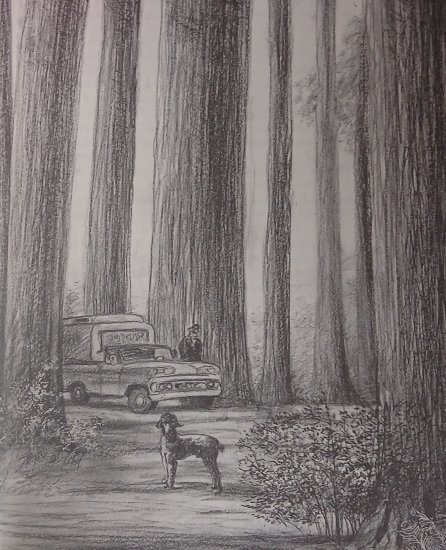
It is a very uneven travelogue anyway, by page 160 of the Folio Society edition I have we are in Seattle having left New York State and travelled along the US/Canadian border, so just one side of the rough rectangle planned for the journey. On that basis we should be looking at a four or five hundred page epic but instead it is only 241 pages in total, so over two thirds of the mileage is covered in a quarter of the pages and the detail in the first three quarters is lost in the remainder. That said I actually think the last quarter is the most important, as we have Steinbeck returning to search for his roots in California and finding that they are irretrievably lost. Cannery Row has been gentrified and he barely recognises the places of his childhood. Charley is also confused but that is mainly down to the visit to the giant redwoods which are so huge that he doesn’t seem to see them as trees and finds a small bush to mark instead.
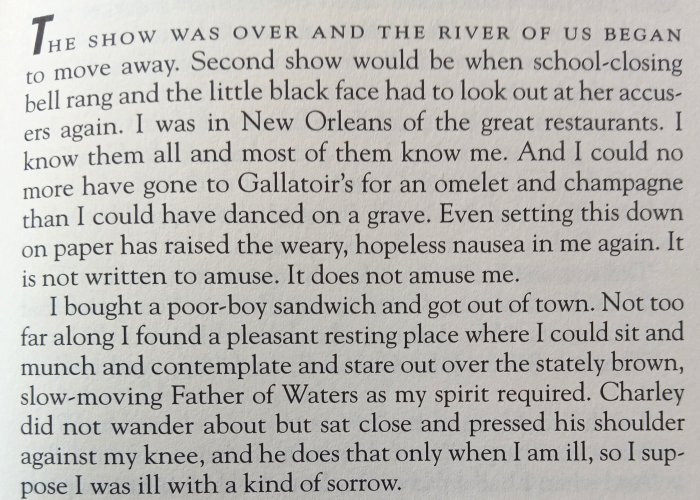
But it is pretty well the last section that is the most important of this ‘almost’ documentary and drives home Steinbeck’s dislike of some of what he found on his journey when he goes to New Orleans in search of ‘the Cheerleaders’. These frankly repellent middle aged white women gathered each day to scream abuse at six or seven year old children going or leaving school who just happened to be a different colour than they were. Steinbeck was appalled by them and the crowds they pulled together which meant the children needed police support just to go to school.
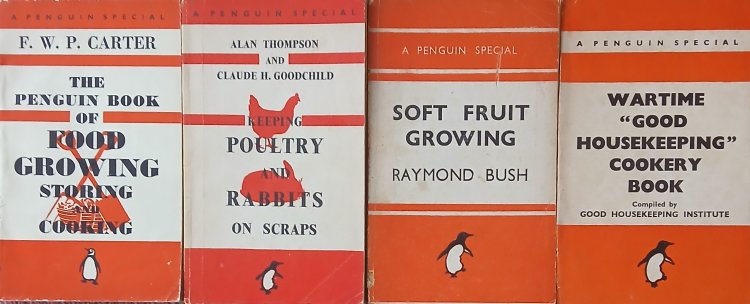
Last week saw the fiftieth anniversary of the end of the Vietnam War and this week sees the eightieth anniversary of VE Day, the end of the Second World War in Europe, as this post goes live on the 6th May 2025 two days before VE Day itself. Whilst last week I read Felix Greene’s excellent summary of the first half of the Vietnam War, this week I’m looking at eight books produced as part of the Penguin Specials series which were designed to help the population feed themselves during a time of food shortages and rationing. Penguin Specials were intended to be books dealing with issues of the day and they had rapidly multiplied during WWII with such titles as ‘Aircraft Recognition’, ‘Nazis in Norway’, ‘How Russia Prepared’, ‘Signalling for the Home Guard’ etc. The books were produced far quicker than titles in the other Penguin Series so that they were relevant to the issues of the day, but before the designation of some of them as handbooks there had also been some concerned with making best use of the food supplies however these were in the more usual red covers for Specials. These included ‘S90 The Penguin Book of Food Growing, Storing and Cooking’ (May 1941), ‘S101 Keeping Poultry and Rabbits on Scraps’ (January 1942), ‘S119 Soft Fruit Growing’ (December 1942) and ‘S127 Wartime Good Housekeeping Cookery Book’ (February 1943).
The dates shown below for most of these handbooks may seem quite late in the war for those of us born after the end of shortages and rationing, but it should be noted that general rationing in the UK continued until July 1954 although some items such as bread (1948) did come off rationing before then.
S132 Tree Fruit Growing – Apples – December 1943
Raymond Bush had already written one book for Penguin, as can be seen above, but the two handbooks detailing tree fruit growing took us to his main speciality which he had adopted following a bad accident in 1914 and being advised that an outdoor life would be better for his health than the poster design his company had been doing prior to the First World War. He was a commercial grower from 1915 up until 1935 when he started advisory work on the subject for various scientific committees. The book is a wide ranging guide to growing apple trees with notes where similar methods are appropriate for other fruits such as pears and almost a third of the book is dedicated to pests and how to get rid of them, but it is based on Bush’s determination that the wartime population should not be derived of wholesome fruit. As he says in his introduction “Well my amateur friends, once again you must sit back and watch the Ministry of Food collect most of the fruit to make jam go several times as far as it has any rights to go by the judicious addition of apple pulp, swedes, mangolds and what not. That is unless you grow your own fruit and make your own jam.”
S137 Preserves for all Occasions – April 1944
This book admits that it will soon become out of date as ingredients become more available after the war ut nevertheless it provide a lot of useful information on the varying ways of preserving food. Not just the expected jams and chutneys but syrups, bottling means of drying fruit, vegetables and herbs and how to store fresh produce for the longest time. Unlike other books on preserving that I own it doesn’t include recipes but instead concentrates on good techniques and means of avoiding common mistakes.
S138 Tree Fruit Growing – Pears, Quinces and Stone Fruits – December 1943
Volume 2 of Tree Fruit Growing concentrates much more on the individual varieties of a wider range of crops than I was expecting. I hadn’t realised that almonds were not true nuts but were in fact relative of the plum and peach where we eat the seed and discard the rest as a direct opposite to the two fruits. Bush admits to not having grown them himself and struggled to find any information but put together what he could. There is also a section on laying out an orchard and a substantial chapter on bees at the end along with the inevitable chapter on spraying for pests, a subject clearly on Bush’s mind a lot.
S140 Rabbit Farming – June 1944
Inspired by the success of ‘S101 Keeping Poultry and Rabbits on Scraps’ which as Goodchild explains in the introduction to this book was “giving all the practical hints I knew on rabbit keeping under wartime conditions in order that many newcomers could make a success of rabbit meat production”. This book on rabbit farming is however a very different work as it is aimed at a larger scale operation and includes use of the fur in coats and other clothes necessary to make a living from the business. Goodchild himself came from a long line of farmers and along with his partner ran the largest rabbit farm in England producing not just meat but from it’s manufacturing division coats, gloves and other assorted fur products. The photographs, presumably taken at his site near Crawley in south east England, show an extensive operation which must have been very useful to wartime food and clothing supplies.
S144 Poultry Farming – May 1945
The second of the books split off from ‘S101 Keeping Poultry and Rabbits on Scraps’ took almost a year longer to write than the first. Alan Thompson was amongst other things the editor of the monthly magazine ‘The Poultry Farmer’ which had started in 1874 as ‘The Fanciers Gazette’ and was eventually bought by the publishers of ‘Poultry World’ in 1968, so he was ideally suited to write the book. The book is not aimed at people wanting to keep a handful of chickens in their garden or allotment which was the point of S101 but instead those planning to run a commercial operation and early on mentions a figure of £2,000 (£73,500 in today’s money) for initial outlay if you want to have a hope of making a success of such a venture. The book goes into considerable detail not only on housing and selecting your chickens but also the finances of such an operation with several pages of photographs along with many line drawings to illustrate various points. My copy has clearly been well used.
S145 Trees, Shrubs and How to Grow Them – January 1945
Uniquely in this collection of eight books we have a title not covering food preparation or production and it is also, for me anyway, the least interesting of the titles. It goes into considerable detail about the various trees and shrubs in the UK, with guides as to what to plant and where, such as hedgerows and because Rowe is trying to impart so much information in a book just short of two hundred pages it is not particularly readable. That’s not to say it isn’t useful but just not for the general reader.
S146 The Vegetable Growers Handbook – Volume 1 – May 1945
All the other handbooks were commissioned by Penguin especially for this series and my copies are therefore true first editions whilst S146 and S147 are first editions in Penguin. The Vegetable Growers Handbook by civil servant Arthur J Simons however had first appeared in 1941 published by Bakers Nurseries Ltd of Codsall, Wolverhampton. Simons had written it during a period of quarantine he had undergone after contracting “a succession of childish but contagious diseases during the air raids”. In it you learn the basics of preparing the ground, improving the soil, using manure, compost and chemical fertilisers and this takes up the first third of the book. You then progress on what to grow, how to sow the seeds and raise the plants successfully initially in open ground and then a short section on using greenhouses and frames before a final chapter on pests and diseases and what to do about them. All in all a pretty comprehensive guide and I’m sure customers of Bakers Nurseries found it very useful.
S147 The Vegetable Growers Handbook – Volume 2 – May 1945
The second volume doesn’t have a first published date, but it doesn’t appear to be a Penguin original so I’m guessing this also first appeared from Bakers Nurseries. This volume deals specifically with the various crops you can grow, when to sow them and how to ensure a long cropping season with various vegetables ripening throughout many months. Like the first volume there are suggested plans for gardens or allotments to make maximum use of the space without wastage from gluts in certain weeks. Simons refers to letters he received after the first volume with suggestions which prompted this second book and despite the focus on wartime household needs these two books would even now be useful for a keen vegetable grower.
After the war it was decided to create a series of its own called Penguin Handbooks, the first new title of which was The Penguin Handyman which came out in November 1945 and was assigned the number PH9 with the obvious intention to move the existing eight books into this new series, however it all became more complicated than that, as it often does with Penguin Books. In fact PH1 is a 1945 reprint of ‘S119 Soft Fruit Growing’ but in the green cover of Penguin Handbooks rather than its original red. PH2 was assigned to the reprinted ‘S132 Tree Fruit Growing – Apples’ and PH3 became the reprint of ‘S138 Tree Fruit Growing – Pears, Quinces and Stone Fruits’, both of which are covered above and these would ultimately be combined into a single volume ‘PH83 Tree Fruit Growing’ in September 1962.
Despite the assumed plan of simply renumbering the existing handbooks into the gap left at the beginning of the new series we already have one book which hadn’t previously been issued as a handbook and just two of the originals occupying the first three numbers and this gets worse as numbers PH4 and PH5 were not in the end used and neither was PH8. This leaves just two numbers PH6 which became a reprint of ‘S145 Trees and Shrubs and How to Grow Them’ in 1951 and PH7 which combined S146 and S147 as the ‘Vegetable Grower’s Handbook’ in 1948.
Oddly ‘S137 Preserves for all Occasions’ did get reprinted as a ‘proper’ handbook as PH12 in July 1946, why they didn’t use one of the abandoned numbers I have no idea. ‘S140 Rabbit Farming’ and ‘S144 Poultry Farming’ were both discontinued in favour of their original base work ‘S101 Keeping Poultry and Rabbits on Scraps’ which came out as handbook PH14 in June 1949 making these two some of the most difficult to find Penguin Handbooks.
This post is being published on the 29th April 2025, the day before the fiftieth anniversary of the surrender of South Vietnam and the ending of the Vietnam war, the Vietnamese by the way refer to it as the American war. The choice of this book amongst several that I have on the conflict was pretty well certain as over half the book consists of photojournalism and the balance a series of essays detailing in chronological order what led up to the war and the first ten years of the fighting. Even though Greene was a British journalist the book was first published in 1965 in America, with still eight more years of American involvement and beyond that two years of the slow push down the country by the North until they finally prevailed. That this book was written roughly half way through the war would have horrified its author who, at least partly, hoped that exposing just what was going on might have hurried the end. My copy is the 1967 British paperback edition by Penguin Books.
By going back to the French Indochina colonies pre WWII and taking the story of how America came to be fighting there the twenty two essays that make up the second half of the book largely follow a historical progression. So how did America get into this mess? Well it turns out that when the French were kicked out by the invading Japanese during WWII they were determined to regain control of their colonies just as the Vietnamese, along with the populations of Cambodia and Laos for that matter, saw an opportunity to gain independence at the end of the war. There was a short lived declaration of independence for all of Vietnam but the French did re-invade in 1946, however they needed American assistance, which was forthcoming as part of the anti-communist sentiment in American politics through the 1950’s and this led to them supporting the extremely unpopular puppet president Diem with ever increasing military power initially in the guise of ‘advisers’ and ‘trainers’. The French eventually gave up and left leaving the Americans, who by then were financing roughly three quarters of the military push and supplying arms despite the Geneva accords of 1954 which said that foreign forces should not be in Vietnam and there should be elections within two years leading to reunification of Vietnam. America and France, despite being signatories to these agreements had no intention of allowing them to happen.
Picture by Kyoichi Sawada – United Photo Industries (UPI)
And so we ended up with America fighting the Vietnamese under the guise of preventing North Vietnam gaining control of the south but in fact the National Liberation Front, known outside of the country as the Vietcong, set up in 1960 was entirely composed of people from the south who wanted the foreign forces out of their country and the weapons they used were almost entirely from deserters from the American backed Vietnamese troops.
I have been selective in which photos to use from the book as a lot of them are far more shocking than the example of American torture shown above and include the famous picture of the monk, Thich Quang Duc, sitting and burning in the road as he set fire to himself in protest at the ongoing conflict in June 1963. In truth the photographs are far more telling than the essays, especially when juxtaposed with quotes which clearly don’t match the images such as the destroyed houses below.
Photo by Felix Greene
There are clearly books that look back on the war with the benefit of hindsight which I could have reviewed but I was drawn to this work written during the middle of the conflict. It may not be the most dispassionate summary of what was going on but Greene was trying to make sense of what he witnessed whilst reporting and for that it is a fascinating book.
Top photo by Bob Ibrahim UPI, bottom photo un-credited UPI
I travelled the length of Vietnam in 2007-8 and was lucky to have three very different guides which could provide alternate viewpoints. Starting in the south the guide was an older gentleman who had lived through the defeat of the south a a civilian and could talk about the pulling out of the American forces and the advance of the troops from the north leading to the surrender. In central Vietnam our guide was an ex Vietcong fighter who still walked with a limp from a war injury sustained in Hue, whilst the north was explained by a man in his early twenties who had never known anything other than a unified country. I doubt it is possible to have such an interesting selection of guides nowadays fifty years on from the end of the conflict and I’m glad I went when I did.
Cicero was a prominent statesman, lawyer and orator at a time of great turbulence in the Roman empire. Born in 106BC and elected one of the two consuls in 63BC, he was at his prime when Julius Caesar became dictator following his invasion on 49BC, and whilst not one of the group that ultimately assassinated Caesar in 44BC it was generally known that he supported them. He is one of the most prominent men of letters of his time with over eight hundred existing examples and many of his speeches were published. We don’t by any means have everything he wrote but what we have is still a substantial body of work. This book starts with his opening speech in the prosecution of Gaius Verres for mismanagement during his time as Governor of Sicily. the Roman legal system at the time expected a very long speech, normally over a day, in such matters but Cicero gave a ‘shortened’ version (still 23 pages long) as he was concerned that with various public holidays coming up the trial could be postponed for months. It’s a good introduction to Cicero’s style as are the selection of twenty three letters that follow which include one from Caesar.
It is in the third section that we really see Cicero in full flow in the second of his fourteen speeches mainly given in the Senate against Anthony, although this particular speech was never delivered there, being published instead. This massive fifty three page speech established Cicero as a major opponent to Anthony, who had seized control of Rome following the death of Caesar. The series of speeches were known as the Philippic’s after Demosthenes’s denunciations of Philip II of Macedon and were so powerful that Cicero eventually convinced the Senate to declare Anthony an enemy of the state as Cicero attempted to gather support for Anthony’s son, Octavian, to stand against his father. The section below is just a small part of the second Philippic against Antony but gives a feeling of the enmity between the two men:
For what was left of Rome, Antony, owed its final annihilation to yourself. In your home everything had a price; and a truly sordid series of deals it was. Laws you passed, laws you caused to be put through to your interests, had never even been formally proposed. You admit this yourself. You were an auger, yet you never took the auspices. You were a consul, yet you blocked the legal right of other officials to exercise the veto. Your armed escort was shocking. You are a drink-sodden, sex-ridden wreck. Never a day passes in that ill-reputed house of yours without orgies of the most repulsive kind.
The book concludes with two of Cicero’s best known works, the third part of ‘On Duties’ and all of ‘On Old Age’. ‘On Duties III’ consists of eleven sections where Cicero endeavours to explain the preference for actions seen as right as opposed to ones which are simply advantageous and why an action which may appear advantageous but cannot be seen as right is never the correct thing to do. This book, along with the first two parts is addressed to Cicero’s son Marcus who was then in Athens and is a guide to moral behaviour. ‘On Old Age’ is a lot more fun to read, it is written as an imagined conversation between Cato the Elder, who was 84 at the time it is set in 150BC, with Scipio Aemilianus, then 35, and Gaius Laelius, also in his thirties. Cato expounds on the advantages of old age and a reconciliation to the fact that death cannot be far away, in Cato’s case the following year.
Cicero was murdered in 43BC aged sixty three as he was attempting to escape the wrath of Anthony, now reconciled with Octavian, and his head and hands, specifically requested by Anthony as punishment for writing the Philippics, were nailed to the Rostra in the Forum Romanum.
The translation is by noted classicist Michael Grant, Professor of Humanity at the University of Edinburgh and was the first of several translations, mainly of Cicero, that he undertook for both Penguin Books and the Folio Society. This has been the first time that I’ve read Cicero although I can’t imagine it will be the last, there are several Penguin Classics that cover more of his writings and The Folio Society have recently published a massive single volume 664 page collection.
And now for some nostalgia, I first read this book along with the first book in the series ‘The Incredible Adventures of Professor Branestawm’ when I was in Primary school aged about seven or eight years old. I never actually owned a copy of either book, simply reading the ones in the school library, but the other day I came across this copy, dated 1966, which is the same as the version I first read all those years ago at the end of the sixties. I had to have it and see if childhood memories of loving the books were anywhere near as good as with Elleston Trevor’s ‘Where’s Wumpus’. Sadly the adult me found the book a bit of a curate’s egg (good in parts) and some parts have not dated very well, but when it was good it was great fun.
For those unfamiliar with the absent minded professor and inventor of crackpot inventions Branestawm would be partly great fun to meet but also a complete danger to anyone around him as his inventions not only invariably go wrong but also quite frequently do so in catastrophic ways, often explosively. His jacket is fastened by safety pins, having lost its buttons many years ago, and he wears five pairs of spectacles, one set is specifically for looking for the other four whenever he loses them, which is frequently. His housekeeper, Mrs Flittersnoop, is often to be found residing at her sister Aggie’s house when the professor’s home has been rendered uninhabitable by one disaster or another. In this book one of the stories concerns the house burning down, amazingly not caused by one of Branestawm’s inventions but not helped by him trying to put the fire out by trying to smother the fire with a rug, which promptly caught fire, adding to the conflagration, and then throwing alcohol on the flames which of course made everything worse. This leads to him trying to invent automatic fire alarms which prove to be so sensitive that even the mayor’s cigar sets them off and the professor ultimately having to move in with Mrs Flittersnoop’s sister as well because so little of the house is still standing. Other regular characters are Colonel Dedshott of the Catapult Cavaliers who is always to be found in full regimental dress uniform complete with jangling medals, Mr Chintzbitz the owner of the furniture shop and Doctor Mumpzanmeasle, these names giving a hint of Hunter’s love of word play, which can sometimes get in the way of readability as you try to work out just what you have actually read.
‘The Incredible Adventures of Professor Branestawm’ was first published in 1933, whilst ‘Professor Branestawm’s Treasure Hunt’ originally came out in 1937, there then was a long hiatus before book three was released in 1970, with a further eleven being written between 1972 and 1983. I suspect the reprinting of the first two books by Puffin in 1947 and 1966 respectively and especially the subsequent 1969 television adaption did a lot to revive the character and prompt Norman Hunter to write more. I’ve never read any more than the first two and indeed didn’t even know they existed until I came to research this blog. Norman Hunter was born in 1899 and died, aged 95 in 1995
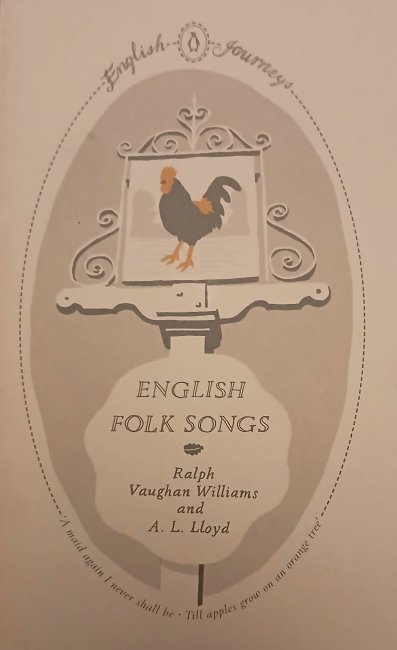
Continuing the bucolic countryside and doomed love themes from last week’s ‘Far From the Madding Crowd’ I was drawn to this book of English folk songs, which was Vaughan Williams’ last book as sadly he died just before it was published. Ralph Vaughan Williams was of course one of the great English composers of the first half of the twentieth century, he died in 1958, and was heavily inspired by English folk songs although he also wrote nine symphonies and four concertos along with his numerous song cycles and choral works. He qualified as a Doctor of Music from Cambridge University and it is as Doctor Vaughan Williams that A L Lloyd refers to him in his ‘Note on the Presentation of the Tunes’ at the start of this book. The selection of songs is quite widespread, although biased toward tunes gathered in the south of England as that was where Vaughan Williams lived so it was easier for him to travel round collecting material in that part of the country although there are a small number from the north. Vaughan Williams was inspired to start collecting English folk songs by contemporaries such as Cecil Sharp and the collections he made helped to preserve a rapidly dying art form as well as influencing his own work.
If I have one criticism of this book it is not in the choice of songs, which provide a spectrum of styles but in the structure of the book itself with the songs in the first part and the accompanying text in the second half which means that you need two bookmarks to keep track of where you are as you continually skip to and fro to read the context and history of the song you have just read. I would have much preferred the descriptions to be interleaved with the music as that would have been far simpler to read.
Before the couple of examples I have chosen, I must explain that the copy I have has a very tight spine and to avoid splitting it I have been forced to hold it open as much as I dared but that has led to somewhat distorted photos of the pages.
Although listed as collected from Somerset, the earliest versions of this song are known from Newcastle Upon Tyne, so the opposite end of the country, and these date back to the late seventeenth century. The lyrics included are a mix of at least three versions into a harmonious whole presumably by Vaughan Williams when collating this book.
The Green Bed follows a theme common with other songs of the period of a sailor who arriving at lodging he has used before claims to have lost all his money in a disaster and is turned away but when he shows that actually he has plenty of money all of a sudden beer and bed are available and the landlady is quite happy to include her daughter in the bed. However the sailor spurns the offer as it is clear that both of them are only interested in the money he has. Again the example comes from the south of England but versions of this song are also known from Warwickshire, in the English Midlands and therefore a long way from the sea.
I really enjoyed this exploration of English folk song and I have various other collections of traditional music which would also be worth exploring at a later date.
I have to admit that in the over three decades I have owned this book, as part of a set of six novels by Hardy from The Folio Society, I have attempted to read it at least three times. Initially when I bought it back in 1993 and then again probably ten years later, where according to the bookmark I found inside I made it to page 84 out of 413, this time I read and thoroughly enjoyed the book in just four days during the last week. I don’t know why I failed the first two times, some books you just have to be in the right frame of mind to appreciate them.
There are five main characters, I’ll tell as much of the start of the novel to set out how they stand with each other. Gabriel Oak who starts the novel as a farmer in good standing with two hundred sheep and a couple of sheepdogs, the younger of which would lead to his ruin by one night driving his entire flock over a cliff edge to their deaths, The sheep were not insured but by selling everything he owned he managed to cover his debts. Also appearing at the start of the book is Bethsheba Everdene, a young woman whom Oak falls in love with, pretty well at first sight, but she does not return his affection. She however soon leaves the vicinity, before Oak’s disaster with the sheep, and he knows not where she has gone. Oak, now penniless takes himself off to a hiring fair hoping to get a job as a bailiff (farm manager), failing to do so he reverts to his skill as a shepherd but still doesn’t get a job so decides to try the next fair in a nearby town. On his way he sees a hayrick on fire and endeavours to put it out, his bravery is soon noticed by the labourers on the farm as they race to his assistance and on the back of this he is offered the job as shepherd by Mistress Everdene who it turns out had inherited this very farm which is why she left the area where Oak was living. Still very much in love with Bethsheba but now so reduced in fortune as opposed to her meteoric rise he realises that he can never hope to gain her hand in marriage.
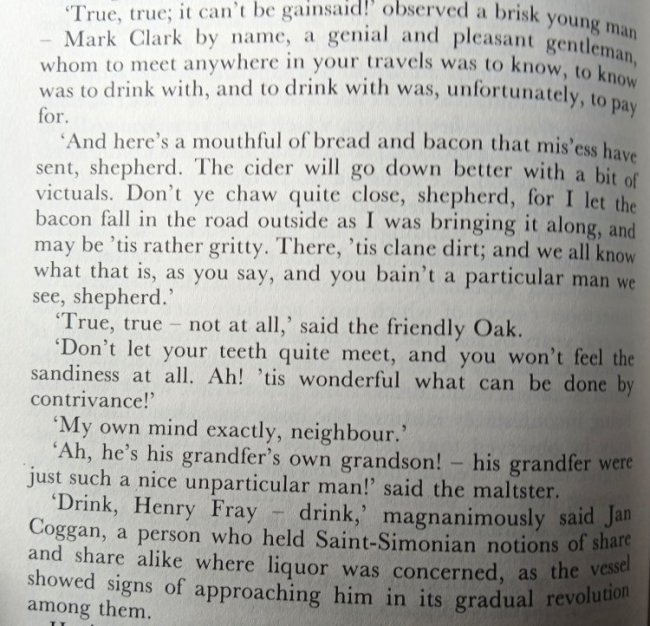
On coming into the village after the fire is extinguished he encounters the young Fanny Robin who it turns out has that night left the house where she was employed as a servant without telling anyone and is running away to her love, a Sergeant Troy in one of the local regiments who has promised to marry her. Troy however is an out and out cad as will become obvious as the book progresses. This leaves one more major character, the owner of the farm adjacent to Bethsheba Everdene’s, Mr Boldwood, I don’t think we ever find out his first name. In a moment of fecklessness Bethsheba sends Boldwood a valentine one year even though she doesn’t love him and this prompts the bachelor to look again at his neighbour and consider marriage for the first time in his life and this will lead to all sorts of problems as the book progresses. These five characters with their interrelationships drive the whole plot but around them the description of rural life and its nearness to poverty is brilliantly told by Hardy, take the following example, which also shows the expression of the local dialect which pervades the novel, this is just after Oak has been retained as shepherd after his heroics with the fire.
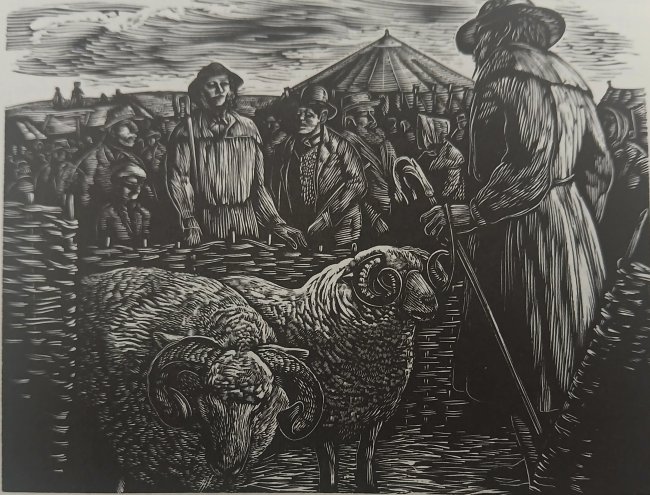
The book, like all Folio Society editions, is beautifully illustrated, this time with thirty one wood engravings by Peter Reddick who worked on all of their Thomas Hardy volumes, around twenty of them, making him the first artist to completely illustrate Hardy.
It was only at the end of the book that it dawned on me how young the major characters are, Gabriel Oak is one who is given a definite age, that of twenty eight at the start of the novel which covers the span of around four or possibly five years so he is thirty two or thirty three at the end of the story. There then becomes the slight problem of the age of Bethsheba Everdene caused by two statements by Gabriel which disagree. In chapter twenty nine – Particulars of a Twilight Walk he says he is six years older:
But in chapter fifty one – Bathsheba Talks with Her Outrider he says there is eight years between them and Bethsheba agrees:
As she agrees and she knows him better by now, as it is near the end of the book, I’m inclined to the eight year gap meaning she was twenty at the start of the novel and twenty four or twenty five at the end. Suddenly it dawned on me just how young she was when she inherited the farm and started running it by herself and that brings a new perspective to her fearlessness and possibly recklessness in deciding to do that. Mr Boldwood is described as ten years older than Oak so allowing for Oak’s approximations in the earlier passage we can say he is in his early forties by the end, which fits with his position as a confirmed bachelor early on in the narrative as he would hardly be described as such if much younger than his late thirties. Sergeant Troy is stated as twenty six at the end of the book and Fanny Robin is twenty, so she was just fifteen or sixteen when she started her relationship with Troy. However I can’t include a picture of where these ages come from without giving away a large part of the end of the book, which I don’t want to do.
I’m so glad I had another go at reading this book and I’m now not sure why it has taken me so long to finish it as I have greatly enjoyed this tale of Victorian life in south west England, so much so that I’m considering which one of the other six Hardy novels I own to tackle next.











 Ramblings on my bookshelves