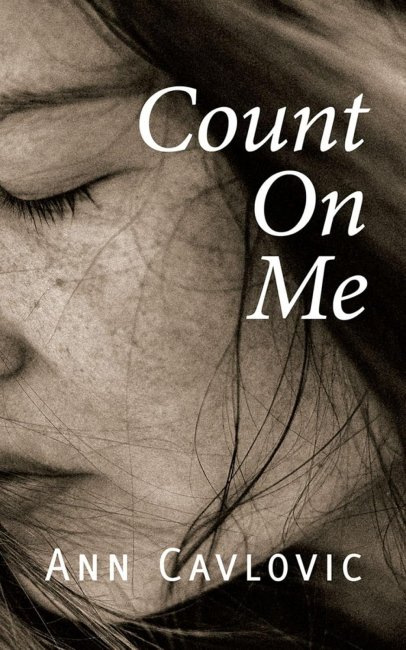
Count On Me – Ann Cavlovic

This, the first novel by Canadian author Ann Cavlovic, is something I’ve been reading as effectively a book proof although it doesn’t have any indication that it is a copy from before the official release date printed within it. The book was published on 1st October last year in its native Canada and I’ve had a copy since September, but most of us here in the UK have to wait until the 8th January 2026 to be able to get a copy. Originally I planned to write this blog before the book was released in Canada but as that would have been four months before its availability in the UK it has been delayed until now, a few days before its release here.

I initially struggled to get into the book, probably as the scenario is so far from my own experience but as the story developed I came to enjoy the book more and more. Without giving too much away we learn of brother and sister Tia and Tristan whose mother really needs to go into a care home and their father isn’t far off being incapable of looking after himself. Tia has problems of her own, recently divorced and with a one year old daughter she is struggling to look after her child and hold down her job and dealing with her parents problems as well just becomes too much. Tristan in the guise of caring for their parents is actually pushing their father out of the family home so that he and his partner can take over and is financially abusing the joint bank account which he has access to via power of attorney. He has also taken and/or sold various items from the family home along with his mothers jewellery which had been promised to Tia and taken out a $20,000 loan against their security. How Tia confronts him about this and starts to put things right whilst still managing to look after her daughter as a single mother and all the issues that position alone puts her into is the plot of the book. Reading that back it sounds like a dark nightmare but the book has enough lightness and humour to make the plot still enjoyable as you watch Tia struggle and ultimately get legal and personal assistance to counteract her brother’s attempt to grab everything including the house.

The book is written in the first person from Tia’s perspective as she tries to make sense of what is going on and protect their parents from Tristan and his girlfriend, who seem determined to gain as much a possible and get the parents out of the way into homes as soon as he can without regard for the best outcome for them, only the way that suits him the most. After initially having problems getting into the book I’m glad I persevered and by mid way I was cheering Tia on as she fought for the best resolution for her parents and to stop Tristan riding roughshod over not only their wishes but the rest of their lives as he tried to get them into the cheapest possible home regardless of the awful reviews the place had received and the general manipulation that he has imposed over them. It is Cavlovic’s first novel, although not by any means her first piece of fiction, you can find more about her at her website.

Many thanks to River Street Writing for supplying my review copy.

Without Prejudice – Frederick William Rolfe (Baron Corvo)

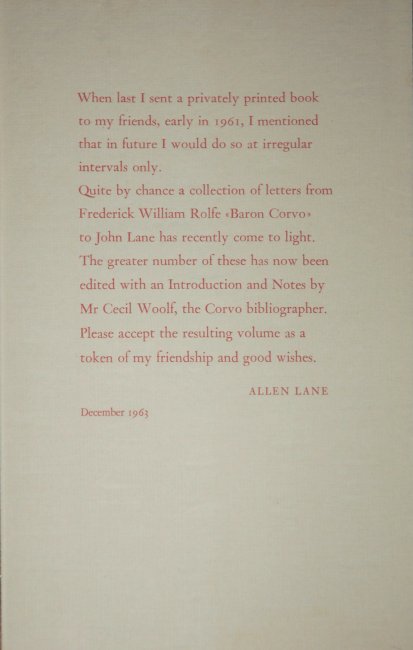
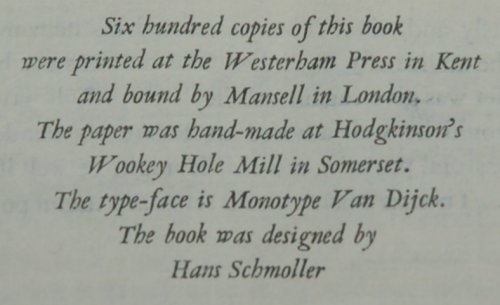
Another of the Allen Lane Christmas books is my featured work for Christmas week. This time the book consists of one hundred letters from the self styled Baron Corvo to John Lane, the founder of The Bodley Head Press. It was sent as a very limited gift of just six hundred privately printed copies in 1963 as can be seen from the enclosed sheet of paper from Allen Lane which is reproduced below.

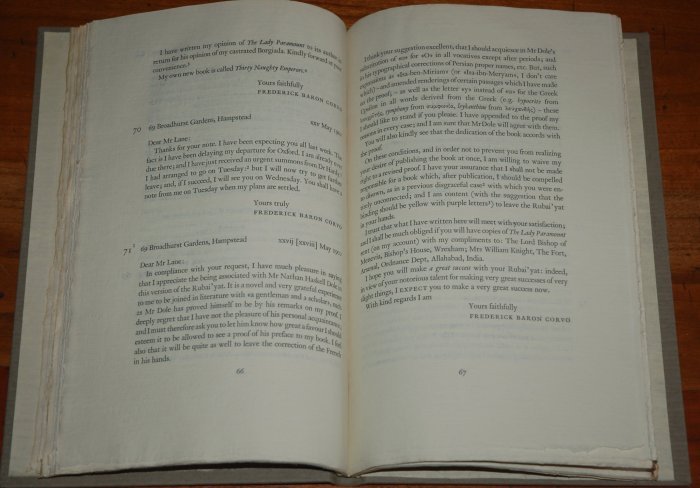
The paper for the book is hand-made with the distinctive ragged edges that such sheets often have if not trimmed which gives the book a lovely look and feel and it would be a pleasure to read is it wasn’t for one issue which I have mentioned before about another book. That is that the very helpful notes are all combined at the end so the reader is forced to use two bookmarks or repeatedly thumb through the pages looking for information. That these notes are necessary is due to the elusiveness of Corvo himself and the fact that what he did write about himself is not to be trusted, so you are regularly searching for context within the letters.

Frederick Rolfe aka ‘Baron Corvo’ was a strange and difficult to pin down person. He claimed the title from time he spent in Italy with an Italian nobleman who apparently granted him the name Baron Corvo but this is probably not true. That he had talent as a writer and artist is however undisputed but often his abrasive and wildly changing personality caused conflicts with those whom he most needed for support and he definitely endured considerable periods of hardship. Looking back over more than a century he is fascinating but not somebody I would have wanted to have anything to do with.

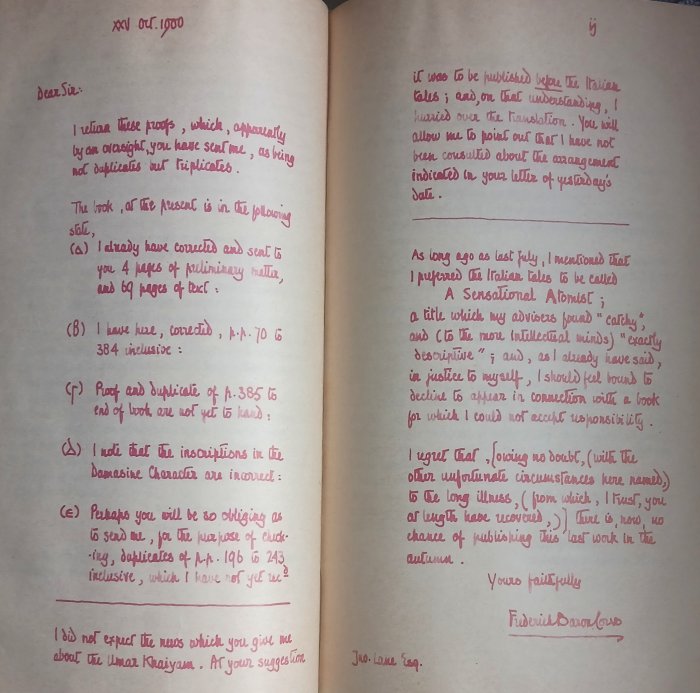
The book includes two of the letters as facsimiles, including the example below where you can see his bold handwriting but also his odd choice of red ink for correspondence. Indeed Corvo used a wide selection of coloured inks for his letters and if all the letters had been in facsimile the book would have been a positive rainbow.

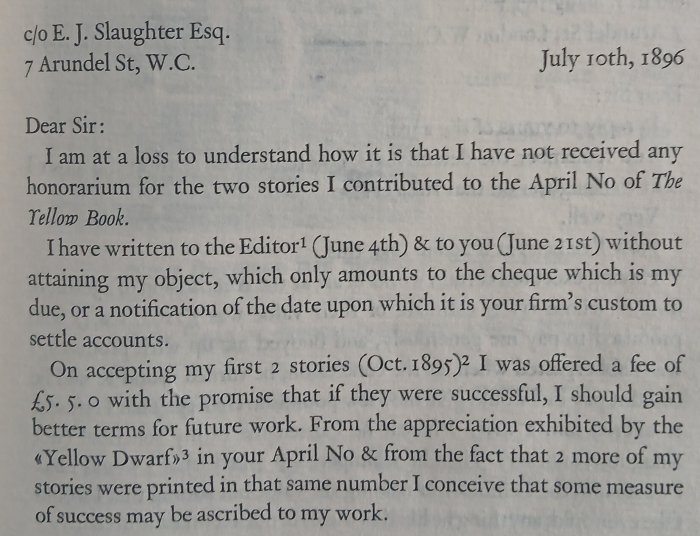
But let’s get to a proper selection of the letters which concern initially possible printing of more of Corvo’s ‘Stories Toto Told Me’ tales, several of which had been well received when published earlier in volumes seven and eleven of ‘The Yellow Book’, which was a Bodley Head i.e. John Lane publication. Over the years a possible illustrated edition of the Rubaiyat of Omar Khayyam was also mooted and the letters become more concerned with that. As the book is rare I have included a few letters so you can get to have a feel for the man, beginning with this letter chasing payment, and all too familiar theme in all of Corvo’s correspondence, from July 1896.

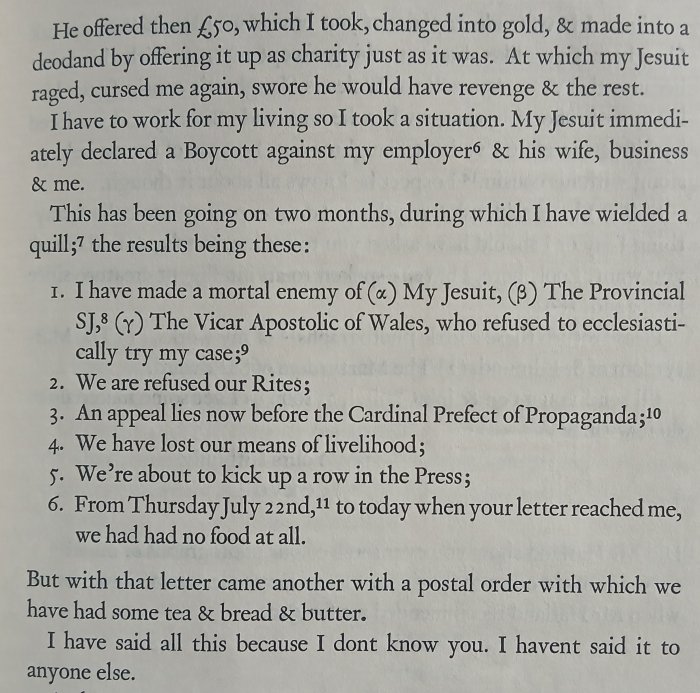
A year later, July 1897, and this is the second half of a letter which is happier in that he had received payment, which he had then given away principally in order to annoy the priest that gave him the money. I will go into more about what had happened here and some of the basis of his feuding with religious authorities next week when I dig more into the man behind these letters.

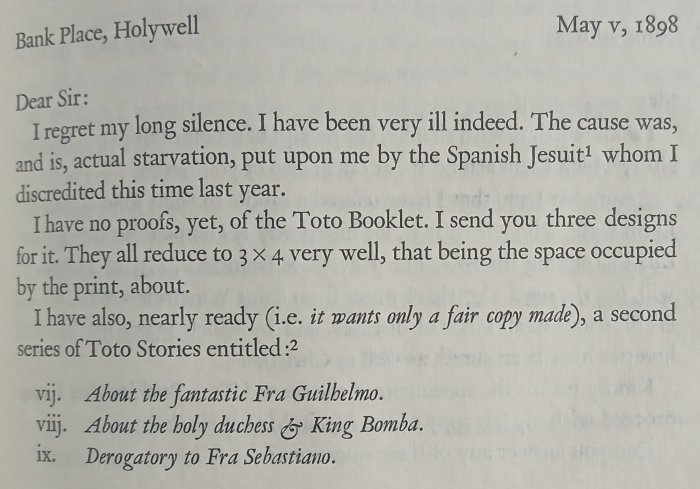
By May the following year Corvo was still in dispute with the church in Wales, but is also still trying to follow up what is happening with his Toto stories and is getting increasingly frustrated with Lane’s lack of replies to his numerous letters. It should be noted that a long silence from Corvo would only be a matter of weeks as he was a prolific sender of letters.

The next letters I have chosen from the hundred in the book are three years later, from 1901 where we see the first of numerous chases for what is happening with the Rubaiyat but also in the second one here a firm statement of his intention to remain private. It is this secrecy, and indeed the choice of different names he would use not just in print but whilst living in locations where he wasn’t already known, that makes tracking down Corvo and what he was actually doing from time to time so difficult.

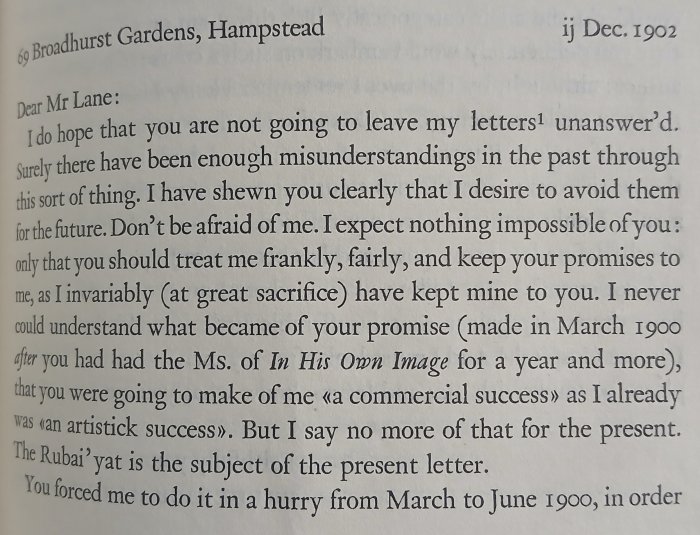
The start of the next letter, December 1902 has the familiar complaints of lack of response and more chasing of the Rubaiyat, I don’t think this was ever published however. In Lane’s defence he was known to be poor at replying to letters and the sheer number he was getting from Corvo was likely to make him even less prone to keep up a two way correspondence.

Finally I have chosen this letter from 1903 which is one of the sources of the title of this book, he uses the phrase ‘without prejudice’ several times whilst in disputes on various occasions.

So there it is, an unusual book for Christmas giving an insight into a distinctly unusual person published fifty years after his death. But who was Frederick Rolfe, aka Baron Corvo, aka Frank English, aka Frederick Austin, aka Fr Rolfe (giving the deliberate impression he was in the priesthood), aka ‘A Crab Maid’ etc. well more will be revealed next week when I review ‘A Quest for Corvo’ by AJA Symons.

The Prose Edda – Snorri Sturluson

Snorri Sturluson (1179–1241) was born in western Iceland, the son of an upstart Icelandic chieftain. In the early thirteenth century Snorri rose to become Iceland’s richest and, for a time, its most powerful leader. Twice he was elected law-speaker at the Althing, Iceland’s national assembly, and twice he went abroad to visit Norwegian royalty. An ambitious and sometimes ruthless leader, Snorri was also a man of learning, with deep interests in the myth, poetry and history of the Viking Age. He has long been assumed to be the author of some of medieval Iceland’s greatest works, including the Prose Edda and Heimskringla, the latter a saga history of the kings of Norway.

This version of the Prose Edda is not complete. as although The Prologue is all there, as is Gylfaginning, only a selection of ten tales from Skáldskaparmál are included and the lists giving word definitions and origins at the end of this section are omitted entirely as is The Háttatal which is a discussion on the composition of traditional poetry, which is more of a technical handbook on this verse structure and is quite commonly left out of translations. This abridgement of the Prose Edda is therefore a more readable text than the full scholarly manuscripts believed to be composed by Sturluson. The name ‘The Prose Edda’ is used to distinguish this work from the earlier verse forms of similar material known as ‘The Poetic Edda’.

It is probably best to look at the three sections separately beginning with ‘The Prologue’. This was a real surprise to me as it initially reads like a variant of the Old Testament with Adam and Eve along with Noah’s ark referred to in the first page and there is a lot of naming of sons of sons of sons to illustrate how the generations have passed. We then suddenly leave the Old Testament in favour of Homer as Odin is named as coming from Troy and travelling north from that city and Asia or at least that part of the continent known at the time and specifically Turkey is seen as the origin point for the Norse gods and name of the Æsir, which is the main group of these that reside in Asgard, is implied to be derived from Asia which is a concept I have not come across before. ‘The Prologue’ is short but full of surprising elements like this.

On to the Gylfaginning (Old Icelandic for ‘The tricking of Gylfi’). This is in the style of a conversation between the Swedish King Gylfi and three men on thrones in Asgard called High, Just-As-High, and Third. Gylfi asks many questions of the three men on the history and future of the Æsir and from this we learn the names and attributes of the gods and goddesses with tales of their exploits, some of which I knew and others were new to me. The tales start with the creation of the Earth and all that live on it along with the rise of the gods and take us right through to Ragnarok, the great battle and the death of most of the Æsir along with those that had opposed them such as the world girdling Midgard serpent. The text quotes extensively from The Sybil’s Prophesy which I take to refer to Völuspá, a Norse poem which forms part of The Poetic Edda, and there are other poetic sections quoted in Gylfaginning which are also to be found in this ancient collection of verse.

Then finally the Skáldskaparmál (Old Icelandic for ‘The language of poetry’), The ten stories included in this selection are extremely bloodthirsty with barely a page between the death of one or more characters but it was interesting and unexpected to find the basis for Wagner’s retelling of the Ring of the Nibelung which I read recently. There is the Valkyrie Brunhilde, the fire surrounding her which could only be crossed by a hero and Sigurd who is clearly the basis of Siegfried. There is also Fafner, although here a serpent rather than a dragon although these are largely interchangeable in Norse sagas, the Rhinegold hoard and a ring which brings doom to all that possess it.

Anyone interested in the Icelandic Saga tradition should definitely read ‘The Prose Edda’ and I’m surprised it has taken me so long to get round to doing so. This book is from the Penguin Archive collection of ninety books to celebrate Penguin Books ninetieth birthday in 2025.

The Man in the White Suit – Ben Collins

By writing this book, which was published in 2010, Ben Collins effectively called an end to his time as The Stig on BBC television’s Top Gear as his contract required him to be anonymous. He was quietly replaced by Phil Keen after the end of series fourteen and Keen continued to set lap times and coach celebrity drivers whilst wearing the white suit until Top Gear came to an end in 2023. To be fair to Collins his identity was becoming known through 2009 and was being hinted at in newspapers just as Perry McCarthy had been revealed as the original ‘Black Stig’ (so called as he wore an all black racing outfit) in 2003 but that didn’t stop the BBC pursuing a legal case to try to stop publication of this book.

The first chapter details Collins’ ‘interview’ for a role he hadn’t been told about, just being asked to go to Dunsfold Aerodrome and do some circuits. He had no idea that Dunsfold was where Top Gear was filmed, as that didn’t become general knowledge until much later, and he didn’t know the shows producer, Andy Wilman, who did the timings so it was a very strange day for a racing driver, just driving a not very good car around an airfield and not being told why. He didn’t hear anything for several months so assumed that whatever it was for hadn’t happened. The book then leaps backwards with Collins growing up and his father was always attracted to fast cars and driving although never as a racer so you can see where he got his love of speed. The story continues with his first forays into racing and the fact that he never raced in Formula 1, but got as close as being offered a test driver role but the team wanted him to put up £1.5 million as his way in which he clearly didn’t have access to. Instead he raced at Le Mans and Daytona in various formats including the GT championship, ASCAR (the European answer to NASCAR) which he won the championship in 2003 in his first year as The Stig and competed in Formula 3.

Collins was also a member of the British Army and interestingly the book covers his training and physical endurance testing to become a member of the Parachute Regiment in parallel with his early days as The Stig, eventually after four years in the army he had to quit as his work as The Stig and racing at circuits around the world didn’t allow for his time in the forces. He then increased his time racing and also became a stunt driver, particularly for the James Bond films although I was quite surprised that quite a few of the segments for Top Gear where The Stig appeared but didn’t actually do any driving were still filmed by him as frankly anyone could have stood in for him on the episode where they raced across London using different modes of transport with The Stig using the Underground and buses. It’s a really good autobiography and the 323 pages flew by but the paperback is rather annoying as at the back it includes acknowledgements for the photographs which were presumably in the hardback but which were removed for the paperback edition.

On the 30th November 2025 Collins and Wilman appeared in a Youtube video where they are talking about Wilman’s new autobiography but they keep hinting that they are going to deal with the publication of ‘The Man in the White Suit’ and finally at about 38 minutes in they address the various issues and the court case. However the entire video is well worth watching and can be seen here.

If the title feels familiar then you are remembering an Ealing Studios satirical comedy film made in London and Burnley in 1951 starring Alec Guinness as a scientist who invents a pure white fibre that never wears out or gets dirty, in fact it cannot even be dyed. To promote the material he has a suit made but eventually it dawns on people that an indestructible garment that doesn’t need to be cleaned would bankrupt the textile industry as nobody would need to buy any more clothes once they had a few items and he is pressured to abandon the invention. Even the book jacket reflects the aesthetic of the original film poster with its red and black background.

English Drama 1485–1585 – FP Wilson and GK Hunter

I’ve always liked Shakespeare, whose first play was performed in the 1590’s, but didn’t really know much about who came before him so decided to pull this volume from The Oxford History of Literature off the shelf and actually read it, rather than my usual use of books from this set which is as reference material. I was quite surprised to discover that this volume at least is quite readable so I’m now tempted to complete the set, as I currently only have ten of the fifteen volumes that take the history of English literature from Middle English in 1100 to 1400 through to the early twentieth century and DH Lawrence. Firstly a little bit about the history of the hundred years covered in this book as the choice is quite deliberate. The year 1485 saw the crowning of Henry VII after the fall of Richard III at the Battle of Bosworth Field and the end of the War of The Roses between the houses of York and Lancaster over which should rule England. Henry VII (Lancaster) married Elizabeth (York) linking the warring families and founded the Tudor dynasty which would rule for the next 118 years. We then see Henry VIII, Edward VI, Mary I and finally Elizabeth I, who was the last Tudor monarch, reigning from 1558 to 1603, so the period covered in this book is almost the entire Tudor dynasty but ending before the great flowering of English drama at the end of the reign of Elizabeth I as this has its own volume.

The period starts with the tail end of the countrywide performances of religious Mystery and Passion plays which had started as instruction to the populace centuries earlier (think of the still performed decennial Oberammergau Passion Play for a modern example) and leads us through the development of other subjects beyond religion becoming the basis of performances both comedy and tragedy along with the first appearance in England of professional actors. In 1485 there were no companies of players, plays were normally performed by children, often cathedral choristers or pupils of the Grammar schools, which would be given at the royal court or in their own halls. For adult performances there would be plays by teachers at the universities (primarily Oxford and Cambridge) and oddly by members of the four Inns of Court, presumably due to the eloquence of professors and barristers. Indeed members of both the Inner Temple and Middle Temple are referred to many times throughout the book as performing plays especially at Christmas. No dedicated theatre as such existed in England until the last decade or so covered by this book and it was only then that adult actors started to outnumber child performers and professionalism began to gain ground.

But let’s get a flavour for the plays being performed, these were often inspired in structure and sometimes in subject by the Roman playwrights Terence and Seneca with the latter being the dominant influence as the century progressed, at the end of the 1400’s Latin was still used but the English language was beginning to be more common for plays. driven by its rise in poetry and song. For an example of the sort of thing you would have encountered at the end of the 15th century with a playwright better known as a poet John Skelton’s Magnificence, a five act play of 2,567 lines with a distinct moral theme.

One aspect of plays of this period is that characters rarely had ‘normal’ names instead they would be called after the vice or virtue that they represent, a good (or possibly bad as I’m sure I wouldn’t want to see the play) example of this is Lupton’s ‘All for Money’ the essence of the plot is described below:

etc. I’m sure you get the idea. The plays would be in verse, with probably the most clunky format, the fourteener, which was very popular at the time. Blank verse would not make its appearance until the late 1550’s and even then would barely have an impact in the morality plays which were still being written.

The comedies that start to appear in the 1540’s by playwrights such as Udall from Eton College who wrote Jack Juggler and Roister Doister, two of the better plays of the period that would stand up to modern performance which frankly most of the works covered in this book would not. Tragedies however would need to wait for later writers before becoming suitable and not something that audiences would probably walk out of from boredom. A lot of the plays of the period only exist as titles, so much has been lost but the authors of the book are not dismayed by this as they say themselves:

Dramatically the hundred years covered here yield little of real substance but they set the ground for what was to follow and as the Elizabethan proverbs say “a bee sucks honey out of the bitterest flowers” and “out of a little spark came a great flame” within a decade we would have Christopher Marlowe (Dido and Tamburlaine both 1587), Ben Jonson (various minor plays he didn’t really get going until the late 1590’s) and of course William Shakespeare (first play Richard III – early 1590’s date uncertain). It has definitely been an interesting read even though it has given me little in the way of encouragement to delve into the plays of this time themselves. The massive leap in quality of play-writing and indeed performance at the end of the Elizabethan period is remarkable and it is no wonder that Shakespeare is still the most widely performed author in the world.

The volumes I have so far, quite an attractive set.

Keepers of the House – Lisa St Aubin de Terán

Lisa St Aubin de Terán gained her exotic sounding name from a mix of her mothers maiden name (St Aubin) and her first husband’s surname (Terán) of which more later. Born in London she was just twenty nine in 1982 when she wrote this, her first novel, but had already by then amassed life events enough for any aspiring writer to draw on. The novel tells the story of Londoner Lydia Sinclair who at the age of seventeen marries thirty five year old Venezuelan Don Diego Beltrán and goes to South America to live with him on his vast but declining estate. The book starts with a prologue which is set in the present day and tells how Lydia ended up in Venezuela before diving back over the two centuries of the rise and fall of the Beltrán family and estate until Don Diego is virtually the last of the family, and even he has a stroke several years into the marriage and is paralysed.

But the story of the early years of the Beltrán’s is of strong and powerful men rising to senior political and military ranks backed by the wealth from their estate. It is only after a horrific massacre of the family a century ago, men, women and children gunned down by soldiers goaded by members of a rival dynasty and a plague of locusts that destroyed all the crops in the valley leaving the villagers starving and almost as importantly the sugar cane that was the source of the money. The years of drought during Lydia’s time was the final straw, nothing is left, it is time to go. It sounds like a depressing read and in places it is but there is still some lightness to provide succour to the reader and it is certainly well worth reading. I also have her second novel ‘The Slow Train to Milan’ which is also based on her life with Jaime from after their marriage but before they finally moved to Venezuela and were instead travelling around Europe with increasingly bizarre experiences

Keepers of the House gets its title from a quote in the bible, specifically Ecclesiastes 12, and won the British literary prize The Somerset Maugham Award in 1983, which ironically is “to enable young writers to enrich their work by gaining experience of foreign countries.” whilst St Aubin de Terán had already had seven years of experiences in Venezuela, which was used as the basis of the novel, and was now safely back in England. I have written about one of her other autobiographical books in another blog back in 2020 ‘A Valley in Italy‘ and up until now have largely read her non-fiction works but have recently purchased a couple of her novels, this one included. I was struck particularly by the similarities between the stories of fictional Lydia and real life Lisa when comparing this book to ‘The Hacienda’, her memoir of her time in Venezuela published in 1997. If you thought that the plot of the novel was somewhat far fetched then the real story of Lisa is definitely worth reading as in ‘The Hacienda’ she tell of how she married at the age of sixteen to an exiled Venezuelan man more than twice her age who is wanted in his home country for bank robbery but who nevertheless takes her back to South America to live on his estate. She eventually comes back to England with her daughter Iseult to avoid the planned suicide pact intended by her husband Jaime as he realises that the marriage is falling apart.

The Unpleasantness at the Bellona Club – Dorothy L Sayers

This post is going live on Remembrance Day 2025 so it is appropriate to feature this Lord Peter Wimsey crime novel as the body is discovered on the 11th November and the fact that it is Armistice Day, as it is called throughout the book, is vitally important to the plot. This is the fifth of the original ten Penguin books published on 30th July 1935 that were the start of the company and which I started reading in their first editions in August, the remaining five will be covered between now and July 2026. This book was originally published in 1928 and is the fourth title featuring Sayers’ amateur detective Lord Peter, I have previously written about her twelfth novel Busman’s Honeymoon and a collection of short stories, some of which feature Lord Peter, Hangman’s Holiday.

I’ve always liked the Lord Peter Wimsey books since watching as a child the television series featuring Ian Carmichael in the 1970’s and this, whilst not one of the best, is a really good read. As can be expected the initial unpleasantness at the Bellona Club is the discovery of the body of Colonel Fentiman in his customary chair by the fire in the club on the evening of the 11th November still clutching his newspaper which he was wont to doze under soon after arriving in the morning. He was after all in his nineties so the death, apparently of heart failure, was not entirely unexpected although unfortunate. To the club members however the unpleasantness was to continue for several more weeks due to the wording of both his and his sister’s wills, as she had also died on the morning of the 11th. The Colonel’s will left the majority of his estate, some £2,000 (roughly £110,000 today) to his youngest grandson George with the residual going to his other grandson Robert on the basis that George as a married man suffering from shell shock after WWI needed the money more than Robert who was still single and a Major in the army. His sister, Lady Dormer, however drafted her will so that her estate, which had come to her on the death of her wealthy husband, and was worth around £700,000 (about £38 million today) would mainly pass to the Colonel if he was still alive when she died but if he predeceased her the vast majority would go to Miss Dorland who had been her companion for many years. It was therefore vitally important to establish exactly when the Colonel had died as if it was before 10:37am, when Lady Dormer had passed, then Miss Dorland was now extremely wealthy and if it was after that time then Robert Fentiman, gaining the residual after George had his £2,000, would be the one to gain.

But that is somewhat leaping ahead, Lord Peter is a member of the club and a friend of George and was acquainted with the Colonel and Robert. A the book begins the club was busy as a lot of members had come to London for the Remembrance Day event, Lord Peter and all three of the Fentiman family were at the club, Robert was staying there as he didn’t live in London whilst George and Lord Peter met in the bar that evening, the Colonel, as previously mentioned, either dozed or had died but had not yet been discovered in his chair by the fire but was about to be. Fortunately when Colonel Marchbanks found he was addressing a body Dr. Penberthy, the old man’s physician was also at the club and he and Wimsey moved the body to one of the club bedrooms noticing one thing odd in that the left knee of the corpse moved freely indicating that rigor mortis had begun to pass off but strangely only that joint was free.

That should have been the end of the story for Lord Peter but Mr Murbles, Peter’s solicitor and also the representative of Colonel Fentiman called several days later to advise him of the conflicting wills and asked him to make some discrete enquiries to try to establish when the old man had died. But how to establish when a man’s heart had given out precisely enough to reconcile the issue and both Fentiman brothers were acting rather oddly. Peter begins to suspect foul play…

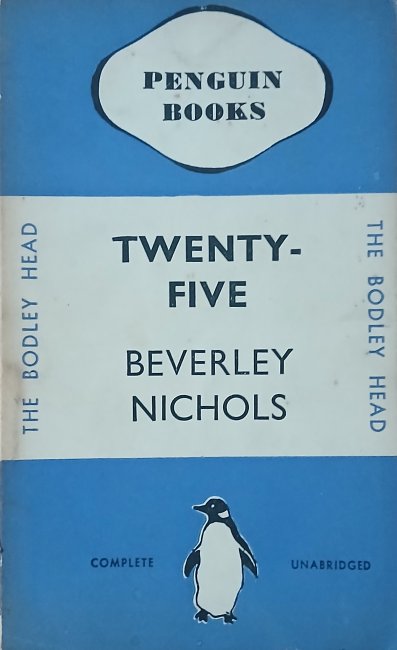
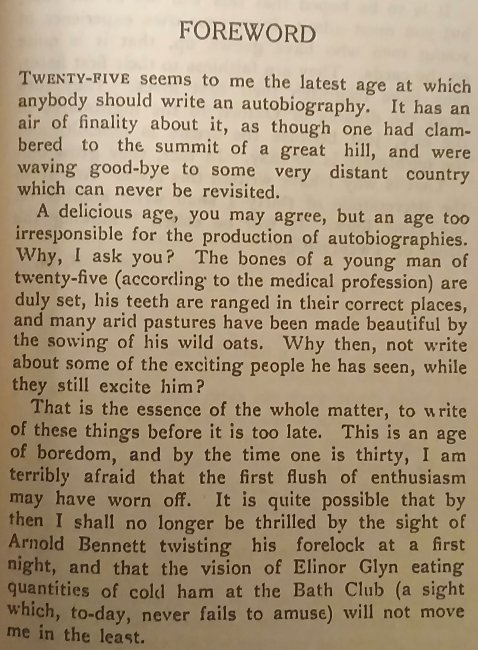
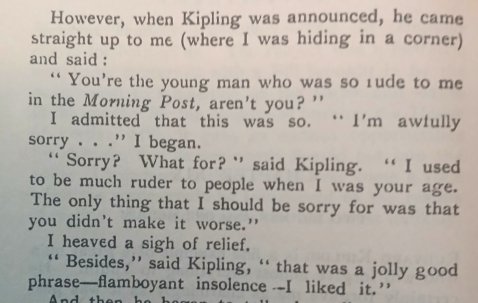
The sixth of the first ten Penguins is ‘The Mysterious Affair at Styles’ which I have already reviewed as The Strange Case of the Sixth Penguin Book where I explain why there are two books with that number so the next book to be covered of this group will be Twenty-Five, the autobiography of the young Beverley Nichols.

The Seventh Voyage – Stanislaw Lem

Polish author Stanislaw Lem is probably best known for his 1960’s science fiction masterpiece Solaris which has been adapted into a couple of films, in 1972 there was a Russian version and then fifty years later in 2002 James Cameron produced another in America. The Russian original is generally regarded as the better film although the latter is supposedly closer to the original book. This collection produced as part of Penguin Books 90th birthday celebrations consists of the short story ‘The Seventh Voyage’ (27 pages) along with a couple of short novellas, or longer short stories depending on how you define the categories, ‘Terminus’ (63 pages) and ‘The Mask’ (68 pages). I’ll review each one separately.

The Seventh Voyage

Well that was great fun, the story comes from a 1957 collection entitled The Star Diaries and despite being called The Seventh Voyage it is the first one in the collection which are different numbered journeys through space by Ijon Tichy as told by the equally fictional Professor Tarantoga. In this one Tichy encounters time loops after his spaceship is damaged and needing two people to effect the repairs decides to team up with one of his alternate selves to do the work. However all the various versions of himself seem to be a cross purposes and start fighting amongst themselves over who should have the one spacesuit to ensure that a future version can also have a suit on and also who can eat which bits of the limited rations.

Terminus

From Lem’s Book of Robots this story from 1961 is much more a ghost story rather than the humour of the first story although it is also clearly a work of science fiction. Pirx has just received command of an old spaceship and on first arrival at the spaceport was less than impressed with his ship with it’s visible rust internally and obvious patch jobs all over the place. Intrigued as to its history he searches for the ship’s log and finds out that the agent was not kidding when he said it was historic. In fact notorious would be closer to the mark as the ship was originally called Coriolanus and every space traveller knew that name and the disaster that befell it when it was caught in a meteor storm and so badly damaged that the crew were trapped in separate sections as the oxygen slowly ran out. All nineteen crew members died and the ship was assumed to be scrapped, but it was here, with its slapdash repairs to save money and barely capable of the run to Mars that Pirx had been assigned to do. Whilst exploring the ship after take-off Pirx notices that a pipe is vibrating and what is more it is doing so in Morse code and passing messages between the now dead crew calling for help as they slowly suffocate…

The Mask

This 1974 story can originally be found in the collection of Lem’s stories entitled Mortal Engines and we are this time in the realm of science fiction horror and it is a very strange but engaging tale. It is however very difficult to review without giving away the twists in the story, which is what the Wikipedia entry does within the first paragraph, you have been warned. The story starts with a nightmarish sequence where our first person narrator has no real idea what is going on or even who they are. This very quickly segues into what appears to be a regency royal ball, all crinolines and lace, but our narrator has no idea as to why she is there and still no clue as to their identity, is she recovering from amnesia, is she mad, or is there some other explanation? She is drawn to a mysterious stranger sitting alone in a window, but why and how can she know him better when she doesn’t even know herself? The explanation to these various questions is slowly revealed and the true horror of both their situations is a total surprise, unless that is you have sneaked a peek at Wikipedia, which I’m glad to say I only did to verify when this was first published after completing the story.

Although I knew the name Stanislaw Lem I have to admit that I hadn’t read any of his work before this book which was the main reason I bought a copy from this anniversary collection. I’m definitely going to read more, starting with Solaris of which I have seen the original Russian film version but never read the book.

The Crusades Through Arab Eyes – Amin Maalouf

I’ve read several accounts of the Crusades but all from the perspective of the Christian west so it was fascinating to read this version from the Islamic side. The first thing you discover is that the invaders were not taking on established states, but rather what was mainly individually controlled cities and towns which were sometimes in loose alliances but more often were warring amongst themselves making them relatively easy prey for the more organised crusader forces. Certainly for the first hundred years or so of the crusader conflicts whenever an Islamic ruler died there would invariably not be a clear successor so internecine warfare would break out making the city and its surrounding territory ripe for conquest by not only the crusaders but also the neighbouring city states that were, in theory at least, on the same side. What the Islamic forces lacked was a leader that most of them would follow and this was why the crusaders found the invasion of the holy lands relatively easy in the beginning and with a couple of short lived exceptions this would be the case until the rise of the Kurdish officer Salah al-Din Yusef known in the west as Saladin, who had gone to Egypt with his father in 1173 as a young man despite having no appetite for warfare and ended up the effective ruler of Egyptian lands but still nominally under the control of Nur al-Din from Syria who had sent the army in the first place. The complex interrelationships between the various states and warlords with the added mix of a fanatical sect founded in the 1070’s by Hasan Ibn al-Sabbah who became known as the Assassins. Although these killers would operate independently they were often paid by various rivals, or even other family members to remove people in the way of their own rise to power. How these original assassins operated is described in the book.

Although the preparation was always conducted in the utmost secrecy, the execution had to take place in public, indeed before the largest possible crowd. That was why the preferred site was a mosque, the favourite day Friday, generally at noon. For Hasan, murder was not merely a way of disposing of an enemy, but was intended primarily as a twofold lesson for the public: first the punishment of the victim, and second, the heroic sacrifice of the executioner, who was called fida’I or ‘suicide commando’ because he was almost always cut down on the spot.

This constant warfare amongst the various states and cities lasted long into the Crusade period and the various parties rarely agreed on alliances to take on the invaders and when they did, at least initially had nothing that would allow them to ambush knights in armour as they had no equivalent defences so hadn’t developed weapons to defeat them. But the book is not all negative regarding the Islamic resistance there were leaders who could push back the Crusaders, at least temporarily, before Saladin and he had a bad habit, at least in a war leader, of being too merciful to those he defeated often simply sending them away, along with their armaments, leaving them free to attack again at a later date or surrendering territory in the hope of achieving a more lasting peace

The book is fascinating, especially if you have read any of the various western accounts of the period, I will be reading The Chronicle of the Crusades by Geoffrey of Villehardouin and Jean de Joinville at some point next year, the book is already on my shelves, and this will round off the overview of the Crusades I started with T.E Lawrence’s book on Crusader castles which I read at the start of this year. It’s a period of history I remember reading a lot about whilst at school both as set texts and independent study and this book has certainly given me a lot to think about with its alternative viewpoint.

The Man Who Died Twice – Richard Osman

Earlier this year I read Richard Oman’s first novel and thoroughly enjoyed it, so it really was only a matter of time before I got to the second one. This continues the story of the four residents of a senior citizens residential village who originally got together to discuss unsolved murders and have now moved on to solving various current crimes, invariably including murder but not exclusively. One of the things I really liked about this book was the development of the characters from their first adventure, we gain quite a lot of new information on everyone, especially former spy Elizabeth who we now know as Dame Elizabeth Best, the title implying that she was even more senior in the service that previously suggested and from other comments that she had a reputation as one of the finest in her field. Fiery ex trade union leader Ron gets to show his gentle side as his grandson comes to stay, as well as becoming a highly effective ‘field operative’ for the Club and Joyce is braver and more intuitive than previously expected, although still so innocent that she chooses a combination of an old nickname and the year her daughter was born giving @GreatJoy69 as her Instagram user name, fortunately she can’t work out how to access her private messages. Her diary is again used as a mean of filling in story as she can review the days occurrences it’s a clever use of first person narrative in largely alternating chapters throughout the book. Ibrahim, the semi-retired psychiatrist, gets seriously mugged and kicked in the back of the head early on in the book and this puts him off leaving the retirement complex, or even his flat there, for a large part of the book. But it also drives the others to come up with a way of exacting revenge on his mugger in a way only they, and certainly not the police, could.

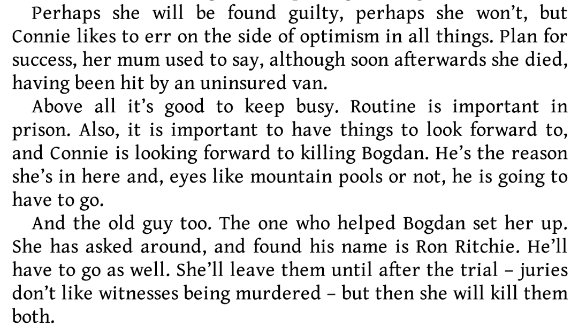
The remaining three have their work cut out dealing with £20 million worth of diamonds, the American mafia, an international crime go-between, a drug dealer, Elizabeth’s old employer MI6 or possibly MI5 it’s not made clear, and even Elizabeth’s ex husband whom he hadn’t seen for twenty years amongst others. Like the first book the plot is fast paced, full of twists and turns and the body count is surprisingly high for a book about four pensioners. We also find out more about the two local detectives who seem to have been seconded by the Club, Donna and Chris; along with the ever useful Polish builder Bogdan who has certainly gone up in the world since he killed off his main local rival in the first book and therefore got a lot more lucrative work. The book is full of humour as well, again not laugh out loud jokes, but humour nevertheless, it really is a fun read which is probably why less than twenty four hours after starting a 444 page book (I have the Waterstones edition with the extra chapter) I have finished it and am writing this blog.

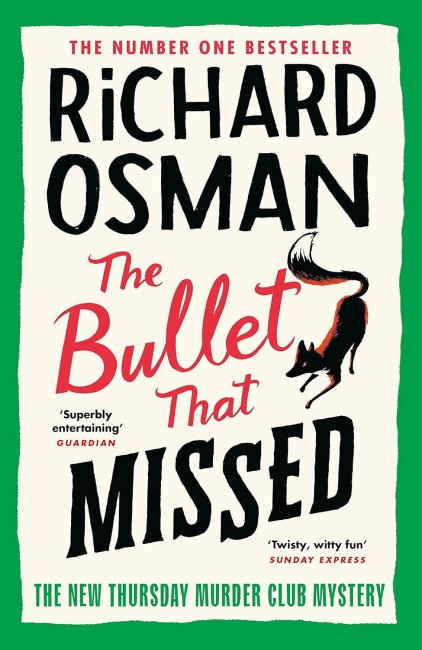
The fifth book in the series came out last month and is of course already a bestseller, it seems that Osman can do no wrong with his septuagenarian detectives, although Ibrahim at least is now in his eighties and I hope to read many more books about them all. By the way I checked out the Instagram account and it is registered as belonging to Joyce Meadowcroft from the book, well done Richard Osman or possibly Penguin Books for not only having the account but posting pictures of her dog Alan and trips out exactly as I would expect Joyce to do. Much more sensible than Douglas Adams who used his own phone number in the first Hitch-hikers Guide to the Galaxy book and had to get his phone number changed when people started ringing it.