A series of essays inspired by books that I own, talking about their history, some reviews and also how they came to be on my shelves. With over 6,500 books here and several more arriving each week I doubt I'll ever be short of a topic.
This post is being published on the 29th April 2025, the day before the fiftieth anniversary of the surrender of South Vietnam and the ending of the Vietnam war, the Vietnamese by the way refer to it as the American war. The choice of this book amongst several that I have on the conflict was pretty well certain as over half the book consists of photojournalism and the balance a series of essays detailing in chronological order what led up to the war and the first ten years of the fighting. Even though Greene was a British journalist the book was first published in 1965 in America, with still eight more years of American involvement and beyond that two years of the slow push down the country by the North until they finally prevailed. That this book was written roughly half way through the war would have horrified its author who, at least partly, hoped that exposing just what was going on might have hurried the end. My copy is the 1967 British paperback edition by Penguin Books.
By going back to the French Indochina colonies pre WWII and taking the story of how America came to be fighting there the twenty two essays that make up the second half of the book largely follow a historical progression. So how did America get into this mess? Well it turns out that when the French were kicked out by the invading Japanese during WWII they were determined to regain control of their colonies just as the Vietnamese, along with the populations of Cambodia and Laos for that matter, saw an opportunity to gain independence at the end of the war. There was a short lived declaration of independence for all of Vietnam but the French did re-invade in 1946, however they needed American assistance, which was forthcoming as part of the anti-communist sentiment in American politics through the 1950’s and this led to them supporting the extremely unpopular puppet president Diem with ever increasing military power initially in the guise of ‘advisers’ and ‘trainers’. The French eventually gave up and left leaving the Americans, who by then were financing roughly three quarters of the military push and supplying arms despite the Geneva accords of 1954 which said that foreign forces should not be in Vietnam and there should be elections within two years leading to reunification of Vietnam. America and France, despite being signatories to these agreements had no intention of allowing them to happen.
Picture by Kyoichi Sawada – United Photo Industries (UPI)
And so we ended up with America fighting the Vietnamese under the guise of preventing North Vietnam gaining control of the south but in fact the National Liberation Front, known outside of the country as the Vietcong, set up in 1960 was entirely composed of people from the south who wanted the foreign forces out of their country and the weapons they used were almost entirely from deserters from the American backed Vietnamese troops.
I have been selective in which photos to use from the book as a lot of them are far more shocking than the example of American torture shown above and include the famous picture of the monk, Thich Quang Duc, sitting and burning in the road as he set fire to himself in protest at the ongoing conflict in June 1963. In truth the photographs are far more telling than the essays, especially when juxtaposed with quotes which clearly don’t match the images such as the destroyed houses below.
Photo by Felix Greene
There are clearly books that look back on the war with the benefit of hindsight which I could have reviewed but I was drawn to this work written during the middle of the conflict. It may not be the most dispassionate summary of what was going on but Greene was trying to make sense of what he witnessed whilst reporting and for that it is a fascinating book.
Top photo by Bob Ibrahim UPI, bottom photo un-credited UPI
I travelled the length of Vietnam in 2007-8 and was lucky to have three very different guides which could provide alternate viewpoints. Starting in the south the guide was an older gentleman who had lived through the defeat of the south a a civilian and could talk about the pulling out of the American forces and the advance of the troops from the north leading to the surrender. In central Vietnam our guide was an ex Vietcong fighter who still walked with a limp from a war injury sustained in Hue, whilst the north was explained by a man in his early twenties who had never known anything other than a unified country. I doubt it is possible to have such an interesting selection of guides nowadays fifty years on from the end of the conflict and I’m glad I went when I did.
Cicero was a prominent statesman, lawyer and orator at a time of great turbulence in the Roman empire. Born in 106BC and elected one of the two consuls in 63BC, he was at his prime when Julius Caesar became dictator following his invasion on 49BC, and whilst not one of the group that ultimately assassinated Caesar in 44BC it was generally known that he supported them. He is one of the most prominent men of letters of his time with over eight hundred existing examples and many of his speeches were published. We don’t by any means have everything he wrote but what we have is still a substantial body of work. This book starts with his opening speech in the prosecution of Gaius Verres for mismanagement during his time as Governor of Sicily. the Roman legal system at the time expected a very long speech, normally over a day, in such matters but Cicero gave a ‘shortened’ version (still 23 pages long) as he was concerned that with various public holidays coming up the trial could be postponed for months. It’s a good introduction to Cicero’s style as are the selection of twenty three letters that follow which include one from Caesar.
It is in the third section that we really see Cicero in full flow in the second of his fourteen speeches mainly given in the Senate against Anthony, although this particular speech was never delivered there, being published instead. This massive fifty three page speech established Cicero as a major opponent to Anthony, who had seized control of Rome following the death of Caesar. The series of speeches were known as the Philippic’s after Demosthenes’s denunciations of Philip II of Macedon and were so powerful that Cicero eventually convinced the Senate to declare Anthony an enemy of the state as Cicero attempted to gather support for Anthony’s son, Octavian, to stand against his father. The section below is just a small part of the second Philippic against Antony but gives a feeling of the enmity between the two men:
For what was left of Rome, Antony, owed its final annihilation to yourself. In your home everything had a price; and a truly sordid series of deals it was. Laws you passed, laws you caused to be put through to your interests, had never even been formally proposed. You admit this yourself. You were an auger, yet you never took the auspices. You were a consul, yet you blocked the legal right of other officials to exercise the veto. Your armed escort was shocking. You are a drink-sodden, sex-ridden wreck. Never a day passes in that ill-reputed house of yours without orgies of the most repulsive kind.
The book concludes with two of Cicero’s best known works, the third part of ‘On Duties’ and all of ‘On Old Age’. ‘On Duties III’ consists of eleven sections where Cicero endeavours to explain the preference for actions seen as right as opposed to ones which are simply advantageous and why an action which may appear advantageous but cannot be seen as right is never the correct thing to do. This book, along with the first two parts is addressed to Cicero’s son Marcus who was then in Athens and is a guide to moral behaviour. ‘On Old Age’ is a lot more fun to read, it is written as an imagined conversation between Cato the Elder, who was 84 at the time it is set in 150BC, with Scipio Aemilianus, then 35, and Gaius Laelius, also in his thirties. Cato expounds on the advantages of old age and a reconciliation to the fact that death cannot be far away, in Cato’s case the following year.
Cicero was murdered in 43BC aged sixty three as he was attempting to escape the wrath of Anthony, now reconciled with Octavian, and his head and hands, specifically requested by Anthony as punishment for writing the Philippics, were nailed to the Rostra in the Forum Romanum.
The translation is by noted classicist Michael Grant, Professor of Humanity at the University of Edinburgh and was the first of several translations, mainly of Cicero, that he undertook for both Penguin Books and the Folio Society. This has been the first time that I’ve read Cicero although I can’t imagine it will be the last, there are several Penguin Classics that cover more of his writings and The Folio Society have recently published a massive single volume 664 page collection.
And now for some nostalgia, I first read this book along with the first book in the series ‘The Incredible Adventures of Professor Branestawm’ when I was in Primary school aged about seven or eight years old. I never actually owned a copy of either book, simply reading the ones in the school library, but the other day I came across this copy, dated 1966, which is the same as the version I first read all those years ago at the end of the sixties. I had to have it and see if childhood memories of loving the books were anywhere near as good as with Elleston Trevor’s ‘Where’s Wumpus’. Sadly the adult me found the book a bit of a curate’s egg (good in parts) and some parts have not dated very well, but when it was good it was great fun.
For those unfamiliar with the absent minded professor and inventor of crackpot inventions Branestawm would be partly great fun to meet but also a complete danger to anyone around him as his inventions not only invariably go wrong but also quite frequently do so in catastrophic ways, often explosively. His jacket is fastened by safety pins, having lost its buttons many years ago, and he wears five pairs of spectacles, one set is specifically for looking for the other four whenever he loses them, which is frequently. His housekeeper, Mrs Flittersnoop, is often to be found residing at her sister Aggie’s house when the professor’s home has been rendered uninhabitable by one disaster or another. In this book one of the stories concerns the house burning down, amazingly not caused by one of Branestawm’s inventions but not helped by him trying to put the fire out by trying to smother the fire with a rug, which promptly caught fire, adding to the conflagration, and then throwing alcohol on the flames which of course made everything worse. This leads to him trying to invent automatic fire alarms which prove to be so sensitive that even the mayor’s cigar sets them off and the professor ultimately having to move in with Mrs Flittersnoop’s sister as well because so little of the house is still standing. Other regular characters are Colonel Dedshott of the Catapult Cavaliers who is always to be found in full regimental dress uniform complete with jangling medals, Mr Chintzbitz the owner of the furniture shop and Doctor Mumpzanmeasle, these names giving a hint of Hunter’s love of word play, which can sometimes get in the way of readability as you try to work out just what you have actually read.
‘The Incredible Adventures of Professor Branestawm’ was first published in 1933, whilst ‘Professor Branestawm’s Treasure Hunt’ originally came out in 1937, there then was a long hiatus before book three was released in 1970, with a further eleven being written between 1972 and 1983. I suspect the reprinting of the first two books by Puffin in 1947 and 1966 respectively and especially the subsequent 1969 television adaption did a lot to revive the character and prompt Norman Hunter to write more. I’ve never read any more than the first two and indeed didn’t even know they existed until I came to research this blog. Norman Hunter was born in 1899 and died, aged 95 in 1995
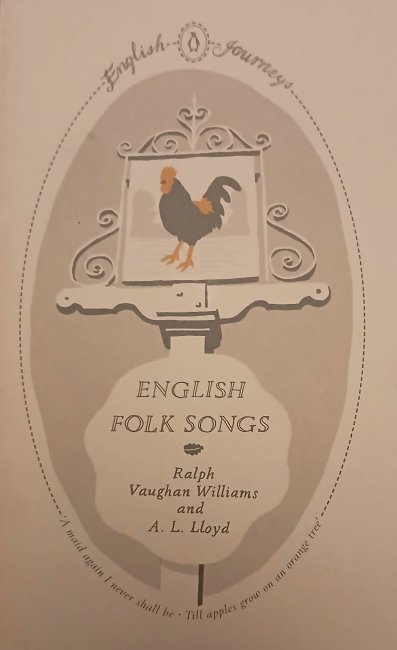
Continuing the bucolic countryside and doomed love themes from last week’s ‘Far From the Madding Crowd’ I was drawn to this book of English folk songs, which was Vaughan Williams’ last book as sadly he died just before it was published. Ralph Vaughan Williams was of course one of the great English composers of the first half of the twentieth century, he died in 1958, and was heavily inspired by English folk songs although he also wrote nine symphonies and four concertos along with his numerous song cycles and choral works. He qualified as a Doctor of Music from Cambridge University and it is as Doctor Vaughan Williams that A L Lloyd refers to him in his ‘Note on the Presentation of the Tunes’ at the start of this book. The selection of songs is quite widespread, although biased toward tunes gathered in the south of England as that was where Vaughan Williams lived so it was easier for him to travel round collecting material in that part of the country although there are a small number from the north. Vaughan Williams was inspired to start collecting English folk songs by contemporaries such as Cecil Sharp and the collections he made helped to preserve a rapidly dying art form as well as influencing his own work.
If I have one criticism of this book it is not in the choice of songs, which provide a spectrum of styles but in the structure of the book itself with the songs in the first part and the accompanying text in the second half which means that you need two bookmarks to keep track of where you are as you continually skip to and fro to read the context and history of the song you have just read. I would have much preferred the descriptions to be interleaved with the music as that would have been far simpler to read.
Before the couple of examples I have chosen, I must explain that the copy I have has a very tight spine and to avoid splitting it I have been forced to hold it open as much as I dared but that has led to somewhat distorted photos of the pages.
Although listed as collected from Somerset, the earliest versions of this song are known from Newcastle Upon Tyne, so the opposite end of the country, and these date back to the late seventeenth century. The lyrics included are a mix of at least three versions into a harmonious whole presumably by Vaughan Williams when collating this book.
The Green Bed follows a theme common with other songs of the period of a sailor who arriving at lodging he has used before claims to have lost all his money in a disaster and is turned away but when he shows that actually he has plenty of money all of a sudden beer and bed are available and the landlady is quite happy to include her daughter in the bed. However the sailor spurns the offer as it is clear that both of them are only interested in the money he has. Again the example comes from the south of England but versions of this song are also known from Warwickshire, in the English Midlands and therefore a long way from the sea.
I really enjoyed this exploration of English folk song and I have various other collections of traditional music which would also be worth exploring at a later date.
I have to admit that in the over three decades I have owned this book, as part of a set of six novels by Hardy from The Folio Society, I have attempted to read it at least three times. Initially when I bought it back in 1993 and then again probably ten years later, where according to the bookmark I found inside I made it to page 84 out of 413, this time I read and thoroughly enjoyed the book in just four days during the last week. I don’t know why I failed the first two times, some books you just have to be in the right frame of mind to appreciate them.
There are five main characters, I’ll tell as much of the start of the novel to set out how they stand with each other. Gabriel Oak who starts the novel as a farmer in good standing with two hundred sheep and a couple of sheepdogs, the younger of which would lead to his ruin by one night driving his entire flock over a cliff edge to their deaths, The sheep were not insured but by selling everything he owned he managed to cover his debts. Also appearing at the start of the book is Bethsheba Everdene, a young woman whom Oak falls in love with, pretty well at first sight, but she does not return his affection. She however soon leaves the vicinity, before Oak’s disaster with the sheep, and he knows not where she has gone. Oak, now penniless takes himself off to a hiring fair hoping to get a job as a bailiff (farm manager), failing to do so he reverts to his skill as a shepherd but still doesn’t get a job so decides to try the next fair in a nearby town. On his way he sees a hayrick on fire and endeavours to put it out, his bravery is soon noticed by the labourers on the farm as they race to his assistance and on the back of this he is offered the job as shepherd by Mistress Everdene who it turns out had inherited this very farm which is why she left the area where Oak was living. Still very much in love with Bethsheba but now so reduced in fortune as opposed to her meteoric rise he realises that he can never hope to gain her hand in marriage.
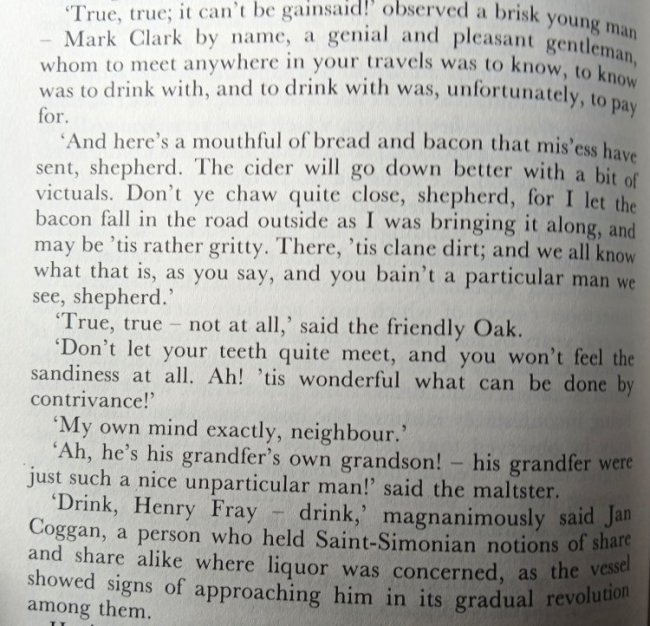
On coming into the village after the fire is extinguished he encounters the young Fanny Robin who it turns out has that night left the house where she was employed as a servant without telling anyone and is running away to her love, a Sergeant Troy in one of the local regiments who has promised to marry her. Troy however is an out and out cad as will become obvious as the book progresses. This leaves one more major character, the owner of the farm adjacent to Bethsheba Everdene’s, Mr Boldwood, I don’t think we ever find out his first name. In a moment of fecklessness Bethsheba sends Boldwood a valentine one year even though she doesn’t love him and this prompts the bachelor to look again at his neighbour and consider marriage for the first time in his life and this will lead to all sorts of problems as the book progresses. These five characters with their interrelationships drive the whole plot but around them the description of rural life and its nearness to poverty is brilliantly told by Hardy, take the following example, which also shows the expression of the local dialect which pervades the novel, this is just after Oak has been retained as shepherd after his heroics with the fire.
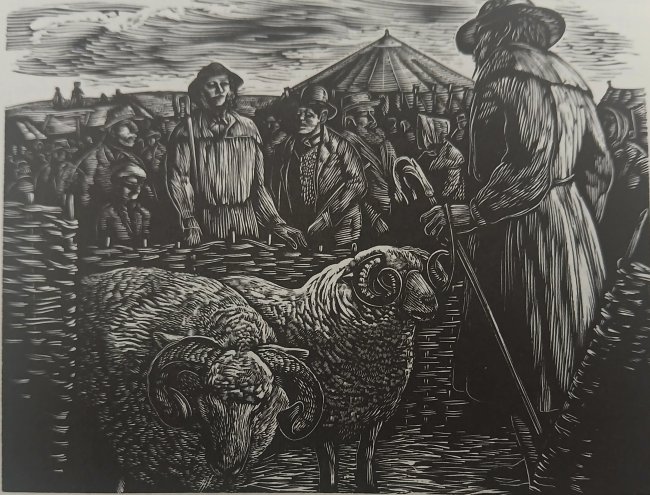
The book, like all Folio Society editions, is beautifully illustrated, this time with thirty one wood engravings by Peter Reddick who worked on all of their Thomas Hardy volumes, around twenty of them, making him the first artist to completely illustrate Hardy.
It was only at the end of the book that it dawned on me how young the major characters are, Gabriel Oak is one who is given a definite age, that of twenty eight at the start of the novel which covers the span of around four or possibly five years so he is thirty two or thirty three at the end of the story. There then becomes the slight problem of the age of Bethsheba Everdene caused by two statements by Gabriel which disagree. In chapter twenty nine – Particulars of a Twilight Walk he says he is six years older:
But in chapter fifty one – Bathsheba Talks with Her Outrider he says there is eight years between them and Bethsheba agrees:
As she agrees and she knows him better by now, as it is near the end of the book, I’m inclined to the eight year gap meaning she was twenty at the start of the novel and twenty four or twenty five at the end. Suddenly it dawned on me just how young she was when she inherited the farm and started running it by herself and that brings a new perspective to her fearlessness and possibly recklessness in deciding to do that. Mr Boldwood is described as ten years older than Oak so allowing for Oak’s approximations in the earlier passage we can say he is in his early forties by the end, which fits with his position as a confirmed bachelor early on in the narrative as he would hardly be described as such if much younger than his late thirties. Sergeant Troy is stated as twenty six at the end of the book and Fanny Robin is twenty, so she was just fifteen or sixteen when she started her relationship with Troy. However I can’t include a picture of where these ages come from without giving away a large part of the end of the book, which I don’t want to do.
I’m so glad I had another go at reading this book and I’m now not sure why it has taken me so long to finish it as I have greatly enjoyed this tale of Victorian life in south west England, so much so that I’m considering which one of the other six Hardy novels I own to tackle next.
When I decided to review a book about Peter Cook this week I was faced with a dilemma, should it be ‘Something like Fire’ edited by his widow Lin Cook, or ‘Tragically I was an Only Twin’ edited by William Cook who is apparently not related to the great comic. Both books are wonderful tributes to Peter Cook who sadly died thirty years ago (9th January 1995) at the far too young age of just fifty seven. In the end I chose the second not because ‘Something Like Fire’ is the lesser book, it is a compendium of reminiscences and through that you learn a little more about what it was like to be with Peter Cook and it is of course extremely funny. But this book is a collection of his works, many transcribed from recordings as either there aren’t scripts existing anymore or in several cases there weren’t scripts in the first place, Peter’s genius lay in extemporisation. What this book definitely isn’t as a complete Peter Cook, that would be multiple volumes, but what is here is representative and whilst reading it I can hear Peter’s voice, especially in his guises of E L Whisty and Sir Arthur Streeb-Greebling or memorably with Dudley Moore as Pete and Dud.
The performances between Cook and Moore worked mainly because they rarely had a script or rather there was the basis of one which Dudley Moore would learn but Peter Cook wouldn’t despite having dictated it into his ever present tape recorder, relying instead on headlines to keep the performance going in the right direction. Cook would invent a lot during the double act which gave spontaneity to the shows and would often lead to Moore struggling to keep a straight face as some new brilliant line would strike Cook as a better alternative to what he should have been saying. That Dudley Moore could continue regardless is a mark of his acting abilities but it also left William Cook with a dilemma whilst compiling this book as there would be several different versions of a lot of the sketches so he had to choose which one should be included. There is a lot more to Peter Cook than his work on stage or on television and his writing for newspapers and the satirical magazine Private Eye, which he ran for many years, is also featured in this collection.
Sadly Cook did most of his best work in the 1960’s and 70’s only occasionally appearing after then and then only when he wanted to but when he did it was invariably superb. The one legged Tarzan sketch seen in the link is a classic and was originally performed in 1964 but this is a version from one of the Secret Policeman’s Balls in the 1980’s to raise money for Amnesty International. The real tragedy of this book is it highlights how much of the early material no longer exists, a lot of the 1960’s performances for the BBC were wiped when the BBC decided to re-use the master tapes so only records and tapes still exist and almost all of those are no longer available to purchase so this book is invaluable in preserving the work one of the great comic geniuses. Sadly I never heard his alter-ego Sven the Norwegian who would call in to a late night local radio show and would be so strange whilst talking about the Norwegian obsession for fish which had driven him from his home country without the radio host, at least at first, having any idea he was actually talking to Peter Cook. I did see the wonderful Clive Anderson interviews from December 1993, also included here, where Clive apparently interviewed four different, and distinctly odd, people in one show all played by Peter including a biscuit quality controller who had been abducted by aliens, a judge who shot a defendant in court, a football manager and an ageing rock star. Peter Cook’s performance in these was entirely unscripted and this was probably his last great appearance.
For those inspired to approach Cook’s work after reading this blog I feel I should warn about the language used in Peter Cook and Dudley Moore’s last collaboration, that of Derek and Clive. These sketches are deliberately littered with profanities and the two performers are often inebriated whilst coming out with this stream of consciousness. The coarseness of the language and the, at times, unpleasantness from Cook to Moore, who at the time (late 1970’s) was becoming successful in Hollywood just as Cook’s career was struggling sometimes makes these a difficult read but they are nevertheless very funny.
This book, Rageh Omaar’s first, starts with him being the first BBC journalist allowed into Iraq after five years in September 1997. He had become the BBC Middle East correspondent that summer and had straight away applied for a visa for Iraq not really expecting it to be granted as anyone from the BBC was persona non grata in the country since the end of the Gulf War in 1991. But Omaar is not the white middle class reporter expected by the regime, rather he was born in Mogadishu, Somalia and speaks fluent Arabic so amazingly they let him in. The book would be fascinating enough if it just dealt with the next six years whilst Omaar gets to know Baghdad and develops friendships with not just his team but ordinary Iraqis, finds a regular tea shop and chats to locals providing an insight to daily life in a country few of us have had a chance to visit. Of course during that time Omaar only spent a few weeks or months at a time in Iraq, he had the entire Middle East to cover and in 2001 and 2002 he was in Afghanistan reporting on the fall of the Taliban, I’d love to read a book by him about that time as well. But at the end of 2002 he was back in Iraq as US President George Bush Jr and British Prime Minister Tony Blair falsely accused Saddam Hussain of having weapons of mass destruction that he would be willing to use and decided on regime change in Iraq as part of the Global War on Terror started following the attack on the Twin Towers in New York in September 2001, which Iraq had nothing to do with.
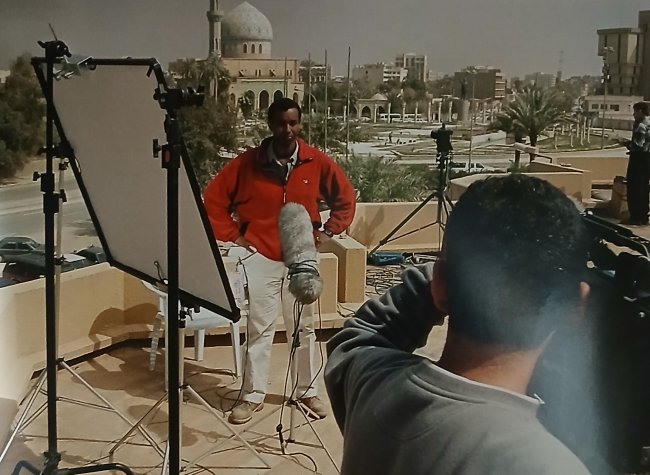
As 2003 began it became clear that despite the lack of a UN resolution supporting such action America was going to lead a coalition force including Britain in invading Iraq and journalists and their teams were given the opportunity to get out of the country. Despite it clearly being highly dangerous, especially for news teams from countries involved in the invasion, Omaar and a much reduced team decided to stay. The picture above is of them filming on top of the Palestine hotel in central Baghdad with the 14th of Ramadan mosque behind him during the invasion, just three days later they would be in the same place when the Americans bombed the hotel, the impact knocking them flat and killing at least one member of another news team. This is despite the much vaunted precision guided weaponry in use in the conflict and the location of the hotel and the use it was being made of by a lot of journalists still in the country being clearly flagged to the invading forces.
The descriptions of just how the news reports were made and transmitted from the middle of a conflict zone are really interesting and Omaar’s continuing ‘normal’ life in Baghdad interacting with ordinary people, still going to his favourite tea room etc. adds greatly to the story he is telling. I remember hearing him being interviewed from London on a satellite phone as bombs and missiles rained down around him but it is the calls made on the same phone to his wife and family afterwards to assure them he was OK that bring home the fragility of his and his crews existence at the time.
The book has an epilogue where he goes back to Iraq a few months after the invasion and speaks to Iraqi’s about how they are surviving after the conflict and the mismanagement of the country by the victors, who didn’t seem to have a plan for what to do afterwards, is well worth reading, as of course the whole book is.
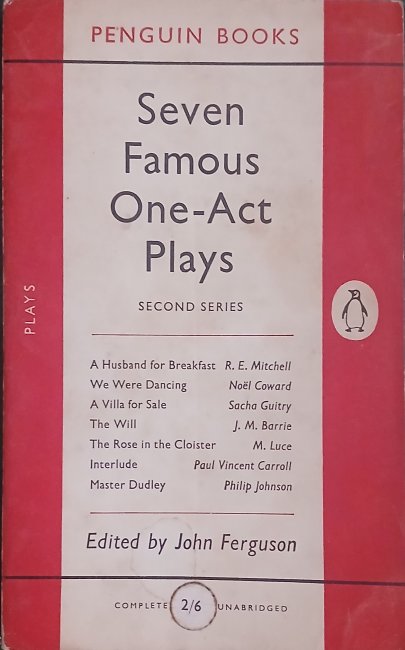
It was a long time between the first collection of one-act plays published by Penguin and this second selection, the first volume was published in November 1937 whilst this one came out in November 1953. Part of the sixteen year gap can of course be explained by the onset of WWII but Penguin wouldn’t publish any more collections of one-act plays until 1965 and the establishment of Penguin Plays as a series of its own. Which is odd if the blurb on the rear of the book is true as this suggests that one-act plays are particularly popular with amateur dramatic associations. Popular or not I’ve largely enjoyed this collection even if, just over seventy years after it came out, I recognise the names of just two of the playwrights of the seven ‘famous’ plays and there are three I would really like to see performed. Taking them in the order they appear in the book, rather than the front cover:
Villa For Sale – Sacha Guitry
A noted French actor, playwright and film maker, Guitry was prolific in both his production of plays and films, often acting, producing and directing in the same film where he also wrote the script and in 1936 he performed all four roles in four separate films. Villa for Sale is translated from the original French, although no translator is given in the book, and it was quite enjoyable as an entree to the collection. However it isn’t really satisfying as a story as the characters are quite lightly painted possibly due to the restrictions of the length of the play but as my favourite of this set is only a little longer I’m less inclined to give Guitry the benefit of the doubt with this. The story concerns a French lady who is trying to sell her villa for 250,000 Francs but would take 200,000 at a pinch, the villa is in an up and coming neighbourhood for the French film industry so should be in demand but has been on the market for a while, however she has a viewer this afternoon. A couple arrive and are welcomed but the husband is clearly bored of looking at villas and doesn’t really want to buy anything. Whilst his wife is upstairs being shown around it becomes clear that this couple are not the expected buyers but have turned up on spec when the real potential purchaser arrives, mistaking the man as the seller of the property she offers 300,000 Francs and provides a cheque straight away as she wants the place immediately ready to start working on a film. She leaves just before the real owners comes back downstairs and the husband writes a cheque for 200,000 Francs to buy the villa. All in all a rather tawdry story and not one I would rush to see performed.
We Were Dancing – Noel Coward
The play that for me has aged least well in the book, this comedy of manners based around a woman who feels that she has suddenly fallen in love with the man she was dancing with despite being married for many years to another man she loved once but over time it has become more habit to be together rather than love. I had high hopes for this as I had never read a play by Noel Coward, and at times the interactions between her husband and her new infatuation did work but frankly for the most part it left me bored and the clip I found of Coward performing the song included in the play does little to improve my opinion of the play.
Master Dudley – Philip Johnson
In third place of the plays I would like to see performed is this one, although the chance of any company even hearing of the play never mind putting it on are very low. Over fifty of Philip Johnson’s one-act plays appeared in the Samuel French catalogue of published plays of 1951 – more than any other author. In the comparable catalogue of 2005, his plays had disappeared without trace. At the start of the play Dudley’s aunt Stella had just arrived from America to provide support to her sister’s family as Dudley was on trial for murder, however as she arrives he is sensationally acquitted, It becomes clear as the play progresses that there has been a grave miscarriage of justice…
Interlude – Paul Vincent Carroll
Irish playwright Paul Carroll was well known in Ireland and wrote many works including for the National Theatre and this almost makes it into my list of plays I would like to see performed as I suspect that done well it would make great entertainment. The play is set in the office of a money lender in a small market town in Northern Ireland, Judy Tippin and her husband have come to Farrelly’s office to try to get an extension on their loan which was actually due to be settled the day before. Judy and Farrelly have history and she is hoping to use this to soften the heart of the famously stern money lender. The use of ‘defective’ electrics in the office which cause the lights to flicker occasionally and then ultimately go out leaving the performance by candlelight for a short-while has Judy almost convincing Farrelly to forget the debt in lieu of happy memories but then the lights come back on and in the harsh light the hard-hearted Farrelly takes her money leaving her and her husband with nothing.
Although Carroll was lauded in both Dublin and New York as a major new theatrical voice, virtually none of his work has been in print since his death in 1968 until Colin Smythe published a significant collection in 2014 as the sixteenth volume in his series of Irish dramatists, with six complete plays (although not including this one) and overviews of many of his other works.
A Husband for Breakfast – Ronald Elwy Mitchell
Top of my list for plays I would like to see performed from this collection is this one, yet annoyingly Mitchell is the author I can find least about on the internet, other than born in Camberwell, Surrey in 1905 and died in Dane County, Wisconsin, USA in 1986. Nothing he wrote appears to still be in print yet from this short play he was clearly an excellent writer. The play, set in a small Welsh village, is full of humour. It starts early morning as Aholibah is starting to prepare breakfast for her and her husband Isiah, who is still asleep, but is surprised by the arrival of a neighbour who is clearly expecting some sort of show. It becomes clear that Isiah had been in the pub the previous night and when it came to his turn to pay for the drinks he hadn’t any money. Trying to think of anything he could sell or barter for his round he was constantly thwarted by people pointing out the items he came up with belonged to Aholibah. Eventually he struck a deal with Moses Roberts to sell Aholibah herself to him for the price of the drinks. Various villagers were therefore descending on Aholibah’s cottage to see how she reacts. Eventually Moses Roberts himself arrives seeking the return of the half a crown he had paid Isiah but Aholibah sensing a way to profit from this instead sets him to work around the house as her new ‘husband’ much to the amusement of the other villagers there. Moses Roberts is then desperate to get out of the bargain as can be seen below and a trade is proposed for Roberts to buy himself out of the ‘contract’ which starts with two bushels of wheat but quickly escalates:
The Rose in the Cloister – Margaret Luce
Later Lady Margaret Luce as her husband was knighted when he became Governor of Aden in 1956 she is also one of the grandmothers of English actress Miranda Hart and wrote a book about her experiences in the Middle East ‘From Aden to Gulf: personal diaries’, which covers 1956 to 1966 and is a book I will definitely be looking out for. The play is well written and is also by far the shortest work in this collection being just nine pages long yet it manages to tell a complete story and even deliver a moral. It starts with a monk just concluding his sermon in the cloister of the monastery during which he points out a rose bush with a single flower and warns that “Only he whose heart is true as steel and without sin may pluck that rose from its stem: if any other dare to make the attempt his hands as they touch the stem will be burned”. This greatly excites his listeners but one resolves to take the rose and give it to his true love in place of the rose he has already brought for her.
The Will – J M Barrie
Second in my list of plays I want to see is this one. Barrie is probably most famous as the creator of Peter Pan and this is beautifully written as we see the effect of the years passing with the simple expedient of altering the set dressing, and presumably some quick changes on behalf of the cast. It is set in a solicitors office and a young couple arrive to set out his will in favour of his new wife. Once this is done the curtain falls ut rises again just ten seconds later to reveal subtle changes such as the portrait of the monarch going from Queen Victoria to King Edward VIII. The couple return, a little older, and revise the will, he is obviously doing much better than anticipated yet the beneficiaries other than his wife are getting less. The curtain falls and rises ten seconds later again, the portrait of the monarch has altered to King George V along with other small changes. The couple return and again revise the will, he is now wealthy but again the changes show even less regard for others. The curtain comes down and back up for a third time and this time just the man arrives as his wife has died, this time he wants to revise to will to pay back those people he had taken advantage of on his way up in society. The play is really well done as not only are the changes in the couple elegantly drawn but the father and son pair of solicitors also evolve over time.
One thing I would have liked included in the book is a brief biography of the various writers, I assume it is missing as they would have been well known at the time, but only Coward and Barrie have lasted the decades as names I recognised so I’ve had to do a little research to identify the authors.
The start of the trial of Hadi Matar on the 10th February 2025 for the attempted murder of Salman Rushdie in August 2022 prompted me to go back to the shelf of Penguin Drop Caps volumes far earlier than I planned, as I knew that there I would find Haroun and the Sea of Stories. This novel for children was Rushdie’s first published work after ‘The Satanic Verses’, which had led to the fatwa declared against him by Ayatollah Khomeini of Iran for blasphemy and which almost certainly inspired Matar, a twenty seven year old American of Lebanese descent, to attack Rushdie almost killing him, stabbing him fifteen times, leaving him blind in his right eye, with a severely damaged hand and multiple other injuries. That the novel was published ten years before Matar was born and that Iran had said the fatwa would not be enforced also before he was born seems not to have affected Matar who admitted he had only read a few pages; and Rushdie had said that he was at last leading a relatively normal life without protection in an interview just two weeks before the attack. Still enough of the context as to why I picked the book up, let’s look at this wonderful fantastical story which I hadn’t read before.
Rushdie had me hooked from the opening lines of this novel:
There was once in the country of Alifbey, a sad city, the saddest of cities, a city so ruinously sad that it had forgotten its name. It stood by a mournful sea full of glumfish which were so miserable to eat that they made people belch with melancholy even though the skies were blue. In the north of the city stood mighty factories in which (so I’m told) sadness was actually manufactured, packaged and sent all over the world, which never seemed to get enough of it. Black smoke poured out of the chimneys of the sadness factories and hung over the city like bad news.
It goes on to say that most places in Alifbey had just one letter as their name so there is the town of G and the nearby valley of K nestled in the mountains of M, this means that lots of places had the same name and therefore post was often delivered to the wrong place. In a helpful couple of pages at the back of the book Rushdie explains that the name Alifbey is based on the Hindustani for alphabet and that another destination on the journey of our heroes, for what sort of children’s book doesn’t have heroes even unlikely ones, is The Dull Lake “which doesn’t exist, gets its name from The Dal Lake in Kashmir, which does”. Rushdie was born in India and lived there until he was seventeen and takes a lot of inspiration in his writing from his youth. I have mentioned our heroes and they are Rashid Khalifa and his son Haroun, these are named after Haroun al-Rashid the legendary Caliph of Baghdad who appears in the Arabian Nights stories. Rashid is the happiest man in the very sad city and is renowned as a storyteller gaining the titles of The Ocean of Notions or the Shah of Blah because he could keep telling tales without repeating himself, weaving stories together without ever losing the intricate plots and therefore whenever he spoke he would draw huge crowds. This made his especially popular with politicians trying to get people to listen to them as elections approach as he could start the rally and pull people together from the surrounding area.
But one day disaster struck, the flow of stories just stopped, Rashid couldn’t string two words together and this was at the start of a tour arranged by politicians so it was vital that the reason was discovered. The second night of the trip saw Rashid and Haroun on a boat on The Dull Lake where Haroun encounters Iff the Water Genie who had come to disconnect the invisible tap that linked Rashid to the Sea of Stories, the source of all his tales. In vain Haroun argued that it was a mistake but finally he convinced Iff to take him to the Earth’s invisible second moon, Kahani, so that he could meet the leader of the Eggheads and appeal for Rashid’s tap to be reconnected. Travelling on a giant mechanical Hoopoe called Butt they arrive on Kahani and find the Ocean of Stories is heavily polluted with the stories dying off so Haroun then has to find out what is causing the pollution and stop it. Along the way he finds Rashid has also made his way to Kahani and has his own quest to undertake.
The book is a wonderful adventure story full of linguistic jokes, like the talking fish with lots of mouths which are called the Plentymaw fish in the Sea and the Pages, or soldiers, arranged into chapters and volumes instead of companies and battalions. It is split into twelve chapters, each no longer than fifteen pages so ideal to be read as to a child as a bedtime story over a couple of weeks. I loved the book and it was so different to the other book by Salman Rushdie I reviewed on this blog back in 2019, The Jaguar Smile. I also have his second novel, Midnight’s Children, which was his first best seller, hopefully I won’t wait another five and half years before reading that.
You can find more about the Penguin Drop Caps series in my overview here, which also includes links to the various books I have reviewed from this set of twenty six books.
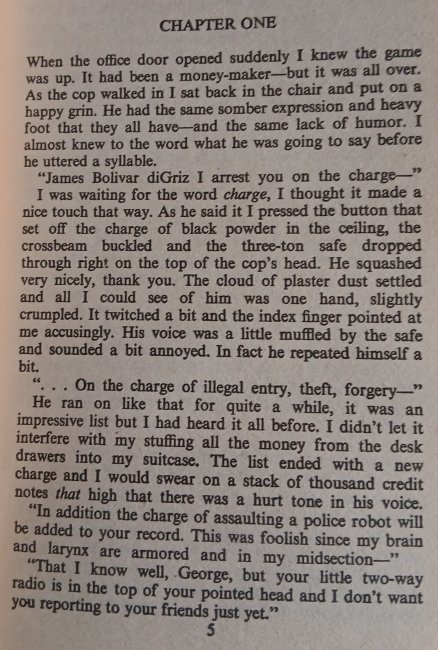
A few weeks back I featured a book written by Harry Harrison ghost writing as Leslie Charteris in the first ‘Saint’ book written by someone other than Charteris and that prompted me to look on the shelves for something where Harry Harrison was properly credited. That led me to a series of books I bought, and probably last read, back in the mid 1980’s and Harrison’s most famous creation The Stainless Steel Rat. There are a dozen books in the series and this was the first, it is based on a couple of short stories originally published in Astounding magazine in 1957 and 1960 which were linked and expanded to make the novel in 1961. The best way of introducing the character of Slippery Jim diGriz, alias The Stainless Steel Rat is to read the opening page of this book.
I like the way it is only revealed that the policeman is a robot after the safe is dropped on him, in fact The Stainless Steel Rat is proud of the fact that for all his criminal escapades he has never killed anyone. The stories are set in the distant future and on various planets far from our own, this is pure science fiction fantasy with a heavy dose of humour mixed in for good measure. As is stated in the page shown DiGriz is a career criminal, something of a rarity in this version of the future where children are scanned for any tendency to not be upright law abiding citizens and ‘corrected’ before adulthood. The crime he was committing at the beginning of the book was a simple one, rent a warehouse next to a government storage site, which is full of food but intended for emergencies so rarely visited, cut a hole in the wall and help himself to the goods, relabelling everything so it isn’t obvious it has come from the next door building. Using robots to do the work meant he could keep the money rolling in 24 hours a day without having to do any menial work himself.
Escaping from the police raid using a carefully planned route DiGriz soon starts another caper, this time the theft of an armoured car carrying the takings from a large department store, this is done in quite an ingenious way but this time someone was out thinking him every step of the way and he finds himself trapped. This is his first encounter with Special Corps, an interstellar police service headed by Harold Inskipp, who was a legendary criminal before DiGriz turned to crime and was assumed to be locked up somewhere as he hadn’t been heard of for years, instead he had been recruited to run Special Corps and now he wants DiGriz to add his special talents to the organisation.
I won’t go into too many details of the plot, it’s quite a short book, just over 150 pages, and can be read quite quickly, suffice to say that in the course of the novel DiGriz meets his future wife and mother of his twin sons although this won’t happen until the next book ‘The Stainless Steel Rat’s Revenge’, I have half of the Stainless Steel Rat books along with several other books by Harrison including one of his few books not to funny, Make Room! Make Room! which would be loosely adapted into the superb dystopian 1973 film Soylent Green, a very early warning on the dangers of the greenhouse effect and overpopulation. I have to admit that I prefer Harrison as a comedic writer with a strong streak of anti-authoritarianism thrown in.








 Ramblings on my bookshelves