Holy Terrors – Arthur Machen

it’s a riff on Arthur Machen’s “The Great God Pan,” which is one of the best horror stories ever written. Maybe the best in the English language. Mine isn’t anywhere near that good, but I loved the chance to put neurotic behavior—obsessive/compulsive disorder—together with the idea of a monster-filled macroverse. That was a good combination. As for Machen vs. Lovecraft: sure, Lovecraft was ultimately better, because he did more with those concepts, but “The Great God Pan” is more reader-friendly. And Machen was there first. He wrote “Pan” in 1895, when HPL was five years old.

The above quote is by Stephen King and if anyone can judge a horror story then he is probably the man, it can be found on his website here as part of one of his ‘self interviews’. Sadly I don’t have a copy of ‘The Great God Pan’ as this is the only book I have by Arthur Machen, which is actually the pen name of Welsh fantasy and horror writer Arthur Llewellyn Jones. Even Lovecraft regarded Machen as a great in the horror story genre naming him amongst the four modern masters of the style and he was highly influential in the development of Lovecraft’s Cthulhu stories. This book consists of fourteen short stories which whilst none of them are of the horror genre give a glimpse of the abilities of this popular writer many of whose works are still in print almost eighty years after his death. Indeed several bear the mark of another writer who came later that of Roald Dahl and his ‘Tales of the Unexpected’.

As is often the case with collections of short stories the better examples are the longer ones, especially in this set, the final tale of which, that I will also come to last, is excellent. The stories range from a story about a clergyman who vanishes without trace from his home for six weeks only to re-appear exactly as he was last seen by his housekeeper working at his desk and with no feeling that he had stepped away for more than a few minutes. One story I particularly enjoyed is ‘The Tree of Life’ which tells of a seriously unwell man running the lands of his estate from his sick bed by communicating his wishes via his land agent. The ending of the tale completely upends the story so far but in a completely believable manner. ‘The Bright Boy’ and ‘The Happy Children’ are the closest we get to horror in this collection with the first story of a man with the appearance of a boy and the odd occurrences that happen in the vicinity of the house where he lives with his supposed parents. The happy children tells however of a journalist unexpectedly coming across the spirits of dead children in the streets of a Yorkshire town before they process up to the abbey ruins. There is also the story an unspecified ceremony being performed at a strange stone in the woods that I wish was longer as the atmosphere is so well created and then it stops leaving me wanting more and ‘The Soldiers Rest’ where it gradually becomes clear what sort of rest he is having. All of these are wonderfully written but it is the final story of this collection along with one that is sadly missing that cement Machen in his position as a truly great writer of short stories never mind his horror novels.

The one that is missing is ‘The Bowmen’ which was first published on 14th September 1914 and tells the story of a horde of phantom bowmen from the Battle of Agincourt, five centuries earlier, which came to the aid of British troops at the Battle of Mons. This story, as it was published in The Evening News newspaper which Machen worked for at the time became believed as true and is the foundation of The Angel of Mons and evidence of divine intervention on behalf of the British soldiers. No matter how often Machen tried to say that he made it up he was rarely believed and the tale was spread around the world as fact. The story that completes this set is however ‘The Great Return’ and this is the first published story telling of the existence of the Holy Grail in modern times and the miracles that occur along with its reappearance. The story which along with Machen’s novel taking the same theme ‘The Secret Glory’, which he had already written by then but which wasn’t published until 1922, would clearly influence writers such as Dan Brown in his Da Vinci Code and George Lucas with Indiana Jones amongst others.

You can find out more about Machen via ‘The Friends of Arthur Machen‘ an international literary society dedicated to the works of this remarkable author.

Memoirs From Beyond the Tomb – François-René de Chateaubriand

I was going to call this an autobiography, but it is so much more than the history of one man, for example there are over a hundred pages that detail the rise and fall of Napoleon from his early days in power when Chateaubriand was in various roles including Secretary to the Holy See until their split over the execution of the Duke of Enghien and then onwards to Moscow, exile to Elba, his return and ultimate defeat at Waterloo and final exile to St Helena. None of these later actions after his diplomatic roles ended involved Chateaubriand except as an observer on the impact in his beloved France. Chateaubriand is an excellent historian and writer but with considered views on the results of that history on himself, those around him and the wider public which add considerably to his narrative. But if you don’t know of him a section from his preface will give an idea of the breadth of his experience:

I have met nearly all the men who in my time have played a part, great or small, in my own country or abroad: from Washington to Napoleon, from Louis XVIII. to Alexander, from Pius VII. to Gregory XVI., from Fox, Burke, Pitt, Sheridan, Londonderry, Capo d’Istrias to Malesherbes, Mirabeau and the rest; from Nelson, Bolivar, Mehemet Pasha of Egypt to Suffren, Bougainville, La Pérouse, Moreau and so forth. I have been one of an unprecedented triumvirate: three poets of different interests and nationality, who filled, within the same decade, the post of minister of Foreign Affairs—myself in France, Mr. Canning in England, Señor Martinez de la Rosa in Spain. I have lived successively through the empty years of my youth and the years filled with the Republican Era, the annals of Bonaparte and the reign of the Legitimacy.

It should be pointed out at this point that this 2016 Folio edition is a reprint with some amendments of the abridged 1961 Hamish Hamilton Ltd. version, later a Penguin Classic, selected and translated by Robert Baldick and even at 367 pages doesn’t have room for Chateaubriand to encounter all the people listed above but it is still a substantial read covering an important part of French history from the Revolution through the entire time of Napoleon and beyond to the restoration of the Bourbons with Louis XVIII and Charles X and their subsequent fall. I have to admit that apart from the British view of Napoleon and the basic knowledge from school of the French Revolution I didn’t know much about this period of French history and Chateaubriand is in a unique position to expand my knowledge. As members of the nobility his eldest brother and wife were executed during the revolution and a lot of his family, including his mother were imprisoned, Chateaubriand was the tenth child, so as he was not seen as important at the beginning managed to escape France and lived in poverty in London, a time he writes about decades later in this book whilst a famous author and French Ambassador to the UK. The juxtaposition of his various positions through his life is one of the things that make the story so fascinating, he left the ambassadors role to become a member of the French government as Minister for Foreign Affairs in 1822.

I found myself constantly learning French history as I read Chateaubriand’s story of riches to rags, back to riches, obscurity to fame and a return to relative obscurity in his later life as he largely became a recluse trying to complete the four sets of volumes (there is a total of forty two ‘books’ each of which form part of a published volume) that this work became. as the range covered kept expanding and he was also busy with many other projects. Originally he planned for these books to be published fifty years after his death but in fact the first part appeared just a year after he died with the rest published the following year. This was to be his masterpiece and it is a fascinating read. It sealed his place as one of the founders of French romanticism and influenced French writers for decades.

Designing Terry Pratchett’s Discworld – Paul Kidby

Well I was halfway through the book that will now be the subject of next weeks blog when this arrived and was begging to be read. As regular readers of this blog will know I have been a reader of Terry Pratchett’s work since the very beginning of Discworld back in 1983 and have numerous pictures by Paul Kidby on my walls that attest to that interest, some signed by Paul, some by Terry. For Terry the art of Paul Kidby came the closest to what was in his mind of anyone who has illustrated his works so I was fascinated to read this book, indeed I had ordered it from Paul many months ago and whilst knowing it was to be published in November 2024 had lost track of the actual publication date so when this signed copy dropped through my door on Friday then it just leapt to the top of the to be read list and frankly I haven’t been remotely disappointed. The pages have a high gloss finish, entirely appropriate for the art book that this is, but making them extremely difficult to photograph.

The above picture is of Kidby in his surprisingly bare, and quite small, studio with his dog asleep under his desk. This is from a chapter where we look at the materials he uses to create his art, specific boards, brushes, pencils and paints that he prefers and this is interesting as he explains why he picks particular art supplies. But the vast majority of the book looks at the development of the various characters. All the major characters have at least a page discussing how Kidby came up with the their look and how they have changed over the years, so I’ll feature Lady Sybil Ramkin.

As you can see there is an original sketch which frankly looks more like the Clarecraft version of Lady Sybil than the later iterations by Kidby and there are often handwritten notes like the one featured above adding more details of the artistic influences to the illustrations. One thing I particularly liked was the inclusion of the original art when Kidby does one of his numerous parodies of famous paintings so that you can clearly see where his inspiration came from.

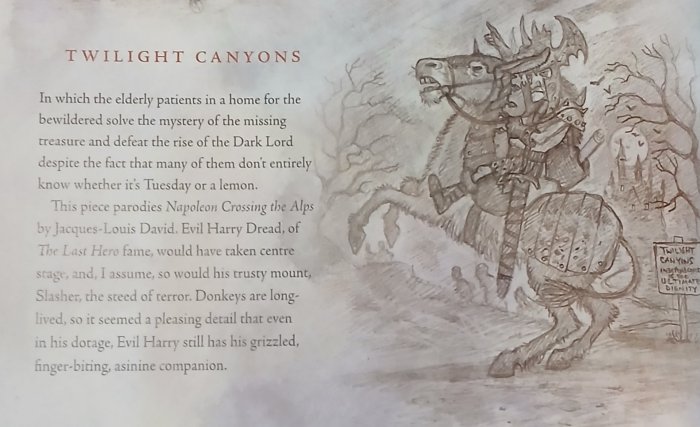
One of the joys of the book however is right at the end in a chapter called ‘The Road Not Taken’ where Kidby has produced a brief sketch for books that never were, Pratchett’s work in progress at the point of which he could no longer write and one of these is Twilight Canyons.

I was in the audience for ‘Bedtime Stories’ at the 2016 UK Discworld Convention, this section had always featured a reading from a book that hadn’t been published yet, initially read by Terry and latterly by his Personal Assistant Rob Wilkins. This was the first convention after Terry’s untimely death and seeing this on the programme had raised a definite buzz of anticipation, what would Rob do? Maybe just tell stories about how he and Terry had worked together and that indeed is how he started but suddenly he reached over for a sheaf of paper and started reading Twilight Canyons, a book that was clearly well in progress but which we would never get to read, the room fell even quieter as we all knew this was our only chance to experience this book.

Right after he finished the quite long extract he removed the On Air sign and the coat to reveal that the ‘table’ beside him was a shredder and he duly dropped the manuscript into the slot of the now working machine, continuing Terry’s wishes that all his unfinished work was to be destroyed. A sad but fitting end.

Rob wrote the afterword to this book where he explains that it is hoped that this will simply be the first in a series of volumes looking at various aspects of Pratchett’s work and I do hope there is more as this was a fascinating book.

Caught Short of the Boundary – Henry Blofeld

For those of you who don’t know of Henry Blofeld, or Blowers as he became known on the radio, but feel the name Blofeld feels familiar then you are probably thinking of the James Bond villain Ernst Stavro Blofeld whom Ian Fleming named after his fellow Etonian Thomas Blofeld, Henry’s father. Now I have always thought of Henry as a genial old buffer from his days broadcasting on the BBC and thoroughly enjoyed the other, and considerably more substantial, volume I have by him ‘It’s Just Not Cricket!’ so to say I was disappointed by this book would be an understatement. I picked it up in a charity shop expecting more of the same good humoured anecdotes interspersed with journalism and travel writing and yes there are snippets of what I anticipated but for such a short book it is massively padded out. The body of the book itself lasts just 100 pages and of that there are 15 full page cartoons taking it down to 85. Chapters are always stared on a new page so there is a lot of blank space at the end of the previous one which total roughly 6 complete pages meaning there is really only 79 pages of text to the actual book and seven of those are taken up with a chapter simply reprinting pretty poor quality jokes. You would hope therefore that the remaining 72 pages would be worth reading, sadly that is rarely the case.

What comes over is a somewhat boorish character especially when he’s had a few glasses of wine, which appears to be most of the time, who was arrested for assault of his then girlfriend whilst visiting New York and describes visiting brothels whilst following cricket tours. The picture on the front cover shows him looking matey with England cricketer Ian Botham but the story inside concerns Botham’s indignation to a piece written by Blofeld which was highly critical of his abilities. Later on we discover that he also upset Dennis Lillee, the great Australian player, again through his highly critical writing, only to find himself booked as a speaker at one of Lillee’s testimonial dinners, he attempts to make this funny but fails miserably. I simply cannot recommend this book to anyone, indeed by the time you read this it will already be back in the charity shop and I hope that whoever picks it up next has a better time with it but at least the charity will make a little money each time it gets bought.

The cartoons are by Charles Griffin, then working as the political cartoonist for the newspaper The Sunday People, and frankly they are often the best part of the book.

Whatever Happened to Margo? – Margaret Durrell

Last weeks blog about Lawrence Durrell’s book ‘Bitter Lemons of Cyprus‘ was intended to be my last encounter with the Durrell siblings for a while having started with Gerald a couple of weeks ago, but here we go again with a memoir by their sister Margaret. This deals with her time starting a lodging house in Bournemouth just over the road from the home then belonging to her mother but which was sold soon after Margo got her business running. Quite when the book was written isn’t clear but it deals with the end of the 1940’s so coincides with Gerald’s ‘The Overloaded Ark‘ which I wrote about in the first of these linked blogs. ‘Whatever Happened to Margo?’ however wasn’t published until 1995, long after Gerald’s Corfu trilogy about his childhood on that island made the family household names and gave rise to the title as whatever happened to Margo, and presumably her other brother Leslie, became regular questions amongst readers. Margaret’s book also answers some of the questions about Leslie as he appears fairly regularly in here, as at the time he is also living in Bournemouth having returned to the family fold from a business failure when the fishing boat he had put his life savings and his share of his father’s inheritance into had sunk. But more of Leslie, just to round out the family, later.

Margaret has a writing style far closer to Gerald than Lawrence with a gentle humour enveloping the trials and tribulations of running a lodging house with no previous experience of doing such a thing, especially as a young (she was twenty eight when she bought the property) recently divorced mother of two boys. We are introduced to another member of the family, Aunt Patience, early on in the book and she encourages Margaret in her business plan whilst making regular suggestions as to how to keep the place running efficiently and with propriety. Margaret is somewhat subdued by her aunts overbearing personality and also by the need to keep her sweet as the potential source of investment funds but dreads her arriving to see the somewhat eclectic mix of people she has already had moving in. Margaret attracts oddballs the way her younger brother attracts unusual animals, her first lodger is Edward, an artist who has fallen out with his previous landlady over his liking to paint nudes, along with his wife who also poses for him. She also gains the downtrodden Mrs Williams and her fat son Nelson who would prove to be a lovable rogue; always getting into scrapes, he features in numerous tales often leading Margaret’s own children in ways she would never have thought of including breeding mice in the disused outside toilet. The lodgers increase rapidly including a pair of glamorous nurses whose trail of ardent male admirers gave rise to the suggestion in the neighbourhood that Margaret was in fact running a house of ill repute. The list of interesting characters just keeps going and keeping the peace between them whilst not upsetting the neighbours is a constant battle especially when Gerald arrives with a selection of animals whilst still looking for somewhere to set up his own zoo. The book is great fun, and whilst not a laugh out loud read keeps the reader thoroughly entertained throughout its just over 250 pages.

And so to Leslie, during the time this book covers he moved in with Doris, the landlady of a local off-licence for whom he was delivering beer, they married in 1952 and later that year moved to Kenya to run a farm. They swiftly left Kenya in 1968 after Leslie was accused of theft, probably accurately as he always sailed close to the wind as far as the law was concerned, this is implied right at the start of Margaret’s book. They briefly moved in with Margaret in Bournemouth before getting a job as caretakers to a block of flats in London and it was in London that he died. By this time he had so estranged relations with the rest of the family that none of his siblings attended his funeral.

Margaret would outlive all her brothers by quite a long way. Leslie had a heart attack in 1982 aged 65, Lawrence died after a stroke in 1990 aged 78, Gerald succumbed to septicaemia in 1995 aged 70 but Margo was 87 when she died in 2007. This meant that none of her siblings saw her book get published, Gerald died in January of the year the book came out but he did write the preface in November 1994 where he states that she is still in Bournemouth, although presumably no longer a landlady as she was 75 by then. He continues that he often visits her there, just as she comes out to his zoo in Jersey and home in Provence, they have even holidayed together in Corfu so bringing the whole saga full circle. I’ll leave the final word to Gerry (as he is called in his books about Corfu) :

From the beginning and every bit as keenly as the Durrell brothers, Margo displayed an appreciation of the comic side of life and an ability to observe the foibles of people and places. Like us, she is sometimes prone to exaggeration and flights of fancy, but I think this is no bad thing when it comes to telling one’s stories in an entertaining way.

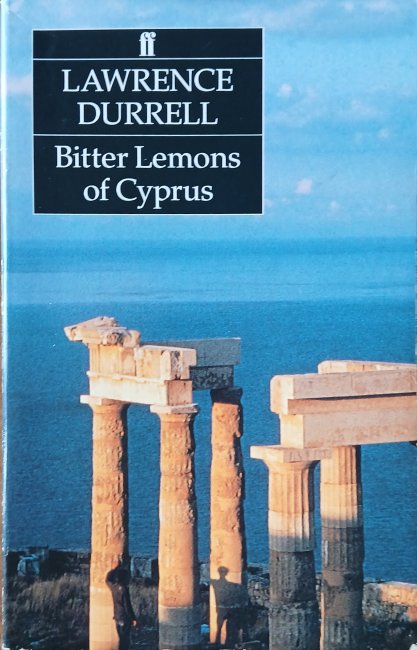
Bitter Lemons of Cyprus – Lawrence Durrell

Following on from his brother Gerald’s book last week, this is one of Lawrence Durrell’s travelogues and covers the years he spent in Cyprus from 1952 to 1956 after he left the British Council in Belgrade and planned to restart his novel writing, hopefully inspired by returning to a Greek island. Although he was there with his very young second daughter Sappho, born 1951, and without his wife who had been hospitalised back in England with post-natal depression you wouldn’t really know it as he largely avoids his family problems in the book. Indeed apart from a brief mention of Gerald, whom he claims had died in Thermopylae fighting alongside the Greeks in order to calm down a somewhat drunk Greek in a bar there are very few family references.

Sappho makes her first (and unnamed) fleeting appearance on page 102 and then only to note that she could see Turkey from an upstairs window of the house Lawrence is having renovated. Lawrence’s mother even makes an appearance, mainly I suspect to look after Sappho whilst Lawrence is working away to support the renovations, and Gerald threatens to appear, which as Lawrence points out would be awkward due to his apparent death at Thermopylae. One odd thing did occur to me at this point, why could the brother who died fighting not be thought of as Leslie, anyone who has read Gerald’s accounts of growing up in Corfu knows that there is another brother but Lawrence seems determined to ignore his existence, much as Gerald left out Lawrence’s first wife Nancy whom he lived with throughout the time the family were in Corfu and not with the rest of the Durrell family as stated in the books, and with whom he had his first daughter, Penelope.

Back however to this book, chapters vary wildly from good humour and even hints of farce when considering the purchase of the house and the crazy driving from person to person to get the legal process complete before they are caught up with by the rest of the sellers family who don’t think she is getting enough money for the property; to extremely serious such as the chapter entitled ‘A Telling of Omens’ which deals with the issue of Enosis, or the proposed union of Crete with mainland Greece and thereby ending the British rule, which was still in place whilst Lawrence was there. You can tell when reading this chapter that Lawrence initially didn’t believe that this would such an issue and neither did the Cypriots he lived amongst. It is only from the older students he started teaching English to in order to raise money to complete the house that he starts to see the first flickering of the violent unrest that is less than a few months away. But from this point onwards the tone of the book changes, turning from gentle humour to deadly serious as the situation on Cyprus quite literally explodes.

Lawrence was also a poet and the book ends with his poem Bitter Lemons, as does this review, but the beauty of his text can be seen in this extract describing a beach at dawn.

In the fragile membranes of light that separate like yolks upon the cold meniscus of the sea when the first rays of the sun come through, the bay looked haunted by the desolate and meaningless centuries which had passed over it since the first foam-born miracle had occurred. With the same obsessive rhythms it beat and beat again on that soft eroded point with its charred looking sand: it had gone on from the beginning, never losing momentum, never hurrying, reaching out and subsiding with a sigh.

When Gerald and his wife arrive Lawrence is about to take on a new role as press adviser for the colonial government which would mean living in the capital rather than his out of the way village so he basically left the house in Gerald’s care during the week, only returning at weekends. This role also gives him an insight into the ramshackle government operation which is totally ill prepared for what is to come and it is this summary of the failings of the British administration that makes the book so important as a document of the times. The book changes tone roughly halfway through as Durrell leaves the realm of good natured village life and instead describes the slow disintegration of all that he had come to love about Cyprus and the introduction of thousands of British troops to try to put a lid on the bombings and shootings which would eventually lead to independence in 1960, long after Durrell had left the island.

The Overloaded Ark – Gerald Durrell

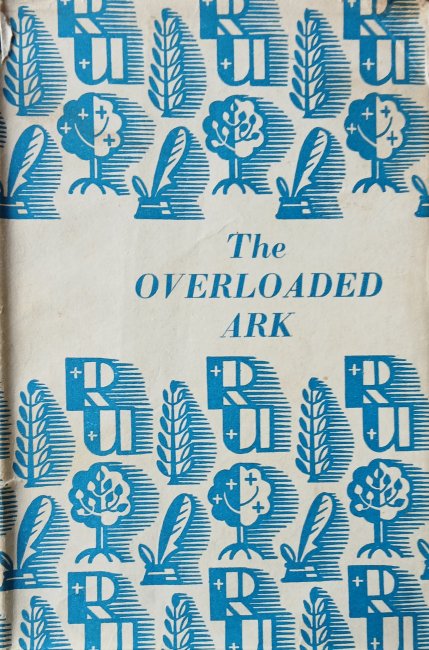
I remember reading lots of Gerald Durrell books as a child but this was the first I read as it is one of my father’s books, so it was sitting on the bookshelf for as long as I can remember. Published by The Readers Union, a book club run by Faber and Faber, who had first published the book, this volume dates from 1955. The odd thing is that I don’t remember any other books from this club at home although there were other book clubs represented on the shelves as that was probably the source of most of dad’s books. This was Durrell’s first attempt at writing a book and described his first ever collecting expedition which was to to British Cameroons and took place in 1947 with ornithologist John Yealland. He took to writing not because he particularly enjoyed it but because he needed the money partly to pay off debts from his first three collecting expeditions and also to finance his family life as he had married in 1951. He was fortunate to be able to get advice on writing from his elder brother the novelist and travel writer Lawrence Durrell and although their two styles are dramatically different they are both eminently readable.

The best way to illustrate Durrell’s style is to quote a section from the preface where they were loading the truck to get from Victoria to Mamfe where the two men were to part company to set up separate camps, Yealland to collect birds around the town of Bakabe and Durrell to go further into the bush to Eshobi searching for reptiles and mammals and also some birds not found near Bakabe. The truck was arranged for 7:30am and the plan was to be on the road by around 8:30am. The lorry however finally arrived at 11am and was full of a dozen of drivers relatives, friends and assorted goods that he was planning on getting a paid for ride up country with. The first job was therefore to get all these people and various items off the lorry as it would be fully needed to carry all the equipment.

After a prolonged altercation which for shrillness and incomprehensibility could not have been rivalled by any race on earth, they were removed, together with their household goods and livestock. The driver then had to turn the lorry for loading, and my faith in his abilities was rudely shattered when he backed twice into the hibiscus hedge, and once into the rest house wall. Our baggage was then loaded with a speed and lack of care that was frightening, as I watched, I wondered how much of our equipment would be left intact on arrival in Mamfe. I need not have worried. It turned out later that only the most indispensable and irreplaceable things got broken.

This diary like narrative, although without specific dates, is continued for the rest of the book as Durrell gets in and out of various scrapes, either attempting to collect animals himself or dealing with the numerous creatures brought to this strange white man that wants animals but not to eat them. Sadly it also covers animals that he obtained but which try as he could he couldn’t keep alive in the rapidly growing makeshift zoo he became in charge of, despite his time as a trainee keeper at Whipsnade Zoo before quitting to go animal collecting. These included the Giant Otter Shrews two of which he obtained and apparently successfully converted to a diet that could be more expected to be available in captivity only for them both to die overnight for no apparent reason and the lovely Duiker antelope fawns which eventually he put a stop to collecting as they always refused milk from a bottle and gradually starved to near death before being humanely killed, and he only ever had young as these were ones found after the hunter had killed its mother.

He does however put together an excellent collection in his time at Eshobi and transports what he has obtained to Bakabe to join Yealland and see what else he can find there which includes Cholmondeley, a large fully grown chimp that had been brought up with an English family and had gained quite a few idiosyncrasies including liking a large mug of sweet tea and cigarettes which he could light either with matches or using a lighter and sit there smoking away extremely happy. The funniest part of the book is probably the partly successful trip to the mountain of N’da Ali, the first attempt at which is interrupted by a hunter bringing an Angwantibo, a species of primate he was particularly keen to find. This means dashing back to Bakabe to look after his new prize and delaying his attempt at the mountain for a week.

To say that John Yealland was much happier with his bird only collection he had built up before Durrell joined him would be an understatement as the birds would rarely be in a position to kill him, unlike say the snakes and small crocodiles that came with Durrell, some of which made escapes from their cages, in this case abetted by one of the monkeys that had undone the door to all the cages that it could reach including the deadly Gaboon Viper’s so I’m going to include one final passage from the book:

John was seated near the table, in his pyjamas, he was busy cutting down some old fruit tins to make into water pots for the birds, and he was absorbed in his work. I was just putting the finishing touches to my toilet when I saw something move in the shadows beneath his chair. Putting on my dressing gown I went closer to see what it was. There on the floor, about six inches away from John’s inadequately slippered feet, lay the Gaboon Viper. I had always believed, judging by what I had read and was told, that at moments like this one should speak quietly t the victim, thus avoiding panic and sudden movement. So, clearing my throat, I spoke calmly and gently:

“Keep quite still, old boy, the Gaboon Viper is under your chair.”

On looking back I feel I should have left out my reference to the snake in my request. As it was my remark had an extraordinary and arresting effect on my companion. He left the chair with a speed and suddenness that was startling; and suggestive of the better examples of levitation.

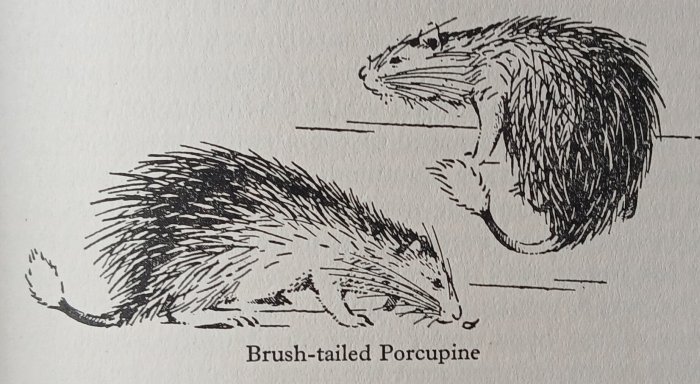
The numerous illustrations through the book are by Sabine Baur based on drawings and photographs by Gerald Durrell. Durrell wrote many books about his collecting experiences, the zoo he founded in Jersey and various conservation projects he became involved in but is probably best known for his series of three books about growing up with his family on Corfu just before WWII, especially the first ‘My Family and Other Animals’. I’m going to stay with the Durrell family next week with his eldest brother’s book ‘Bitter Lemons of Cyprus‘.

Short Stories – Fyodor Dostoyevsky

I’ve been meaning to read Fyodor Dostoyevsky for a long time but in common with a lot of other Russian novelists his books are somewhat daunting for a blog which appears every week, just checking my shelves I find:

  • ‘Crime and Punishment’ – 559 pages
  • ‘The Devils’ – 669 pages
  • ‘The Idiot’ – 661 pages
  • ‘The Brothers Karamazov’ – 2 volumes totalling 913 pages
  • and a volume containing two short stories and a novella ‘The Cossacks’ – 334 pages

It was then I spotted that I had two volumes from the Penguin Little Black Classics series which would give me an entry point to Dostoyevsky to see if I like him as an author. The first one is number 44 from this series ‘The Meek One’ which only has this one short story in it. The title is more usually translated as ‘A Gentle Creature’, and it is just 57 pages, still quite long for a short story, but a lot more approachable. Warning there are spoilers in this review if you want to read the stories first I cannot find ‘The Meek One’ but ‘White Nights’ is on Project Gutenberg here and ‘Bobok’ can be found here.

‘The Meek One’ begins with the un-named narrator contemplating the body of his equally un-named young wife laid out on a table in their home waiting for the undertaker to arrive the next day and we then go back over the story of how the two met and the short and largely unhappy marriage that they had. They had originally come into contact with one another as she would often come and pawn items in his pawnbrokers to raise money to advertise her services as a governess or more latterly almost any job to enable her to leave her two aunts. At the time of their marriage he was forty one and she just sixteen, however he regarded himself as her saviour from a planned marriage arranged by these aunts to a shopkeeper in his fifties who had killed his two previous wives whilst drunk and was looking for a third. The relationship between the couple seems to have deteriorated very quickly after the wedding and it is a sad story he tells of long silences and barely communicating through the winter including a time when she places a loaded gun to his head whilst thinking he was asleep but doesn’t pull the trigger. In the spring he makes an unexpected move to rescue the marriage suggesting a journey to France but it is whilst out getting the passports that she commits suicide.

Russian writing has an often undeserved reputation for gloominess and this short story doesn’t go any way to repudiate that impression, maybe the next book will have something more uplifting.

The second and third of Dostoyevsky’s short stories in volume 118 of the Penguin Little Black Classics series has ‘White Nights’ paired with ‘Bobok’. ‘White Nights’ is 86 pages long, ‘Bobok’ is the shortest at just 27 pages.

‘White Nights’ tells the story of a twenty something recluse in St Petersburg and yet again we don’t have his name, this lack of a name seems to increase the isolation of Dostoyevsky’s characters and this time he is pretty well the only un-named person in the story. He spends his days wandering around the city imagining having conversations with the people and even the houses he sees but in fact the only person he communicates with is his maid Matrona who is supposed to look after his apartment but hasn’t even removed the cobweb on the ceiling, mind you neither has he. One day whilst out on one of his aimless walks he sees a pretty young girl crying on a bridge and this time builds up the courage to approach her, however she evades him only to be threatened by an older passerby and our narrator steps in the save her. So begins the four days of happiness that he is to enjoy as they get to know one another, he explains that he is a lonely dreamer whilst she tells of a unhappy time living with her blind grandmother who pins their clothes together so that she can be sure Nastenka is not wandering off. She also tells of a lodger they had a year ago whom she fell in love with but who had to return to Moscow but promised to return and marry her when he left. The narrator rapidly also falls in love with her but agrees to carry a letter to a family who know the ex-lodger to see if he has returned and is still planning on restarting their relationship whilst secretly hoping that he has found somebody else in Moscow. The story is well written with the narrator regarding himself as the hero almost of a book of his life, indeed Nastenka rebukes him for telling his story almost as if he was reading it out. Sadly the ex-lodger does return and the narrator returns to his apartment downcast looking to another fifteen years of loneliness but Matrona does at least remove the cobweb.

‘Bobok’ is easily the strangest of the three stories and to my mind the best due to its originality, although it starts out normally enough with our narrator, this time with a name, Ivan Ivanych, going to the funeral of a distant relative and avoiding the lunch afterwards, takes to lying down on one of the long stones in the graveyard for a rest. All of a sudden he hears voices, muffled but intelligible, and wonders where they may be coming from. Gradually he realises that they are coming from the graves around him and it appears that the dead have a second short life in the grave where they can communicate with each other for two or three months, possibly up to six before they decompose too far. I loved this story as I hadn’t read anything like it before, The various conversations start off reflecting the status of the characters as they were before they died but gradually they decide to throw off their previous lives and simply talk to one another until they suddenly fall silent when they become aware he is listening. Another possible reason for our narrator hearing them is given in the opening lines of the story:

The day before yesterday Semyon Ardalyonovich suddenly comes out with: ‘And would you kindly tell me Ivan Ivanych will the day come when you’ll be sober?’

All three tales are taken from the Penguin Classics volume ‘The Gambler and Other Stories’ translated by Ronald Meyer which also includes the short stories ‘The Dream of a Ridiculous Man’, ‘A Christmas Party and a Wedding’ and ‘A Nasty Story’ along with its title novella ‘The Gambler’ which was actually written by Dostoyevsky in order to pay off his debts from losses at roulette.

The Good Soldier – Ford Madox Ford

This truly remarkable novel makes use of the ‘unreliable narrator’ literary style and is probably the best version of this particular method of slowly revealing the true aspects of the story I have read. Not for nothing did it come as high as thirteenth in the BBC poll of literary critics for the one hundred greatest English novels. But first let’s address the title, which is not the original given to it by Ford. The book was due to be first published by John Lane: The Bodley Head in 1915, in his later dedication appended to the book in 1927 Ford explains what happened:

The book was originally called by me The Saddest Story, but since it did not appear until the darkest days of the war were upon us Mr. Lane importuned me with letters and telegrams – I was by that time engaged in other pursuits! – to change the title which he said would at that date render the book unsaleable. One day, whilst I was on parade, I received a final wire of appeal from Mr. Lane and the telegraph being reply paid I seized the reply form and wrote in hasty irony ‘Dear Lane, why not The Good Soldier’… To my horror six months later the book appeared under that title.

That the new title was ironic certainly becomes obvious the more you read the book, although initially it appears to be highly suitable. The original title does make its appearance in a few places with Ford having his narrator say several times similar phrases to ‘I call this The Saddest Story’, which is actually the opening line of the final part or ‘THIS is the saddest story I have ever heard’ which is the books’ first sentence. When you start reading however there is no hint of the tragedies still to come as John Dowell, our unreliable narrator, starts off painting a happy friendship between the English couple Edward and Leonora Ashburnham and the Americans John and Florence Dowell set over nine years largely in the German spa resort of Bad Nauheim where the couples regularly meet. Captain Edward Ashburnham is the good soldier of the title and is apparently there for treatment of his heart condition that has effectively invalided him out of his regiment. Florence is also there for treatment of a heart condition, fear of which has prevented her from having sexual relations with John since their marriage began. Apart from that the couples seem ideal, independently wealthy so they can choose to live where they want and largely do what they want all is happiness in this small group of friends.

But that is what John initially wants you to think and it may be what he believes at least at the start of the narrative but gradually he reveals more, almost inadvertently, recalling details that turn the situation on its head and this is where reviewing this book becomes tricky because I really want to encourage you to read the book and discussing what happens is almost impossible without revealing too much. Suffice to say that almost nothing you are told in the first part of the book turns out to be true, instead there is a complex inter-relationship between the characters which is nothing like it first seems and even the reasons for them being in Germany at all is based on a tissue of lies.

The slow reveal of the various facts and of the other tragic characters associated with the ‘good’ Captain show a superb skill in the writing of the book as revelation after revelation come after the barest of hints that all is not right but remain believable and despite John’s bewildered insistence that he is the one steady rock in the narrative the fact that he keeps changing his story leaves the reader wondering just how much of what you come to understand by the end is really what happened and what is still John’s reinterpretation of the story. There is a good reason why this book has remained in print for almost 110 years so far so even if you have never heard of Ford Madox Ford I recommend that you get hold of a copy and read it.

Artemis Fowl – Eoin Colfer

This is the first of an eleven book series written by Irish author Eoin Colfer, eight of which are about Artemis Fowl II and in the final three books, which are effectively a reboot, his twin younger brothers. My copy is a hardback from the first year of publication, 2001, and has a metallic, highly reflective dust jacket which made it very difficult to photograph. Later editions retain the gold colouring but are not metallic. At the start of this book is an introductory prologue which finishes as follows:

Artemis Fowl had devised a plan to restore his family’s fortune. A plan that could topple civilisations and plunge the planet into a cross-species war.
He was twelve years old at the time…

This last line, more than anything else in the prologue, establishes that we are in the literary genre known as young adult, which is not a area I have explored on this blog for a while so please be aware that this book is not aimed at me as a typical reader. Having said that I quite enjoyed this, and the next two books which I have also read, I have also discussed the series with other people who first read the books whilst they were within the target age range of roughly twelve to eighteen to obtain a more rounded viewpoint.

Artemis’s father is missing, presumed dead and his mother has become a barely functioning recluse in the attic triggered by her grief for her missing husband, this leaves Artemis without parental supervision in his parents large house in Ireland with only his mountainous bodyguard, deliberately confusingly called Butler and Butler’s younger sister Juliet. There are presumably servants but they don’t appear in the narrative. The family money was built upon criminal enterprises and Artemis is definitely a chip off the old block but he believes he has found a target for his genius beyond the jurisdiction of the Irish Gardaí or indeed any normal police force, his plan is to get money from the fairy world by obtaining their legendary supply of gold. And so we are entering the realm of fairies, elves, dwarfs, trolls and other magical creatures but not as imagined by Tolkein, Pratchett or others who have raided mythology for their characters modifying them to suit their plots. Here the changes are if anything more radical, dwarfs chew their way through the earth having first dislocated their jaws and expelling the residue via what can most delicately be called their opposite end having first dropped the flap in their trousers. That Butler at one point is in the way of a cataclysmic fart from Mulch Diggums. the kleptomaniac dwarf, is clearly there to appeal to the younger readers who by and large can never resist a fart joke. Elves are approximately a meter tall and one of the books major characters, Holly Short, is one of those, she is also part of LEPrecon, part of the police force for the fairy peoples who are now forced to live deep underground to avoid the Mud People as they refer to humans. Colfer explains that LEP stands for Lower Elements Police a somewhat tenuous forcing of the word Leprechaun into his plot line.

I’m not going to go into the plot of the book, suffice to say that Artemis has quite an ingenious plan to part the fairies from their gold which first involves deciphering their language, a sample of which is on the cover and which is also depicted on the base of each page of the novel, as far as I can tell differently on each page. The story moves on at quite a pace and I found myself at the end of the 280 pages far quicker than I expected. I mentioned at the beginning that I have read the first three Artemis Fowl books and talking to my friends who read them as teenagers I’m told I shouldn’t go much beyond about book five as they reckon that the plots get a bit similar as though Colfer was running out of stories to tell with these characters. One friend has read the first of the Artemis twins books but didn’t feel the urge to read the others, which I think says a lot, so by all means have a go at the early books as a bit of light reading between more weighty tomes but probably skip the later ones.