The Second Voyage – Captain James Cook

Continuing with the voyages of Captain James Cook, the second trip had much greater funding than the first and Cook had charge of two vessels, Resolution and Adventure with Cook leading from HMS Resolution and HMS Adventure captained by Tobias Furneaux. They were charged with trying to discover the supposed great southern continent then known as Terra Australis, modern day Antarctica as opposed to Australia which was called New Holland at the time. It was believed by many scientists that such a mass of land must exist, if only as the source of the icebergs. The other thing that Cook and Furneaux were to study was on behalf of the Board of Longitude. Calculating latitude, how far up or down you are in the world was relatively easy however longitude, how far round the world you are, was much more difficult and ideally needed accurate knowledge of the time back where you started and clocks and watches were highly susceptible to temperature and climate variations. Cook therefore had a watch made by Larcum Kendall which was a copy of that designed by John Harrison and alongside this a watch made by John Arnold, Ferneaux had two watches made by Arnold, these were to be tested at sea and their accuracy determined, Cook and Ferneaux duly set off in May 1772. I’ll be reading more about the search for accurate longitude in the fourth book of this months theme ‘Longitude’ by Dava Sobel.

Cook duly sailed south and spent months skirting ice fields, with the two ships becoming on the 17th January 1773 the first from Europe to cross the Antarctic Circle and the following day getting to seventy five miles from the continent itself but without spotting land due to the amount of ice between them and Antarctica. Cook describes himself as surprised that the ice they recovered from the ocean in order to replenish the ships water stocks was fresh with only a small salty coating which would soon melt off and wonders how sea water freezes without retaining salt without realising that this is proof of fresh water glaciers further south that have broken off and are simply floating past the ships. One interesting quote a few days earlier gives an idea as to how the crew were faring in the extreme cold again featuring Cook’s idiosyncratic approach to spelling.

Monday 4th January 1773: First and middle parts strong gales attended with a thick fogg, sleet and snow, all the rigging covered with ice and the air excessive cold, the crew however stand it tolerably well, each being clothed with a Fearnaught jacket, a pair of trowsers of the same, and a large cap made of canvas and baize, these together with an additional glass of brandy every morning enables them to bear the cold without flinshing.

Cook would make another trip south in December 1773 after spending time in New Zealand along with Tahiti and Tonga amongst others repairing and re-equipping his vessels, and indeed getting back with HMS Adventure as the two ships had lost one another in thick fog in February 1773. Fortunately anticipating such an occurrence there had agreed to meet at New Zealand if they parted in the Antarctic ice. This trip round the South Pacific islands enabled Cook to also reacquaint himself with people he had met on his first voyage and pass on the bad news that the islander who had accompanied Cook on that voyage had sadly died on his way from Indonesia to South Africa and had therefore never seen Europe.

The second trip in search of Antarctica was no more successful than the first and Cook became convinced that there was no great southern continent, what he did however prove was that none of the lands known and partly mapped reached down through the ice to the far south. Indeed there would be no confirmed landing on Antarctica until the Norwegians got there in 1895 but to my surprise Cook is definitely a pioneer of Antarctic exploration getting far further south than anyone else in his time, something I hadn’t realised until I read this book. I had always though of Cook sailing in warmer climes so to read the battles with ice in this volume was fascinating but by February 1774 he finally turned north again eventually arriving at Easter Island in the hope of trading for more supplies. However Easter Island was to be a disappointment, the rich fertile land described by the first European visitors, the Dutch, in 1720 had gone and the people were reduced to a subsistence existence, the population also appeared to be greatly reduced, clearly something had happened here but Cook didn’t have the time, or the inclination, to find out what as he needed supplies so headed back to Tahiti.

Cook would make a further attempt to head south in 1775, this time in the South Atlantic having passed the southern tip of South America and would briefly visit South Georgia. By this time although he still hadn’t seen land to the far south he was convinced there was something as he had realised that it was needed to be a source of the ice. He wrote on 6th February 1775:

We continued to steer to the south and SE till noon at which time we were at the Latitude of 58 degrees, 15 minutes South, Longitude 21 degrees 34 minutes West and seeing neither land nor signs of any. I concluded that what we had seen. which I named Sandwich Land was either a group of islands or else a point of the continent, for I firmly believe that there is a tract of land near the Pole, which is a source of most of the ice which is spread over this vast Southern Ocean.

From the South Atlantic Cook finally turned north and sailed back to England, arriving in July 1775. The illustrations shown above are from Tanna, in the New Hebrides, now Vanuatu including a portrait of a native islander whilst below is the map that comes with this set which folds out to quite a good size.

The Ship Beneath The Ice – Mensun Bound

Mensun Bound was the Director of Exploration for the two trips to the Weddell Sea where they ultimately found Endurance so he is ideally placed to tell the story of finding the wreck. In a decades long career as a marine archaeologist (he is now seventy years old) he has been involved in the discovery of many famous shipwrecks and he tells the story in the beginning of this book of being in a coffee shop with a friend ten years ago and how he came to be looking for Endurance.

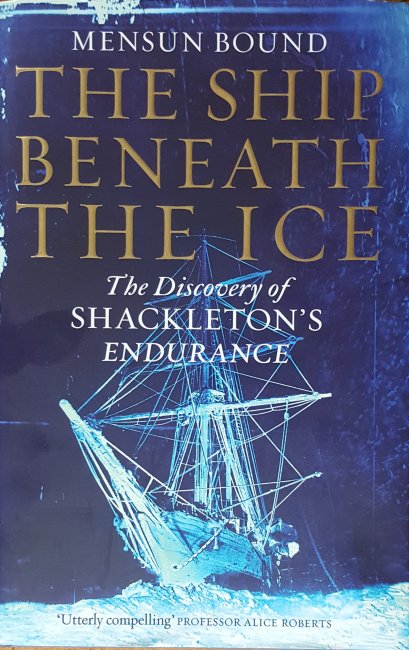
The book is actually two books, the first is about the unsuccessful 2019 expedition and was written by the author during the 2021 Covid lock down in Port Stanley, capital of The Falkland Islands which is where he was born. At the time he wrote it he never expected to get a chance to go back and try again so after 204 pages it ends with him and his team defeated. The second half of this volume recounts the unexpected return and the elation of success in 2022 and was written partly on his way back from Antarctica and completed at his home in Oxford. I’ll deal with the two parts separately. The combined book, the first section wasn’t printed independently, was first published by Macmillan in 2022 and my copy is the sixth impression which shows that this was a story a lot of people were interested in. The front cover features a famous floodlit night-time photograph taken by Frank Hurley of Endurance stuck in the ice shortly before she was finally sunk by the enormous pressure on the hull.

The Weddell Sea Expedition 2019

This trip was run under the auspices of Netherlands based The Flotilla Foundation and was mainly a scientific expedition with the search for Endurance added on the end once the data on climate change, species proliferation and ice core sampling in The Weddell Sea had been accumulated by the scientific team. Starting on the 1st January 2019 and in a day by day diary format Bound describes the work of the crew, discoveries made and provides comments as to Shackleton and his crew’s movements over a hundred years earlier. Like Bound I’ve been fascinated by Shackleton and his expeditions since an early age and have numerous books on Antarctic exploration a couple of which I have previously reviewed, see a list at the end of this blog. Most of January is dedicated to getting to Antarctica from South Africa and the scientific research which Bound wasn’t involved in so it is referred to but not in much depth. Where he does get involved is the use of the Remote Operated Vehicle (ROV) and the two Autonomous Underwater Vehicles (AUV). ROV’s are controlled via a long cable back to the ship, AUV’s are robots which operate on their own for hours on end before returning to the ship for downloading of the data they have gained, both have advantages. ROV’s provide a continuous stream of data back to the ship but are restricted by where the cable lets them go, AUV’s can go anywhere and as the search area in the Weddell Sea for Endurance was under the pack ice this was vital however they aren’t in communication with the ship so you don’t know what they found until they get back. The expedition was to have serious problems with both sorts.

It was the 25th January before the scientific work completed and the ship set out for the last ‘known’ position of Endurance, it’s latitude and longitude had been taken by its captain, Frank Worsley, just before it sank and he was one of the finest navigators at the time but working in very difficult conditions with no readily available flat horizon and very little sight of the sun due to poor weather, how accurate had he been? One of the AUV’s was no longer available after failing during the scientific surveys and on the way to Worsley’s position it was decided to do a test dive with the ROV to the depth of Endurance (approximately 3000 metres), just before it got there the ROV catastrophically failed, this was now the 30th January, time was running out and so was the equipment. It was decided to try to repair the ROV but this meant abandoning the voyage to the search area and heading off to the nearest ice airstrip to get parts which were going to be flown to them. This used up days of possible search time and ultimately failed as the plane couldn’t reach them due to bad weather. Finally deciding to just use the remaining AUV they went back to the search site with just fifty hours of possible dive time available before they had to leave or be locked in the ice just as Endurance had been. We will never know if the AUV found Endurance as it never returned from it’s dive, it also failed. This part of the book ends in dejection all round, but it’s still a fascinating story and if it had been published with no follow up I would still have really enjoyed the book, however better news is to follow.

The Endurance22 Expedition 2022

As can be told by the expedition title this was an all out attempt to find Endurance and was funded by the Falklands Maritime Heritage Trust. It is hardly giving anything away to say that they succeeded, news reports early last year went round the world that the ship was discovered and it’s plastered all over the front cover of the book. But that’s not to say there were no doubts as the days went on and very little was found. This time the brand new SAAB built autonomous vehicles were on armoured fibre optic cables so real time images were retrieved and if necessary the cables could be hauled back to retrieve the submarine. The ice conditions were a lot better for exploration as well with significant breaks so they were on station a couple of days earlier than planned and moving around was much less fraught but even so it looked like time was going to run out before the ship was discovered as the Antarctic winter was setting in and they were in to the last few days that they could remain on station before they found her. Again it is diary entry format so you can follow along with the highs and lows.

The ship was just three miles south from where Worsley had said she was and within the search box defined for the 2019 expedition by Mensun Bound which shows what a superb set of calculations both men had made but there was one very odd coincidence that was only spotted the day after the discovery and that was the date. Shackleton was buried on South Georgia on the 5th March 1922 after dying of a heart attack on his rather nebulous Quest expedition. Endurance was found on the 5th March 2022 exactly one hundred years later. It gets stranger, according to contemporary news reports his funeral service was at 3pm and allowing for a half hour service, regrouping of attendees and the twenty plus minutes to get the coffin from the chapel up to the graveyard they probably got there around 4pm, a few last words at the graveside and Shackleton was probably buried a few minutes after 4pm, Endurance was found at 4:04pm.

It’s a brilliant book, I was hooked all the way through and thoroughly recommend it as a read.

Other Antarctic blog entries

Biography of Tom Crean – who sailed with Scott and Shackleton and was one of the crew members of the James Caird, the lifeboat sailed from Elephant Isle to South Georgia to get help for the rest of the crew of Endurance.

Biography of Sir Ernest Shackleton – written by fellow Antarctic explorer Sir Ranulph Feinnes

An Unsung Hero: the remarkable story of Tom Crean: Antarctic Explorer – Michael Smith

20190312 Tom Crean 1

Roald Amundsen, Robert Scott, Ernest Shackleton, Tom Crean. The first three Antarctic explorers listed are household names but Tom Crean is, as the title of the book implies, largely unknown. But he should be celebrated, as he took part in three of the main British Antarctic expeditions during what became known as The Heroic Age of Antarctic Exploration during the first two decades of the 20th century.  He  was with Scott and Shackleton on the Discovery Expedition from 1901 to 1904 which at the time set the record for furthest south at 82° 17′. He was then with Scott on his ill-fated Terra Nova expedition from 1910 to 1913 and Scott’s attempt on the South Pole, where he was beaten to it by Amundson and died on his way back to the ship. Crean was later with Shackleton on his failed Imperial Trans-Antarctic expedition on the Endurance from 1914 to 1917 where the Endurance sank early in the venture. Shackleton walked his men to Elephant island and then chose four to go with him for help in an open boat across over eight hundred miles of the South Atlantic to South Georgia and Crean was one of those who was part of possibly the greatest feat of seamanship seen in the last hundred years.

So why is he so barely known, apart from those of us with a fascination with Polar exploration? Well part of the reason is that Crean was really only semi-literate, so he left no diaries or any other documentation for posterity; he also never gave any interviews and the four medals he earned in the Antarctic weren’t displayed. Apparently he never even told his daughters about his exploits in Antarctica. The sole hint that here was a man with his background in exploration was that when he left the navy in 1920 he opened a pub in his home town of Annascaul in Southern Ireland which he called The South Pole Inn. The pub is still called that and in 2003 a statue of Crean was erected in the town, so maybe wider recognition is finally happening for this quiet and self-assuming man and it may well have been helped by this excellent book which was originally printed in 2001, my copy is the first paperback edition from 2002 also published by Headline.

Despite the lack of much documentary evidence from Crean himself Michael Smith has done an excellent job of research to piece together his life from lots of sources. Sixty six books are listed in the bibliography, quite a few I already have in my small Polar library and this list has pointed me to others that sound worth adding to my collection. There are also numerous letters, unpublished diaries and other documents that have been consulted. All this has made a beautifully illustrated book of over three hundred pages which tells not only the story of Tom Crean but also the expeditions that he took part in.  He was in the group of the last eight men on the Beardmore with Scott when he chose the last five to make the final push for the pole. That Scott decided not to chose him may well have been an error as Crean was still fit and strong unlike Oates who had an injured leg and Taffy Evans’ badly cut hand, both of which for reasons of his own Scott decided to take with him. That this undoubtedly saved Crean’s life and allowed him to continue his polar explorations with Shackleton a few years later. What can only be wondered is if Scott had taken the fitter Crean then would his party made it back to the food depot they were aiming for when they died on the ice. We will never know, Michael Smith makes it quite clear where his opinion lies:

Scott, it must be said, made two basic mistakes in selecting his final party to reach the pole. First, he chose the men at the wrong time and second he chose the wrong men.

Shackleton on the other hand greatly valued the taciturn and powerful Irishman, not only selecting him for the crew of the Endurance but picking him as one of the four to go for help with him in that open boat when the expedition became a rescue mission. I’ll cover this in a later blog as I have been in awe of that journey since first reading about it as a child. After returning from the expedition Crean joined the war effort and Shackleton encouraged him to get promotion, along with writing to the First Lord of the Admiralty personally recommending his promotion. This he duly got and after the war ended up with a reasonable pension, which along with money sent to him by Shackleton enabled him to open the South Pole Inn. Shackleton tried to convince Crean to join him again on a trip south but by this time he was a family man with two daughters and declined, his exploring days were behind him.

Michael Smith has written a hugely enjoyable book about one of the lesser known great Polar explorers and even if you know nothing about the history of the time it is well worth reading.