
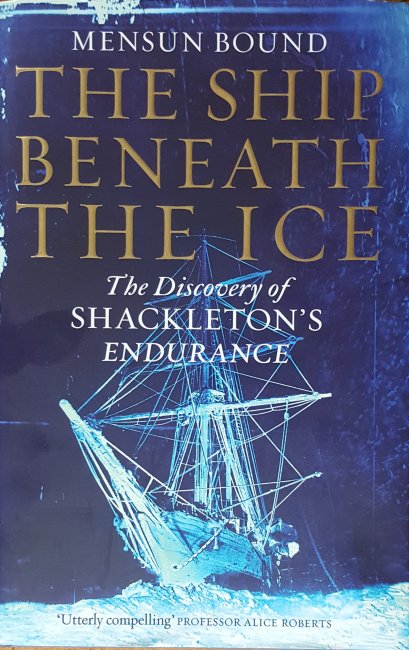
The Ship Beneath The Ice – Mensun Bound

Mensun Bound was the Director of Exploration for the two trips to the Weddell Sea where they ultimately found Endurance so he is ideally placed to tell the story of finding the wreck. In a decades long career as a marine archaeologist (he is now seventy years old) he has been involved in the discovery of many famous shipwrecks and he tells the story in the beginning of this book of being in a coffee shop with a friend ten years ago and how he came to be looking for Endurance.

The book is actually two books, the first is about the unsuccessful 2019 expedition and was written by the author during the 2021 Covid lock down in Port Stanley, capital of The Falkland Islands which is where he was born. At the time he wrote it he never expected to get a chance to go back and try again so after 204 pages it ends with him and his team defeated. The second half of this volume recounts the unexpected return and the elation of success in 2022 and was written partly on his way back from Antarctica and completed at his home in Oxford. I’ll deal with the two parts separately. The combined book, the first section wasn’t printed independently, was first published by Macmillan in 2022 and my copy is the sixth impression which shows that this was a story a lot of people were interested in. The front cover features a famous floodlit night-time photograph taken by Frank Hurley of Endurance stuck in the ice shortly before she was finally sunk by the enormous pressure on the hull.

The Weddell Sea Expedition 2019

This trip was run under the auspices of Netherlands based The Flotilla Foundation and was mainly a scientific expedition with the search for Endurance added on the end once the data on climate change, species proliferation and ice core sampling in The Weddell Sea had been accumulated by the scientific team. Starting on the 1st January 2019 and in a day by day diary format Bound describes the work of the crew, discoveries made and provides comments as to Shackleton and his crew’s movements over a hundred years earlier. Like Bound I’ve been fascinated by Shackleton and his expeditions since an early age and have numerous books on Antarctic exploration a couple of which I have previously reviewed, see a list at the end of this blog. Most of January is dedicated to getting to Antarctica from South Africa and the scientific research which Bound wasn’t involved in so it is referred to but not in much depth. Where he does get involved is the use of the Remote Operated Vehicle (ROV) and the two Autonomous Underwater Vehicles (AUV). ROV’s are controlled via a long cable back to the ship, AUV’s are robots which operate on their own for hours on end before returning to the ship for downloading of the data they have gained, both have advantages. ROV’s provide a continuous stream of data back to the ship but are restricted by where the cable lets them go, AUV’s can go anywhere and as the search area in the Weddell Sea for Endurance was under the pack ice this was vital however they aren’t in communication with the ship so you don’t know what they found until they get back. The expedition was to have serious problems with both sorts.

It was the 25th January before the scientific work completed and the ship set out for the last ‘known’ position of Endurance, it’s latitude and longitude had been taken by its captain, Frank Worsley, just before it sank and he was one of the finest navigators at the time but working in very difficult conditions with no readily available flat horizon and very little sight of the sun due to poor weather, how accurate had he been? One of the AUV’s was no longer available after failing during the scientific surveys and on the way to Worsley’s position it was decided to do a test dive with the ROV to the depth of Endurance (approximately 3000 metres), just before it got there the ROV catastrophically failed, this was now the 30th January, time was running out and so was the equipment. It was decided to try to repair the ROV but this meant abandoning the voyage to the search area and heading off to the nearest ice airstrip to get parts which were going to be flown to them. This used up days of possible search time and ultimately failed as the plane couldn’t reach them due to bad weather. Finally deciding to just use the remaining AUV they went back to the search site with just fifty hours of possible dive time available before they had to leave or be locked in the ice just as Endurance had been. We will never know if the AUV found Endurance as it never returned from it’s dive, it also failed. This part of the book ends in dejection all round, but it’s still a fascinating story and if it had been published with no follow up I would still have really enjoyed the book, however better news is to follow.

The Endurance22 Expedition 2022

As can be told by the expedition title this was an all out attempt to find Endurance and was funded by the Falklands Maritime Heritage Trust. It is hardly giving anything away to say that they succeeded, news reports early last year went round the world that the ship was discovered and it’s plastered all over the front cover of the book. But that’s not to say there were no doubts as the days went on and very little was found. This time the brand new SAAB built autonomous vehicles were on armoured fibre optic cables so real time images were retrieved and if necessary the cables could be hauled back to retrieve the submarine. The ice conditions were a lot better for exploration as well with significant breaks so they were on station a couple of days earlier than planned and moving around was much less fraught but even so it looked like time was going to run out before the ship was discovered as the Antarctic winter was setting in and they were in to the last few days that they could remain on station before they found her. Again it is diary entry format so you can follow along with the highs and lows.

The ship was just three miles south from where Worsley had said she was and within the search box defined for the 2019 expedition by Mensun Bound which shows what a superb set of calculations both men had made but there was one very odd coincidence that was only spotted the day after the discovery and that was the date. Shackleton was buried on South Georgia on the 5th March 1922 after dying of a heart attack on his rather nebulous Quest expedition. Endurance was found on the 5th March 2022 exactly one hundred years later. It gets stranger, according to contemporary news reports his funeral service was at 3pm and allowing for a half hour service, regrouping of attendees and the twenty plus minutes to get the coffin from the chapel up to the graveyard they probably got there around 4pm, a few last words at the graveside and Shackleton was probably buried a few minutes after 4pm, Endurance was found at 4:04pm.

It’s a brilliant book, I was hooked all the way through and thoroughly recommend it as a read.

Other Antarctic blog entries

Biography of Tom Crean – who sailed with Scott and Shackleton and was one of the crew members of the James Caird, the lifeboat sailed from Elephant Isle to South Georgia to get help for the rest of the crew of Endurance.

Biography of Sir Ernest Shackleton – written by fellow Antarctic explorer Sir Ranulph Feinnes

The Epic of Gilgamesh

A five thousand year old story rediscovered on cuneiform tablets in the ruins of Nineveh in what is now Iraq back in the nineteenth century, this epic series of poems is probably the oldest piece of literature we have available to us today. This Penguin Classics edition is described as an English version rather than a translation because N.K. (Nancy Katharine) Sanders didn’t go back to the original cuniform or even later Assyrian texts but rather compiled the story from existing translations to provide a ‘readable’ rather than scholarly interpretation. The original tablets are damaged with a lot of them broken in bits with parts in different museums around the world and several sections are missing altogether, which makes the task of translating even more difficult that it should be. What Sanders has achieved is a knitting together of the various existing versions, which by definition also have large gaps or variant approximations as to what could have been the meaning of damaged sections. She also wrote an excellent introduction which is roughly as long as the surviving parts of the epic itself and which is highly necessary if the reader is to understand anything of the background to a story from 3000 BCE. This book is an original piece of work for Penguin Classics and my first edition is from 1960 and is a prose version of the original epic poem.

This version of the Epic of Gilgamesh is in seven parts and whilst they are mainly linked it cannot be called a continuous narrative, there may well be other sections still to be discovered even now on the tens of thousands cuneiform tablets or fragments thereof spread around the world in various museums, quite a few of which have yet to be translated, but let’s take the sections we have one by one.

The Coming of Enkidu

At the start of the tale Gilgamesh is the all powerful ruler of the city of Uruk (now Warka in Iraq) situated on the Euphrates river and his people were frightened of him because he had nobody to challenge him so he took everything and everyone he wanted.

But the men of Uruk muttered in their houses, ‘Gilgamesh sounds the tocsin for his amusement, his arrogance has no bounds by day or night. No son is left with his father, for Gilgamesh takes them all, even the children; yet the king should be a shepherd to his people. His lust leaves no virgin to her lover, neither the warrior's daughter nor the wife of the noble; yet this is the shepherd of the city, wise, comely, and resolute.' 

A tocsin is an alarm bell and should only be used in emergencies to rouse the defences of the city, but clearly Gilgamesh found it amusing to just raise panic amongst his population. To counteract him the gods decided to create an equally powerful being, Enkidu, who would provide sufficient distraction for Gilgamesh so that his people were safer from his excessive desires. This they duly did and almost at first sight Gilgamesh and Enkidu became firm friends and the plan by the gods worked as they spent a lot of time together mainly outside of the city so peace largely reined in Uruk.

The Forest Journey

This is a tale of Gilgamesh and Enkidu heading off to a mighty forest in search of huge cedar trees for building materials in Uruk. The forest is guarded by the giant Humbaba and he several times intervenes to try to stop them cutting down the trees but without success. Eventually seeing that he cannot prevent the felling of the cedars he offers himself as the servant to Gilgamesh and will cut down the trees for him. Gilgamesh is all for this proposal but Enkidu insists that Gilgamesh should kill Humbaba instead and this he duly does before sailing away back down the Euphrates with his cargo of sweet smelling wood.

Ishtar and Gilgamesh, and the Death of Enkidu

Ishtar is the goddess of love, but also the goddess of war in the Sumerian mythology, an interesting combination and also why Gilgamesh is not particularly enamoured by her approach to him at the very start of this section

Gilgamesh Washed out his long locks and cleaned his weapons; he flung back his hair from his shoulders; he threw off his stained clothes and changed them for new. He put on his royal robes and made them fast. When Gilgamesh had put on the crown, glorious Ishtar lifted her eyes, seeing the beauty of Gilgamesh. She said, ‘Come to me Gilgamesh, and be my bridegroom; grant me seed of your body, let me be your bride and you shall be my husband.

Whilst it is clearly an honour for a man to be approached by a goddess in this way Gilgamesh is all too aware of the fates of previous mortals who had dallied with Ishtar which were not good and he doesn’t want to end up as a bird with a broken wing or transformed into a mole to give just two examples. In her rage at rejection Ishtar sends a mighty Bull of the Heavens to destroy Gilgamesh and his city but Gilgamesh kills it and in petulance she then persuades other gods to kill Enkidu and so deprive Gilgamesh of his companion.

The Search for Everlasting Life

In his despair at the death of his friend Gilgamesh takes to the wilderness, living off what he can hunt and wearing animal skins whilst determining to seek for the secret of eternal life. He has many adventures but is generally shunned due to his unkempt appearance until he finds a way to get to a man who already has to power to live forever. This section is somewhat confused either because sections of the story are missing or there is another story, which would have been well known five thousand years ago when this tale was first transcribed, which fills in gaps in the narrative and explains important details.

The Story of the Flood

We suddenly get a lurch away from the stories of Gilgamesh and deal instead with an ancient story of inundation at the instigation of the gods who are annoyed with the noise made by the humans on Earth. This section was the most fascinating to me as it is clearly the basis for the tale of Noah in the Bible only in this version the boat builder was Utnapishtim, a man of Shurrupak, son of Ubara-Tutu and it was the wrath of gods rather than god that caused the floods to exterminate the human race. There is also a proper crew rather than Noah and his family on their own looking after all the animals on board

Then was the launching full of difficulty; there was shifting of ballast above and below till two thirds was  submerged. I loaded into her all that 1 had of gold and of living things, my family, my kin, the beast of the field both wild and tame, and all the craftsmen. I sent them on board, for the time that Shamash had ordained was already fulfilled when he said, "in the evening, when the rider of the storm sends down the destroying rain, enter the boat and batten her down." The time was fulfilled, the evening came, the rider of the storm sent down the rain. I looked out at the weather and it was terrible, so I too boarded the boat and battened her down. All was now complete, the battening and the caulking; so I handed the tiller to Puzur-Amurri the steersman, with the navigation and the care of the whole boat. 

They sailed for many days and to determine if the flood waters were subsided set free birds to see if they returned, just as Noah does in the biblical version. In all the two stories align extremely well so Noah is clearly a rewriting of this more ancient tale which was itself lifted from a still more ancient Babylonian story.

The Return

Having found Utnapishtim, Gilgamesh is finally told that the reason he has eternal life is that he saved mankind and all the animals in his boat and was so rewarded by the gods who had regretted sending the floods when they saw the devastation. This means that he cannot tell Gilgamesh how to live forever because it was a gift of the gods not some potion or magic. Disappointed Gilgamesh decides to return to Uruk which he does without incident in a matter of two or three paragraphs.

The Death of Gilgamesh

This is by far the shortest section, and far from a heroes death in battle which you may have expected from the epic so far Gilgamesh appears to simply die of old age worn out by his travels.

Nancy Sanders was primarily an archaeologist and was involved in digs across Europe and the Middle East. She was born in 1914 and died, aged 101 in 2015, still living in the house she was born in. There is an interesting web site dedicated to her, which can be found here.

Kindred – Rebecca Wragg Sykes

Subtitled ‘Neanderthal Life, Love, Death and Art’ this book gives a comprehensive overview of not just what we know about Neanderthals but also how we got to this level of knowledge where such a book covering those topics and many more could be written. A superb piece of research that has deservedly been one of the science highlights of the last year, it only came out in the summer of last year and has yet to appear in paperback but my copy is already the seventh impression of the hardback which suggests excellent sales. The real surprise, to me at least, is just how much our knowledge of Neanderthals has advanced in the last two decades due to much better archaeological techniques which more accurately map the various strata of a dig and the positioning of thousands of objects but also from the DNA analysis that is now possible.

Although aimed at the interested amateur Sykes makes some assumptions regarding the knowledge of the reader in the terminology she uses. For example ‘analysing the calculus’ is not explained for well over a hundred pages from when it is first used. When it is defined it turns out to mean studying the teeth, or more specifically the residues built up on the teeth of the fossil remains rather than the obviously wrong, but entertaining until proved otherwise, that Neanderthals had somehow grasped differential mathematics. The complexity of various rock knapping techniques and how this helps define groups of Neanderthals who must therefore have interacted with each other is very well explained although I would have liked more diagrams to illustrate this to make the differences clearer. The last time I read a book on this subject was definitely over two decades ago so a vast amount of information in this book was new to me and as it is 380 pages long there is a huge quantity to take in.

It is very well written, and whilst the necessary vocabulary did sometimes have me checking on Google to make sure I understood this was a relatively rare occurrence as for the most part terms are explained as they are needed, with the obvious exception of calculus, however a small glossary at the back along with the detailed index would have been useful. Sykes can’t resist the occasional pun either such as ‘harvest the data’ when referring to gathering evidence of plant eating and this lightens the tone of what could have been in a lesser writers hands quite a dry study making it very readable and engaging.

The opening chapter deals with the slow growth of knowledge about Neanderthals from when they were first discovered just over 160 years ago and then through the book we are introduced to the 99 sites that remains have been discovered at right across not only Europe, which was their heartland but the ones in the near and far east which I had never heard about, there is a useful map on the front end papers which shows this spread. As you would expect from such an all encompassing subtitle Sykes attempts to not just document the artefacts found but also place them into context of the living, breathing people that used them. Just how would such a chipped rock be used? Were they making personal adornments? What can the spread of hearths (areas where a fire was lit rather than necessarily anything physically built) within a cave complex tell us about the size of the population using the shelter or the timescales that a place was used? How did they co-exist not just with each other within clan groups but with other clans and even Homo Sapiens when they appeared on the scene moving into Europe from their African homelands hundreds of thousands of years later? All of this and more is covered, it is definitely a book that will repay rereading in a few months to fully take in the sheer mass of information.

According to her introduction Sykes completed the book in June 2020 and hints at several, as yet unpublished, studies that she has clearly had access to meaning that this truly is as up to date as it was possible to be. But with the indicated speed of advances, especially in DNA analysis, either a revised and updated version or even a second volume must be a possibility in a few years time. Even the fact that she completed the book during lock down for the coronavirus pandemic becomes significant, we still don’t know why Neanderthals disappeared, was there perhaps a contagion brought by Homo Sapiens that further weakened the existing population, struggling as it was with climatic changes 40 thousand years ago as the continent swung from glaciation to warmer temperatures and back again. Of course they never truly went away, DNA analysis proves this, modern humans, at least outside those of African descent, have a small percentage of Neanderthal DNA and knowing this the story of this ‘lost’ people gains even more relevance today.

The one criticism that I do have is the unnecessary fanciful opening sections to each chapter in either prose or verse, lasting between a half and a full page of text, they add nothing to the rest of the work but fortunately can be easily skipped as they are in italic. Clearly influenced by Jean Auel and her very good Earth’s Children series of novels set in the time of the Neanderthals, I started off reading these chapter preambles but after chapter five just left them out.