I Wanna Be Yours – John Cooper Clarke

This is my three hundredth blog entry so I have decided to tackle what turned out to be a fascinating autobiography of the famous ‘punk poet’ which comes in at a pretty massive 470 pages, of which more later. Clarke is now seventy four and has lived a fairly unusual life, which he is extremely frank about in the book. This includes his many years as a heroin addict, indeed his descriptions of sometimes desperate attempts to get his next fix make up quite a lot of the last half of the book, it could have been a depressing read and it says a lot about his wordsmith skills that it isn’t. I first came across Clarke’s work when I went to university in Manchester in 1980 although sadly I never managed to see him perform. His famously stick thin physique was undoubtedly aided by the heroin but I hadn’t know until reading this book that at the age of eight he had had tuberculosis and probably shouldn’t have made it out of childhood in Salford, South Manchester. Clarke is brutally honest about his slide into addiction and the subsequent partial collapse of his career as getting the next fix became more important than anything else. He even took to avoiding his mother after she found out and he claimed to her to be getting help when in fact he was taking even more drugs and progressing to speedballs, cocaine and heroin mixed in one shot this is probably the lowest point of the narrative.

I was aware he had had a drug problem but the extent of it surprised me and I wasn’t really prepared for the story of a drug addict being the main part of the book rather than his climb to be performing and comparing at shows at the biggest clubs in Manchester. Thinking about it later I was also aware that he had largely disappeared for years after the late 1970’s, or at least I hadn’t heard of him for a long time until he reemerged to a larger public presence many years later and yet now plays sell out shows around the world. Indeed his 2024 fiftieth anniversary of performing tour, entitled ‘John Cooper Clarke: Get Him While He’s Alive!’ is already having to add extra dates due to demand for tickets.

There is also substantial coverage of his childhood and early years before starting to perform which was characterised by the poverty of growing up in Salford in the 1950’s and the extra problems due to his poor health. He worked as a bookies runner for a while whilst still at school before the police started to crack down on unlicensed bookmakers and going round taking bets and paying out winnings became too hot a job to continue. He was always looking for a way to earn some money but his apprenticeship on leaving school as a car mechanic eventually ended early due to both parties, employer and employee, recognising that he had absolutely no aptitude for anything mechanical. His desire to be a poet was strong even then but his father pointed out that nobody made any money at poetry until they were dead and it was only the arrival on the scene of the so called Mersey poets from Liverpool that proved that it was possible to make it a career. But it took a long time, and the assistance of Manchester club owner Bernard Manning, now a somewhat controversial figure, that eventually got him onto the stage and making some money at what he wanted to do.

As I wrote at the beginning of this review the book is 470 pages long, but by page 430 we have spent so much time on his childhood, youth and addictions we have still only reached 1985 and I was thinking that this was just the first half of a planned two volume autobiography. Instead Clarke basically sums up the remaining thirty seven years as: Met Evie (his wife), tried and eventually kicked heroin, rebuilt the career, started a family, gained an honorary doctorate from Salford University and nothing else much happened. Thirty seven years in forty pages, I’m pretty sure there is more to that period than that and as I had so enjoyed reading the first 430 pages, covering thirty six years since his birth in 1949, I was definitely set up for volume two.

If I have one criticism of the book it is Clarke’s excessive name dropping, usually in long, frankly tedious, lists of people or bands he has met or worked with, or maybe had worked in the past at a venue he was then working at, which I got into the habit of skipping as I got more into the book but as the last line of the book makes clear he isn’t bothered about criticism of the autobiography.

Any complaints, mail them to last Tuesday, when I might have cared.

Confessions of a Bookseller & Remainders of the Day – Shaun Bythell

Shaun Bythell’s first book, ‘The Diary of a Bookseller‘, was one of the very first books I reviewed on this blog back in January 2018. Since then he has written three more books, two of which continue his diary of owning the largest secondhand book shop in Scotland, which is in Wigtown and it is these two books I have read this week. The diaries cover the following periods:

  • The Diary of a Bookseller – Published 2017 – covers Wednesday 5th February 2014 to Wednesday 4th February 2015.
  • Confessions of a Bookseller – Published 2019 – covers Thursday 1st January 2015 to Thursday 31st December 2015
  • Remainders of the Day – Published 2022 – covers Friday 5th February 2016 to Saturday 4th February 2017

It was only as I typed the list above that I realised that there is a five week overlap between the first two books so had to get ‘The Diary of a Bookseller’ off the shelf to compare the entries. They are completely different even down to the number of orders, customers and shop takings.

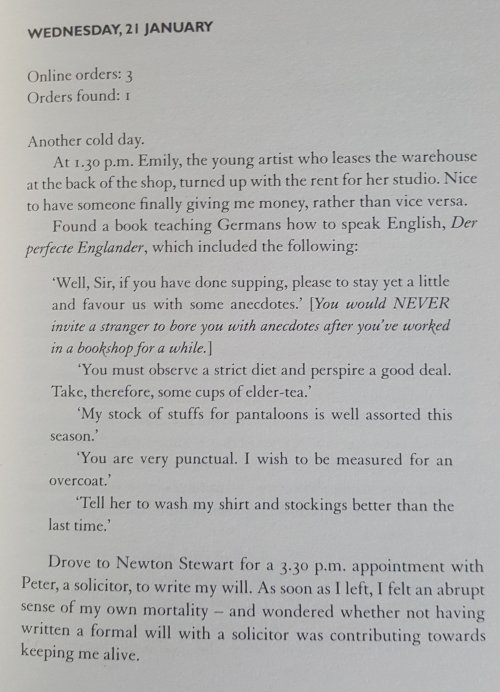
Wednesday 21st January – Diary of a Bookseller

Wednesday 21st January – Confessions of a Bookseller

As the third book, like the first, starts on the 5th of February I’m left wondering if the 1st January to 4th February in Confessions and which are clearly labelled 2015 are actually entries for 2016 transposed to the start by an overzealous editor who assumed that a diary should be for a calendar year.

The books are quite long, 328 pages for Confessions and 377 for Remainders but reading them just flies by and I finished both books inside four days. As I mentioned in my review of his first book I also own and run an independent specialist shop so the interactions with customers he details are frighteningly familiar and all the funnier for that. He has also noticed that anyone who comes through the door and says out loud “Oh I’m in heaven, this is just the sort of shop I love”, or words to that effect never buy anything, but will inevitably spend a lot a lot of time wandering round the shop and moving stock from shelf to shelf whilst not doing so. This means that you then have to spend even more time putting things back where they should be so that actual customers have a chance of finding them. I’m going to lend the books to my staff as I’m sure they will appreciate them as well and I’m thankful I don’t have staff as mad as Shaun seems to.

A few months after writing my review of The Diary of a Bookseller in 2018 I met Shaun in Hay on Wye, the Welsh book town that Wigtown has modelled itself on, lots of book shops all in one small place may sound like overkill but it really works by making the town a specific destination for collectors and there are few things I love more than wandering round book shops. Shaun was being interviewed by Jasper Fforde as part of a book collectors Instagram event which the owner of my local secondhand bookshop and I had also given a talk at a couple of days earlier on the subject of collecting Penguin books. Shaun came over as a really nice person but then again I wasn’t trying to buy a book off him at the time, I still haven’t made it to Wigtown but I’m determined to get there, in fact I just checked and it’s 285 miles from where I live and would take just over five hours to get there, the Google maps picture of the shop is from this month and shows a copy of Remainders of the Day in the right hand window along with the inevitable large number of boxes of more stock just inside the door and by the other window.

Tuffer’s Alternative Guide to The Ashes – Phil Tuffnell

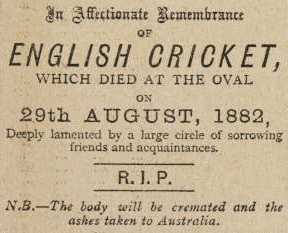
The 2023 Ashes Series is starting on Friday 16th June, for those of you who don’t follow cricket this is one of the oldest bilateral sports tournaments in the world, starting in 1877 and pits Australia versus England at cricket in a series of five day matches. It’s worth noting that it didn’t gain the name of ‘The Ashes’ until the ninth test match between the two sides, which took place in England in 1882 and which England somehow managed to lose from what should have been a winning position. This led to a mock obituary appearing in The Sporting Times on 2nd September 1882.

The urn containing ‘the ashes’ was presented to the captain of the touring England team in Australia that Christmas and is now kept at Lord’s Cricket Ground in London as it is extremely fragile, only rarely being removed from its glass display case for ceremonial occasions, and has only actually travelled to Australia twice in the intervening years. It isn’t the official trophy for the tournament but symbolises the rivalry between the two countries but replicas and images of this tiny, 6 inch (15cm), vase are to be seen whenever the two teams play each other and its silhouette can be seen on the front cover of this book between the words ‘The’ and ‘Ashes’.

This year there are five games to be played in June and July at various venues across England, five games is the most common number of matches but it does sometimes alter. Phil Tufnell played in five of these series and both his first and last test matches for England were against Australia. It should be noted that at the time the England team were pretty weak and the Australians very good so he never got near to being on the winning side in an Ashes series. Tufnell retired from playing serious cricket in 2003 and gained a job as a summariser on The BBC Test Match Special which he still does and he continued to play cricket for celebrity teams for many years after his official retirement.

I didn’t know what to expect from this book, but thought it would probably be descriptions of his experiences and whilst those do appear, the book is a whole lot more than that. In fact it is a highly entertaining look over the entire existence of the tournament from the first matches and includes the origin story of the Ashes urn but also lots of stories of players and games over the entire, almost 150 years, that England and Australia have faced each other on the cricket grounds in both countries. These range from when in 1903, back before aeroplanes existed and it would take three weeks by boat each way to get to the tour, the England team on their way out managed to lose a game of deck cricket against a team of female passengers. In 2001 The Australians hosted a charity function in Manchester and the first auction item was a chance to train with the team, bidding was slow as the room hadn’t really got going when they started this so a couple of Australian players decided to bounce the bids on a bit, which was fine until Steve Waugh ended up winning the auction and paying £500 to train with his own team-mates.

Scattered through the book are lists of ten players in various categories including, ten fast bowlers Tuffers was happy to have never faced, ten Ashes blockers and ten Ashes bashers amongst other selections. These are fun as it’s not just a list but reasons why. Chris Tavare is probably the best of the blockers that I have seen and he once spent ninety minutes at the crease without scoring anything at all and had on a different occasion taken two hours to score nine, not entertaining but incredibly frustrating for the Australian bowlers and winding them up led to mistakes.

My copy is the first edition hardback from 2013 published by Headline and I have to wonder why it has languished on my shelves for ten years its been a really fun read and here’s hoping for an equally fun summer of cricket.

A Portrait of the Artist as a Young Man – James Joyce

A long time ago I read Ulysses by James Joyce and for decades considered that was enough Joyce to last a lifetime; but I also had this book, and at 199 pages it was a lot shorter, maybe it was time for another go? Well I finished it this morning and if anything it was the tougher read of the two books. A series of disjointed episodes with several characters appearing seemingly at random but treated as though they had been there all the time however lacking context to place them within the tale, such as it is. It was also, to my considerable surprise, a book about Stephen Dedalus, the main character for the first third of Ulysses and here more clearly as a fictional representative of James Joyce himself. The book starts with the earliest memories of Stephen as a very small child and finishes with him deciding to leave Ireland just as Joyce did, and on the way Stephen attends the same schools and university as the author and his family has the money problems not helped by his father’s alcoholism. So is it a work of fiction or is it a disguised autobiography? It’s a bit of both, a fictionalised autobiography and with no way to separate the two parts, it also has several issues which made it a more difficult read even than the famously difficult Ulysses; the biggest of which is the twenty odd pages in the middle of the book that is basically a religious screed on life, death, heaven and hell which in places reads like a sermon from the more hellfire branch of the Catholic church and in others like an interminable list of confusing arguments, see below for a random sample of this section.

What you eventually get from this huge section is Stephen Dedalus’s slow retreat from the Catholic doctrine that he has been immersed in from childhood, first at home and then at the Jesuit boarding school of Clongowes Wood College and after a year there, when his father ran out of money to pay the fees for that place, on to the Christian Brothers O’Connell School in Dublin. This was exactly as Joyce himself did. By the end of the book as he is graduating from university Dedalus admits to his friend that he doesn’t want to take holy communion as his mother wishes because he has largely lost his faith “I will not serve that which I no longer believe”. Joyce himself had a somewhat more complicated relationship with Catholicism, certainly by the time he left Ireland he was not a practising Catholic but he attended church services during his self imposed exile on the continent, largely in Paris and Trieste, which lasted from 1904 until his death in 1941.

My other problem with the book is the regular use of Latin in the text, which I have never studied, and in this version of the book is not translated in footnotes which I suspect more modern editions do. My copy is from May 1948 during the crossover from Penguin Books in America to them going independent as Signet which explains the somewhat confusing references to Penguin, Signet and even New American Library (NAL) on the front cover. There is also Irish slang and several words that I didn’t recognise so that much like the Dean in the passage below I found myself putting the book down to look up a word.

A tundish by the way is nowadays a plumbing term for a device placed close to the pressure release valve that allows people to see if water has escaped the system due to excessive water pressure rather than a means of getting liquid into something but a century ago when ‘A Portrait of the Artist as a Young Man’ was written it was more usually a funnel used in the brewing industry.

All in all you are left with the impression that Joyce was more concerned with showing off his own perceived brilliance than telling a coherent story and at times I was tempted to give up but by then I was half way through so kept on going. Fortunately the final chapter, of the five, did read more like the book I was expecting so it was worth ploughing on. Will I read more Joyce? Probably not; but then again I said that after finishing Ulysses. I don’t have any more of his works on the shelves though so it would have to be a new purchase.

Wall and Piece – Banksy

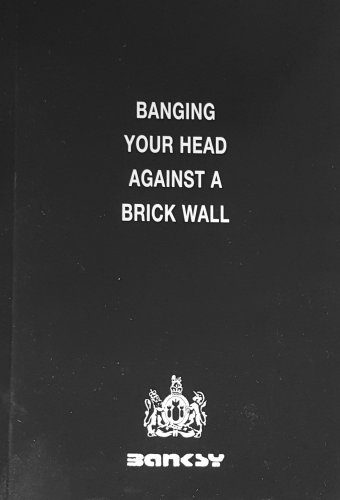
Iconic and famously anonymous graffiti artist Banksy first wrote about his works in three small books just 148mm x 105mm (5.8″ x 4.1″) Banging Your Head Against a Brick Wall came out in 2001, Existencilism in 2002 and Cut it Out in 2004. I bought Banging Your Head Against a Brick Wall when it came out but unfortunately missed the other two which were also published by Banksy’s own Weapons of Mass Distraction publisher. I say unfortunately because you cannot pick up any of these for less than £100 each nowadays. Far easier to find is the subject of this weeks blog Wall and Piece first published in 2005 by Century, part of the Random House group, and much larger at 257mm x 210mm (10.1″ x 8.3″) and 240 pages and which is in full colour unlike the small black and white only books which are just 48 pages long.

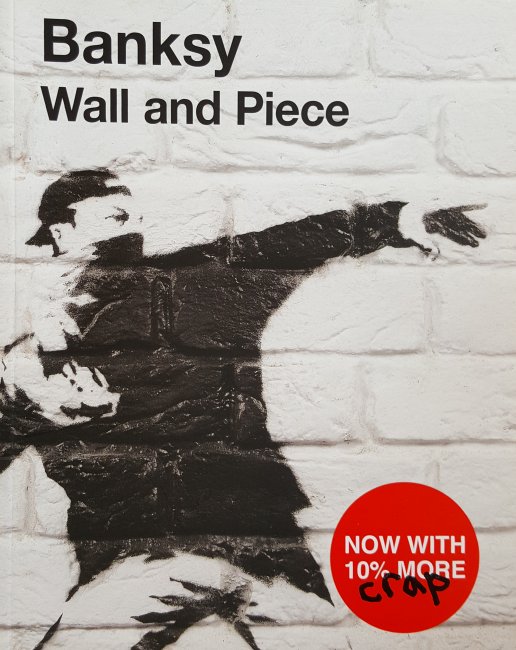
As for the ‘Now with 10% more crap’ sticker on the cover, my edition is the 9th impression and talking to a friend who has an earlier version, without the sticker, she confirmed that my copy is noticeably thicker than hers. We haven’t done a page by page comparison to establish the additional material but it was clearly an evolving project and I would have expected this to be a second edition rather than the 9th impression of the first. Wall and Piece, as a mass produced book running into multiple print runs is unsurprising quite cheap to find second hand, costing just a few pounds although I bought it new from a book shop and paid full price (£12.99) for mine.

The art is roughly in chronological order, starting with his chimp wearing a tabard with assorted messages on it to his rats which is when he really started to be noticed with his instantly obvious style and sense of humour. It is probably the fun in what he does that makes him so different to the vast majority of graffiti artists and which makes him so collectable with one of his works recently selling for £18.5 million, including premiums at auction. But this book takes us back to the beginning and he explains where the idea for the stencils came from, he was trying to paint ‘LATE AGAIN’ on the side of a train and taking far too long about it so that the police arrived and he only avoided being caught by escaping through thorn bushes and then hiding under a dumper truck. Looking up he saw the stencilled plate on the base of the fuel tank.

I got home at last and crawled into bed next to my girlfriend. I told her I’d had an epiphany that night and she told me to stop taking that drug ‘cos it was bad for your heart.

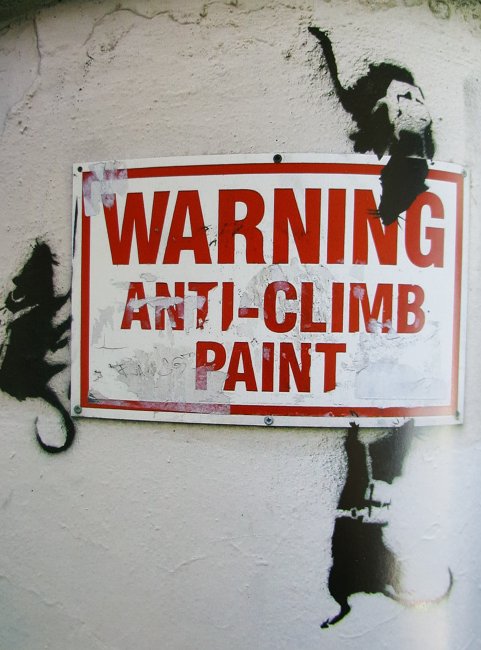
More rats, and this shows how he makes use of existing things on the walls he paints on either because it’s funny as in this example or because he is trying to make a more serious point. The vast majority of his works in the past have been either painted over or simply cleaned off the wall involved so it is the photographic records that are his lasting legacy. Most recently, due to the considerable value of his authenticated works, huge sections of wall have simply been removed and presumably sold such as the seagull art in Lowestoft taken earlier this month, see here.

The newest works in the book are from 2005, which is when the book was first published, and feature the works that Banksy, and a team of helpers, painted on the segregation wall illegally built by Israel through the occupied West Bank, the one above is near the checkpoint in Ramallah. They mainly appear to be holes in the wall with attractive views, one has a mountain range, another a tropical beach although one looks simply like the dotted line with scissors used to surround items to be cut out from printed items, this particular image is over twenty feet high. Although the paintings are largely appreciated by the inhabitants Bansky describes the wall in the book as something that “essentially turns Palestine into the world’s largest open prison.”

Old Man You paint the wall, you make it look beautiful
Me Thanks
Old Man We don’t want it to be beautiful, we hate this wall, go home

One section I particularly like deals with his re-interpreted art such as Sunflowers (from a Petrol Station) seen above. Banksy has managed to hang his parodies in numerous famous galleries by simply walking in and putting them up usually with explanatory cards in the form used by the gallery itself. These establishments include The Tate Gallery in London, The Louvre in Paris, The new York Metropolitan Museum and the Natural History museums in both London and New York amongst others. In the book these works are often accompanied with various photographs of Banksy hanging the ‘fake’ painting, the pictures normally survive on the walls for a few hours before being removed after which they have been discarded by the gallery or more recently added to their own collections.

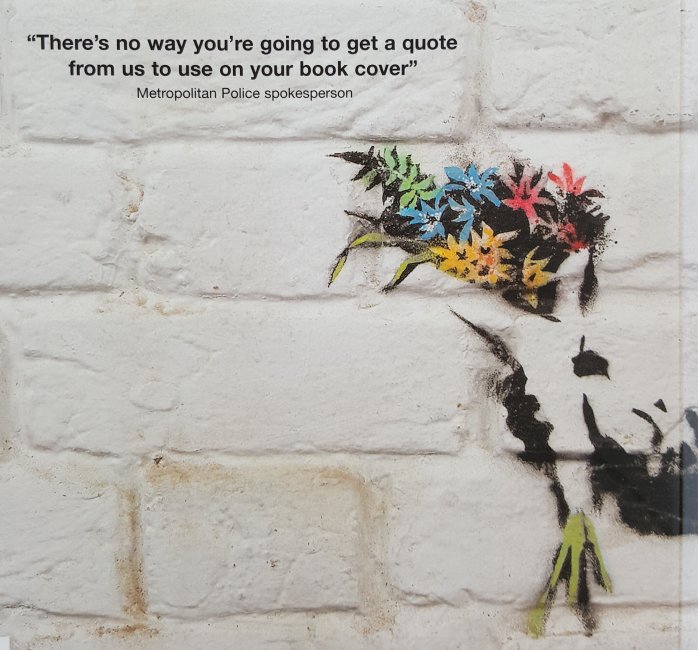
Above is part of the rear of the book which not only completes the image on the front where the masked man is shown to be throwing a bunch of flowers rather than the Molotov cocktail that might have been expected from first impressions but also includes a quote from the Metropolitan Police, London’s police force, which may or may not be genuine.

Finally below is the book that started it all, a lot of the images from ‘Banging Your Head Against a Brick Wall’ are also in Wall and Piece but in colour and much larger than could be achieved in such a small book. Surprisingly though there is a quite a lot of text in this small volume whilst Wall and Piece is largely a picture book, although it does include quite a bit of information about the various styles he has used and little bit of biographical detail but not enough to come any where near identifying him. There are also hints for how to do your own stencil graffiti in a few pages at the back and some introductory paragraphs at the start of each section.

Surely You’re Joking, Mr Feynman! – Richard Feynman

Well this book was a complete surprise when I finally pulled it off the shelf where it has sat, largely undisturbed, for over ten years. The year before buying it I had read Six Easy Pieces and Six Not so Easy Pieces which were sections lifted from the Feynman Lectures on Physics and whilst I had enjoyed them I never felt in the mood to see which topics were included in this volume. In fact this isn’t a physics textbook but a stab at autobiography based on taped conversations between Feynman and Ralph Leighton largely done over a seven year period whilst they were drumming together, Feynman was a keen bongo player. The short pieces that make up the book are arranged in a rough chronological order from his childhood to getting his degree in physics at MIT in the first section, his time getting his PhD at Princeton University in the second. Part three covers his time at Los Alamos working on the Manhattan Project which developed the first atomic bomb during WWII whilst part four has him working as professor of physics at Caltech and Cornell universities and the final section has some fairly random stories in it. This potentially sounds rather dry but it is far from it, what we actually get is a total of forty anecdotes a lot of which have nothing to do with physics at all. As well as being one of the outstanding physicists of the twentieth century Feynman loved an anecdote and also stretching his brain doing things that had nothing to do with his career such as learning to do safe-cracking and taking it upon himself to translate Mayan pictographs relating to mathematical problems, both of which are covered in this book.

The stories are often humorous such as the first one concerning his Princeton years, which is also where the title of the book comes from. On arrival to start work on his doctorate he was invited to the rooms of the head of college for tea and being a young man from a Jewish background in New York he hadn’t come across this decidedly English concept which was popular amongst the academic elite at Princeton so didn’t really know what to expect. On being asked if he wanted lemon or milk in his tea he replied ‘both’ leading the lady pouring the tea to exclaim ‘Surely you’re joking, Mr Feynman!’ One of the funniest stories is his battle with the censors working at Los Alamos, now technically they weren’t allowed to censor mail within America but clearly they were going to because of the nature of the work on the Manhattan Project, However Feynman liked to keep his mind sharp so had already started having his correspondence with his father and his wife include codes without giving him a hint as to the key so that he had to crack the codes and the censors really didn’t like that aspect of his letters. Eventually they settled on having the letter writer include on a separate piece of paper how to crack the code and the censors would remove the solution before passing it onto Feynman. All I can say is he must have been a tricky person to work with and indeed his long time collaborator, Freeman Dyson, described him as ‘half genius, half buffoon’ which he later updated as ‘all genius, all buffoon’.

By its very nature the book is somewhat bitty, there are little, if any, links between the various stories included and you quite often want to know more and it leaves out large chunks of his life including his work on the report into the space shuttle Challenger disaster which helped bring him to wider public recognition outside of the world of physicists and academia. However the fact that it is forty largely self contained tales means it can be just dropped into wherever you feel making it ideal for reading when you just have short periods of time available and it is definitely worth reading, even if Feynman does come over as a pain in the ass at times. My copy was published by The Folio Society in 2012, twenty seven years after it first came out and is beautifully illustrated with numerous photographs along with drawings by Aude van Ryn.

Beyond the Wand – Tom Felton

Published last month (October 2022), this is a really fun autobiography, even though I have to admit that I have never managed to get on with the Harry Potter books or the films. However I have heard Tom being interviewed a few times and his totally laid back and unpretentious style, so unlike the character of Draco Malfoy he plays in the films, drew me to this book pretty well as soon as it came out. I wasn’t to be disappointed. The foreword is by Emma Watson.

Tom is likewise eloquent about his friendship with Emma and several times states his admiration for her along with Daniel Radcliffe and Rupert Grint especially over the very strange childhoods that these three child actors had. As the filming schedule of the Harry Potter was relentless all three existed in a bubble of private tutoring alongside their filming commitments. These were the only three to have this regime however, Tom along with all the other child actors went to a normal school but with random absences to be on set and he freely admits that he took advantage of this to bunk off school as it would be assumed he was working on Harry Potter. At thirteen when he started filming the series he was also significantly older than the three stars, Daniel and Rupert were eleven and Emma just nine years old and that age gap is important when you are so young, this all meant that whilst he wasn’t particularly close to the other three at least at the start of the movie series his friendship with them all has continued long after the films stopped.

Obviously most people reading this book will be looking for insights into the making of the Harry Potter films and yes that is covered with chapters talking about the various actors he worked with and what he learned from their vast experience. The cream of British acting talent were involved in the films over the years and even though at the start Tom had hardly heard of a lot of them he certainly learnt to respect their talent and almost used the films as an ultimate acting class. But, if like me, you haven’t seen the films then there is still a lot to be got out of this autobiography and Tom’s confusion when people treated him as the character he played, abusing him for what Draco had done is genuine and quite funny.

Tom also isn’t shy about writing about his failings, either a one off shoplifting offence done under peer pressure from the other lads at his school or during the time his elder brother Chris was his chaperone on set them disappearing all night to go carp fishing. Chris is a well known angler and Tom also loved nothing better than getting his equipment out and fishing through the night. Indeed when it came to filming the green screen quidditch sequences each actor had a photograph on a pole which marked where their eye line was supposed to be in each shot, somebody had Cameron Diaz, Tom had a particularly attractive carp. He also covers his time avoiding and then eventually spending time in rehab after his drinking and cannabis smoking got too much after the Harry Potter films had finished and he had moved to Hollywood. All in all this is a very honest book and well worth a read.

Elisabeth Sladen the Autobiography

2005, My first day on the new job.

I took my place in front of my little paper sign and glanced around the table. And there, just across from me and down to my left, a face from my childhood leapt out from among the throng.
Sarah Jane Smith was quietly leafing through a script and composing herself for the afternoon ahead

If Sarah was here, there was nothing to worry about. Later that afternoon she would be calling me Doctor. The little eight-year-old in my head (who was frankly reeling at the fact I was in that room at all) was soothed, and of course thrilled, that the Doctor’s one true assistant was there to look out for him.

Extracts from the Foreword of this book by David Tennant

The final book in my August selection of Sci-fi autobiographies had to Elisabeth Sladen, best known for her role as Sarah Jane Smith in Doctor Who in the mid 1970’s, but who re-appeared in David Tennant’s fourth broadcast episode (but the third filmed) as the Doctor in 2005 and later went on to have her own programme ‘The Sarah Jane Adventures’ which ran for five series up until 2011. David Tennant was clearly a fan, and so was I, although not to the extent of having posters of her on his childhood bedroom walls as he did. This book was a joy to read and despite its 334 pages plus the foreword and acknowledgements from her daughter Sadie it positively flew past it is so well written. The final draft of the book was delivered for her to read through just before Christmas 2010 but family was always more important than work for Elisabeth so it was put in a drawer and she was always so tired recently. The scripts were coming through for series five of the Sarah Jane Adventures and she need to prioritise those before her own project but in February 2011 she was diagnosed with cancer and just two months later she died aged only sixty five. In a heart breaking final chapter her husband, Brian Miller, and her daughter describe picking the book up some months after her death and reading it, then deciding that it had to be published, I’m so glad they did.

The book is far more than her involvement with Doctor Who, Elisabeth was an established theatre actress for twenty years before getting the role that truly made her name and that part of her career is given proper coverage as she learnt her craft, met and married Brian and toured all over the country with occasional TV, radio and film parts. We also get her time post Doctor Who back in theatres and various TV roles as well as the times she spent in America on the convention circuit with her first Doctor, Jon Pertwee, where she was always a popular speaker. Unlike Tom Baker’s autobiography which I reviewed first in this brief series Sladen does focus on her time in Doctor Who. She was cast for the role by Barry Letts and also worked on the first two series of Tom Baker’s Doctor and frankly we learn more about the start of his time in the role from this book than in his own autobiography. The story continues up until she decides to retire from acting in the early 2000’s as the roles simply weren’t coming through, then in 2005 she gets a call from Russel T Davies who had restarted Doctor Who after more than fifteen years off the TV screens and suddenly she ended up busier than ever.

It’s a fascinating book and her memory for details going back decades adds a lot to the enjoyment of reading it but is sadly out of print. I bought my copy when it first came out and read it then and it was fun to get it back off the shelf eleven years later. Frankly I’ve been building up to this book all month, deliberately including Tom’s and Barry’s books and finishing with Elisabeth’s. I was eleven when her first Doctor Who story, ‘The Time Warrior’, was broadcast and she was in a total of eighty episodes in that first time in the role so for me she will always be, as David Tennant put it in his foreword ‘the Doctor’s one true assistant’ and so sadly taken from us when her career was blossoming all over again.

I, Robert – Robert Rankin

I, Robert is not so much an autobiography but rather a series of loosely connected anecdotes which when read as a whole coalesce into an autobiography. It is by no means in true chronological order, apart from the second half of which more later, but rather a series of chapters, each just a handful of pages long, which deal with one or more aspects of his life. The title is of course based on the Isaac Asimov short story I Robot and the cover picture shows Rankin as Robbie the Robot from Forbidden Planet so you get two puns for the price of one which is very much in Rankin’s style. I have read a lot of Robert Rankin’s works in the last two or three years and have even reviewed his first book ‘The Antipope’ on this blog back in April 2019. Reading my way through Rankin’s books was the perfect antidote to sitting at home during the coronavirus lock downs, I own a shop so my business was closed down by the government for long periods of time, his humour largely helped to keep me going so I was really looking forward to reading this book and I wasn’t disappointed.

I, Robert was self published as a limited edition in 2015 and at the time of writing he still hasn’t sold out of the 5000 copies that were printed so if you are interested it can be found here.

The second half of the book is a series of chapters each about some aspect of one of his books in chronological order. Here he tells stories about how the books came to be written, problems with publishers and who the various characters in his books were actually based on. Rankin himself is apparently Jim Pooley, a long standing character from the Brentford series of books that is about to reach its twelfth (and apparently final) volume with Normanghast. In total thirty four books are discussed in some depth written between 1981 (The Antipope) and 2012 (The Educated Ape and Other Wonders of the World). There is also a section at the end where he discusses losing his contract with Orion and deciding to self publish, which is what he exclusively does now, and also the final ‘contractual obligation’ book when Orion realised that right at the beginning of his contract with them he had been paid for three books but only written two. This was actually by agreement with his editor at the time but she had moved on and they wanted their pound of flesh so in 2013 his final mainstream published work (The Chickens of Atlantis and Other Foul and Filthy Fiends) came out, it’s not bad but not one of his better works.

There are also tales of misidentification in the book including spending a remarkably quiet three week signing tour in New Zealand because they had booked the crime writer Ian Rankin but the publishers had sent Robert leading to all publicity about the tour being hurriedly removed at the book shops he was going to and hardly anyone turning up. Some time later the two writers met and Robert told him about his lovely all expenses paid holiday with his wife and apparently Ian Rankin was not amused. This leads to the final page of the first half of the book which I will just leave here as it is pretty well explanatory apart from knowing that the picture on the left is the Marquess of Bath whilst Robert Rankin is on the right.

Who & Me – Barry Letts

Barry Letts was an actor, writer, director and producer for decades, mainly for the BBC, and is most famous as the series producer of Doctor Who from Jon Pertwee’s second story in 1969 to Tom Baker’s first in 1974 returning as executive producer at the end of Baker’s long run in the part in 1980. He also directed several stories for Doctor Who starting with the Patrick Troughton story ‘The Enemy of the World’ and wrote others although this was done using pseudonyms as the BBC at the time did not approve of the series producer also writing episodes. The front cover shows Barry, in the striped shirt, and Jon Pertwee, in full costume as his dandy Doctor Who leaning on a dalek. Terrence Dicks, who wrote the foreword, was script editor on Doctor Who between 1968 and 1974 and these two men formed a strong partnership which drove the programme back out of the doldrums of the end of the Troughton era and up the viewing ratings. Katy Manning played Jo Grant, one of the Doctor’s companions during this period.

The book doesn’t only cover Doctor Who but delves back into Barry Letts’ decades long acting career and how he progressed into a writer, then director before finally being persuaded to be a producer, which he would only do if he was still allowed to direct the occasional story line. It is worth noting for anyone who only knows the modern re-invention of Doctor Who that back in the 1960’s there would be over forty episodes a year, every year, and stories would normally be told over four, five, six or even seven episodes rather than the at most two episode individual stories in modern Who. The workload was tremendous and Letts was responsible for improving the process by reducing the number of episodes to twenty five a year along with recording episodes in pairs so reducing the need for constantly building and taking down sets so allowing more time for recording along with other changes to scheduling.

Letts is brutally honest about his successes and failures over the years and readily admits things he got wrong such as his first directing job on ‘The Enemy of the World’ which lacked pace in numerous parts especially in the one surviving episode which definitely drags out the material. I watched this again after reading the book and can see why he really wasn’t happy about the end result. In complete contrast he was also responsible for possibly my favourite story of ‘classic Doctor Who’ which was ‘The Daemons’ which came to its climax around my ninth birthday and with it’s story about black magic and the raising of a demon absolutely enthralled and terrified me as a young child. It also has probably the best line for The Brigadier in all his appearances instructing one of his soldiers “Chap with the wings there, five rounds rapid!“. Along the way he explains a lot of what both the director and producer actually did on TV programmes of the time and this was really interesting as it a side of the making of TV that isn’t covered very often. He also covers the work of Terrence Dicks in just how a script comes to be agreed and written from the initial ideas to outlines, then initial script, leading to fine tuning with cuts and additions to make each episode not only the right length but also to maintain the flow of the story.

So here we are at the end of our second season which is where I always intended to end this first volume.

Start of chapter 22 of Who & Me

The final chapter of the book starts with the words above, but sadly Letts didn’t even live to see this volume get released as he died in October 2009 aged 84, shortly before publication, leading to a final short postscript by his family thanking people for their good wishes after his death was announced. The book was an interesting read and he dropped so many hints of things that he wanted to cover in a later volume eventually leading up to Tom Baker’s first story as Doctor Who which would have tied back nicely to the first book in my August Sci-fi autobiography readings. It is such a pity that the cancer he had been suffering from for years got him before he could even start on the second book as I’m sure we would have learnt a lot more about the jobs of producer and director.