Orlando – Virginia Woolf – part 2

This blog follows on from Part 1 but goes through the entire plot line so should not be read if you have not previously read the book or do not mind knowing what happens.

The book is split into six chapters and each is effectively a stand alone tale dealing with a specific period in Orlando’s life. The first chapter makes perfect sense as you read it, Orlando is a boy when Queen Elizabeth I visits his fathers’ great house and so captivates Her Majesty that he is invited to court towards the end of her reign, where he grows up to be a young man about town and is still around the court when James I becomes king after the death of Elizabeth. By the end of this chapter you are happily reading a novel set in the time of the Stuarts where Orlando has loved and lost the Russian noblewoman Sasha and you are wondering what will befall him next.

Chapter two has him exiled from court due to the scandal with Sasha and spending time back in the family house attempting to write great works but being unsatisfied with them all and holding parties. This is a not so subtle reference to Virginia’s lover Vita Sackville-West who is also trying to write ‘a great work’ but Virginia doesn’t rate her as an author and doesn’t believe she is capable of achieving this ambition. Orlando also at this time meets Romanian Arch-duchess Harriet who attempts to seduce him but without success. Ultimately Orlando is getting bored stuck at home so that he requests a job from the King and is sent as ambassador to Turkey. This is also a reference to Vita as she lived in Constantinople (as it was then) when her husband was sent to the embassy there from 1912 to 1914.

If you know English history a few comments in the book may be ringing bells by now but the storyline still flows without many issues. The third chapter deals with his time in Turkey initially as ambassador but then the book takes a dramatic swerve. There are a few pages that read like sections of an ancient Greek play, with Purity, Chastity and Modesty introduced as characters parading through his bedroom with trumpet calls and overblown narrative until Orlando finally awakes as a woman. As a plot twist it is certainly unusual and gets odder as people seem relatively unfazed by the change and as the embassy had been attacked during an uprising whilst Orlando slept he/she goes off to live with gypsies for a while. This last part is again a link to Vita who had a highly romanticised view of the Romany people as free living and unconstrained by the pressures of modern life. The book has her living with them for a while and then realising that she is really an interloper and misses the green lands of her home, this is Woolf pointing out to Vita that for all she may fantasise about the gypsy life she would not cope with the reality.

Chapter four has her decide to return to London and her home in Kent where she again meets the Arch-duchess who reveals herself to actually be Arch-duke Harry and this time as a man tries to seduce the now female Orlando with much the same result. Again nobody appears to be surprised by this. She throws herself into London society and meets many famous writers before taking to disguises to explore the seedier side of London to stop life getting too dull. By the end of this chapter the aspect of the book that was ringing bells earlier has now been made explicit but without any explanation, I’ll get to it later.  The fifth chapter takes place entirely in the great house without providing much detail as to what goes on. By the end however the court cases started when she returned from Turkey as a woman and caused all sorts of issues with who owned what and if she really was Orlando are settled although they have used up most of her fortune and she marries somebody she has barely got to know just in time for him to leave to go to sea.

The book ends with her finally finishing her great work “The Oak Tree” and it being praised and even winning a prize before her husband returns to her from foreign climes and she rushes to greet him.

20180529 Orlando 3

This cover is a bit problematic for me as the inclusion of the aircraft gives away the one aspect I left out in the summary above and that is the time travelling aspect of the novel. You start reading the book and it is clearly set at the end of the 1500’s with the reign of Elizabeth I coming to an end. Orlando is mentioned several times lying under the tree so what is the plane doing there?

In fact you slowly become aware of the drift of history through the book. As stated above Orlando was clearly a young man at the end of Elizabeth’s reign and much later on in the book we discover that the poem he has been working on since boyhood is dated 1586, so that would probably place him as born in around 1575, Elizabeth died in 1603 and we know he was at court during her reign for a period of years. The next monarch mentioned is James I (1603 to 1625) during whose time Orlando is largely banished from court after his relationship with Sasha at the frost fair. There were two of these during his reign (1608 and 1621) so Orlando is roughly 33 or 46 at this point. The first of these sounds more likely from his behaviour so let us say he retires to his country house in 1608, this is all quite plausible up to this part of the novel.

The next time period mentioned is when he goes to be Ambassador to Turkey after getting tired of being at home. I’m not surprised he was getting bored by then as the Monarch he asks for the job is King Charles II (he is described as being with his mistress Nell Gwyn so we know which Charles we are talking about). His reign was from 1660 to 1685 and he started his relationship with Gwyn in 1668 so as a minimum Orlando is now 93 and has spent at least the last 60 years holding parties at home. This is the first time that the time-scale appears to have stretched, as up until he goes home in 1608 it is quite believably a tale about a late Elizabethan gentleman, nobody appears to be surprised by this and he is still clearly a young man in the novel. Charles II is still on the throne when Orlando is made a Duke and subsequently changes sex. We then hit her time with the gypsies and this is also clearly several decades. On return to England she sees the dome of the new St Paul’s cathedral (consecrated 1697) and the captain of the ship refers to the late William III (died 1702) so we are now in the reign of Queen Anne (1702 to 1707) and this is explicitly stated later in the book as Orlando enters society as a young and eligible woman at the age of 130!

At last a positive date… Well sort of. There is a mention of 16th June 1712 being a Tuesday, it was actually a Thursday but never mind, it is the first specific date in the novel and this is when Orlando decides to quit society only to decide not to the next day due to an invitation that she really wanted to go to. There she meets Alexander Pope and through him various other writers such as Swift who quotes from Gulliver’s Travels, a book printed in 1726 so time is still moving on apace. She sees Johnson and Boswell (circa 1770’s) and chapter four concludes with the dawning of 1st January 1800 with a dark cloud over London. Chapter five includes a statement that she had been working on the poem “The Oak Tree”

… for close on 300 years now. It was time to make an end.

so that takes us up to the 1860’s. This is another huge leap in the time line of the book as it is only 8 pages into the chapter. It’s an odd chapter, using damp weather as a metaphor for the changes in society through the Victorian age, no more gay parties and bright lights, now the houses are cluttered and cold, the people withdrawn and everything is dark and covered up as society becomes more straight-laced and women are expected to be ‘the little woman at home’ safely married off. It’s also no wonder the court proceedings have used most of her fortune, they would have started in the early 1700’s and concluded roughly 160 years later as Lord Palmerston and Gladstone are mentioned with the court documents and Palmerston died in 1865. It is worth noting however that it does leave Orlando with the house, which as I stated in the previous essay on the book Vita specifically didn’t get as she was a woman so maybe this is a put in as a solace to Vita that although it may take 160 years a woman will eventually inherit what would be hers by right if she had been a man.

The sixth, and final, chapter brings us to the present day, well 1928 which is when the book was written anyway. It begins slightly before then at the end of the Victorian age as she finally gets her poem The Oak Tree published with the help of Nicholas Greene but most of the chapter is set on the 11th October 1928 starting in London with a very confused shopping trip. She drives out of London to the great house in Kent and is there as her husband finally comes home this time by aeroplane whilst she lies under the tree as she used to as a boy centuries earlier

It is not only Orlando who straddles time in the novel, several of the fictional characters fail to grow old with her, the Arch-Duchess/duke is also mentioned in chapter five as married and settled in Romania so he is also as old as Orlando and others survive well beyond a normal lifespan such as Nicholas Greene, the poet and critic who first met Orlando in the Elizabethan age and meets her again in the Victorian. Sasha from the frost fair in 1608 is also glimpsed during the shopping trip in 1928 and is described as late middle aged. Orlando’s husband, Shelmerdine, is also timeless, at least since coming into contact with Orlando, for they meet and marry in the 1860’s when her court cases have completed but he is clearly still only in middle age by 1928.

The book is complex and at times infuriating as it leaps about but still an enjoyable read, I’ve also had quite a bit of fun reading through it again trying to identify all the historical events that can be dated for this essay.

Orlando – Virginia Woolf – part 1

HE – FOR THERE could be no doubt about his sex, though the fashion of the time did something to disguise it – was in the act of slicing at the head of a Moor which swung from the rafters. It was the colour of an old football, and more or less the shape of one save for the sunken cheeks and a strand or two of coarse, dry hair, like the hair of a coconut.

The opening two sentences of Orlando certainly make you want to know more… Just what is going on here?

Virginia Woolf’s best known work is 90 years old this year so it seems appropriate to write about it now. The book is strange reading it now; it must have been extraordinary to readers back in 1928 with it’s bizarre plot twist halfway through. Although for me it’s what Woolf does with the character of Orlando before and after that point that is interesting rather than the twist itself but it must have been quite a jump for the casual reader in 1928. I have split this blog into two because I really want to be able to discuss the plot line and that will require me to include a lot of spoilers so this part talks generally about the book and part two will summarise the plots within it and contain the spoilers, so if you haven’t read Orlando this blog is perfectly safe.

20180529 Orlando 1

Although it is a short novel (just over 200 pages) there is a lot packed into the book and part of the conceit of it is that it claims to be biography. Virginia writes in first person as the biographer and frequently employs the literary equivalent of the theatrical trick of ‘breaking the fourth wall’ by talking directly to the reader about the difficulties of finding material to work from in compiling the biography. There is even a short index at the back as you would expect in such a work. One particular passage near the end of the book sums up this stylistic method rather well.

It was now November. After November comes December. Then January, February, March and April. After April comes May. June, July, August follow. Next is September. Then October, and so behold, here we are back at November again, with a whole year accomplished.

This method of writing biography, though it has its merits, is a little bare, perhaps, and the reader, if we go on with it, may complain that he can recite the calendar for himself and so save his pocket whatever sum the Hogarth Press may think proper to charge for this book.

As can be seen ‘the biographer’ can be quite chatty to the reader but also quite pompous, these brief interludes give you time to absorb wherever the plot has suddenly taken us next, but it is also Virginia’s way of ridiculing historical biographers who she clearly thought took themselves far too seriously.

From the way she writes about it Woolf was clearly also not a fan of ‘Society’, that endless round of functions and engagements that the upper classes seemed so devoted to right up to her time. There are many disparaging passages in the book about this foolish waste of time and money where nothing seems to be done or said that was memorable. She is also less than enamoured by her own profession of writing, or at least the majority of what was being written at the time, one particularly favourite quote of mine from the book is.

For it is rash to walk into a lion’s den unarmed, rash to navigate the Atlantic in a rowing boat, rash to stand on one foot on the top of St. Paul’s, it is still more rash to go home alone with a poet.

The book is definitely an oddity, so many different things happen and great numbers of historical characters are introduced and yet there is the constancy of the huge family house which is used to pull Orlando back to normality when things get too strange only to bore after a while and lead into another adventure. It really becomes one of the characters in the story and is the solid anchor around which the shifting tale is woven.

20180522 Orlando 4

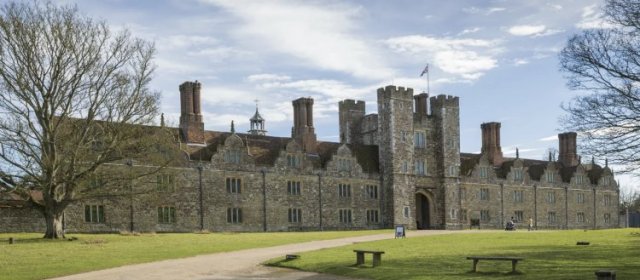
The house featured in the book is clearly based on Knole in Kent, one of the largest houses in England; and one I know well, as it is 17 miles from where I used to live at the end of the 1990’s. It was the family home of Vita Sackville-West and like her house at Sissinghurst it is now owned by the National Trust. I used to go there regularly to explore the 1,000 acre park or wander round the house, it has according to Vita 365 rooms just as Orlando’s vast house does; although she also said that “I do not know that anyone has ever troubled to verify it”. The house was also the source of great sadness for Vita as if she had been born a man she would have inherited it as her parents only child but as a woman she was passed over in favour of her cousin. As explained in my previous blog about Vita, she and Virginia were lovers for many years and there is a lot of Vita’s family history interwoven in the book.

The dig at writers and specifically poets mentioned above was also somewhat aimed at Vita who was clearly not in Virginia’s league and for all that she loved her Virginia really didn’t rate her as a poet or author. There is also, at the start of the final chapter some discussion as to whether it is even proper for a married woman to be a writer. Clearly it is fine for an unmarried female to dabble in writing for her own amusement and also what is marriage anyway…

She was married true: But if one’s husband was always sailing round Cape Horn was it marriage? If one liked him, was it marriage? If one liked other people, was it marriage? And finally, if one still wished, more than anything in the whole world, to write poetry, was it marriage? She had her doubts.

Both Virginia and Vita were married throughout their relationship and Vita in particular took other lovers at the same time both male and female. Orlando was written at what is now recognised as the peak of their love for each other when both were also at their creative best, probably feeding inspiration off each other. It was also a time of female emancipation in Britain, 1928 was not only when this book was written but it was also the year that woman finally gained full voting equality with men and more pointedly a couple of pages later Woolf includes the line…

as long as she thinks of a man, nobody objects to a woman thinking

I struggled initially with the plot of the book (see part 2) but I’m glad I persevered, this is the first of Woolf’s novels I have read although I had read her best known feminist work ‘A Room of One’s Own’ and ‘The Common Reader’ before. Maybe it’s time to get that copy of ‘To The Lighthouse’ off the shelves where it has languished for a few years.

20180529 Orlando 2

Of equal interest, to me at least, is the background to the three copies of the novel that I possess and two of whose covers have punctuated this essay. The top one is the first Penguin Books edition (number 381) from July 1942 and therefore published under wartime restrictions. This meant that fewer copies were printed than might have been the case before the war and also that the paper quality is poor to say the least, making the book quite fragile.

The second cover at first glance look to be the same, but this was printed in Cairo in 1943 for the troops fighting on the African front. This explains the price in piastres printed on the cover. If possible these books, there were 20 titles printed in English and 1 in French as part of this programme, are even more fragile than the ones produced in England at the same time and few have survived their time in the Africa campaign. Books for the troops were in short supply, especially in Africa and as any soldier will tell you a culture of ‘hurry up, and wait’ means that there is a lot of quick movement followed by long periods of not a lot apparently happening so any reading material was eagerly seized upon. Quite what the troops made of this very strange book is not recorded, I can think of many more suitable novels from Penguins extensive catalogue which would have been a lot more popular.

The third copy I have is the American Penguin edition from April 1946 and this being far more capable of surviving having its pages turned is the copy I read for these essays. However as the illustrated cover includes a massive spoiler for the book I have used this in part 2 of my discussion of Orlando. There is also an interesting tale behind this imprint. Penguin wanted to sell books in America during the war but clearly shipping books across the Atlantic was out of the question, as was using up the paper ration that they had been allocated on books which would not then end up on sale in the UK so they sought an agent to produce the books for them. They settled on Ian Ballantine and he originally printed books that looked like their UK equivalent but soon switched to illustrated covers to appeal more to the American reader. In the end under his control over 180 titles were printed in the US as either Penguin or Pelican before in 1948 Penguin Books withdrew from this enterprise as they could now export again. The titles were re-branded as Signet (for the Penguins) and Mentor (for the Pelicans) and Ian Ballantine with his wife Betty continued to publish under those brands before also creating Bantam, New English Library and of course Ballantine books. The Ballantine book group was acquired by Random House in 1973 which in turn merged into Penguin Random House in 2013 thereby bringing the story full circle.

When I was Very Young – A.A. Milne

Although nowadays best known for his stories about his son Christopher Robin and his toys Winnie The Pooh and all the other characters in the Hundred Acre Wood, Alan Alexander Milne would rather be known for his other books and plays. He wrote a surprisingly good crime novel (The Red House Mystery) and over 3 dozen plays along with several books of non-fiction. When I was Very Young is one of his rarest works as the only publication of it is the limited edition from The Fountain Press printed in 1930. Just 842 copies were produced and all were signed by Milne on the limitation page at the back of the book, my copy is number 38. The book comes in a plain card slipcase rather than a dust wrapper although this easily damaged and is often missing from copies for sale

20180619 When I was Very Young 1

The book consists of five short biographical stories from Milne’s childhood which are written in the first person and probably true as the facts that it is possible to check are accurate, such as H.G. Wells being his science teacher at his first school, where his father was head-master. In the book his two older brothers are called David and John (in reality David Barrett Milne and Kenneth John Milne) and the age differences are correct along with the description of all three having blue eyes and golden hair. There are several illustrations by Ernest Shepard and the pages have the feel of handmade paper with rough edges. It’s short, here are only 23 pages of text along with 2 title pages, one page with the copyright information and the limitation page at the back so it definitely only takes a few minutes to read.

20180619 When I was Very Young 2

All of Milne’s Christopher Robin books were also printed as deluxe editions along with several of his plays and other works some of which were also released as signed limited editions. Milne, or at least his agent in America assuming he had one, also seemed to go in for special editions only sold in the USA so there are numerous varieties of some of his titles to collect especially limited editions and pre-signed signed copies. When I was Very Young was not even the first short book by Milne in being initially issued exclusively as such a volume, in 1929 The Fountain Press released The Secret and Other Stories in an edition of 742. The Secret has however since been printed in unlimited modern editions leaving When I was Very Young alone in not being available to a wider readership.

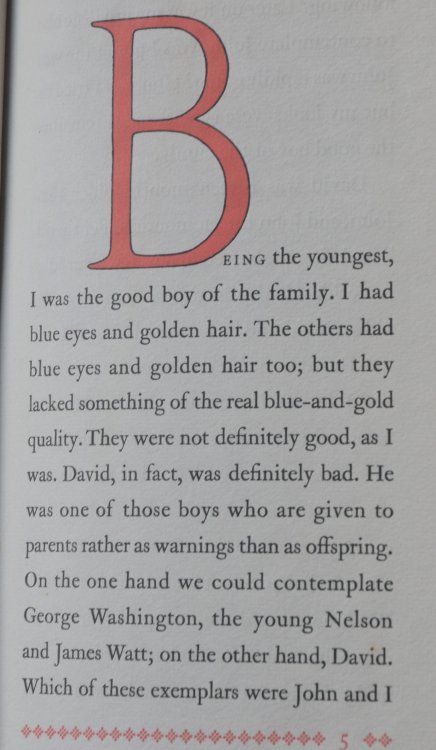
The first page sets the scene

20180619 When I was Very Young 3

After this introduction to the boys David isn’t mentioned in the first two tales, it is clear that Alan and John were close playmates though and the two boys shared a bed for many years but David, as the eldest, presumably had his own room. The first tale is a bit odd as it relates to an apparently shared dream of the two boys when they were about 5 years old for them to wake up one morning and find that everyone else in the world was dead.

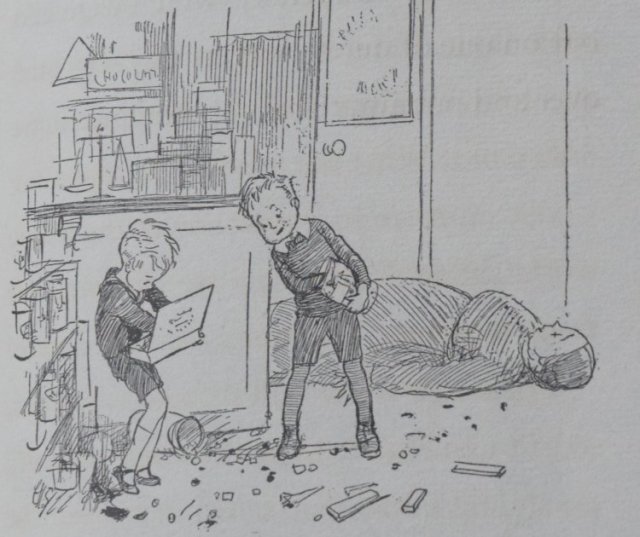
As soon as we woke up we should know that it had happened; the absence of the governess from our morning toilet, the discovery of her body in the passage between her room and ours – these would be the first signs. Having explored all over the house to make sure that the thing had been done properly, and that there really were no survivors to say “Don’t” we would then proceed to such-and-such, a sweetshop, step over the body of the proprietress and have our first proper breakfast.

There then follows a drawing by Shepard with the boys eating chocolates and sweets in the shop with the corpse in the background.

20180619 When I was Very Young 4

Not exactly the gentle Winnie the Pooh type tale you might expect! The second story is considerably less disturbing but none the less would be surprising to us nowadays. The two boys had collected various mineral samples and decided that they wanted to show them to somebody at the Geological Museum (then in Jermyn Street). By now it was 1890 and they were 8 and 9 years old and living in St Johns Wood, which is about 3½ miles (5½ km) from the museum. However their father seemed quite happy to let them go on their own as long as they ‘asked a policeman to help them cross Piccadilly Circus’, one of the most busy and therefore dangerous junctions in the city. They manage the trip, meet the curator who spends time with them looking at their small collection and also shows them round the museum and on their way back buy some matches to strike in their bedroom at night after the lights had gone out.

Two very short reminiscences follow, both featuring all three boys, in the first, inspired by a book called The Golden Key they put on an impromptu (and unscripted) play which turns out to be very short and in the second again after being inspired by a book they decide to be sailors and having lined up in front of their father David explains this to him. After consideration their father explains that “There will be examinations to pass”, at this David promptly gives up on the idea.

The final story moves us forward in time again to 1896 when ‘John’ and Alan were both at Westminster Public School and Alan was 14. Although they were boarding students they were allowed out at weekends providing they had somewhere to stay and this one weekend they were staying at the home of some elderly friends of their father. They had found a firework left over from the bonfire night celebrations and decided to extract the gunpowder from it. After a while a fairly disappointing quantity of powder was tipped out…

20180619 When I was Very Young 7

I don’t know why Milne always refers to his brother as John rather than Kenneth or Ken in this short volume, particularly as he always calls him Ken in his book It’s Too Late Now: The Autobiography of a Writer published in 1939 and dedicated as follows; 1880-1929 To the memory of KENNETH JOHN MILNE who bore the worst of me and made the best of me.

Oddly David is called Barry in the autobiography so Alan does like to confuse his readers.

20180619 When I was Very Young 5

The signed limitation page at the back of the book

20180619 When I was Very Young 6

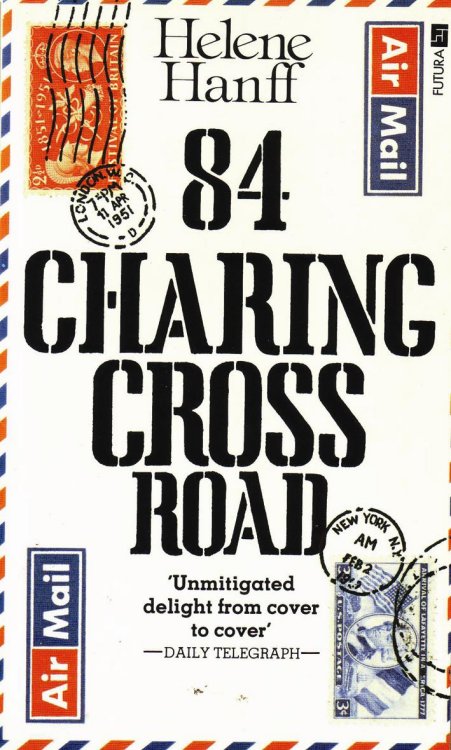
84 Charing Cross Road – Helene Hanff

Last week I went to see the play based on Helene Hanff’s best known work 84 Charing Cross Road at the Grand Theatre in Wolverhampton. There is a touring production currently travelling the UK with Stephanie Powers playing Helene and Clive Francis as Frank Doel. I first read the book in the early 80’s and have happy memories of that and seeing the film with Anne Bancroft and  Anthony Hopkins made in 1987 so it was a joy to see the play and how well it was done. I think that from now on that when reading the book I will always hear the letters as read by Stephanie Powers she gave a wonderful performance. Clive Francis was very good as Frank, but it’s very difficult to beat Anthony Hopkins, so I now have a weird mix of play and film in my head. You can see a clip from the film on youtube here.

20180605 Charing Cross Road

However this is a review of the book, it was first published by Grossman in the US in 1970 then by Andre Deutsch in the UK in 1971, the copy I currently have was printed by Time Warner Books in 2006. It has to be at least the third copy of this book I have owned as previous copies have disappeared over the years, as I either gave them away to people who I thought would love the book or just never got back a loaned volume. Like most editions nowadays in this copy the original book is paired with Hanff’s follow up work The Duchess of Bloomsbury Street which describes her journey to London for the UK launch of the original book. The first book itself simply consists of the letters between Hanff, who is in New York and Marx & Co. antiquarian booksellers based at number 84 Charing Cross Road. Initially they are quite business like, Hanff has seen an advert in the Saturday Review of Literature so on 5th October 1949 she first makes contact with the firm and pens a short note with a list of books she wants to see if they can supply them. but by the time of the last letter from the firm to Helene it is almost 20 years later on 8th January 1969.

There is no exposition, it is just the letters so all you know about Frank, Helene and the others who write occasional missives is what they include in the correspondence; but from this you really get involved in this developing two decade long friendship. By the end you feel you know them and the final few letters mean as much to you as they must have meant to Helene when they prompted her to compile the book, as she writes in Q’s Legacy.

“I have to write it.”

Then I went cold inside, I could only write it if I still had Frank’s letters. I’d begun saving them 20 years later because a tax accountant wanted a record of what I spent on books… The thin blue airmail letters with a rubber band round them took up no space, lying nearly flat under manuscripts in a back corner of one of six small cabinet drawers under my bookshelves. But year after year when I cleaned out the cabinets, I’d come on them and wonder why I was saving them. Sitting there that evening, I vividly remembered that when I had reorganised the cabinets a few weeks earlier I’d stood by the waste basket hefting the letters, debating whether to keep them or throw them out. I couldn’t remember which I’d done. And I was afraid to find out.

Fortunately she hadn’t thrown them out although they were only found after an agonising search

I carried the letters to the table and opened them – and snapshots of young families spilled out of them. Some were from Nora Doel, some were from one of the girls who worked in the shop, all of them were 10 or 15 years in the past … I found snapshots of Frank standing proudly beside his new secondhand car. I was laughing by this time, I poured another cup of coffee and settled down to read the letters.

By the time I went to bed I was positively happy, I was going to relive the lovely episode Marks & Co. had been in my life by making a short story of the correspondence.

20180605 Charing Cross Road 3

The letters get less formal as the years go on, by February 1952 Frank is writing to ‘Dear Helene’ as opposed to ‘Dear Miss Hanff’ which is how he starts off and whilst initially Frank’s letters are solely about the books or in response to gifts of food Helene sends to ration struck England, Helene’s become quite chatty very early on and she jokingly tells him off several times (these are just extracts from letters not full examples)

November 2, 1951

Dear Speed ___

You dizzy me, rushing Leigh Hunt and the Vulgate over here whizbang like that. You probably don’t realise it, but it’s hardly more than two years since I ordered them. You keep going at this rate you’re gonna give yourself a heart attack.

20180605 Charing Cross Road 4

Clearly remembering this letter many years later Frank was able to eventually get in a small riposte.

3rd May 1957

Dear Helene,

Prepare yourself for a shock. ALL THREE of the books you requested in your last letter are on their way to you and should arrive in a week or so. Don’t ask how we managed it – It’s just a part of the Marks service.

20180605 Charing Cross Road 2

Other members of staff at Marks & Co. also write to Helene, along with Dora (Frank’s wife) who initially just thanks her for the food she has sent but then also enters into a longer correspondence. What I really liked about the play was that the script really was just reading the letters to one another, the stage was split into Helene’s New York apartment on the left with the bookshop taking up roughly two thirds of the stage to the right. Almost all the letters in the book were read verbatim, in the film the letters are still the main part of the text but it is expanded to make it more cinematic and as you can see from the clip I included a link to above we even see other locations than the bookshop and the apartment.

It’s very difficult to review this book without spoiling it for new readers but it is truly a delight to read and if you haven’t read it then please do so, then see the film and if possible catch it in the theatre. The images from the play are lifted from the Cambridge Arts Theatre website whose production this was.

The second book included in the paperback is The Duchess of Bloomsbury Street and this is more of a diary tracking Helene’s trip to the UK, all the people she meets and the various publicity events she goes to including a special opening up of the by now closed Marks & Co. shop on Charing Cross Road, so she did finally get to visit ‘her bookshop’ even if it was too late. The main signing event took place in Poole’s bookshop, next door in number 86. This diary runs from 17th June to 26th July 1971 and is considerably longer that the book it celebrates. Sadly the shop is now a McDonald’s burger place but there is a plaque outside commemorating the old bookshop and Hanff’s apartment on  305 E. 72nd Street has been named “Charing Cross House”.

For the really keen there is the third book in ‘the series’ which I quoted from above, Q’s legacy explains how, when it became clear she was not going to be able to afford any more than a year at college, she was in a library and she first came across Sir Arthur Quiller-Couch. She felt his books of essays and lectures taught her more than the first year had done and she was hooked. Q, as he was invariably known, introduced her to Walton, Newman, Milton and numerous others and she wanted to read more than just the extracts he quoted so was looking for a good bookshop when she saw that advert in the Saturday Review. If anyone is responsible for all that followed after that it is the now largely forgotten Q. Forgotten that is except by those of us who own a copy of his massive 1100 page work The Oxford Book of English Verse which for decades was the definitive collection, first published in 1900 and revised in 1939 to expand the selection up to 1918.

Conrad’s Congo

In 1890 naturalised Briton, although Polish born, Captain Józef Teodor Konrad Korzeniowski left England to take command of the steamship Roi des Belges on the River Congo. He had gained his Master of the British Merchant Marine certificate four years earlier and had had a previous command of a ship called the Otago but this was to be his most significant position, at least as far as it’s mark on his later life. He had begun his maritime career back in 1875 as a trainee seaman on the barque Mont Blanc and had worked his way up the ranks on various vessels over the following years and hoped this would be a stepping stone to command of larger ships but it wasn’t to be. Amongst the possessions he took with him for an expected 3 years away in the Congo was a manuscript for a novel he was working on and it was this, along with the ill health that followed his African adventure that largely kept his away from future seagoing, would make the name of Joseph Conrad. ‘Almayer’s Folly’ was published in 1895, 15 months after he left his final marine post and a stream of novels and stories were to follow including the novella ‘Heart of Darkness’ based on his time in the Congo and published in 1899.

Although I will refer to Heart of Darkness several times during this essay, the book that has prompted me to write is ‘Conrad’s Congo’ published by the Folio Society in 2013 which gathers for the first time in one volume letters and diaries by Conrad relating to his ill-fated trip, along with the short story ‘An Outpost of Progress’ which also draws on his time in Congo. The book is bound in cloth blocked with a design by Neil Gower of the Roi des Belges steaming along the Congo. At 256 pages it is more than twice the length of Heart of Darkness and includes some fascinating contemporary photographs.

20180501 Conrads Congo 1

The Congo at the time was being run a private fiefdom by King Leopold II of Belgium and the astonishing cruelty against and exploitation of the people there was without parallel even amongst other colonies. It only started to be reigned in after the report into what was happening there by Roger Casement became public and eventually the Belgian government stripped Leopold of his autocratic control. It is estimated that of Congo’s 20 million population in 1880 this was roughly halved by 1920 mainly from famine and disease as all able bodied people were forced to work collecting ivory, rubber or other commodities to enrich Leopold meaning there was nobody to hunt, fish or plant crops. Part of Casement’s report is included as an appendix to the book and makes disturbing reading even though I already knew some of the background.

20180501 Conrads Congo 2

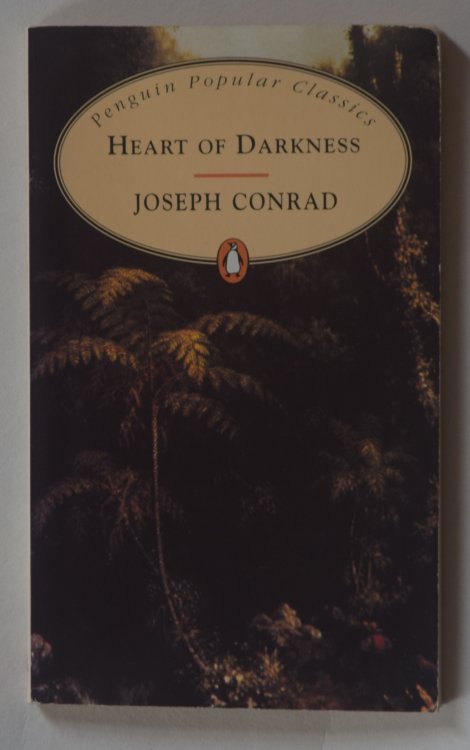
The cover of the Penguin Popular Classics edition  of Heart of Darkness was chosen by somebody who wanted a dark jungle view but managed to select not only the wrong country but even the wrong continent as the painting is a detail from Hunter in Brazilian Jungle by Marrin J Heade, so the plants growing are completely wrong for Africa.

Conrad’s Congo starts off with a series of letters initially with Albert Thys, deputy director of the Belgian Company of the Upper Congo as he tries to get a job with them then moves on to letters to his distant cousin (although referred to as uncle in the letters) Aleksander Poradowski then living in Belgium and when he dies soon after this correspondence starts the letters continue to his widow Marguerite (written to as aunt) and it is she that helps get him the captaincy he is looking for. In Heart of Darkness this is fictionalised in the tale told by Marlow (a thinly disguised Conrad) in which he says

“I am sorry to own I began to worry them. This was already a fresh departure for me. I was not used to get things that way, you know. I always went my own road and on my own legs where I had a mind to go. I wouldn’t have believed it of myself; but, then–you see–I felt somehow I must get there by hook or by crook. So I worried them. The men said ‘My dear fellow,’ and did nothing. Then–would you believe it?–I tried the women. I, Charlie Marlow, set the women to work–to get a job. Heavens! Well, you see, the notion drove me. I had an aunt, a dear enthusiastic soul. She wrote: ‘It will be delightful. I am ready to do anything, anything for you. It is a glorious idea. I know the wife of a very high personage in the Administration, and also a man who has lots of influence with,’ etc. She was determined to make no end of fuss to get me appointed skipper of a river steamboat, if such was my fancy.

Six months after approaching Thys, Conrad had his job and his letters to his ‘aunt’ continue through his voyage to the Congo talking about the trip but also his first impression of colonial Africa as he works his way along to coast encountering French ships. The letters hint at a growing romantic link between the two as the tone becomes more playful such as might be written between two lovers separated by distance. On arrival at Matadi he finds that the Roi des Belges is 200 miles away and there is no way to get there up the river due to the rapids between the coast and the station where the ship awaits him so Conrad is forced to walk to his boat and this is covered in ‘The Congo Diary’ which makes up the next section of the book. It is in this short work where he meets Roger Casement and we first read of the casual cruelty inflicted on the natives and hints as to the fate of the majority of the colonialists.

On the road today passed a skeleton tied up to a post. Also white man’s grave – no name. Heap of stones in the form of a cross.

The short Congo Diary is immediately followed with ‘The Up-river book’ which covers his first trip on the Roi des Belges and is largely technical notes presumably to assist him in future trips such as this part of the entry for the 3rd August 1890.

Always keep the high mountain ahead crossing over to the left bank. To port of highest mount a low black point. Opposite a long island stretching across. The shore is wooded –

As you approach the shore the black point and the island close in together – No danger – steering close to the mainland between the island and the grassy sandbank, towards the high mount.

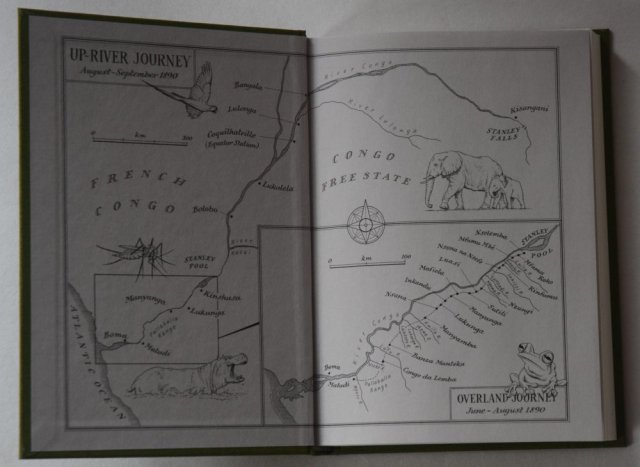
There are also numerous sketch maps of sections of the river which are also included in the Folio edition. The endpapers of this book have maps for both The Congo Diary and The Up-river Book so that you can follow the journeys.

20180501 Conrads Congo 3

Unlike in Heart of Darkness where Marlow on having walked to his boat just as Conrad did, the Roi des Belges was clearly ready to sail as they set off a couple of days after he arrived. In the story Marlow found his ship had sunk a few days earlier so was obliged to spend many months getting it out of the water and repaired before they could do anything. The enforced break affords Conrad the chance to set up his plot for the rest of the story and also to make various observations about the conditions the natives are under. In reality he was off from Kinshasa to Stanley Falls almost immediately. This section of the Folio book is frankly not very readable and in truth was not intended to be so as it is really just notes on the route to avoid the numerous sandbanks and rocky snags that litter the river. Conrad’s sketch maps are interesting with their dotted lines indicating the correct path between islands especially the long section dealing with the clearly complicated Lulanga river passage, this takes 7 maps and several pages of notes to get through so it must have had a justified reputation for difficulty in navigation.

At the end of The Up-river book we are back to a small section of correspondence as letters have caught up with Conrad at Stanley Falls. One of these is highly significant as the letter to Marguerite includes the first mention that he has been very ill with dysentery as well as fever (malaria) and that there is a mutual dislike between him and the manager of the station he is based at so there is little hope of any advancement in his career. It is quite clear from the letter that the manager of the station that Marlow finds himself at is modelled on the real Monsieur Delcommune. This is how Marlow describes him..

He was commonplace in complexion, in features, in manners, and in voice. He was of middle size and of ordinary build. His eyes, of the usual blue, were perhaps remarkably cold, and he certainly could make his glance fall on one as trenchant and heavy as an axe. But even at these times the rest of his person seemed to disclaim the intention. Otherwise there was only an indefinable, faint expression of his lips, something stealthy–a smile–not a smile–I remember it, but I can’t explain. It was unconscious, this smile was, though just after he had said something it got intensified for an instant. It came at the end of his speeches like a seal applied on the words to make the meaning of the commonest phrase appear absolutely inscrutable. He was a common trader, from his youth up employed in these parts–nothing more. He was obeyed, yet he inspired neither love nor fear, nor even respect. He inspired uneasiness. That was it! Uneasiness. Not a definite mistrust–just uneasiness–nothing more. You have no idea how effective such a… a… faculty can be. He had no genius for organizing, for initiative, or for order even. That was evident in such things as the deplorable state of the station. He had no learning, and no intelligence.

The last letter in this section is to the publisher Thomas Fisher Unwin who was acting as Conrad’s literary agent and mentions the short story ‘An Outpost of Progress’ based on his experience at the station which makes up the next section of the Folio volume.

20180501 Conrads Congo 4

Conrad would be invalided out of the Congo by the end of 1890 to the relief not only to himself but also to Delcommune who wanted rid of him, and never recovered his health. Malaria is one of those persistent diseases that keeps flaring back up and it would afflict him several times back in England. The remainder of the Folio book is letters he sent long after his return, including 3 to Roger Casement at the end of 1903 just before the Casement report was published in February 1904, along with extracts from articles he wrote, followed by 2 appendices. The first of these is a series of five short testaments about Conrad written by people who met him including John Galsworthy and Bertrand Russell and then finally the extracts from Casement’s report that was mentioned earlier.

All in all a fascinating book which gives an insight into the creation of Heart of Darkness and which even if you have never read the novella provides an overview of the awful situation in the Congo under Belgian control and it should be recommended if only for the historical record.

The Diary of a Bookseller – Shaun Bythell

For my entry this week I’ve decided to review a book I was given at Christmas and thoroughly enjoyed, The Diary of a Bookseller by Shaun Bythell.

20170123 The Diary of a Bookseller

Shaun is the notoriously curmudgeonly owner of the largest second hand bookshop in the Scotland which goes by the wonderfully simple name of The Bookshop. Not The Wigtown Bookshop (which is where it is) or Bythells’ Books, no it’s just The Bookshop, direct and to the point just like its owner. His website name is similarly one to be envied by anyone in the trade www.the-bookshop.com. The book takes a very simple starting point “to write things down as they happened in the shop” and develops into an entertaining story of how a year passed for Shaun and his equally eccentric staff.  It starts randomly on Wednesday 5th February 2014 and finishes on Wednesday 4th February 2015 (this entry is as far as I can remember the only time the year is specified).

As the owner of a specialist retail business in a small town myself the interactions with customers, or at least people who wander into the shop, move stock around and then leave without buying anything, that Shaun documents are all to familiar.

Tuesday 8th April

At 10:15am a woman walked in and roared, I am in my element! Books! then continued to shout questions at me for an hour whilst she waddled about the shop like a ‘stately goose’ as Gogol describes Sobakevich’s wife in Dead Souls. Predictably she didn’t buy anything.

Few things are more guaranteed than when somebody you have never seen before in the shop and expresses huge enthusiasm on entering is that they won’t buy anything.

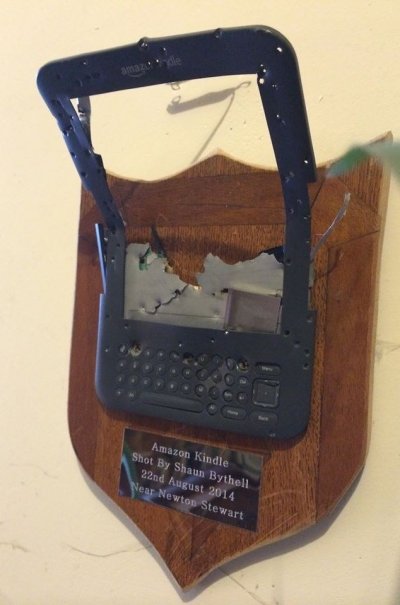
Shaun also has a dislike, no that’s the wrong word, hatred would be better, of Kindles and this is referred to several times in the book even to the point of shooting one and mounting the remains on the wall in his shop like a hunting trophy.

20170123 The Diary of a Bookseller 2

This is totally understandable for somebody who makes their living selling books (well maybe not the shooting part) you can’t after all trade the contents of a Kindle but as somebody who loves books I also dislike the impersonal nature of reading on a screen. I found the photo on pinterest so don’t know who originally took it so I apologise in advance for unacknowledged copyright.

However I don’t want to give the idea that the book is just full of Shaun complaining, sometimes he is having a great time, although usually this is whilst he isn’t actually in the shop. Wigtown is Scotlands’ book town, based on the idea by Richard Booth in Hay on Wye, gathering bookshops together to make the place a specific destination for book lovers all over the world and The Bookshop was the first of what is now 13 independent retailers in the town.  It is also home to a book festival at the end of September which is documented in the book.  The Bookshop hosts ‘The Writers Retreat’ a place where guest speakers at the festival can escape to good food and drink and to chat amongst themselves and this leads to more stories being told. There is clearly a lot of effort put into the festival and I really ought to go, but maybe not this year as I suspect a lot of readers of this book have had the same idea.

Tuesday 25th March

Shortly after Andrew had left an extremely rude old woman demanded a copy of Simon Sebag Montefiore’s biography of Stalin. We had one in the Russia section which she brought to the counter. It was an unusually pristine copy in a mint jacket, clearly unread – original price £25. She asked how much it was, I pointed to the sticker that says £6.50. She pushed it away from her and turned; walking out muttering, ‘Too expensive’. I’m pretty sure she’ll be back so I re-priced it at £8.50.

I loved the book and can’t recommend it more, you don’t have to be a bookseller or even a shopkeeper of any sort to get a lot of pleasure from it.

By the way I checked and yes you can get it on Kindle, Shaun is presumably furious…

Welcome

1894 - Lane Christmas Book- The Life of Sir Thomas Bodley- 2 title pageWelcome to my book shelves, home to some 6500 volumes dating back to the mid 1700’s right up to the present day. I’m going to use these as the basis for short essays or reviews not just of these books but where ever they wish to take me.  The aim is to pick a book, or group of books each week and look at its significance, or just tell a tale as to why it has found itself here.

The Life of Sir Thomas Bodley featured with this first article is a good entry point as the Bodliean Library in Oxford takes its name from Sir Thomas who came to its rescue in the 1590’s and put it finally in the secure position it now holds as one of the worlds greatest libraries. So immediately we have a book leading to more books

When John Lane founded his publishing company in 1887 he chose to call it The Bodley Head in honour of Sir Thomas and for Christmas 1894 printed a very small number of copies of Bodley’s autobiography as gifts to friends and people who had helped set up the business.  Very few of these books have survived the intervening 123 years but it’s an interesting work that should perhaps be better known.

I have two copies of ‘The Life’ one still in the original card covers and one rebound in boards and this also includes the original compliments slip from John Lane.

My main interest in The Bodley Head however is in one of his employees in the 1930’s, Allen Lane, who went on to found a far more famous publishing company namely Penguin Books, which now owns The Bodley Head imprint and uses it for non-fiction titles.

Well over 2000 of my books are Penguins and I specialise in the first 10 years of the company 1935 to 1945 which led to some fascinating books and stories about how they came about as the firm struggled with wartime restrictions but also the greater need amongst the population at home and also servicemen/women for something to read.  More to come about those in future entries to this blog…