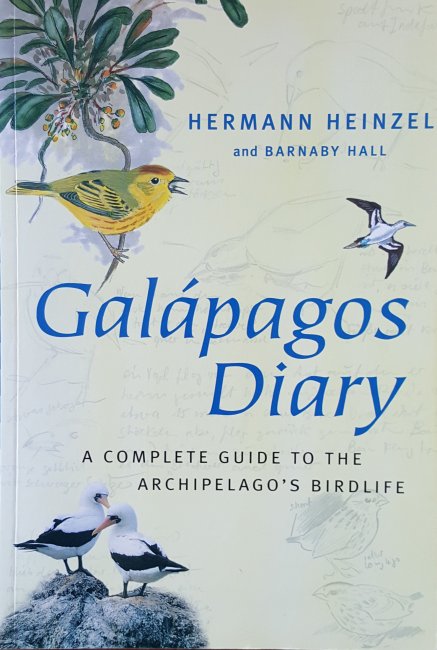
Galápagos Diary – Hermann Heinzel and Barnaby Hall

The fourth book in my natural history themed August reading material is a book I originally used as reference material. Although entitled Galápagos Diary, this book is far more than a journal of a 1995 trip round most of the islands in the Galápagos archipelago by artist and author Hermann Heinzel and teenage photographer Barnaby Hall. The book was first published in 2000 and you can see why it took so long to come out as it is a truly beautiful book, heavily illustrated with sketches and photographs. But the reason I bought this copy in 2002 is that I travelled to the Galápagos that year, to mark a significant birthday, and needed a guide to the wildlife, especially the birds. Heinzel I had already heard about as he has illustrated several ornithological volumes including the classic Collins handbook ‘Birds of Britain and Europe’. Originally born in Germany, Heinzel has lived for many years in France and knew Rod and Jenny Hall and their son Barnaby, Jenny and Barnaby had been to Galápagos in 1994 and Barnaby assured Heinzel that he had seen Cattle Egrets there which surprised the naturalist who suspected that what he had really seen was Great Egrets but Baranby was certain so they decided to go together during the school holidays the following year and so the expedition was planned. Not only to see if Cattle Egrets had indeed made it to the islands but also to attempt to see all the endemic species of birds to be found there.

The book is split into three sections, pages 1 to 158 cover the diary of their travels with lovely hand drawn maps showing where on each island they stopped, with drawings and photographs mainly done at the time. A sample page, seen above, deals with part of the time they spent travelling around one of the inhabited islands, San Christobel, the birds drawn by Heinzel are North American Bobolinks which as the name implies are visitors to the islands rather than endemic. Below is a page featuring what for me was the most surprising bird I saw in Galápagos, the endemic Galápagos Penguin. Bearing in mind the island group is on the equator I really wasn’t expecting to see penguins but these photographed by Barnaby on Bartolome, which is where I also spotted them, prove that sometimes animals are not where you think they should be.

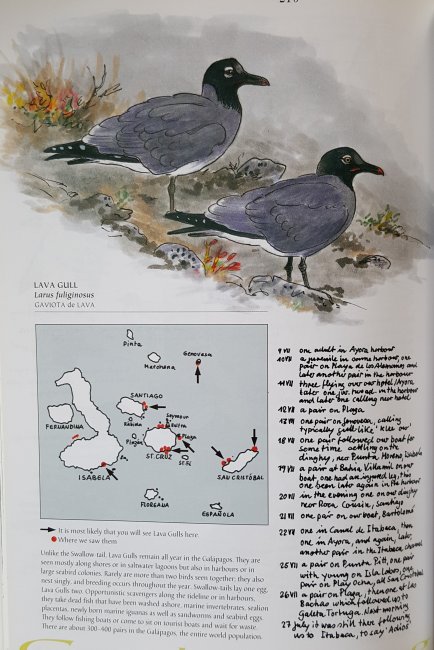
The next section is the species guide and takes up pages 159 to 261, this is entirely done by Hermann Heinzel using sketches and completed paintings of each of the endemic species, no photographs are used in this section. On this trip they failed to see just 3 of the 59 types of breeding species of bird on the islands, just the Marsh Owl, the Painted Rail and the rarest of all, the Mangrove Finch eluded them. In all they saw 66 species and they were all sketched by Heinzel and the three breeding birds they didn’t find had been seen and drawn by him on previous trips so it is a complete guide. Along with the drawings you get a map where they spotted the bird and notes relating to each sighting. The page below is for the Lava Gull, a bird that seems to be everywhere as you can tell by the notes which state that they saw examples on half the days they were in the Galápagos and I spotted them on multiple occasions.
The final section is a nine page checklist of Galápagos birds, both endemic and visitors which invites you to tick off species as you see them but I couldn’t bring myself to do so. It is not just a list but also includes which islands they are to be found on. Despite being able to fly, with the exception of the penguin and oddly the cormorant which has become flightless since arriving in the island group, the birds tend to stick to specific islands where their needs are best catered for. The islands have surprisingly different habitats even though they are a relatively small group and a tiny number of species can be seen from every island, even including those that can be expected to be seen going past.

It was a very useful book when in Galápagos and also later on trying to identify each bird I photographed. Perhaps surprisingly I have no memory of actually reading the diary at the time, I appear to have just used it as a guide to tell what I had been looking at. That is definitely a pity as it is an interesting read as well as a beautiful book.

If you are interested in the photographs I took in 2002 they can be found here:

San Cristobal and Bartolome

Santiago and Genovesa

Seymour and Santa Cruz

The Year of Sitting Dangerously – Simon Barnes

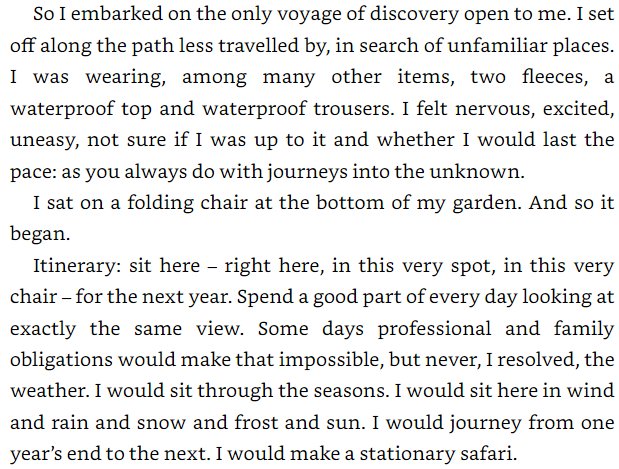
So this August I am devoting to natural history and by contrast with last week’s book from the 18th century this is so contemporary that it was written during the various covid lockdowns here in the UK and was first published by Simon & Schuster on the 13th April 2023. Simon Barnes was looking forward to a trip to South Africa as a guide on a wildlife tour when all of a sudden he wasn’t going anywhere, so decided to really not go anywhere and just sit in a chair at the bottom of his garden for a year and record his experiences. Now Barnes is lucky, he lives in the Norfolk Broads, an extensive flat wetland area to the east of the UK so his bird watching possibilities just sitting at home are considerably better than the average town dweller, although by the nature of it being a flat open landscape (the highest point in Norfolk is just 344 feet (105m) above sea level) he was rather exposed to the elements.

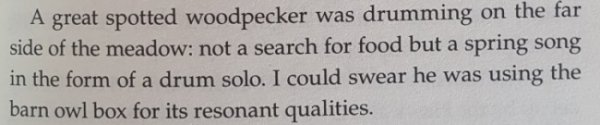
Oddly, although he had decided to do this he didn’t explain what he was doing to his family for several months, they must have assumed that he was having a rather strange reaction to being forced to go nowhere. He is actually quite fastidious about sitting out and noting whatever he sees which is why the book runs to 336 pages from Sunday 27th September 2020 to Monday 27th September 2021, the extra day signalling that he intends to continue sitting out and making notes whenever he can going forward. It isn’t an end to his experiment but a continuation of an experience he has grown to love regardless of the discomfort sometimes. I have included a couple more sample passages below so you can see the changes to the writing style as the year progresses. I think he gets more poetic as he sinks more and more into the communion with nature that his self imposed routine gives him.

There is humour and drama aplenty as he follows the lives of the various creatures he is observing, from the majestic marsh harriers swooping across his eyeline to the much bullied buzzards, which every bird seems engaged in driving away. The herons in the lakes and marshes just beyond the river flowing past his seat and the great flocks of corvids (rooks, jackdaws and crows mainly) that are often seen, to the gay pair of male swans that encroach into his garden and one morning had clearly been roosting overnight in his chair judging by the mess. Through the year we see the animals that live here all the time along with the seasonal visitors, them pairing off in the summer months and hopefully raising young although obviously not in the case of the gay swans the relationship between them only slowly dawns on Barnes as he watches them, initially trying to work out which was the female. We also get brief insights into his family life, especially his increasing frail father who is finding living alone in London through covid lock downs particularly difficult.

I was really looking forward to reading what he saw on my birthday, in early June, and was somewhat disappointed to find that he actually did manage to get away for a weeks family holiday boating on the broads which coincided with the day in question so there were no entries between the 8th and 14th June. I am always intrigued when reading diaries to see what the person was up to on my birthday, it adds something personal to the reading experience, however it wasn’t to be with this book. That however was the only slight let down in a book I have thoroughly enjoyed and definitely learnt from. His descriptions of birds, mammals, and in the later chapters insects as he starts to take more notice of them as well are really good especially as he explains how he determines which species he is actually looking at from bird calls, flight patterns, the shape of wings and other features and what they tell you about the way the bird looks for food or finds a mate. I am by no means a bird watcher although I do watch birds when they are around, a fine but important distinction I think. I no longer have a garden, but when I did I had numerous feeders up to attract birds, nowadays I am restricted to what I can see from my living room window although that does quite often include buzzards wheeling over the valley so it’s not all bad.

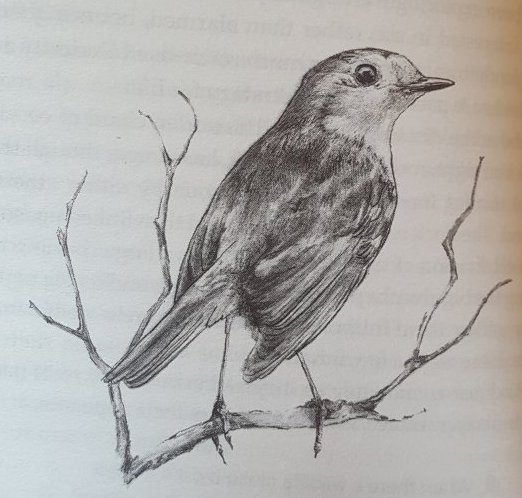
Each month starts with a beautiful pencil sketch of a bird that features in the chapter. These drawings were done by Simon Barnes’ wife, the artist Cindy Lee Wright. The one I have included above is the lovely picture of a robin which starts the chapter ‘February’. I have a certain fondness for robins, they are definitely the bird least bothered by human presence near them here in the UK and used to perch watching me as I worked in my garden in case I unearthed anything worth eating.

I can definitely recommend this book, the idea of just sitting in one place for a year and writing about what was seen from that vantage point could have been dull but I found myself racing through the pages totally drawn in by the gentle and engaging tone of the writing.