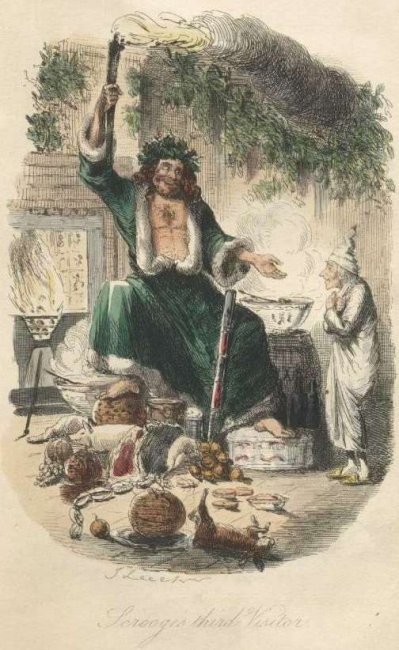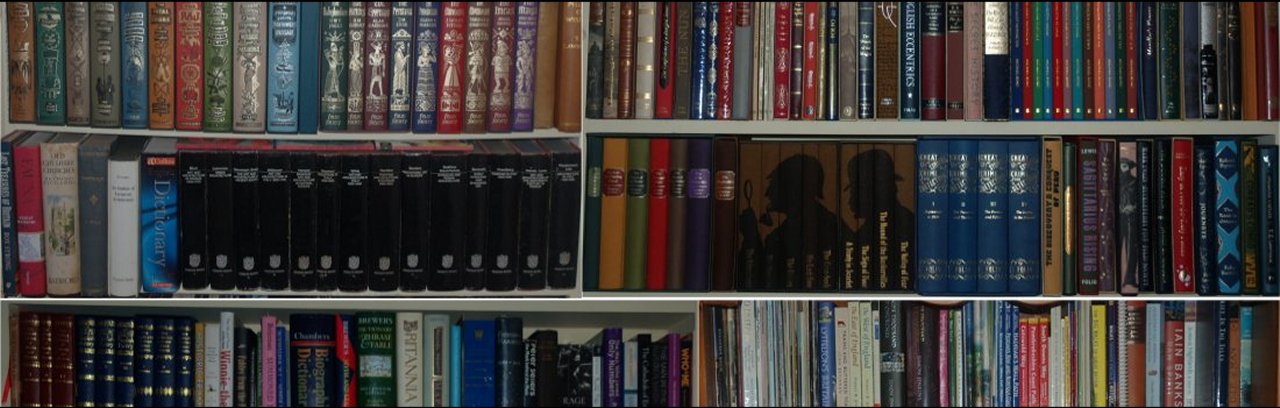
The Haunted Man – Charles Dickens

The Haunted Man and The Ghost’s Bargain to give the book its full title is the fifth and final Christmas book by Charles Dickens. I have a copy as part of my collected volume of Christmas Books published by Gerald Duckworth Ltd in 2005 as part of their failed series of facsimile reproductions of the famed 1937 Nonesuch Press collected Dickens. I say failed as there was originally supposed to be twenty four volumes published at a rate of six a year from 2005 but six years later only twelve books had appeared (six in 2005, three more in 2008, and a final three in 2011) before the project was abandoned. The private Nonesuch Press Dickens was one of the finest editions of his collected works ever produced and was limited to just 877 sets, the odd number being due to the inclusion with each set of an original engraved steel plate from the first edition printed by Chapman and Hall Ltd. They had 877 plates in storage, all of which were purchased by Nonesuch and included in a box made to look like one of the books. As I don’t have the several thousand pounds needed to buy one of these sets nowadays, the Duckworth reprint looked like a good option until they stopped printing them. Happily they did include all five of the Christmas stories, combined in one large book as one of the first six volumes printed.

I must admit that apart from ‘A Christmas Carol’, which I read regularly and reviewed on Christmas Day five years ago, the other four Christmas tales by Dickens are ones I have rarely, if ever, dipped into. I’m pretty sure that I have never read ‘The Haunted Man’ before but I really enjoyed it now that I have finally done so. The story concerns a chemist, and lecturer in the subject, Mr Redlaw whose home and teaching establishment occupies part of an old educational building in a somewhat poor and rundown, but otherwise unidentified, part of London.

His dwelling was so solitary and vault-like,—an old, retired part of an ancient endowment for students, once a brave edifice, planted in an open place, but now the obsolete whim of forgotten architects; smoke-age-and-weather-darkened, squeezed on every side by the overgrowing of the great city, and choked, like an old well, with stones and bricks; its small quadrangles, lying down in very pits formed by the streets and buildings, which, in course of time, had been constructed above its heavy chimney stacks; its old trees, insulted by the neighbouring smoke, which deigned to droop so low when it was very feeble and the weather very moody;

From Chapter one: The Gift Bestowed

One of the joys of reading Dickens is his power of description, in a few words he has created a vision of the building occupied by Redlaw and his servants and I can see it clearly in my minds eye. The servants consist of a man and wife along with the mans aged father who continually, and comically, keeps repeating that he is eighty-seven whilst hanging the holly for Christmas Eve. But what of Redlaw, why are we concerned with him? Well he is the haunted man of the title and unusually, in an interesting twist of the traditional ghost story, he is haunted not by the dead but by himself, or at least a simulacrum of himself. Mr Redlaw is a troubled man, deeply wounded by the death of his sister and apparently unable to recover from that loss and it is to apparently offer succour that the phantom has appeared. It suggests that forgetfulness would be the best solution but it is not simple forgetfulness of his sister that is part of the gift it is so much more and the power to continually pass on this ‘gift’ even unwillingly. After great indecision Redlaw consents.

The second chapter appears at first to have abandoned Mr Redlaw as we move to the nearby Jerusalem Buildings, an even more rundown part of the neighbourhood, and the home of the Tetterby’s, A small man running a decrepit shop that has tried, and failed, to make money with all sorts of endeavours. Indeed the only thing that the Tetterby’s have succeeded in is the production of children, of which there are a great many and very little money to go round to support them leading to possibly my favourite and most typically Dickensian passage in the book, the description of their meal for Christmas Eve.

There might have been more pork on the knucklebone,—which knucklebone the carver at the cook’s shop had assuredly not forgotten in carving for previous customers—but there was no stint of seasoning, and that is an accessory dreamily suggesting pork, and pleasantly cheating the sense of taste. The pease pudding, too, the gravy and mustard, like the Eastern rose in respect of the nightingale, if they were not absolutely pork, had lived near it; so, upon the whole, there was the flavour of a middle-sized pig.

From Chapter two: The Gift Diffused

Into this poor but happy home comes Mr Redlaw in search of a student of his whom he has been told is unwell and lodging with the Tetterby’s but brought with him is his curse of forgetfulness of familial ties which leads to fractiousness of the children and more concerning wonders between themselves as to why Mr and Mrs Tetterby ever married each other. He spreads his contamination of discontent between the student and his carer before fleeing into the night so as not to cause more disagreements amongst those whom until his arrival were not just content but happy with their lot.

I’m going to say no more regarding the story except to recommend that you read it as it is wonderfully written, as I would expect from Dickens, and the denouement in chapter three is as unexpected as it is heart warming. If you can’t find a physical copy of the book it is available here on Project Gutenberg.

Merry Christmas
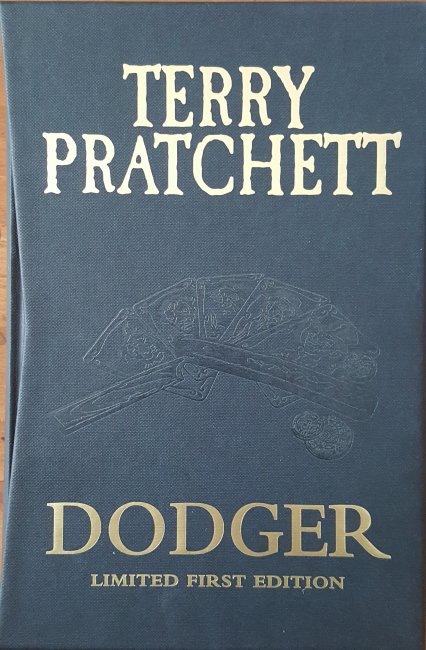
Dodger – Terry Pratchett

Having had my annual read of Charles Dickens’ classic ‘A Christmas Carol‘ I thought I would follow it with a book not written by Dickens but one where he appears as a character. Set in the early years of Victorian London various real people interact with the fictional Dodger and his compatriots including not only Dickens but Disraeli, Gladstone, Robert Peel, Joseph Bazalgette and Henry Mayhew to name but a few. Of these probably the least well known nowadays is Henry Mayhew whose monumental book ‘London Labour and the London Poor’ sits on my shelves just as it did on Terry Pratchett’s. Without this exhaustive, but surprisingly readable, study of the poor in Victorian London which did so much to raise awareness of the problems that beset them and ultimately helped to improve their lot I doubt if Pratchett would have produced such a leap from his ever popular Discworld series. The book is unusually dedicated not just to Terry’s wife Lyn but also to Henry Mayhew.

Dodger, the star of the book is the nickname of a tosher, a person who scours the sewers of London for things that have fallen or been washed down the drains and got caught up in the detritus down there. It was a step up from being a mudlark, someone who similarly looked for lost items or money but along the tidal banks of the Thames, mudlarks still exist but as a hobby rather than a career but toshing stopped after Bazalgette designed the new, more capable, sewer system for London. Right at the beginning of the story Dodger rescues an unknown woman from two men and his adventure, and rapid rise up the social tree begins as his heroism is recognised by Henry Mayhew and Charles Dickens who come along just afterwards. Dodger is an interesting character, clearly based on descriptions in Mayhew’s book but fleshed out by Pratchett in quite a believable way even if his subsequent adventures do stretch the imagination somewhat especially after his encounter with another fictional character from the period Sweeney Todd, the demon barber. It says a lot for Pratchett’s ability as an author that you are quite willing to allow for the speed of the plot and the people he gets to meet so quickly, and improbably for his social class.

The story fairly races along with Dodger and the young woman he rescued being dragged into an international crisis due to her unfortunate background and the reason she was trying to get away. Because of this however it is almost impossible to discuss more of the plot in this review as it would give too much away for future readers but it is a really fun read which I managed in one, fairly long, sitting but I didn’t want to put the book down until I finished. At the end Pratchett provides a short section on his use of actual and fantasy Victorian London

I have to confess ahead of the game that certain tweaks were needed to get people in the right place at the right time … but they are not particularly big tweaks, and besides, Dodger is a fantasy based on a reality. … This is a historical fantasy, and certainly not a historical novel. Simply for the fun of it, and also too, if possible, to get people interested in that era so wonderfully catalogued by Henry Mayhew and his fellows.

Because although I may have tweaked the positions of people and possibly how they might have reacted in certain situations, the grime, squalor and hopelessness of an underclass which nevertheless survived, often by a means of self-help, I have not changed at all. It was also, however, a time without such things as education for all, health and safety, and most of the other rules and impediments that we take for granted today. And there was always room for the sharp and clever Dodgers, male and female.

My copy is one of several ‘special editions’ produced when the book was first published on the 13th September 2012, this is the specially bound, stamped & numbered, slipcased edition limited to 3000 and sold exclusively by Waterstones, there was also various un-numbered ‘specials’:

  • 20000 copies exclusive to Waterstones with 500 for Australia with a special jacket and an extra section ‘The Wise Words of Solomon Cohen’ at the end.
  • 30000 copies for W.H. Smith along with 3000 for Easons with a bonus scene at end, Dodger goes to Bedlam to see Sweeney Todd. Both are the same except for different stickers on jacket.
  • 25000 copies exclusive to Tesco with post cards inside the front cover.
  • 6000 copies exclusive to Asda with a map of Dodger’s London at end.

This means that the ‘special editions’ outnumbered the ‘normal editions’ at publication in the UK of which there were 77000 copies. The ‘exclusive’ extra chapter in the edition for W.H. Smith and Easons was subsequently included in the UK paperback when this was published by Corgi on 26th September 2013. The Wise Words of Solomon Cohen do not appear to have been available in any other edition than the Waterstones special, they are not in my copy despite that also being a Waterstones exclusive. Bibliographic details are taken from the website of Terry Pratchett’s long time agent Colin Smythe which is a fount of knowledge on the subject of Terry’s works and is a fascinating read.

A Christmas Carol – Charles Dickens

Scrooge! a squeezing, wrenching, grasping, scraping, clutching, covetous, old sinner! Hard and sharp as flint, from which no steel had ever struck out generous fire; secret, and self-contained, and solitary as an oyster. The cold within him froze his old features, nipped his pointed nose, shrivelled his cheek, stiffened his gait; made his eyes red, his thin lips blue; and spoke out shrewdly in his grating voice. A frosty rime was on his head, and on his eyebrows, and his wiry chin. He carried his own low temperature always about with him; he iced his office in the dog-days; and didn’t thaw it one degree at Christmas.

As I post every Tuesday and 25th December 2018 is a Tuesday then there seems only one book that could be covered for the post going live that day. It’s become an annual tradition for me, I read A Christmas Carol every December and usually watch the 1951 Alistair Sim film Scrooge as well, which for my taste captures the flavour of the book best, it is also the most copied sometimes shot for shot in subsequent adaptations. If you want to see it you may need to buy the DVD as they are pretty good at taking down versions on youtube but at the time of writing this was working. It is particularly good at visualising the original John Leech illustrations, each of which are seen within the film. Now it does take several liberties with the original including inventing a character and moving another from one position to another but it does it without messing with the moral of the tale and it can be excused for adding back story to what is actually barely a novella at 28,857 words or just seventy five pages in the classic Nonsuch Press edition in order to make a film.

20181225 Christmas Carol1

It’s not unreasonable to describe Dickens as the father of the modern Christmas, in his five Christmas books if he didn’t actually invent ‘traditions’ he did at least popularise family gatherings with turkey or goose and revived the moribund celebrations that had come to exemplify his time as people moved to the cities and families spread out losing contact. The Christmas tree was introduced to the UK from Germany by Prince Albert but it was Dickens referring to it in one of his other Christmas books and Leech’s etchings of fir branches decorating the house for the Ghost of Christmas Present that really spread the idea. The hale and hearty feast, the family gathering and the spirit of Christmas (dressed in green as this is before Coca Cola turned things red) a roaring fire and welcome to all, this is what Dickens has given us.

20181225 Christmas Carol2

This isn’t an attempt to review the book, pretty well everyone knows the story and if you don’t you can read it for free on Project Gutenberg. The tale of a miser who comes to understand what Christmas is all about with the assistance of the ghost of his business partner and three spirits representing the past, present and future is the quintessential story for this time of year. The tale of why those that can help others should help others, especially at this time of year is one that bears regular retelling. I have two copies, one is the King Penguin edition which makes a good attempt to look like the original edition and I also have the Duckworth Press volume of all five Christmas Stories.

The original book was published 175 years ago today as I write this, coming out on 19th December 1843 and had sold out by Christmas Eve, it went on to be published in ever increasing numbers but Dickens never made much money from the printed editions. The printing cost was too high for the retail price that Dickens himself insisted on for him to make anything much. It was only when he took it to theatres and read the book as a performance that he started to cover the costs and actually profit from his work.

There is no better way to finish than as Dickens himself ended A Christmas Carol

He became as good a friend, as good a master, and as good a man, as the good old city knew, or any other good old city, town, or borough, in the good old world. Some people laughed to see the alteration in him, but he let them laugh, and little heeded them; for he was wise enough to know that nothing ever happened on this globe, for good, at which some people did not have their fill of laughter in the outset; and knowing that such as these would be blind anyway, he thought it quite as well that they should wrinkle up their eyes in grins, as have the malady in less attractive forms. His own heart laughed: and that was quite enough for him.

He had no further intercourse with Spirits, but lived upon the Total Abstinence Principle, ever afterwards; and it was always said of him, that he knew how to keep Christmas well, if any man alive possessed the knowledge. May that be truly said of us, and all of us! And so, as Tiny Tim observed, God bless Us, Every One!