The Holiday Train books – Peter Heaton

These three charming books were printed by Puffin Books in the 1940’s. They don’t seem to have been reprinted, not just by Puffin but by anyone, which bearing in mind that they are for very young readers, or more likely parents reading to young children, and their inherently fragile nature consisting of just eight sheets of paper, including the covers, folded and stapled in their centre makes finding them in good condition extremely difficult. Due to their rarity I have decided to include several double page spreads so that you can appreciate what a delight these little books (182mm x 110mm or 7.16 x 4.33 inches but so thin they are almost pamphlets) are. As implied the three books feature an anthropomorphic railway engine similar to the slightly later, and much more famous Railway Series by Wilbert Awdry and later his son Christopher which feature, amongst others, Thomas the Tank Engine, although that particular character isn’t in the first book which first appeared in May 1945.

The Holiday Train

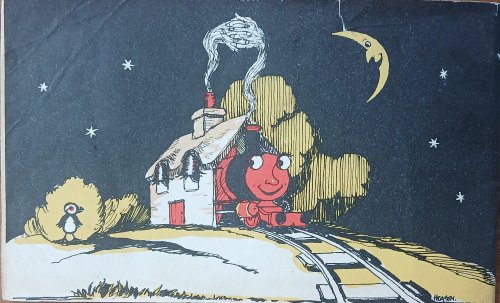
Published in November 1944 as Baby Puffin number five, this introduces The Holiday Train as a character along with the love of his life The Little House which he passed every day whilst travelling up and down the line. Like the Puffin Picture Books, which were well established by then, the books were produced from plates normally cut direct by the artist, But Heaton was not a lithographer and didn’t know the technique so his drawings were converted in house by staff at the printers W.S. Cowell Ltd of Ipswich.
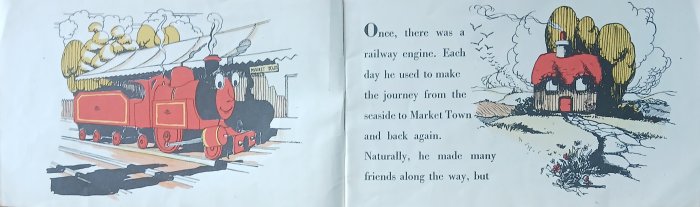
The story actually starts with the older engines, including The Holiday Train, being retired and going off to rest which he was happy about although he was really going to miss The Little House. But the seaside town where he had worked grew in popularity and population so the new engines couldn’t cope and it was decided to bring back the old locomotives.

As you can see above his return didn’t get off to a great start but soon all was well and The Holiday Train could renew his friendship with The Little House until…

The dreadful thing is a violent storm where a lightening strike hits The Little House and destroys it which sends The Holiday Train into depression at the loss of his friend. Trying to work out what to do to bring him back to normal the managers of the railway decide to get him to pull a special train, I love the expressions of the people on this next double page spread.

Of course The Holiday Train not only manages but sets a new record for the journey and as a reward it is decided to rebuild The Little House. I particularly like the puffin, the logo of the imprint, hiding behind a bush on the rear cover of the book as the Holiday Train settles down for the night in his new engine shed built from the ruins of The Little House.
The Holiday Train Goes to America

Published in June 1946 as Baby Puffin number six this takes the form of an international competition held in America between five locomotives from England against five from the USA which means of course crossing the Atlantic by ship. Which is a step up from the branch line antics of the first book, even if The Holiday Train is by far the smallest locomotive and is rather looked down on by the others. This book is very different to the other two, not only because of the use of four colour printing which allows for a full colour palate but also due to the much greater amount of text needed to tell a more complex story. This means a significantly smaller font is used, which along with the more literate style makes this definitely a book to be read to a small child rather than one they would read themselves.

Heaton makes full use of his extended colour range, it would have been difficult to do this book without the inclusion of blue. Speaking of which I’m sure the large blue loco called Blue Racer at the back of the left hand image above is a version of Mallard which at had broken the world speed record for a steam train in July 1938 by pulling seven coaches at a peak of 126 miles per hour, a record that still stands today. This can be better appreciated in a later picture where the streamlining of the LNER class A4 is shown, see below.

I love this picture of a seasick train, not a sentence I thought I would ever type, but Heaton manages to capture the abject misery of this condition so well on the face of the engine.

At last they arrive in New York and after being unloaded were welcomed to America and it appears that The Holiday Train runs on a narrower gauge that the mainline locomotives alongside him, which would somewhat explain his size difference. The two locos either side of him above are definitely giving him side-eye.
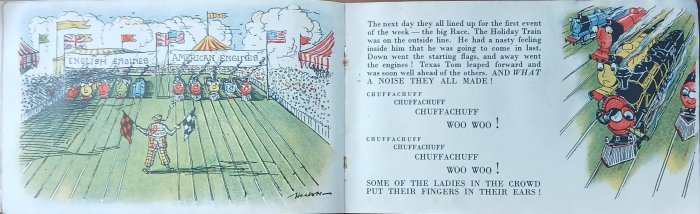
The three competitions are explained, a race, a beauty competition and a prize for the biggest engine which was almost certainly going to go to an American entrant as they are so much bigger than the locomotives from England. It didn’t look like The Holiday Train stood a chance in any of them. But there was a problem with the huge American engine Texas Tom who suddenly let out a lot of smoke obscuring the view for the other engines, but The Holiday Train is so small that he could see clearly under the dark cloud

and went on to win the race. I haven’t included the picture of the race itself but it does feature one of the errors Heaton made in his artwork as the green English train has vanished along with any tracks for him to run on. Another error is seen above as there is only one blue engine out of the ten and that is the Mallard lookalike but the loco shown above is missing the streamlining clearly depicted a few pages earlier. At the beauty contest there are again only nine tracks and no sign of the English green loco.
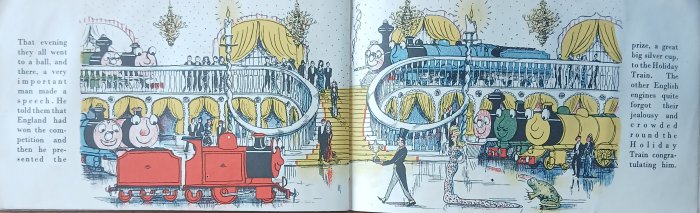
At the ball, where The Holiday Train is presented with the cup there are ten locos depicted but yet again Heaton has forgotten that one of the English locos is streamlined. It’s a fun story somewhat let down by the artistic faults, it is possible however that due to the age of the intended readership that this wasn’t noticed at the time by them, however it was spotted by Penguin management.

The Holiday Train Goes to the Moon

The last book in the series, not just of the Holiday Train but of Baby Puffins themselves as an imprint was published in April 1948 as the ninth Baby Puffin. Frankly this is the least interesting of the three titles, having a fairly simplistic story and a return to just red, yellow and black illustrations. It is noticeable that the scale between The Holiday Train and his engine shed formally The Little House has changed somewhat from the first book. In that the loco only just fitted in the picture on the back cover in the original title but now he is inside quite a roomy place with highly impractical curtains and a rug on the floor, see below.

The book tells the story of The Holiday Train being surprised by Carrumpus, a magical character who introduces himself saying “I come to visit trains when they get tired or overworked and cheer them up.” He does this by granting them a wish.

As you can see above The Holiday Train wishes he could fly and soon he has wonderful golden wings so he could fly around rather than running on rails.

Soon he decides to travel to the moon where he finds a railway, but not one like at home as here the carriages pull the locomotive rather than the other way round. But nevertheless The Holiday Train sets off to explore.

Arriving over the town of Lubbelium he sees some strange birds but suddenly Carrumpus notices the time, it’s almost midnight and the wish expires in a few minutes. Quickly The Holiday Train flies back to Earth and his home in The Little House.

It’s a pity that only nine different Baby Puffins were printed but I’m guessing that they were quite difficult for booksellers to display and sell them as they were so thin with no spine and usually were a horizontal format. With regard to the finishing of The Holiday Train books, by April 1948 the first book featuring Thomas the Tank Engine had appeared and he would go on to become enormously popular so did the world really need another anthropomorphic locomotive especially as Thomas and friends were somewhat more realistically drawn although not as delightfully whimsical. The rear cover of this last book has an appeal from Peter Heaton,

Dear Children,

As you know from reading my little books. I like having adventures. If you can tell me of any exciting places I could go to, write to me, care of Penguin Books, West Drayton, Middlesex, England

So clearly Heaton had no idea either that this would be the last anyone would see of The Holiday Train. Although he also wrote and illustrated the eighth Baby Puffin ‘Dobbish the Paper Horse’ Peter Heaton is probably best known to collectors of Penguin books for his Pelican titles dealing with a very different mode of transport, Sailing (first published June 1949) and Cruising (first published April 1952). He served in the Royal Navy during WWII on armed Merchant Navy vessels, corvettes and Motor Torpedo Boats ending up at the Admiralty and after the cancellation of the Baby Puffin series became friends with Penguin Books’ Managing Director, Allen Lane, regularly accompanying him on journeys on his boat. These trips led to the two factual books which made his name and which would be in print for several decades.
Sophia Scrooby Preserved – Martha Bacon

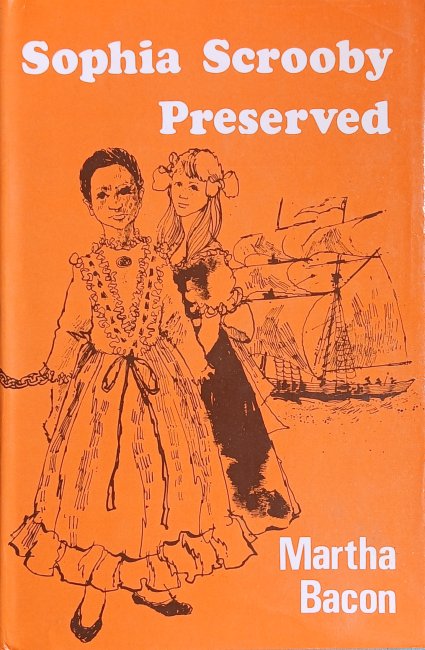
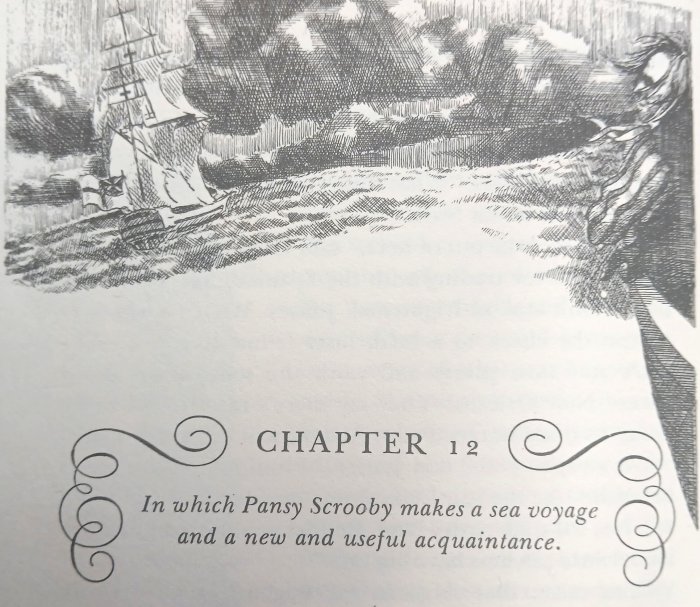
Another of the small number of books I still own from my membership of the Children’s Book Club in the early 1970’s, this one has a rather unusual subject for a book for children as Sophia Scrooby is a child slave in Connecticut around the time of the American War of Independence. Captured in Africa at the age of about six years old after her entire tribe were wiped out in a Zulu raid, she was transported to New England and sold for three pounds (around £500 today) to be trained as a lady’s maid and companion to Prudence, the young daughter of the Scrooby family. Pansy, as Sophia is normally called lives a somewhat unusual life as a slave being treated by the family more as the companion than a servant and is taught embroidery to work on a sampler and whilst working on the letters comprising the border she learns the alphabet and thence by looking through Squire Scrooby’s library secretly slowly teaches herself to read. This ability she reveals after she has been there a year, Squire Scrooby is blind and on his birthday she picks up a book and starts to read to him astonishing the entire family, especially Prudence who hasn’t managed to learn to read yet, Pansy is then tutored along with Prudence in the skills of a young lady, playing music, singing, painting etc. a far different life to that normal for a slave.

This pleasant existence is cut short however by the failing of the Squire’s fortune during the war and his house and goods are seized along with Pansy, who as a slave is simply another chattel to be sold to offset the debts. From this point of the book the narrative speeds up dramatically with Pansy sold to another slaver and pirate intending to take her to New Orleans but she escapes along with two other child slaves and the English captain of a ship captured during a pirate raid. He takes them all to England where Pansy uses her musical talents entertaining his aunt and her friends and then on the London stage. Frankly reading it now for the first time in probably fifty years it’s all rather far fetched but I remember fondly first reading the book (probably at the age of nine) which is why it stayed in my library when a lot of the other books from my Children’s Book Club collection are long gone. I’m glad I came across it again and reread it, it’s not as good as ‘Mortimer Also‘ or ‘The Ghost of Thomas Kempe‘ which are also survivors from that series on my shelves but it was a pleasant read with a satisfying, if rather predictable, ending after 225 pages.

Martha Bacon Ballinger died of cancer in 1981 at the age of sixty four. At the time she was associate professor of English at Rhode Island College and had published several books including two volumes of poetry. Sophia Scrooby Preserved was originally published in 1968 and was her first book for children. After the initial hardback editions by Little, Brown and Company and Atlantic Monthly Press in America and Victor Gollancz in the UK, this Children’s Book Club version was probably published around 1971/2 (it isn’t dated) and finally there was a 1973 paperback by Puffin Books which doesn’t appear to have been reprinted. I can find no further examples and it has remained out of print for over fifty years. All the editions, regardless of publisher, were illustrated by David Omar White.

Professor Branestawm’s Treasure Hunt – Norman Hunter

And now for some nostalgia, I first read this book along with the first book in the series ‘The Incredible Adventures of Professor Branestawm’ when I was in Primary school aged about seven or eight years old. I never actually owned a copy of either book, simply reading the ones in the school library, but the other day I came across this copy, dated 1966, which is the same as the version I first read all those years ago at the end of the sixties. I had to have it and see if childhood memories of loving the books were anywhere near as good as with Elleston Trevor’s ‘Where’s Wumpus’. Sadly the adult me found the book a bit of a curate’s egg (good in parts) and some parts have not dated very well, but when it was good it was great fun.

For those unfamiliar with the absent minded professor and inventor of crackpot inventions Branestawm would be partly great fun to meet but also a complete danger to anyone around him as his inventions not only invariably go wrong but also quite frequently do so in catastrophic ways, often explosively. His jacket is fastened by safety pins, having lost its buttons many years ago, and he wears five pairs of spectacles, one set is specifically for looking for the other four whenever he loses them, which is frequently. His housekeeper, Mrs Flittersnoop, is often to be found residing at her sister Aggie’s house when the professor’s home has been rendered uninhabitable by one disaster or another. In this book one of the stories concerns the house burning down, amazingly not caused by one of Branestawm’s inventions but not helped by him trying to put the fire out by trying to smother the fire with a rug, which promptly caught fire, adding to the conflagration, and then throwing alcohol on the flames which of course made everything worse. This leads to him trying to invent automatic fire alarms which prove to be so sensitive that even the mayor’s cigar sets them off and the professor ultimately having to move in with Mrs Flittersnoop’s sister as well because so little of the house is still standing. Other regular characters are Colonel Dedshott of the Catapult Cavaliers who is always to be found in full regimental dress uniform complete with jangling medals, Mr Chintzbitz the owner of the furniture shop and Doctor Mumpzanmeasle, these names giving a hint of Hunter’s love of word play, which can sometimes get in the way of readability as you try to work out just what you have actually read.

‘The Incredible Adventures of Professor Branestawm’ was first published in 1933, whilst ‘Professor Branestawm’s Treasure Hunt’ originally came out in 1937, there then was a long hiatus before book three was released in 1970, with a further eleven being written between 1972 and 1983. I suspect the reprinting of the first two books by Puffin in 1947 and 1966 respectively and especially the subsequent 1969 television adaption did a lot to revive the character and prompt Norman Hunter to write more. I’ve never read any more than the first two and indeed didn’t even know they existed until I came to research this blog. Norman Hunter was born in 1899 and died, aged 95 in 1995

Haroun and the Sea of Stories – Salman Rushdie

The start of the trial of Hadi Matar on the 10th February 2025 for the attempted murder of Salman Rushdie in August 2022 prompted me to go back to the shelf of Penguin Drop Caps volumes far earlier than I planned, as I knew that there I would find Haroun and the Sea of Stories. This novel for children was Rushdie’s first published work after ‘The Satanic Verses’, which had led to the fatwa declared against him by Ayatollah Khomeini of Iran for blasphemy and which almost certainly inspired Matar, a twenty seven year old American of Lebanese descent, to attack Rushdie almost killing him, stabbing him fifteen times, leaving him blind in his right eye, with a severely damaged hand and multiple other injuries. That the novel was published ten years before Matar was born and that Iran had said the fatwa would not be enforced also before he was born seems not to have affected Matar who admitted he had only read a few pages; and Rushdie had said that he was at last leading a relatively normal life without protection in an interview just two weeks before the attack. Still enough of the context as to why I picked the book up, let’s look at this wonderful fantastical story which I hadn’t read before.

Rushdie had me hooked from the opening lines of this novel:

There was once in the country of Alifbey, a sad city, the saddest of cities, a city so ruinously sad that it had forgotten its name. It stood by a mournful sea full of glumfish which were so miserable to eat that they made people belch with melancholy even though the skies were blue.
In the north of the city stood mighty factories in which (so I’m told) sadness was actually manufactured, packaged and sent all over the world, which never seemed to get enough of it. Black smoke poured out of the chimneys of the sadness factories and hung over the city like bad news.

It goes on to say that most places in Alifbey had just one letter as their name so there is the town of G and the nearby valley of K nestled in the mountains of M, this means that lots of places had the same name and therefore post was often delivered to the wrong place. In a helpful couple of pages at the back of the book Rushdie explains that the name Alifbey is based on the Hindustani for alphabet and that another destination on the journey of our heroes, for what sort of children’s book doesn’t have heroes even unlikely ones, is The Dull Lake “which doesn’t exist, gets its name from The Dal Lake in Kashmir, which does”. Rushdie was born in India and lived there until he was seventeen and takes a lot of inspiration in his writing from his youth. I have mentioned our heroes and they are Rashid Khalifa and his son Haroun, these are named after Haroun al-Rashid the legendary Caliph of Baghdad who appears in the Arabian Nights stories. Rashid is the happiest man in the very sad city and is renowned as a storyteller gaining the titles of The Ocean of Notions or the Shah of Blah because he could keep telling tales without repeating himself, weaving stories together without ever losing the intricate plots and therefore whenever he spoke he would draw huge crowds. This made his especially popular with politicians trying to get people to listen to them as elections approach as he could start the rally and pull people together from the surrounding area.

But one day disaster struck, the flow of stories just stopped, Rashid couldn’t string two words together and this was at the start of a tour arranged by politicians so it was vital that the reason was discovered. The second night of the trip saw Rashid and Haroun on a boat on The Dull Lake where Haroun encounters Iff the Water Genie who had come to disconnect the invisible tap that linked Rashid to the Sea of Stories, the source of all his tales. In vain Haroun argued that it was a mistake but finally he convinced Iff to take him to the Earth’s invisible second moon, Kahani, so that he could meet the leader of the Eggheads and appeal for Rashid’s tap to be reconnected. Travelling on a giant mechanical Hoopoe called Butt they arrive on Kahani and find the Ocean of Stories is heavily polluted with the stories dying off so Haroun then has to find out what is causing the pollution and stop it. Along the way he finds Rashid has also made his way to Kahani and has his own quest to undertake.

The book is a wonderful adventure story full of linguistic jokes, like the talking fish with lots of mouths which are called the Plentymaw fish in the Sea and the Pages, or soldiers, arranged into chapters and volumes instead of companies and battalions. It is split into twelve chapters, each no longer than fifteen pages so ideal to be read as to a child as a bedtime story over a couple of weeks. I loved the book and it was so different to the other book by Salman Rushdie I reviewed on this blog back in 2019, The Jaguar Smile. I also have his second novel, Midnight’s Children, which was his first best seller, hopefully I won’t wait another five and half years before reading that.

You can find more about the Penguin Drop Caps series in my overview here, which also includes links to the various books I have reviewed from this set of twenty six books.

Artemis Fowl – Eoin Colfer

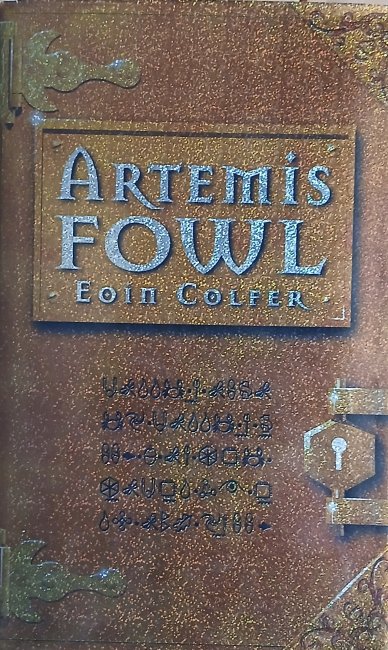
This is the first of an eleven book series written by Irish author Eoin Colfer, eight of which are about Artemis Fowl II and in the final three books, which are effectively a reboot, his twin younger brothers. My copy is a hardback from the first year of publication, 2001, and has a metallic, highly reflective dust jacket which made it very difficult to photograph. Later editions retain the gold colouring but are not metallic. At the start of this book is an introductory prologue which finishes as follows:

Artemis Fowl had devised a plan to restore his family’s fortune. A plan that could topple civilisations and plunge the planet into a cross-species war.
He was twelve years old at the time…

This last line, more than anything else in the prologue, establishes that we are in the literary genre known as young adult, which is not a area I have explored on this blog for a while so please be aware that this book is not aimed at me as a typical reader. Having said that I quite enjoyed this, and the next two books which I have also read, I have also discussed the series with other people who first read the books whilst they were within the target age range of roughly twelve to eighteen to obtain a more rounded viewpoint.

Artemis’s father is missing, presumed dead and his mother has become a barely functioning recluse in the attic triggered by her grief for her missing husband, this leaves Artemis without parental supervision in his parents large house in Ireland with only his mountainous bodyguard, deliberately confusingly called Butler and Butler’s younger sister Juliet. There are presumably servants but they don’t appear in the narrative. The family money was built upon criminal enterprises and Artemis is definitely a chip off the old block but he believes he has found a target for his genius beyond the jurisdiction of the Irish Gardaí or indeed any normal police force, his plan is to get money from the fairy world by obtaining their legendary supply of gold. And so we are entering the realm of fairies, elves, dwarfs, trolls and other magical creatures but not as imagined by Tolkein, Pratchett or others who have raided mythology for their characters modifying them to suit their plots. Here the changes are if anything more radical, dwarfs chew their way through the earth having first dislocated their jaws and expelling the residue via what can most delicately be called their opposite end having first dropped the flap in their trousers. That Butler at one point is in the way of a cataclysmic fart from Mulch Diggums. the kleptomaniac dwarf, is clearly there to appeal to the younger readers who by and large can never resist a fart joke. Elves are approximately a meter tall and one of the books major characters, Holly Short, is one of those, she is also part of LEPrecon, part of the police force for the fairy peoples who are now forced to live deep underground to avoid the Mud People as they refer to humans. Colfer explains that LEP stands for Lower Elements Police a somewhat tenuous forcing of the word Leprechaun into his plot line.

I’m not going to go into the plot of the book, suffice to say that Artemis has quite an ingenious plan to part the fairies from their gold which first involves deciphering their language, a sample of which is on the cover and which is also depicted on the base of each page of the novel, as far as I can tell differently on each page. The story moves on at quite a pace and I found myself at the end of the 280 pages far quicker than I expected. I mentioned at the beginning that I have read the first three Artemis Fowl books and talking to my friends who read them as teenagers I’m told I shouldn’t go much beyond about book five as they reckon that the plots get a bit similar as though Colfer was running out of stories to tell with these characters. One friend has read the first of the Artemis twins books but didn’t feel the urge to read the others, which I think says a lot, so by all means have a go at the early books as a bit of light reading between more weighty tomes but probably skip the later ones.

Cranes Flying South – Nikolay Karazin

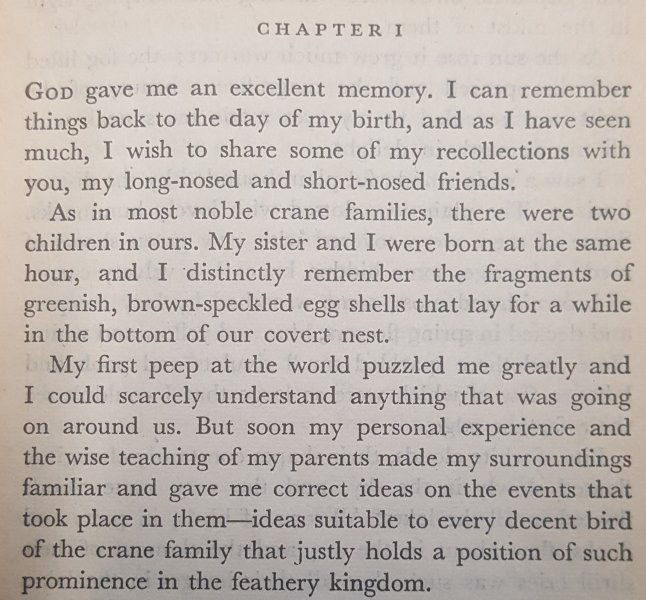
I knew nothing of this book or indeed its author before I picked up this copy a few days ago and there are no biographical details within the book either so onto the internet. Nikolay Karazin was a Russian soldier, artist and author of several books who was born in 1842 and died in 1908, he wrote and painted after retiring from the army and it is for his artwork that he is probably best known nowadays. I suspect the cover illustration is by him although no artist is credited. The English translation, by M.Pokrovsky, of his children’s book Cranes Flying South was first published in 1936 and this is the 1948 Puffin first edition. The book tells the story of the crane’s migration from the Ostashkovo marshes in north western Russia about halfway between Moscow and St Petersburg all the way over eastern Europe and Egypt following the Blue Nile to beyond Khartoum in Sudan, told from the point of view of a bird making his first long distance flight, as the book starts with him and his sister hatching.

His father, Clarion Trumpeter, is quite senior in the military like hierarchy supposed by Karazin to be normal in a colony of cranes especially during the migrations and in this he imposes his background. The story has them flying in structured triangles, which indeed they do, but regarding the stops on the way as camps with posted sentries and the discussions between senior cranes as to the best way to advance is rather more fanciful but does make for a good story. Amongst the other major characters is the Trifler, a crane known for his outrageously tall tales of his adventures and the leader of the colony Longnose the Wise. We never learn the name of our narrator or his sister, or indeed their mother but we are introduced to some of the cranes from another colony based in the Urals who join up as part of the massive flock taking part in the migration. On the way they also meet herons and storks both of which are regarded as inferior to the cranes, herons for their appetite as they will eat pretty well anything unlike the largely vegetarian cranes and storks for their relationship with man whilst cranes regard men as dangerous.

The journey south is full of incidents both with men hunting and also with bad weather which causes the loss of several cranes over open water when they get so exhausted by the buffeting winds but can find nowhere to safely land as cranes cannot swim. The descriptions of the route are also fascinating both the long slow journey over Russia and Ukraine then onto the mouth of the Danube before deciding to either cross the Mediterranean via a rest stop on Cyprus or skirting the coast from Turkey, Syria and Lebanon on their way to the Nile delta. Karazin had clearly read up on the ornithological knowledge at the time regarding the routes taken by cranes which seems to be largely correct according to the data I can find online. One particularly fun bit is near the end:

There are unimaginative persons unable to rise above the commonplace, who are generally very fond of ‘investigating’ things.
I am quite certain that several such persons, on reading of my travels will say: ‘How could he write it, when cranes have no ink and no paper?’
Such a remark will show, to say the least, a total lack of humour.

The book follows the full migration both to and from Sudan back to the breeding grounds in the Ostashkovo marshes and we get the full circle of life with our narrator pairing up with Blackneck, a crane originally from the Ural colony, and them having their own chicks. Sadly the book appears to be out of print but is quite easy to find second hand, it’s a lovely children’s story and worth seeking out.

Worrals of the W.A.A.F. – Capt. W E Johns

William Earl Johns is best known as the creator of James Bigglesworth, better known as Biggles, who featured in ninety eight books of adventure stories. Joan Worralson, aka Worrals, on the other hand appeared in just eleven books and the first three were finally republished in 2013 by Indiebooks after a long period out of print. Whilst it’s good to see these stories back in print I think it’s a pity that the cover illustrations are so childish with Worrals and Frecks depicted as apparently far younger than their actual age in the book which is eighteen and seventeen respectively. With that in mind I think I prefer the original dust wrapper from the first edition in 1941, although in that picture Worrals looks more in her early twenties.

W E Johns adopted the title Captain for his writing career although he never achieved that rank during actual service as a fighter pilot and later a flying instructor during WWI. Remaining in the R.A.F. after the war he was promoted to Flying Officer in 1920 whilst working as a recruiting officer, ultimately transferring to the reserves in 1927 before finally relinquishing his commission in 1931. The following year he wrote his first Biggles book ‘The Camels are Coming’, the title referring to the Sopwith Camel biplane rather than the bad tempered quadruped. His long career in the air force obviously informed his detailed descriptions of flying and the aircraft used, and you can be pretty sure that if Johns says a plane handles a specific way then it really did. The Women’s Auxiliary Air Force which had both Worrals and Betty Lovell, aka Frecks due to her freckled face, as members was founded in 1939 and during WWII it’s members performed various support roles to the R.A.F. including transferring aircraft between airfields and repair sites although this was a relatively uncommon function, most were employed in far more mundane duties. Worrels is therefore highly unusual in performing this task as this was actually a job for the Air Transport Auxiliary which eventually did employ around 100 women, but as a recruiting agent she apparently worked well.

The story begins with Worrals receiving a dressing down by the Squadron Leader for having gone out on a short training flight in a Reliant in contravention of standing orders which did not permit females to fly combat aircraft and she is to be punished along with the Flying Officer who flew with her by loss of leave and in his case a transfer to a forward airfield. Shortly afterwards the Squadron Leader rather shamefacedly asked her to fly the same plane as it needed moving and apparently with the transfer of Bill he had nobody left who had previously flown that make. All rather unlikely but it is really just a device to get Worrals, and Frecks as a passenger up in the air where they spotted a mysterious aircraft and received a general all planes message on the radio that it needed stopping. As the only plane in the vicinity Worrals engaged the other plane and luckily shot it down but not before seeing it swoop low over what appeared to be a golf course. If flying a combat aircraft without specific authorisation wasn’t bad enough before, then actually partaking in combat was very much forbidden, however Worrals managed to talk herself out of further punishment by pointing out that she was flying the only combat plane that had seen the mystery aircraft and otherwise it might have escaped. Worrals not only avoids further censure but gets her weekend leave reinstated.

Worrals decides to use her leave to do some unofficial investigation as she doesn’t think she was taken seriously over the activity at the golf course so taking Frecks with her they head off to the property only to be captured by German spies and the plot unfolds as they slowly work out what is happening during bouts of freedom as they alternatively escape and get recaptured a few times. The plot is well thought out and Johns certainly provides plenty of tension as the two women engage in a battle of wits with the Germans and although a few escapades somewhat stretch the readers credulity I had to remember that I was not the target readership which was largely teenage girls and young women during the war. Having said that I nevertheless enjoyed my first experience of Worrals, but I doubt I’ll read another. I read a lot of Biggles at around the age of ten and I can’t see me rereading any of those either. It was fun though and if you like what is now called Young Adult adventure stories then W E Johns has a lot to recommend him. Please be aware though that the books are very much of their time and although Worrals is largely UK based in all her books, Biggles travelled the world and often had a very 1930’s/40’s attitude to the people he found there.

With thanks to The Ironbridge Bookshop for the loan of the book so that I could try a Worrals rather than reading my extremely delicate and worryingly rare Penguin edition of Biggles Flies Again

Letters from Fairyland – Charles van Sandwyk

Charles van Sandwyk was born in South Africa and raised in Canada; he taught himself calligraphy and intaglio printing as a teenager, his first self-published book appeared when he was just twenty, and won a national award. Since then his work has been archived by the National Library of Canada and rightly so as his art is truly beautiful. Van Sandwyk has produced illustrations for several Folio Society editions but this is the first one I have bought whilst taking advantage of the end of year half price sale they were running which meant that I only paid £25 rather than the £50 original. However having now got a copy I’m thinking about the ones I have missed, such as the limited edition of Alice in Wonderland which was published by The Folio Society to mark the 150th anniversary of the first edition and sold out rapidly. Sadly I can’t see me being able to obtain original books by Van Sandwyk as they are produced in tiny numbers and are mainly snapped up by collectors in Canada so the Folio Society editions will have to do.

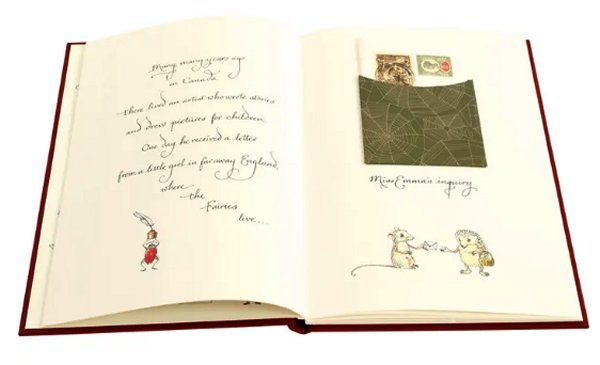
The story goes that many years ago a young artist living in Canada received, out of the blue, a letter from a nine year old English girl, Miss Emma Gladstone. Emma had read some books about fairies which the artist had published and she was writing to ask his advice about the little people who she sometimes could see out of the corner of her eye. She wanted to invite the fairies to come and live in her garden, but she did not know how to make contact with them. The pull out letter is included in a folder, just the first of several items that can be taken from the book and examined by the reader and this is one of the many charms of this edition which includes the gorgeous Modigliani Neve paper that it is printed on which resembles a heavy duty watercolour paper and perfectly sets the beautiful illustrations.

The artist replied with a letter to Miss Gladstone and the book goes on to tell the story of how he had received a summons from the Royal High Secretary to the King of the Fairies, commanding him to paint His Majesty’s portrait; how he had shrunk in size and travelled to Fairyland in a coach drawn by a mouse, and everything that happened to him there. The first edition of the book was published in an strictly limited edition of 200 copies which Van Sandwyk presented to members of an exclusive club, the High Branch Society, which unfortunately I have been unable to find out anything about. The double page spread above includes the finished portrait and an envelope containing fairy money which was apparently Van Sandwyk’s payment. The Folio edition explains that it is an expanded version of this original volume being twice the length but even so it is a very short book being just twenty four pages long, excluding the individual pull out items and it was this very shortness that made me originally hesitate to purchase it as it worked out at just over £2 a page. But it is so lovely that I should have really have got it sooner and treated it as an art purchase rather than a book.

Sadly the Folio Society sale has obviously tipped a few others into making the purchase so the stock of this, the 2020 first edition in this form has now sold out. If this little book has piqued your interest in Van Sandwyk’s work as much as it has mine then you may find the following link useful, I certainly had a great deal of fun exploring other works by this wonderful artist.

Tiffany Aching’s Guide to Being a Witch – Rhianna Pratchett & Gabrielle Kent

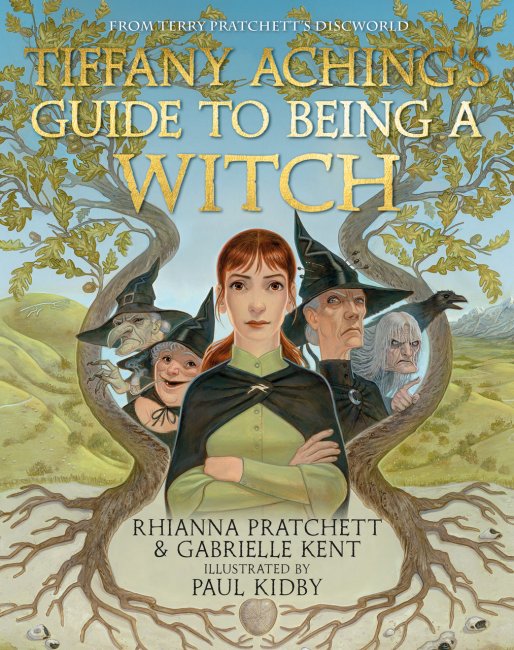
I’m writing this on Friday 10th November having received my copy of this book on the morning of its publication day, yesterday, and spent several happy hours reading it, finishing around 2:30pm yesterday afternoon. I think that tells you how much I enjoyed this first foray into her father’s literary world made by Rhianna and I hope that there will be more to come. When Sir Terry died Rhianna said that she would definitely not be continuing her father’s Discworld novels, and despite initial appearances this book does indeed stick to that line as it is another of the ancillary Discworld books such as Mrs Bradshaw’s Handbook, The World of Poo, the various atlases, or even the assorted diaries, maps, plays and guides all of which were written by people other than Terry Pratchett but based on his works with his approval and undoubted tinkering. Sadly Terry is no longer with us to give his blessings to this book but I’m sure he would have done so as Rhianna has stepped carefully into her father’s legacy with the assistance of Gabrielle Kent, whom I admit not knowing anything about other than she writes the Alfie Bloom series of childrens books, and the wonderful artwork of Paul Kidby who has signed my copy.

Based on the five ‘young adult’ Tiffany Aching books written by Terry , which include his final novel ‘The Shepherd’s Crown’, the book is beautifully designed as a guide to witchcraft by Tiffany but with apparently hand-written notes by other characters from these books such as witches Esme Weatherwax, Nanny Ogg, Miss Tick and the Feegle Rob Anybody along with additional notes from the witch Mrs Letice Earwig inserted so she can complain. Do you need to have read the books before reading this one? Frankly yes. Not only will you understand better what is being covered in the two hundred pages of this work but it basically consists of a huge number of spoilers for the other five books so you definitely don’t want to start here. Below is one of the pages from the main text (carefully chosen so as not to include any spoilers), all of which are full colour and covered in illustrations by Paul Kidby, it really is a pleasure to read the book and admire the artwork.

If you are intrigued by the illustration of the carved chalk figure behind the Feegle it is an accurate depiction of the 180 feet high (55 metres) Cerne Abbas Giant carefully censored by the appearance of the Feegle head to hide his most obvious feature and keep the book child friendly.

The text does contain a lot of original content but also consists of retelling, from Tiffany’s viewpoint, stories from the five Tiffany novels and also other tales from the Witches series of books going all the way back to the third Discworld title, ‘Equal Rites’ in 1987. Equal Rites told the story of Eskarina Smith, the only female wizard, whilst the forty first and final Discworld novel, ‘The Shepherds Crown’ in 2015, in a neat closing of a vast circle includes Geoffrey Swivel the only male witch, both of these characters feature in the new book. The pictures also go back over the decades with old illustrations intermingled with brand new work, some of the older depictions of the characters come from the now difficult to find calendars and diaries so it is good to see them re-used in a book where they can be appreciated by more people, Paul Kidby first started working with Terry back in 1993 doing artwork for the calendars and diaries and various other books but not the novel covers as these were the work of Josh Kirby, sadly Kirby died in 2001 and Kidby took over as the artist of choice by Terry for the novel covers and almost everything else and it is his depictions of the characters and places that are now most familiar to people.

I hope you enjoy the book as much as I did but make sure to read the five Tiffany Aching books first. These are, in order, ‘The Wee Free Men’ (2003) ‘A Hat Full of Sky’ (2004) ‘Wintersmith’ (2006), ‘I Shall Wear Midnight’ (2010) and ‘The Shepherd’s Crown’ (2015). You don’t need to have read any of the earlier Witches series of books before tackling these but they are good so why not? There is a final joke that I almost missed as it is on the back of the dust wrapper. Feegles will steal anything and here they are making off with the barcode block.

Paddington Bear is 65 years old this week

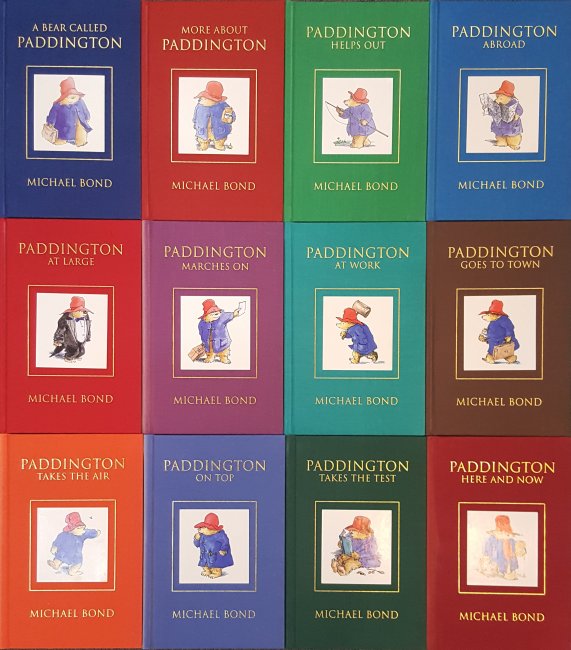
The first Paddington Bear book was published on the 13th October 1958 and Michael Bond went on to write fourteen collections of stories about him along with two specials featuring stories originally published in annuals for the children’s BBC television programme Blue Peter and fourteen other mainly single story picture books aimed at younger readers. The set I have is from The Folio Society and was published as a boxed collection in 2010. Unusually for a Folio edition it wasn’t published by them but rather by Harper Collins, Paddington’s usual publisher and it includes the twelve collections published up until that date in lovely cloth bound volumes. Sadly Michael Bond died in 2017 so there will be no more stories about this lovable bear, but I discovered whilst researching this blog that fittingly Bond is buried in Paddington Old Cemetery in London. The appearance of Paddington Bear in the Blue Peter Annuals came about because Bond was a BBC cameraman, including working on that TV series so he knew the presenters and could incorporate them into stories.

The first book ‘A Bear Called Paddington’ consists of eight connected short stories whilst the remaining thirteen main collections all have just seven each, meaning that there are ninety nine tales in the main block of books, along with those there were a further thirteen stories split across the two ‘Blue Peter’ collections and of course the single story books for small children, so there is a lot to read. The first eleven books were illustrated by Peggy Fortnum and it is her black and white images that came to epitomise the character of the bear as he tries to be helpful but invariably causes more trouble and disasters around him. She however retired from illustrating and the remaining three collections ‘Paddington Here and Now’, ‘Paddington Races Ahead’ and ‘Paddington’s Finest Hour’ were illustrated by R W Alley who clearly based his picture on those done by Peggy Fortnum to maintain consistency.

I’ve loved Paddington since I was a small child, having encountered him first in the Blue Peter annuals and as read out stories on the programme in the late 1960’s. There is just something so beguiling about his well meaning and always polite character and the ways he tries to adapt to his new home in London, which is so different from the Peruvian mountains where he originated from. On arriving at Paddington station having stowed away on a transatlantic ship he is met by the Brown family who take him home and effectively adopt him into their family. Helping him fit in is his great friend Mr Gruber, who owns an antique shop on Portobello Road and escaped from Hungary either to avoid WWII or the suppression of the 1956 Hungarian uprising, it is never made clear which, but this gives him useful insights into the problems of assimilation for Paddington. That makes the books sound heavier in tone than they are, whereas they are delightfully comic and clearly aimed at children, although there is plenty for an adult to enjoy. Rereading a few of the books for this review reminded me just how much I enjoyed the Paddington stories in my preteen-age years. The other major character is the Brown’s next door neighbour Mr Curry who is generally unpleasant to Paddington and always calls him Bear, unlike Mr Gruber who calls him Mr Brown. A lot of the stories have Mr Curry getting his comeuppance in some way or other.

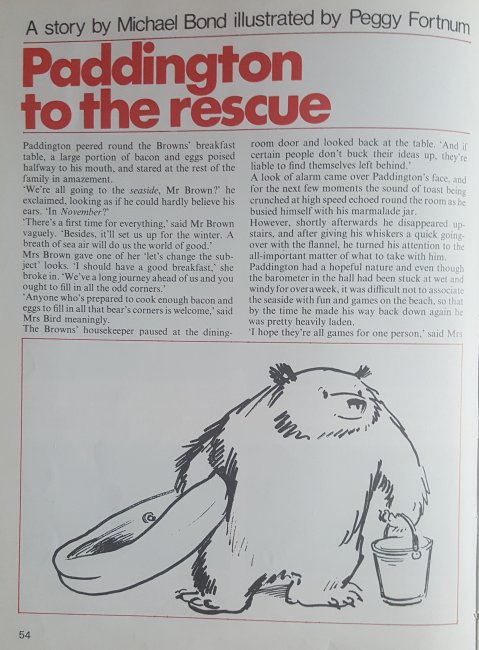
Above is the start of the Paddington story in the Fifth Blue Peter annual published in 1968 and this is how I first read Paddington stories and got to know the character, in this one he goes to the seaside and ends up in the lifeboat bought by the Blue Peter appeal that year. Of course the modern films from StudioCanal have brought a whole new audience to Paddington Bear, many of whom have probably not read the books. These adaptations are not based on specific books or tales but rather on the feel of the entire set of stories and they are a wonderful version with the various characters being very much as I imagined them from reading the books and I hope that they do encourage people to pick the books up and discover the vast range of adventures Paddington gets up to. The third film in the series started production earlier this year and it is due out in time for Christmas 2024, the original cast are back together and I hope that when it eventually gets dubbed into Ukrainian the original voice actor for Paddington in that language is available to repeat his performance from the first two movies, although Volodymyr Zelenskyy is rather busy being President nowadays.

Happy birthday on Friday Paddington.