The Gospel As Recorded by St. Mark

As this blog is being published on Christmas eve, I have taken the opportunity to review another of the privately printed Christmas books given by Alan and Richard Lane as gifts, in this case the book for Christmas 1951. I’m not going to attempt to review the gospel itself, this blog is concerned with the new translation, this edition of the translation and this book in particular. Penguin were to publish a new translation of The Four Gospels by E V Rieu a year later in November 1952 so this was a first view of this very readable new translation. It was a little odd to select the gospel of Mark as a Christmas gift as only Matthew and Luke include the birth of Jesus, which you would have thought would have been a consideration, but as you can see below Mark starts with the adult Christ being baptised by John in the River Jordan.

Mark is one of the three synoptic gospels where the same stories are told in much the same sequence and in similar words, indeed three quarters of Mark’s gospel also appears in those of Matthew and Luke whilst the gospel of St John is quite different both in style and content. As I said earlier the big difference is the lack of a nativity story in Mark but you also don’t get the Sermon on the Mount or several parables amongst other items in Mark which is quite a bit shorter than the other three gospels.

Looking at the first page as translated by Dr. Rieu it is clear that it is written as much more of story than the classic King James translation which I grew up with, which for all its magnificent prose can be a little daunting to approach, particularly for a modern reader. By way of contrast this is the same passage in the King James version.

1:1 The beginning of the gospel of Jesus Christ, the Son of God;

1:2 As it is written in the prophets, Behold, I send my messenger before thy face, which shall prepare thy way before thee.

1:3 The voice of one crying in the wilderness, Prepare ye the way of the Lord, make his paths straight.

1:4 John did baptize in the wilderness, and preach the baptism of repentance for the remission of sins.

1:5 And there went out unto him all the land of Judaea, and they of Jerusalem, and were all baptized of him in the river of Jordan, confessing their sins.

1:6 And John was clothed with camel’s hair, and with a girdle of a skin about his loins; and he did eat locusts and wild honey;

1:7 And preached, saying, There cometh one mightier than I after me, the latchet of whose shoes I am not worthy to stoop down and unloose.

1:8 I indeed have baptised you with water: but he shall baptize you with the Holy Ghost.

1:9 And it came to pass in those days, that Jesus came from Nazareth of Galilee, and was baptized of John in Jordan.

1:10 And straightway coming up out of the water, he saw the heavens opened, and the Spirit like a dove descending upon him:

1:11 And there came a voice from heaven, saying, Thou art my beloved Son, in whom I am well pleased.

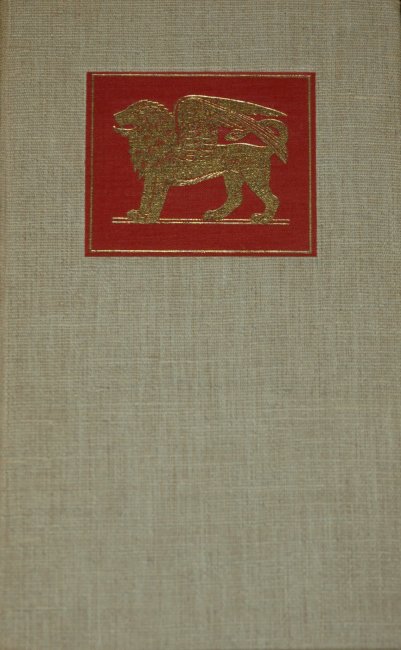
It is almost forty years since I first read E V Rieu’s translation of the four gospels. I took it, along with a couple of others from the Penguin Classics series, as my in flight reading for the first time I crossed the Atlantic in February 1986. I’m not remotely religious although I did go to a Church of England primary school for my education between the ages of four and eleven, but the way the gospels are presented in this translation means you can read them more like a collection of four novellas and enjoy the stories as they are told. This edition is really beautifully produced with canvas covered boards and terracotta cloth labels blocked in gold. The pages are a lovely grey and compliment the overall design by Hans Schmoller well. The lion design by Reynolds Stone is different to the one, also engraved by him, used for the Penguin Classic when it was finally published.

My copy was given to typographer Ruari McLean (it has his bookplate inside) who had joined Penguin Books in 1946 with specific responsibility for Puffin books and was instrumental in introducing Jan Tschichold to Penguin. By 1949 he had moved on and was working with Rev. Marcus Morris on the design of a new comic for boys he had devised called Eagle, which would go on to massive success in the 1950’s and 60’s. Tschichold would radically redesign Penguin books in the late 1940’s and came up with The Penguin Composition Rules.

Poems – St John of the Cross

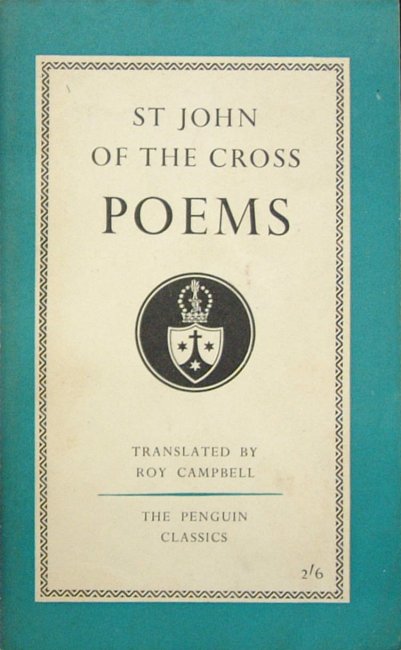
For this, the 200th post in this blog, I have chosen a Penguin Classic translation of the poetry of St. John of the Cross, the 16th century Spanish mystic christian and follower of Teresa of Ávila whose writings have also appeared in the Penguin Classics catalogue. The book is actually rather more than a translation as it is a parallel text edition with the original Spanish text on the left hand pages and the English on the right. Saint John (Juan de la Cruz in Spanish) was a Catholic priest and Carmelite friar involved in setting up religious houses in northern Spain but was also the greatest of the mystic poets in Spanish literature and indeed one of the giants of Spanish literature regardless of style or theme.

However, before discussing the poems, I would like to take a little time over the translator, much as the book does with a preface by his widow Mary Campbell. Roy Campbell was born in South Africa in 1901 and first came to England in 1919 where he met and married Mary in 1922 and they moved back to South Africa in 1925. He worked as an editor on a literary magazine whilst writing poetry but disagreed with the apartheid regime so moved back to London in 1927. On their return to England they fell in with the Bloomsbury Group and Mary started a lesbian affair with Vita Sackville-West at the same time as Virginia Woolf was also having an affair with Vita. Roy strongly, and reasonably, disapproved of his wife’s affair and to separate Mary and Vita the Campbell’s moved first to Provence and then to Toledo in Spain where Roy Campbell discovered the works of St John of the Cross and the couple converted to Roman Catholicism. It was in Toledo that St John had been imprisoned by rival Carmelite monks opposed to the very strict variant of the calling espoused by Teresa and John, he wrote most of his poems during his confinement. Roy Campbell, by the 1930’s, was becoming a well known poet in his own right and was fascinated by the poems of St John and whats more his heroic poetic style seemed ideally suited to the extant works of St John so he began work on a translation that was finally published by Harvill in 1951 and won the 1952 Foyle Prize. It is this verse translation that is reprinted in the 1960 Penguin first edition that I have, Roy Campbell having died in 1957 hence his widow penning the preface where she completely fails to mention the lesbian affair that took them to Spain in the first place.

The Spanish text is by Padre Silverio de Santa Teresa CD, and first appeared in an UK book in 1933 published by the Liverpool Institute of Hispanic Studies.Roy Campbell has done an excellent job of translating the poems as not only has he translated the text but found English words which allow the lines to largely scan and always rhyme as the originals do. A moments thought would tell you how difficult this is and why many poetry translations don’t attempt this.The longest work is ‘Songs between the soul and the bridegroom’ where the poem is in the form of a conversation between the two parts where God is gradually revealed to be the bridegroom that the soul or bride is conversing with. I really enjoyed this one as there is more time for development of the story within the poem as it goes on for seven pages, most are less than a page and a half and some are simply one verse.

Several of the poems use repetition of the last line of each verse such as ‘Song of the Soul that is Glad to Know God by Faith’ where each verse, apart from the eleventh, ends “Aunque es de noche” (Although it is night) although with this particular poem Campbell varies the last line between “Although by night” and “Though it be night” and I’m not sure why he made the change as reading it with “Although by night” seems to scan perfectly well with each verse. My favourite poem of the collection though is ‘Verses about the soul that suffers with impatience to see God’ and this is another where repetition of the last line of each verse is utilised although this time it is the sense of the last line that is repeated as the words vary between “Am dying that I do not die”, “And die because I do not die”, “The more I live the more must die” etc. culminating in the more hopeful “I live because I’ve ceased to die”.

I was surprised by how much I enjoyed this volume of poetry as I’m not remotely religious, let alone Catholic, so am clearly not the target audience. I suspect this is partly down to the way religion is handled in English schools where is is taught as a ‘normal’ subject and after all nobody asks you to believe in geography.

The Book of Margery Kempe

The earliest autobiography in English and by that most marginalised section of the population in historical texts (especially medieval history) a woman.  The book is a remarkable document all the more so from the fact that it was ‘lost’ for many centuries. It was known to have existed because of a seven page extract published by Wynkyn de Worde circa 1501 but the original manuscript which dates back to the 1430’s was believed to no longer exist. However in 1934 a copy was found in the collection of an old Catholic family the Butler-Bowdens, it is not the original dictated by Margery (as she could neither read nor write) but certainly a very early copy and a remarkable survivor. The book was first published in 1936 and the manuscript was acquired by the British Library in 1980. It is split into two books, the first has eighty nine chapters but it turns out that the person she dictated that to had such terrible handwriting that nobody could read it. In the four years it took to find somebody to rewrite this main section she dictated another ten chapters that were added as book two.

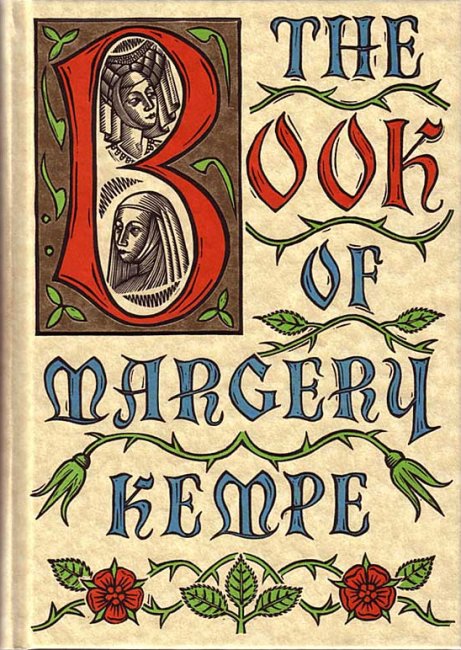
My copy is the first Folio Society edition of 2004 and uses the edited, and updated from medieval English, version by professor Windeatt, which was first published by Penguin Books in 1980, it has a lovely cover by Chris Daunt who also provided a dozen engravings included within the text.

20190430 Margery Kempe 1

In the medieval period a woman was effectively the property of her husband and this is illustrated many times in the book such as within chapter 51 when Margery is in York

Then the worthy doctor said to her “Woman, what are you doing here in this part of the country?”
“Sir, I come on pilgrimage to offer here at St William’s shrine”
Then he went on “Do you have a husband?”
She said “Yes”
“Do you have a letter recording his permission?”
“Sir” she said “my husband gave me permission with his own mouth”

As well as the need to have permission we see here Margery’s habit of referring to herself in the third person, when she is not doing so then she uses ‘this creature’ as the usual term regarding herself. Margery had by this time travelled to Rome, Jerusalem and Santiago (Spain) on a couple of trips all without her husband. In fact he was probably enjoying the breaks from her presence as she has to be the most annoying person I have ever read about and frankly like a lot of her travelling companions I would also have spent a lot of time trying to get away from her.  On her way to Jerusalem from England her companions had abandoned her several times or insisted that she ate separately from them when she was present and in Italy they went so far as to book a ship across the Mediterranean and leave their lodgings without telling her in a desperate attempt to get away.

So why was she so irritating? Well Margery started having visions after her first child was born and would very loudly express them, calling out to all the members of the Holy Trinity and speaking to them as well as quite a few saints in churches dedicated to them. That she clearly believed that she was having these conversations is beyond doubt and she was no longer interested in anything else but aspects of her faith.

And those who knew of her behaviour previously and now heard her talk so much of the bliss of heaven said to her. “Why do you talk so of the joy that is in heaven? You don’t know it, and you haven’t been there any more than we have.” And they were angry with her because she would not hear or talk of worldly things as they did, and as she did previously.
And after this time she never had any desire to have sexual intercourse with her husband, for paying the debt of matrimony was so abominable to her that she would rather, she thought, have eaten and drunk the ooze and muck in the gutter than consent to intercourse, except out of obedience.
And so she said to her husband; “I may not deny you my body, but all the love and affection of my heart is withdrawn from all earthly creatures and set on God alone.

Alongside the visions she also took to weeping and crying whenever she was in a holy place or with a religious person regardless of rank and this would also be loud often involving throwing herself to the ground to bawl like a toddler. This naturally made her a difficult person to be around especially if you are trying to observe the peace of a holy site. When she got back from her pilgrimage to Jerusalem and Rome she would cry around fourteen times a day as she ‘remembered the passion’ as during a vision there she had seen herself with the body of Christ on the cross as though she had actually been present at the crucifixion.

For me, one of her most irritating features though is the total fixation on herself during the book. She travelled across Europe to Rome and onto Jerusalem taking well over eighteen months from late 1413 to Easter 1415 yet she records nothing of the places she went to or the trip itself. This journey alone would have made a fascinating book, she would certainly had a vast number of interesting experiences and a first hand record of Europe and the Holy Land from six centuries ago by an ‘ordinary’ woman as opposed to nobles and royalty would be invaluable to historians. She mentions that she spent twelve weeks in Venice before taking the boat to Jerusalem but that is it, who she met, where she went and what she saw during that time we learn nothing.

But that is not to say that book does not have a lot to recommend it, Margery’s responses to being challenged, even by the highest authority show a quick wit and can be quite funny and despite being frustrating at times to a modern reader, especially the passages where she is conversing with God I’m glad I read it. I’ll finish with a passage from chapter sixty which shows her at her feisty best…

There was a lady who wanted to have the said creature to a meal. And therefore, as decency required, she went to the church where this lady heard her service and where this creature saw a beautiful image of our lady called a pieta. And through looking at that pieta her mind was wholly occupied with the Passion of our Lord Jesus Christ and with the compassion of our Lady, St. Mary, by which she was compelled to cry out very loudly and weep very bitterly, as though she would have died.
Then the lady’s priest came to her, saying “Woman, Jesus is long since dead.”
When her crying had ceased, she said to the priest, “Sir, his death is as fresh to me as if he had died this same day, and so, I think, it ought to be to you and all Christian people, We ought always to remember his kindness, and always to think of the doleful death that he died for us.”

and that told him.