The Gospel As Recorded by St. Mark

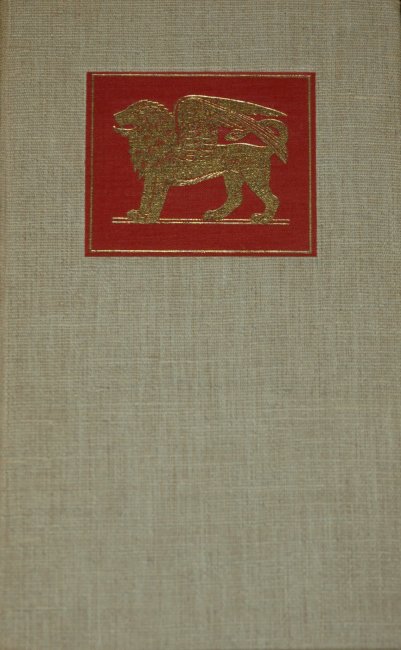
As this blog is being published on Christmas eve, I have taken the opportunity to review another of the privately printed Christmas books given by Alan and Richard Lane as gifts, in this case the book for Christmas 1951. I’m not going to attempt to review the gospel itself, this blog is concerned with the new translation, this edition of the translation and this book in particular. Penguin were to publish a new translation of The Four Gospels by E V Rieu a year later in November 1952 so this was a first view of this very readable new translation. It was a little odd to select the gospel of Mark as a Christmas gift as only Matthew and Luke include the birth of Jesus, which you would have thought would have been a consideration, but as you can see below Mark starts with the adult Christ being baptised by John in the River Jordan.

Mark is one of the three synoptic gospels where the same stories are told in much the same sequence and in similar words, indeed three quarters of Mark’s gospel also appears in those of Matthew and Luke whilst the gospel of St John is quite different both in style and content. As I said earlier the big difference is the lack of a nativity story in Mark but you also don’t get the Sermon on the Mount or several parables amongst other items in Mark which is quite a bit shorter than the other three gospels.

Looking at the first page as translated by Dr. Rieu it is clear that it is written as much more of story than the classic King James translation which I grew up with, which for all its magnificent prose can be a little daunting to approach, particularly for a modern reader. By way of contrast this is the same passage in the King James version.

1:1 The beginning of the gospel of Jesus Christ, the Son of God;

1:2 As it is written in the prophets, Behold, I send my messenger before thy face, which shall prepare thy way before thee.

1:3 The voice of one crying in the wilderness, Prepare ye the way of the Lord, make his paths straight.

1:4 John did baptize in the wilderness, and preach the baptism of repentance for the remission of sins.

1:5 And there went out unto him all the land of Judaea, and they of Jerusalem, and were all baptized of him in the river of Jordan, confessing their sins.

1:6 And John was clothed with camel’s hair, and with a girdle of a skin about his loins; and he did eat locusts and wild honey;

1:7 And preached, saying, There cometh one mightier than I after me, the latchet of whose shoes I am not worthy to stoop down and unloose.

1:8 I indeed have baptised you with water: but he shall baptize you with the Holy Ghost.

1:9 And it came to pass in those days, that Jesus came from Nazareth of Galilee, and was baptized of John in Jordan.

1:10 And straightway coming up out of the water, he saw the heavens opened, and the Spirit like a dove descending upon him:

1:11 And there came a voice from heaven, saying, Thou art my beloved Son, in whom I am well pleased.

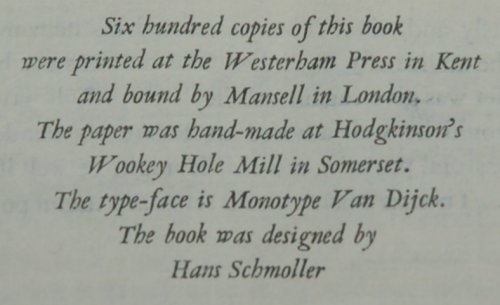
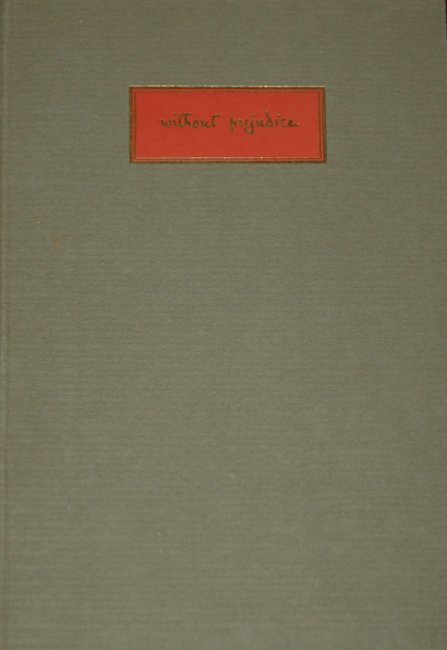
It is almost forty years since I first read E V Rieu’s translation of the four gospels. I took it, along with a couple of others from the Penguin Classics series, as my in flight reading for the first time I crossed the Atlantic in February 1986. I’m not remotely religious although I did go to a Church of England primary school for my education between the ages of four and eleven, but the way the gospels are presented in this translation means you can read them more like a collection of four novellas and enjoy the stories as they are told. This edition is really beautifully produced with canvas covered boards and terracotta cloth labels blocked in gold. The pages are a lovely grey and compliment the overall design by Hans Schmoller well. The lion design by Reynolds Stone is different to the one, also engraved by him, used for the Penguin Classic when it was finally published.

My copy was given to typographer Ruari McLean (it has his bookplate inside) who had joined Penguin Books in 1946 with specific responsibility for Puffin books and was instrumental in introducing Jan Tschichold to Penguin. By 1949 he had moved on and was working with Rev. Marcus Morris on the design of a new comic for boys he had devised called Eagle, which would go on to massive success in the 1950’s and 60’s. Tschichold would radically redesign Penguin books in the late 1940’s and came up with The Penguin Composition Rules.

The Haunted Man – Charles Dickens

The Haunted Man and The Ghost’s Bargain to give the book its full title is the fifth and final Christmas book by Charles Dickens. I have a copy as part of my collected volume of Christmas Books published by Gerald Duckworth Ltd in 2005 as part of their failed series of facsimile reproductions of the famed 1937 Nonesuch Press collected Dickens. I say failed as there was originally supposed to be twenty four volumes published at a rate of six a year from 2005 but six years later only twelve books had appeared (six in 2005, three more in 2008, and a final three in 2011) before the project was abandoned. The private Nonesuch Press Dickens was one of the finest editions of his collected works ever produced and was limited to just 877 sets, the odd number being due to the inclusion with each set of an original engraved steel plate from the first edition printed by Chapman and Hall Ltd. They had 877 plates in storage, all of which were purchased by Nonesuch and included in a box made to look like one of the books. As I don’t have the several thousand pounds needed to buy one of these sets nowadays, the Duckworth reprint looked like a good option until they stopped printing them. Happily they did include all five of the Christmas stories, combined in one large book as one of the first six volumes printed.

I must admit that apart from ‘A Christmas Carol’, which I read regularly and reviewed on Christmas Day five years ago, the other four Christmas tales by Dickens are ones I have rarely, if ever, dipped into. I’m pretty sure that I have never read ‘The Haunted Man’ before but I really enjoyed it now that I have finally done so. The story concerns a chemist, and lecturer in the subject, Mr Redlaw whose home and teaching establishment occupies part of an old educational building in a somewhat poor and rundown, but otherwise unidentified, part of London.

His dwelling was so solitary and vault-like,—an old, retired part of an ancient endowment for students, once a brave edifice, planted in an open place, but now the obsolete whim of forgotten architects; smoke-age-and-weather-darkened, squeezed on every side by the overgrowing of the great city, and choked, like an old well, with stones and bricks; its small quadrangles, lying down in very pits formed by the streets and buildings, which, in course of time, had been constructed above its heavy chimney stacks; its old trees, insulted by the neighbouring smoke, which deigned to droop so low when it was very feeble and the weather very moody;

From Chapter one: The Gift Bestowed

One of the joys of reading Dickens is his power of description, in a few words he has created a vision of the building occupied by Redlaw and his servants and I can see it clearly in my minds eye. The servants consist of a man and wife along with the mans aged father who continually, and comically, keeps repeating that he is eighty-seven whilst hanging the holly for Christmas Eve. But what of Redlaw, why are we concerned with him? Well he is the haunted man of the title and unusually, in an interesting twist of the traditional ghost story, he is haunted not by the dead but by himself, or at least a simulacrum of himself. Mr Redlaw is a troubled man, deeply wounded by the death of his sister and apparently unable to recover from that loss and it is to apparently offer succour that the phantom has appeared. It suggests that forgetfulness would be the best solution but it is not simple forgetfulness of his sister that is part of the gift it is so much more and the power to continually pass on this ‘gift’ even unwillingly. After great indecision Redlaw consents.

The second chapter appears at first to have abandoned Mr Redlaw as we move to the nearby Jerusalem Buildings, an even more rundown part of the neighbourhood, and the home of the Tetterby’s, A small man running a decrepit shop that has tried, and failed, to make money with all sorts of endeavours. Indeed the only thing that the Tetterby’s have succeeded in is the production of children, of which there are a great many and very little money to go round to support them leading to possibly my favourite and most typically Dickensian passage in the book, the description of their meal for Christmas Eve.

There might have been more pork on the knucklebone,—which knucklebone the carver at the cook’s shop had assuredly not forgotten in carving for previous customers—but there was no stint of seasoning, and that is an accessory dreamily suggesting pork, and pleasantly cheating the sense of taste. The pease pudding, too, the gravy and mustard, like the Eastern rose in respect of the nightingale, if they were not absolutely pork, had lived near it; so, upon the whole, there was the flavour of a middle-sized pig.

From Chapter two: The Gift Diffused

Into this poor but happy home comes Mr Redlaw in search of a student of his whom he has been told is unwell and lodging with the Tetterby’s but brought with him is his curse of forgetfulness of familial ties which leads to fractiousness of the children and more concerning wonders between themselves as to why Mr and Mrs Tetterby ever married each other. He spreads his contamination of discontent between the student and his carer before fleeing into the night so as not to cause more disagreements amongst those whom until his arrival were not just content but happy with their lot.

I’m going to say no more regarding the story except to recommend that you read it as it is wonderfully written, as I would expect from Dickens, and the denouement in chapter three is as unexpected as it is heart warming. If you can’t find a physical copy of the book it is available here on Project Gutenberg.

Merry Christmas

A Very Early Victorian Christmas – Hector Bolitho

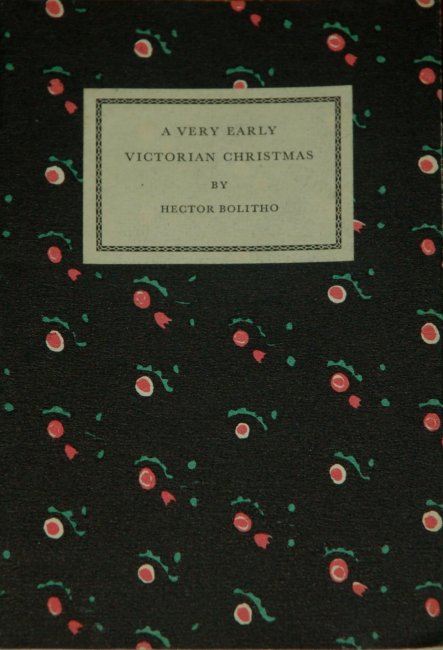
Not so much a book as a pamphlet, this sewn spine publication was privately printed in an edition of just three hundred copies in 1929 as a Christmas gift from Alan, Dick and John Lane. It is the second such Christmas book from the brothers after the previous years Elegy Written in a Country Churchyard by Thomas Gray which I wrote about in a blog two years ago. The story appears to have been specially written by Bolitho for this edition and I cannot find any other time that it has been published, indeed it is so obscure that it wasn’t included in the Hector Bolitho bibliography on Wikipedia until I added it this morning.The book is attractively bound with quite large french flaps and a paper label stuck onto the cover giving the title and author. The first thing you see on opening the book is the gift dedication from the Lane brothers.

Surprisingly what you don’t see is any indication as to who printed the book and for hints as to which company it is I have turned to the Autumn 1984 edition of ‘The Private Library’, which is the quarterly journal of The Private Libraries Association. In this edition Jonathan Gili wrote an excellent article dealing with all the Lane Christmas books and in it he suggests that The Curwen Press, which had suddenly closed down in January of 1984, printed it as the paper cover was definitely from one of their patterns and the Koch Kursive typeface used for the above dedication panel was introduced by them in 1926. The sudden collapse of the business and the subsequent rapid sale and dispersal by auction of their effects would however preclude a more detailed examination.

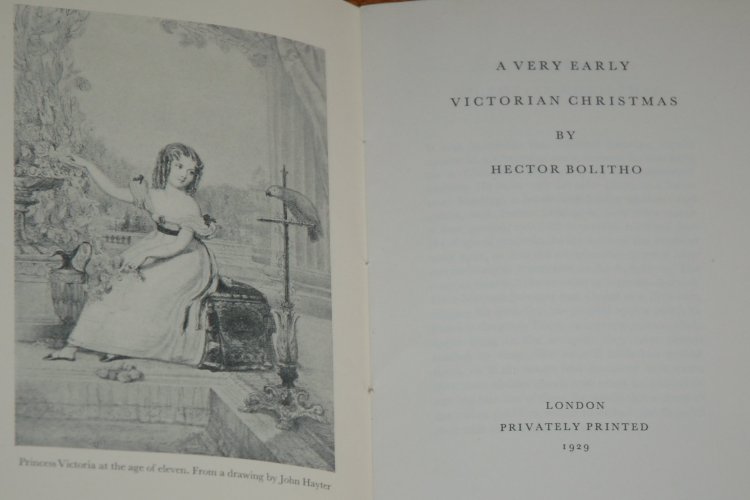
Born in New Zealand in 1897 Bolitho came to England in the mid 1920’s and settled there, initially working as a freelance journalist. He went on to write over fifty books, a large number of which are biographies and a significant number of those are of British monarchs but is now largely unknown and this is the only book by him that I possess. Indeed as I said at the beginning this is barely a book, finishing as it does on page fifteen. The frontispiece shown above features a portrait of Princess Victoria at the age of eleven which would mean it is from 1830 which is roughly when the book is set and is seven years before she would become queen so the title is not really accurate as her father King William IV was monarch at the time and the Victorian era was still a few years away. However the little princess features in this short tale if only in allusion.

The stories lead character is Michael Stranger, born on Christmas Day early in the nineteenth century, and at the start he is living with his older sister near Reading, Berkshire and she is wonderfully described by Bolitho as

a gaunt, hard woman, with a face like a horse. She moved within her clothes as if she were made of laths of wood

Michael is to go to stay with his uncle, Abraham Trotter, from Christmas Day and he had a fine house in the Edgware Road, London, he was apparently

a dealer in tea and spices and cloves and ginger. His wife had died of pneumonia and the spittings and he lived alone

However we never meet him as Michael is to stay overnight on Christmas Eve at an inn in Kensington and on the coach to there he chats with a fellow passenger who tells him of Princess Victoria and that night after his meal, where there is more discussion regarding Victoria, he wanders down the road until he comes to Kensington Palace where a watchman tells him that the lights he can see on are from the windows of the young princess’s rooms. Amazingly that is the end of the book, it has barely got going when it stops.

Village Christmas – Miss Read

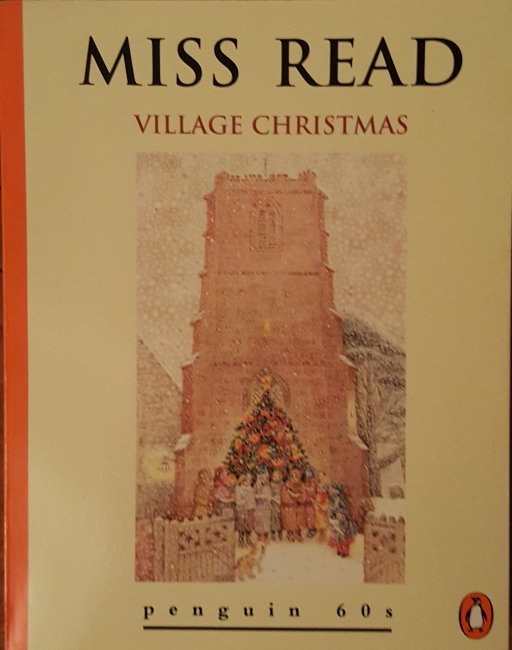
By profession Dora Saint was a school teacher but is best known for her portrayals of English village life under the pen name of Miss Read and the work on her numerous novels and short stories largely took over her working life after WWII. Miss Read is not only the author of the books but in a lot of them she is also a character as a schoolmistress in the fictional village of Fairacre. Although this story is set in Fairacre Miss Read herself does not actually appear instead we are concerned with the ageing spinster sisters Margaret and Mary Waters and the family that had moved in over the road a few months earlier in September.

Initially the Waters sisters were somewhat wary of the new family as they lived a very quiet life and suddenly having three small children and a mother clearly pregnant with a fourth moving in so close was disconcerting. Mrs Emery’s personality was a bit too outgoing for their taste but also to the sisters eyes she was also rather badly dressed so they were unsure what to make of her, the children however were unfailingly polite so there was clearly something being done right in the new household. The story leaps on over the three months to Christmas morning when the sisters are interrupted at breakfast by one of the Emery girls coming for help as their mother is having the baby early and their father had been called away as a relative had had a stroke. Now two spinsters are not ideal midwives and the nurse or doctor couldn’t be contacted so we are taken through their rising panic as they realise that very little preparation had been done as Mrs Emery had clearly not expected to give birth on Christmas day.

One goes over to help Mrs Emery, who is easily the least concerned of everyone, whilst the other sister takes the children back over to her house to keep them entertained and fed and most importantly out of the way whilst trying to contact the nurse and also Mr Emery to let him know what is happening and get him back to Fairacre. It’s a delightful story of how the Waters sisters had a very different Christmas to the one they expected and this was the first time I had read any of Miss Read’s works. I think I’ll definitely tackle another somewhat longer book for my next go at her books, after all there are a lot to have a go at with twenty books set in Fairacre, thirteen novels set in the nearby village of Thrush Green, ten children’s books and a few other titles not set in the two main villages or of a factual nature rather than fiction.

Village Christmas was first published in 1966 although my copy of the book was published in 1995 as part of the Penguin Books 60th anniversary celebrations and it is also available with the two other Christmas tales Miss Read wrote as a single volume, these being Christmas Mouse (1973) and No Holly for Miss Quinn (1976). Confusingly this combination book appears to also be called Village Christmas.

Elegy Written in a Country Churchyard and other poems – Thomas Gray

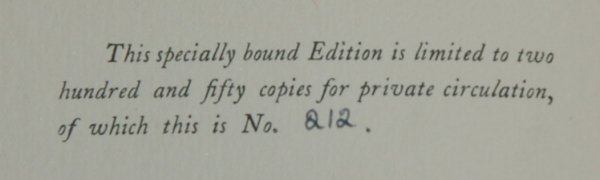
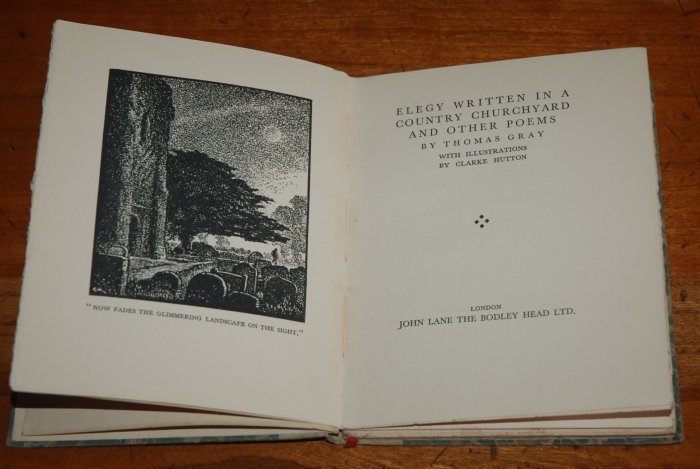
This Christmas I have chosen another of the Allen Lane Christmas books, in this case the first of them which was printed in a limited edition run of just 250 copies in 1928 with wood engravings by Clarke Hutton for Allen and Dick Lane to distribute as Christmas gifts. At the time the brothers were working at what was their uncle John Lane’s publishing house The Bodley Head in London and this book, unlike most of the others is published by The Bodley Head. John Lane had died in 1925 and Allen and Dick were now running the business when they revived his idea of a Christmas gift book which he had first done when he set up the company in 1887. My copy is slightly damp stained on the spine and foxed on the dedication page, but it is such a rare book that I was happy to be able to get this copy for my collection.

This collection is a slightly odd one for a Christmas gift as the three poems are certainly not full of the Christmas cheer. The Elegy is, by its nature, quite sombre as the poet reflects on the past lives of those in the graves around him. ‘Ode on a Distant Prospect of Eton College’ is also looking back to Gray’s own childhood there but also to the difficulties that will be faced by the current pupils as they grow up and enter the adult world. The final poem gives away its downbeat theme from its title ‘On a Favourite Cat, Drowned in a Tub of Gold Fishes’.

The only Christmas link to these works is that Gray was born on Boxing Day (26th December) 1716. Whilst he lived to be 54, he only published thirteen poems during his lifetime; his best known work is undoubtedly ‘Elegy Written in a Country Churchyard’ and this would go on to influence poets and other writers over the following centuries, not least Thomas Hardy who got his title of ‘Far From the Madding Crowd’ from the nineteenth stanza.

Far from the madding crowd’s ignoble strife,
Their sober wishes never learn’d to stray;
Along the cool sequester’d vale of life
They kept the noiseless tenor of their way.

Stanley Kubrick’s great anti war movie ‘Paths of Glory‘ also gets its title from this poem where the full line is ‘The paths of glory lead but to the grave’.

‘Ode on a Distant Prospect of Eton College’ consists of ten stanzas each of ten lines and is probably best known for its penultimate line which is the first use of the phrase ‘ignorance is bliss’ which sums up the happiness of the boys whilst they are at school as they are ignorant of the problems they will face as they grow up.

To each his suff’rings: all are men,
Condemn’d alike to groan,
The tender for another’s pain;
Th’ unfeeling for his own.
Yet ah! why should they know their fate?
Since sorrow never comes too late,
And happiness too swiftly flies.
Thought would destroy their paradise.
No more; where ignorance is bliss,
‘Tis folly to be wise

‘On a Favourite Cat, Drowned in a Tub of Gold Fishes’ is based on a true story and the cat apparently belonged to Horace Walpole who featured in a blog of mine from May this year about The Age of Scandal by TH White. It is basically a morality tale where the cat dies through its own greed and again has a famous line, although this time Gray is not the originator but has adapted a phrase created by William Shakespeare in The Merchant of Venice, ‘All that glisters is not gold‘. Thomas Gray’s version is the last line of this poem and sums up the cautionary tale extremely well.

From hence, ye beauties, undeceived,
Know, one false step is ne’er retrieved,
And be with caution bold.
Not all that tempts your wandering eyes
And heedless hearts, is lawful prize;
Nor all that glisters gold.

To repeat Allen and Dick, With Greetings and Best Wishes for the Coming Year. Merry Christmas.

Puffin Annuals

At the beginning of 1967 Kaye Webb had launched the Puffin Club to great success, in fact more success than anticipated as demand for membership soared, which for a club dedicated to the children’s output of a publisher was unheard of. The quarterly magazine that members received was full of stories, reviews, puzzles and things to make and in 1974 it was decided to produce a larger version, for sale not just to club members, and make it an annual. This post is going up on the 1st December so just about when the annuals were hitting the shops when I was a child. I grew up in the 1960’s and 70’s, probably the heyday of the annual in the UK. What had started as simply a reprint of the weekly child’s magazine with The Boy’s Own and The Girl’s Own papers had expanded via The Rupert Annual (started in 1936 and still going strong) along with The Beano and Dandy comics and of course the much admired The Eagle annuals from 1950 to the late 1960’s all of which featured new material especially for the annual. TV shows got in on the act, Blue Peter has had an annual every year since 1964 and most other children’s shows followed suit especially Doctor Who. Even films spawned annuals, I have The Star Wars annual from 1977, the year of the first film. The Puffin Club had to have an annual, the problem was Penguin Books had never done anything like this before.

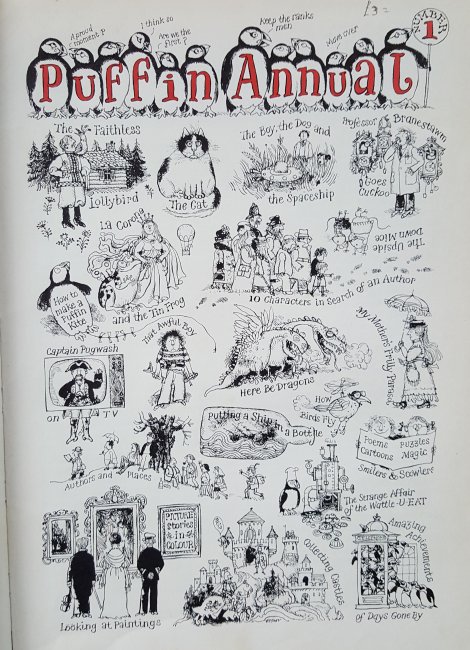
The title page of Puffin Annual number 1 gives a feel for the contents but also the style of the book, this was going to be fun and it really was going to have the look and feel of Puffin Post, the quarterly club magazine only in a much more durable hardback and the same size as all the other annuals out there competing for the eyes of children and the purses of their parents and grandparents, you could rarely go wrong with a Christmas gift of the annual relating to a favourite comic or TV show. This blog is going to be rather image heavy I want to give an impression of just what sort of publication these were.

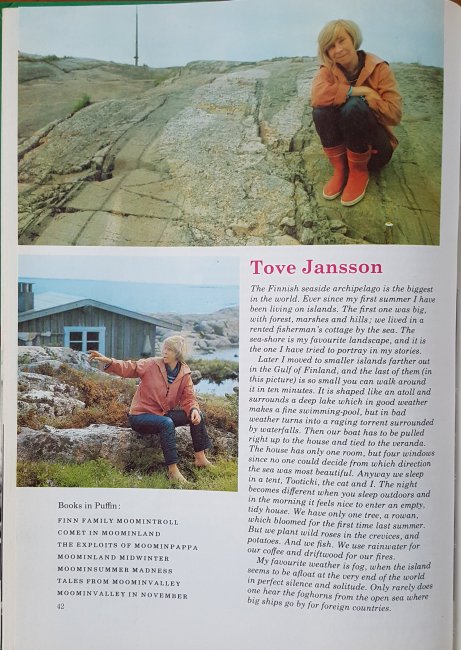
The contributors page of number one is a very impressive name check, including stories by Roald Dahl, Norman Hunter (Professor Branestawm), Tove Jansson (Moomins) and Michael Bond (Paddington Bear) but also artists and illustrators of numerous children’s books, and oddly the violinist Yehudi Menuhin and HRH The Prince of Wales both describe their favourite paintings. Puffin was definitely in the high brow end of the market and that was where it liked to be.

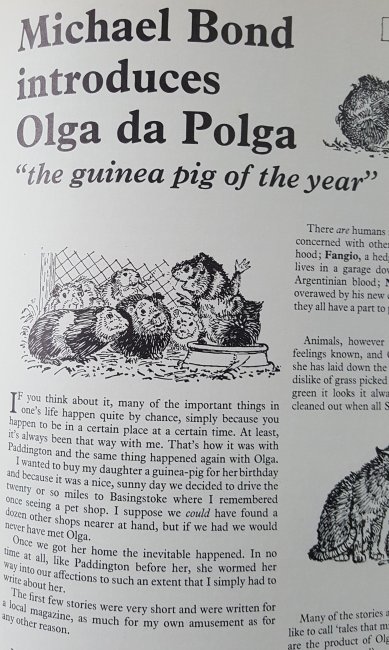
Michael Bond’s contribution was an introduction to his other, now largely neglected, character Olga da Polga who did get a series of books but never really caught on in the way Paddington Bear did. The thinking was sound, children can’t have a bear but they could, and did, have guinea pigs so maybe stories about their adventures would sell, well they sort of did but at a fraction of the sales of Paddington. Whilst Tove Jansson had a short story called The Cat, which she also illustrated.

Roald Dahl however could write about anything and children lapped it up. What you have probably noticed is the major failing of this first annual, there is very little colour. Despite the bright and enticing cover the contents are almost entirely black and white, but that was to change for the next year.

1975’s Puffin Annual was a very different beast to that of 1974. Still the same sort of mix in the contents (see below) but not just the cover had colours, this was much more in keeping with the competition and should have given the Puffin Annual every chance in the marketplace and it had to. This was Penguin’s first attempt at this section of the book business and it had to live or die on it’s performance, Penguin has a history of killing off series if they don’t perform and this was a much more expensive undertaking than the previous years effort. But again the list of people contributing and the variety of material was impressive.

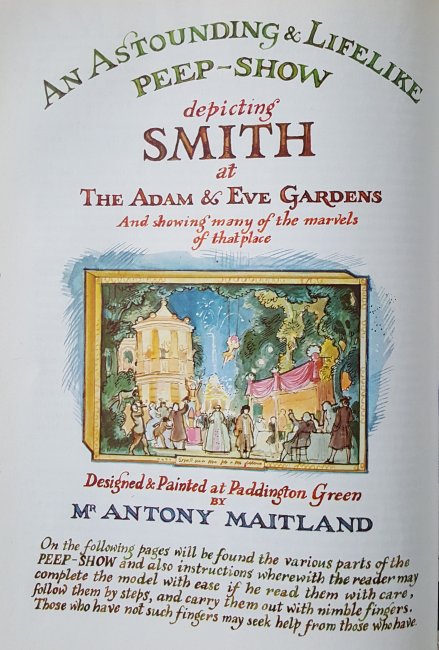
Again though this is aimed squarely at children of better off families, no knockabout comic strips so loved by fans of The Beano or The Dandy, this is much more like a book than a comic but there are more things to do in this edition, not just games and instruction as to how to do simple magic tricks but also a model to cut out and make that takes up eight pages and illustrates one of the stories especially written for the annual.

This is quite an elaborate model and includes basic instructions for fitting small bulbs so that it can be lit up at night. A peep show of the Adam and Eve Gardens in reality would have probably been far too much for a book aimed at children as by the time this park in London was closed down in the 18th century it was a haven for theft and prostitution. There is also a section on paintings although not as formal as the example in the first annual. This book has a lighter touch more in keeping with Puffin Post, I really need to do a blog about that magazine sometime next year.

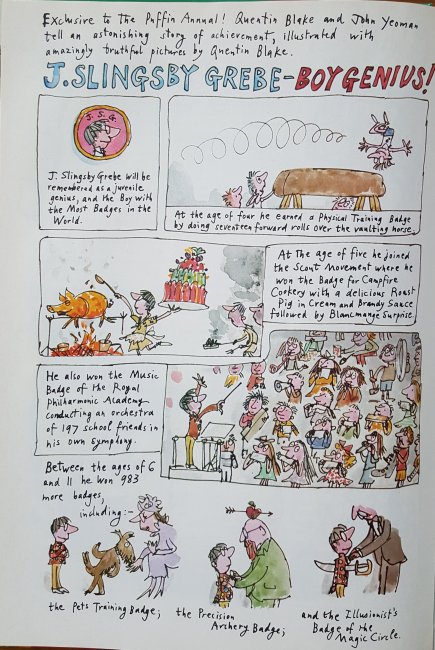
There are a couple of single page ‘introduce the author’ articles and of course lots of artwork by that stalwart of the original magazines, and favourite children’s illustrator, Quentin Blake, who drew the fun end papers which are also the index and also provided pictures for the story of J. Slingsby Grebe – Boy Genius.

This was such a dramatic improvement on the first annual, lightening up the tone and bringing in so much colour but had they done enough to save the Puffin Annual? 1976 would indicate that they hadn’t, when instead of the expected annual number 3 the rather oddly named Puffin’s Pleasure appeared in time for Christmas and styled itself as number one.

Now even a brief glance through this book shows that it was clearly intended to be the third annual, it was even assigned the catalogue reference number that such a book would have had. Annual number one was Puffin Story Book number 700, annual 2 was number 800 and this is number 900. So what happened? Well it appears that although the annuals were assigned to the Penguin scrapheap of failed series so much work had already gone into annual number three with writers and artists commissioned that it may as well be printed. Kaye Webb was apparently unhappy with the name Puffin’s Pleasure but calling this The First of its kind was wishful thinking as this was to be the only edition published.

The contents list is definitely varied and getting an author of the standing of Ursula Le Guin to supply a short story means that Webb and Bicknell certainly had ambition for their publication but it was not to be. There simply wasn’t a big enough market for such a book and Penguin’s lack of experience in such titles led to nervousness and not enough time would be allowed for an annual series to properly establish itself.

Ironically there is a four page article by Nicholas Fisk about the history of comics, the very things that were massively outselling this book and would therefore contribute to its demise. The popular astronomer Patrick Moore provided a single page on space oddities and there was a six page article about the history of the British Canal network.

All very worthy stuff but just who was this aimed at, it feels more like the target audience was the parents who were paying for it rather than the children who would hopefully enjoy it. I must admit reading these three books as an adult has been great fun, but would I have thought so when they came out and I was just leaving ‘young childhood’ and becoming a teenager? Possibly as I was a very bookish child, more often to be found curled up reading than playing outside, I know I didn’t have them as a child even though I was presumably exactly who they wanted as a reader.

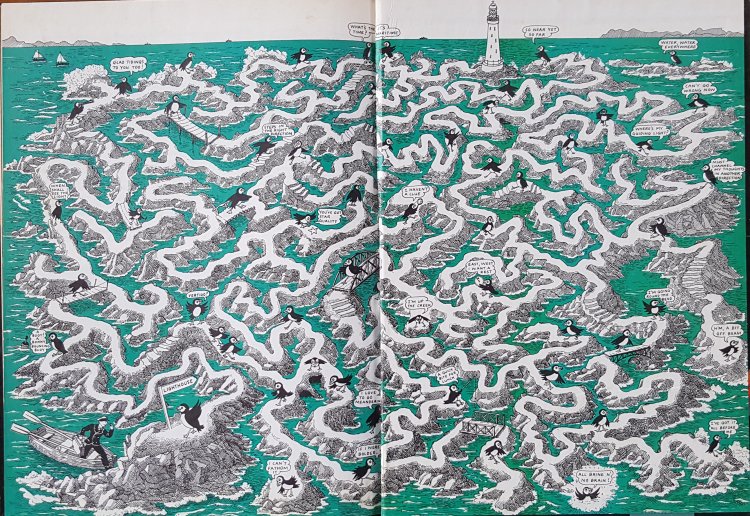
I’ll leave you with the very last item in Puffin’s Pleasure, a maze printed on the endpapers, see if you can get the lighthouse keeper from his rowing boat to the lighthouse, have fun.

The Rime of the Ancient Mariner – Samuel Taylor Coleridge

2019120324 The Ancient Mariner 1

This post is going up on Christmas Eve so I thought it would be good to look at one of the Christmas books sent as occasional gifts by Allen Lane (the founder of Penguin Books) and his family. This isn’t a review of one of the greatest works in English literature, rather I want to look at the book itself and how it came into existence.

The Ancient Mariner was the gift in 1945 from Allen and his brother Richard, sadly the third brother John had died during the war, and this was the first one published since 1930. The tradition of an occasional privately printed limited edition book was started by Allen’s uncle, John Lane, who founded his company The Bodley Head in 1887 initially to sell antiquarian books. In 1894 he started publishing in his own right and that year sent a small volume of the autobiography of Sir Thomas Bodley as a Christmas present to family and friends. It is not known how many copies were printed but it is rarely seen so presumably the print run was quite small. I featured this book in my first ever post on this blog.  There were three books printed as gifts from 1928 to 1930, the first was from Allen and Dick Lane, the other two were from Allen, Dick and John Lane and then whilst there was a gap in the production of books, there were some interesting Christmas cards printed instead in some of those years.

As mentioned above John Lane (Allen’s brother as opposed to his uncle of the same name) died during the war so this restart of a tradition came from Allen and Richard (no longer calling himself Dick). The resultant volume bears the mark of being a little hurried, after all it was only a few months after the end of the war and it was presumably also a little celebration that the conflict was over and normal life could start to return. The cover is full dark blue Niger leather with a medallion stamped in gold and looks rather fine (although it does fade quite badly) however the title page in particular is a bit of a mess with five different fonts and type sizes used in just seven lines.

2019120324 The Ancient Mariner 4

After that unprepossessing start though the presentation of the poem itself is rather lovely, the paper is hand made with a gilded top edge, the illustrations by Duncan Grant are also quite atmospheric and whilst better than the original attempts which were rejected by the artist were apparently not as good as they might have been.

Duncan Grant was not happy with the first illustrations we produced, so we did them again, adding I think two more colours

Richard Lane

Quite what they would have looked like without the extension of the colour palette I can’t imagine as they are fairly restricted in colours used even as ultimately printed. Hans Schmoller, Head of Typography and Design at Penguin Books from 1949 to 1976, also felt that they were not as good as they might have been, although for a different reason.

I’ve always thought it a pity that Duncan Grant’s beautiful coloured drawings were reproduced photo-lithographically instead of as auto-lithographs.

Auto-lithography is definitely a far superior process and one that Penguin already used very successfully to give far more subtle colour grading and is also under control of the artist so would presumably avoided Grant’s original problem with the first version of the prints. Maybe it wasn’t done because of this extra work that the artist has to do, but anyway the illustrations are good but as Schmoller says, could have been better.

2019120324 The Ancient Mariner 2

As can be seen above the actual text is very pleasingly done with the main part of the poem being in black whilst the commentary on the action is in Venetian red. There is also a lot of blank space round the text which makes it easier to read, this is especially noticeable after the cramped styling forced on publishers during the war when the need to conserve paper stocks led to small fonts and words as close to the paper edge as possible. Richard Lane again:

During the war the production of our publications was only moderate – very narrow margins and as many words to the page as we possibly could fit in – so in The Ancient Mariner we went to town on production

I like the book a lot, it is one of the more difficult Lane Christmas books to find as it appeals not only to collectors of these works but Duncan Grant is also very collectable and there were only 700 copies produced. This is a lot compared to the other Christmas books right up until 1950 when the first one with a print run of 1000 appeared but this does appear to be quite elusive, so was one of the last I have managed to acquire for my collection. I leave you with the image of the first appearance of the albatross that would cause so many problems for the Mariner and wish my readers a very Happy Christmas.

2019120324 The Ancient Mariner 3


A Christmas Carol – Charles Dickens

Scrooge! a squeezing, wrenching, grasping, scraping, clutching, covetous, old sinner! Hard and sharp as flint, from which no steel had ever struck out generous fire; secret, and self-contained, and solitary as an oyster. The cold within him froze his old features, nipped his pointed nose, shrivelled his cheek, stiffened his gait; made his eyes red, his thin lips blue; and spoke out shrewdly in his grating voice. A frosty rime was on his head, and on his eyebrows, and his wiry chin. He carried his own low temperature always about with him; he iced his office in the dog-days; and didn’t thaw it one degree at Christmas.

As I post every Tuesday and 25th December 2018 is a Tuesday then there seems only one book that could be covered for the post going live that day. It’s become an annual tradition for me, I read A Christmas Carol every December and usually watch the 1951 Alistair Sim film Scrooge as well, which for my taste captures the flavour of the book best, it is also the most copied sometimes shot for shot in subsequent adaptations. If you want to see it you may need to buy the DVD as they are pretty good at taking down versions on youtube but at the time of writing this was working. It is particularly good at visualising the original John Leech illustrations, each of which are seen within the film. Now it does take several liberties with the original including inventing a character and moving another from one position to another but it does it without messing with the moral of the tale and it can be excused for adding back story to what is actually barely a novella at 28,857 words or just seventy five pages in the classic Nonsuch Press edition in order to make a film.

20181225 Christmas Carol1

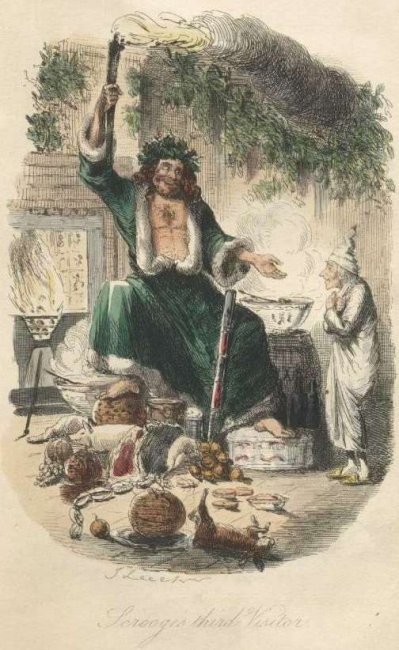
It’s not unreasonable to describe Dickens as the father of the modern Christmas, in his five Christmas books if he didn’t actually invent ‘traditions’ he did at least popularise family gatherings with turkey or goose and revived the moribund celebrations that had come to exemplify his time as people moved to the cities and families spread out losing contact. The Christmas tree was introduced to the UK from Germany by Prince Albert but it was Dickens referring to it in one of his other Christmas books and Leech’s etchings of fir branches decorating the house for the Ghost of Christmas Present that really spread the idea. The hale and hearty feast, the family gathering and the spirit of Christmas (dressed in green as this is before Coca Cola turned things red) a roaring fire and welcome to all, this is what Dickens has given us.

20181225 Christmas Carol2

This isn’t an attempt to review the book, pretty well everyone knows the story and if you don’t you can read it for free on Project Gutenberg. The tale of a miser who comes to understand what Christmas is all about with the assistance of the ghost of his business partner and three spirits representing the past, present and future is the quintessential story for this time of year. The tale of why those that can help others should help others, especially at this time of year is one that bears regular retelling. I have two copies, one is the King Penguin edition which makes a good attempt to look like the original edition and I also have the Duckworth Press volume of all five Christmas Stories.

The original book was published 175 years ago today as I write this, coming out on 19th December 1843 and had sold out by Christmas Eve, it went on to be published in ever increasing numbers but Dickens never made much money from the printed editions. The printing cost was too high for the retail price that Dickens himself insisted on for him to make anything much. It was only when he took it to theatres and read the book as a performance that he started to cover the costs and actually profit from his work.

There is no better way to finish than as Dickens himself ended A Christmas Carol

He became as good a friend, as good a master, and as good a man, as the good old city knew, or any other good old city, town, or borough, in the good old world. Some people laughed to see the alteration in him, but he let them laugh, and little heeded them; for he was wise enough to know that nothing ever happened on this globe, for good, at which some people did not have their fill of laughter in the outset; and knowing that such as these would be blind anyway, he thought it quite as well that they should wrinkle up their eyes in grins, as have the malady in less attractive forms. His own heart laughed: and that was quite enough for him.
He had no further intercourse with Spirits, but lived upon the Total Abstinence Principle, ever afterwards; and it was always said of him, that he knew how to keep Christmas well, if any man alive possessed the knowledge. May that be truly said of us, and all of us! And so, as Tiny Tim observed, God bless Us, Every One!