Designing Terry Pratchett’s Discworld – Paul Kidby

Well I was halfway through the book that will now be the subject of next weeks blog when this arrived and was begging to be read. As regular readers of this blog will know I have been a reader of Terry Pratchett’s work since the very beginning of Discworld back in 1983 and have numerous pictures by Paul Kidby on my walls that attest to that interest, some signed by Paul, some by Terry. For Terry the art of Paul Kidby came the closest to what was in his mind of anyone who has illustrated his works so I was fascinated to read this book, indeed I had ordered it from Paul many months ago and whilst knowing it was to be published in November 2024 had lost track of the actual publication date so when this signed copy dropped through my door on Friday then it just leapt to the top of the to be read list and frankly I haven’t been remotely disappointed. The pages have a high gloss finish, entirely appropriate for the art book that this is, but making them extremely difficult to photograph.

The above picture is of Kidby in his surprisingly bare, and quite small, studio with his dog asleep under his desk. This is from a chapter where we look at the materials he uses to create his art, specific boards, brushes, pencils and paints that he prefers and this is interesting as he explains why he picks particular art supplies. But the vast majority of the book looks at the development of the various characters. All the major characters have at least a page discussing how Kidby came up with the their look and how they have changed over the years, so I’ll feature Lady Sybil Ramkin.

As you can see there is an original sketch which frankly looks more like the Clarecraft version of Lady Sybil than the later iterations by Kidby and there are often handwritten notes like the one featured above adding more details of the artistic influences to the illustrations. One thing I particularly liked was the inclusion of the original art when Kidby does one of his numerous parodies of famous paintings so that you can clearly see where his inspiration came from.

One of the joys of the book however is right at the end in a chapter called ‘The Road Not Taken’ where Kidby has produced a brief sketch for books that never were, Pratchett’s work in progress at the point of which he could no longer write and one of these is Twilight Canyons.
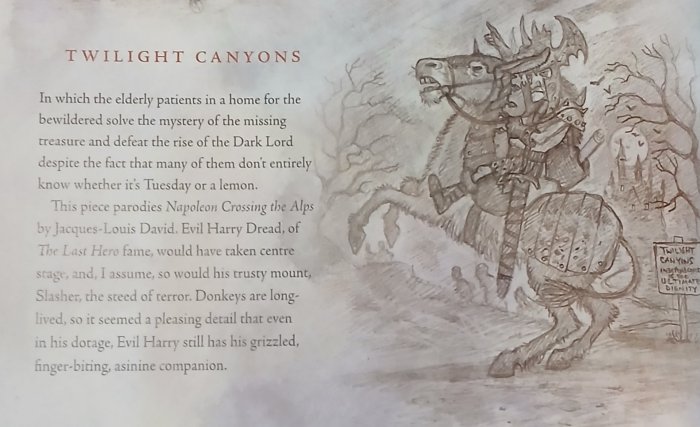
I was in the audience for ‘Bedtime Stories’ at the 2016 UK Discworld Convention, this section had always featured a reading from a book that hadn’t been published yet, initially read by Terry and latterly by his Personal Assistant Rob Wilkins. This was the first convention after Terry’s untimely death and seeing this on the programme had raised a definite buzz of anticipation, what would Rob do? Maybe just tell stories about how he and Terry had worked together and that indeed is how he started but suddenly he reached over for a sheaf of paper and started reading Twilight Canyons, a book that was clearly well in progress but which we would never get to read, the room fell even quieter as we all knew this was our only chance to experience this book.

Right after he finished the quite long extract he removed the On Air sign and the coat to reveal that the ‘table’ beside him was a shredder and he duly dropped the manuscript into the slot of the now working machine, continuing Terry’s wishes that all his unfinished work was to be destroyed. A sad but fitting end.

Rob wrote the afterword to this book where he explains that it is hoped that this will simply be the first in a series of volumes looking at various aspects of Pratchett’s work and I do hope there is more as this was a fascinating book.
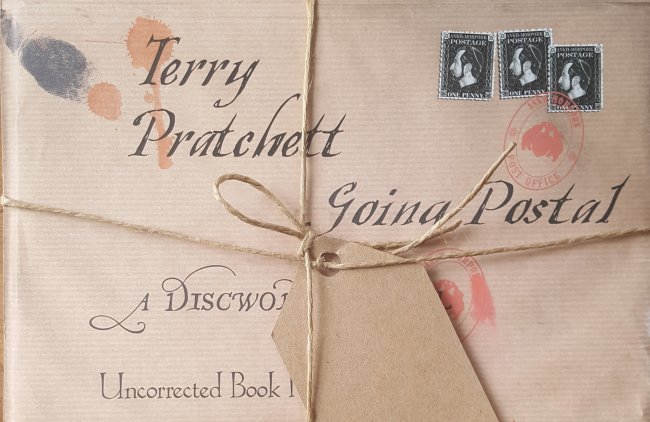
Going Postal – Terry Pratchett

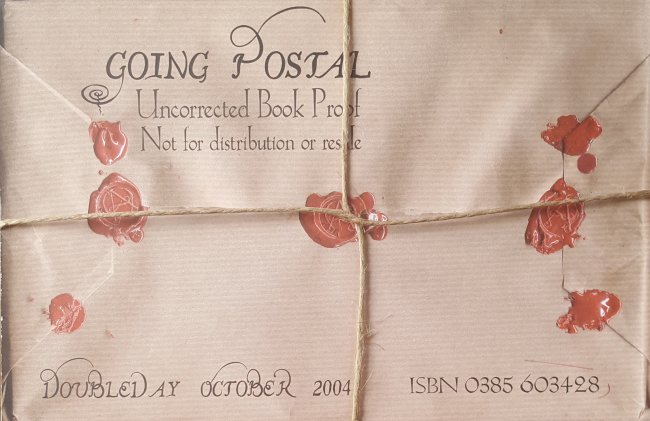
The 9th July 2004 saw the first appearance of stamps purportedly from Terry Pratchett’s Discworld and as I posted an entry on my Instagram account to mark the 20th anniversary of this and the book ‘Going Postal’ which had inspired them I got out my copies of the book of which I have three, the uncorrected book proof, and the first hardback and paperback editions. The cover of the book proof was designed by Bernard Pearson and made to look like a brown paper parcel tied up with string, just 727 copies were printed and sent to book reviewers on the 28th June 2004 with the instruction that they were not to be distributed or sold, the hardback was released on 1st October 2004 and the paperback followed on the 26th September 2005. I’ve never untied the string around my proof copy so had to read the first commercially available edition, see cover further down the blog. As you can see the front cover of the proof includes ‘stamps’ clearly based on the worlds first stamp, the penny black from 1840, but with Queen Victoria’s head replaced by that of Stephen Briggs in his guise as Lord Vetinari, the Patrician of Ankh Morpork, the largest city on the Disc. As I had got them off the shelves, probably for the first time in almost twenty years it seemed logical to read the book again.

Going Postal is the first appearance of a character who would play a major role in most of the remaining Discworld books , well those set in Ankh Morpork anyway, that Pratchett would write before his untimely death in 2015, i.e. Moist von Lipwig, who at the start is facing being hanged for forgery and embezzlement amongst other crimes. To his surprise, and undoubted relief, after being hanged he comes round in the office of Lord Vetinari who reveals that the hangman is an expert in almost hanging somebody such that those observing the event would believe that the prisoner had indeed been executed and instead his lordship wants to offer him a job. Recognising von Lipwig’s abilities and importantly expendability if it doesn’t work out, he wants him to resurrect the moribund Post Office, a branch of government which had failed and no longer delivered anything. The populace instead relying on ‘the clacks’, a primitive form of telegraph system in a world yet to discover electricity, which is increasingly expensive and prone to failure as the new money men who had taken it over fail to understand the importance of daily maintenance to fix small problems before they become much bigger ones.

Without giving the plot away von Lipwig succeeds in re-invigorating the Post Office but in the meantime what initially reads as a comedy fantasy also dissects the world of crooked finance where men just interested in making more money for themselves fiddle the books to project a business doing much better than it really is. The company is therefore able to take on large loans at preferential rates which will be used to enrich the directors whilst loading the company with debts they have no intention of paying back, simply waiting for it to collapse at which point they will buy what is left at a knockdown rate and do it all over again. Pratchett would have another go at the murky world of finance in the next Moist von Lipwig book ‘Making Money’ in 2007.

‘Going Postal’ is a highly entertaining book both for the ruses Moist von Lipwig makes use of in reinventing the Post Office and making it work again, demonstrating time and again the wisdom of Lord Vetinari in putting a conman and most significantly a showman in charge who along the way invents stamps as a means of getting money further up front for delivery of letters and parcels even though he doesn’t understand people who collect them and therefore simply hand over the money for a service they are never going to use. The climactic way he ultimately destroys the money men running the clacks is beautifully written and I highly recommend both this book and ‘Making Money’, something I probably wouldn’t have said at the time they were written when Moist von Lipwig simply didn’t appeal to me as a character but I have to say he has grown on me over the years as I better understood what Pratchett was trying to do with the books.

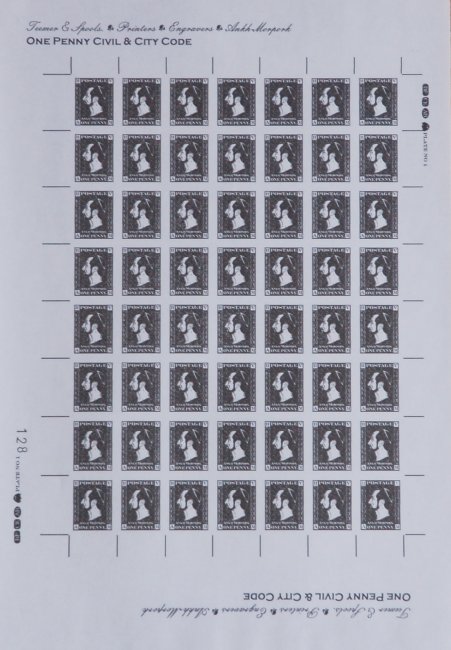
The sheet of stamps shown above replicates the original sheet described as being printed in the book by Teemer & Spools and just 250 sheets were produced by letterpress to be sold to lucky collectors who managed to get one in the couple of days before they sold out. Mine is number 128 as can be seen in the left hand margin. Discworld stamps have become a highly collectable product over the couple of decades they have existed and numerous examples have been produced with new designs coming out every year. For a brief history of the stamps and other postal artefacts see here.

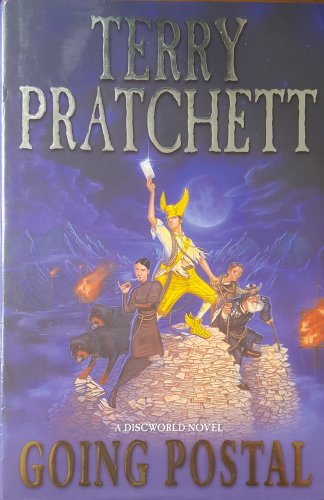
Below is the cover of the first hardback edition this time designed by Paul Kidby.

Tiffany Aching’s Guide to Being a Witch – Rhianna Pratchett & Gabrielle Kent

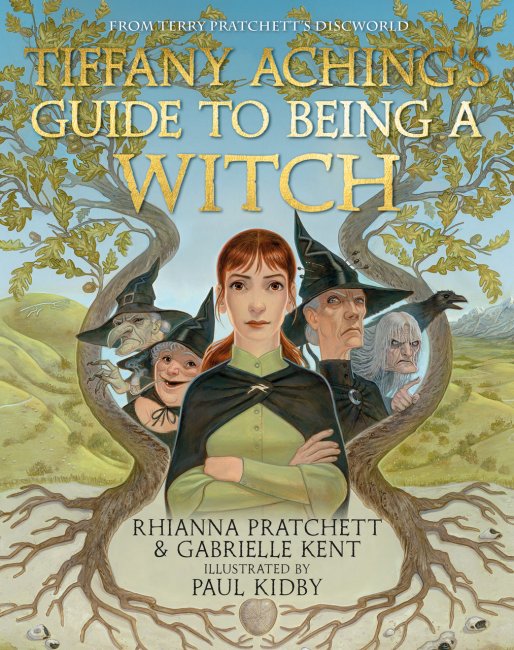
I’m writing this on Friday 10th November having received my copy of this book on the morning of its publication day, yesterday, and spent several happy hours reading it, finishing around 2:30pm yesterday afternoon. I think that tells you how much I enjoyed this first foray into her father’s literary world made by Rhianna and I hope that there will be more to come. When Sir Terry died Rhianna said that she would definitely not be continuing her father’s Discworld novels, and despite initial appearances this book does indeed stick to that line as it is another of the ancillary Discworld books such as Mrs Bradshaw’s Handbook, The World of Poo, the various atlases, or even the assorted diaries, maps, plays and guides all of which were written by people other than Terry Pratchett but based on his works with his approval and undoubted tinkering. Sadly Terry is no longer with us to give his blessings to this book but I’m sure he would have done so as Rhianna has stepped carefully into her father’s legacy with the assistance of Gabrielle Kent, whom I admit not knowing anything about other than she writes the Alfie Bloom series of childrens books, and the wonderful artwork of Paul Kidby who has signed my copy.

Based on the five ‘young adult’ Tiffany Aching books written by Terry , which include his final novel ‘The Shepherd’s Crown’, the book is beautifully designed as a guide to witchcraft by Tiffany but with apparently hand-written notes by other characters from these books such as witches Esme Weatherwax, Nanny Ogg, Miss Tick and the Feegle Rob Anybody along with additional notes from the witch Mrs Letice Earwig inserted so she can complain. Do you need to have read the books before reading this one? Frankly yes. Not only will you understand better what is being covered in the two hundred pages of this work but it basically consists of a huge number of spoilers for the other five books so you definitely don’t want to start here. Below is one of the pages from the main text (carefully chosen so as not to include any spoilers), all of which are full colour and covered in illustrations by Paul Kidby, it really is a pleasure to read the book and admire the artwork.

If you are intrigued by the illustration of the carved chalk figure behind the Feegle it is an accurate depiction of the 180 feet high (55 metres) Cerne Abbas Giant carefully censored by the appearance of the Feegle head to hide his most obvious feature and keep the book child friendly.

The text does contain a lot of original content but also consists of retelling, from Tiffany’s viewpoint, stories from the five Tiffany novels and also other tales from the Witches series of books going all the way back to the third Discworld title, ‘Equal Rites’ in 1987. Equal Rites told the story of Eskarina Smith, the only female wizard, whilst the forty first and final Discworld novel, ‘The Shepherds Crown’ in 2015, in a neat closing of a vast circle includes Geoffrey Swivel the only male witch, both of these characters feature in the new book. The pictures also go back over the decades with old illustrations intermingled with brand new work, some of the older depictions of the characters come from the now difficult to find calendars and diaries so it is good to see them re-used in a book where they can be appreciated by more people, Paul Kidby first started working with Terry back in 1993 doing artwork for the calendars and diaries and various other books but not the novel covers as these were the work of Josh Kirby, sadly Kirby died in 2001 and Kidby took over as the artist of choice by Terry for the novel covers and almost everything else and it is his depictions of the characters and places that are now most familiar to people.

I hope you enjoy the book as much as I did but make sure to read the five Tiffany Aching books first. These are, in order, ‘The Wee Free Men’ (2003) ‘A Hat Full of Sky’ (2004) ‘Wintersmith’ (2006), ‘I Shall Wear Midnight’ (2010) and ‘The Shepherd’s Crown’ (2015). You don’t need to have read any of the earlier Witches series of books before tackling these but they are good so why not? There is a final joke that I almost missed as it is on the back of the dust wrapper. Feegles will steal anything and here they are making off with the barcode block.

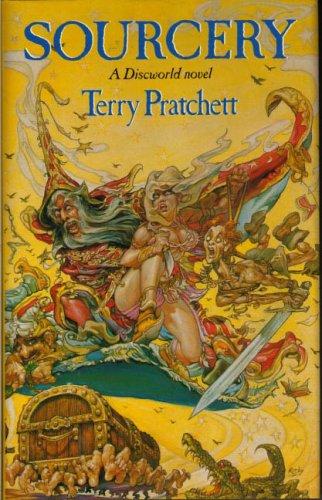
Sourcery (book proof) – Terry Pratchett

20190205sourcery1

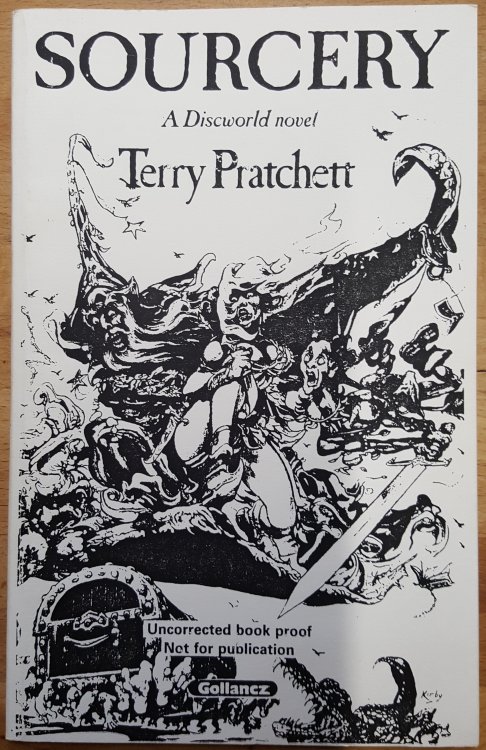
The fifth Discworld novel by Terry Pratchett was published on 26th May 1988, before that however Gollanz released a sample for book reviewers and this was the only time that the book proof of one of Terry’s works was not the complete book. Instead what you got was just the first 61 pages and an essay from Terry explaining Discworld as it was still not well known. It is this short essay that makes this book so interesting as it has never been reprinted so you can only read it is you are one of the lucky few people that own a copy. It is not known exactly how many were printed but the proofs of books four and six in the series were both only of circa 100 copies produced so it is not unreasonable to assume that it is also the case for this example. The poor production value of what is basically a pamphlet with what looks like a bad black and white photocopy of the cover for an author who was not then famous would also suggest that not all of the printed editions were kept.

When Sourcery was printed for real the first edition (see below) ran to 7,600 copies, ten years later Carpe Jugulum (printed 5th November 1998) would have a first edition print run of 160,000 in the UK alone although the proof for that book was still only 148 examples. Pratchett UK book proof collecting takes a lot of looking to find copies and they are all rare.

20190205sourcery2

But back to the sample book proof, the essay inside describes how Terry saw the Discworld at the time, over the years this evolved and it is fascinating to read his views then, just four and a half years after the first book in a series that would eventually run to forty two novels, along with numerous other books, maps, plays etc. that added to the Discworld universe. The essay is headed

An Introduction to the series, composed by the Author, and included to make this special preview sample of Sourcery even more valuable as a collector’s item

In it he gives this description of why he invented Discworld in the first place

 It was created as an antidote to all those trilogies whose worthy heroes stagger across three volumes in order to do whatever it is that the fates have decreed that a hero must do. But fairy tales and folklore and all the feedstocks of fantasy have been dragged into it, and the humour gently teased out of them by the simple process of taking them seriously and staffing them with real people. This is very unfair on them, because it is like turning loose a large herd of cows in a small pottery.

This was indeed the case in the early Discworld books, the story is played for laughs and there is a strong sense of parody about the writing particularly in the ones up to and including Sourcery. The name of the novel by the way is also a joke and is deliberately spelled that way rather than Sorcery. The concept is that the eighth son of an eighth son is automatically a wizard of power but if he then goes on to have children each son would be as powerful as any existing wizard and if he has an eighth son then he would be a wizard squared and be all powerful with access to the source of all raw magic on the Disc hence a Sourcerer rather than a sorcerer. This duly happens and wizards start building towers to fight with one another, laying waste to the lands and peoples between; does this remind you of any three volume series by any chance? Pratchett specifically mentions Tolkien a little later.

Thus on the Discworld, wizards smoke. Nothing new about this Tolkien revealed to the world that wizards smoke. But on the Disc they really smoke, you can tell a wizard by his golden fingers, stained beard, tendency to cough when walking upstairs and, in the dark, by his little red glow.

The book goes on the amplify to the ridiculous numerous tropes of the fantasy novels up until then, barbarian heroes that are either like Cohen at 87 years old and sometimes needs to be carried off by the young maidens he has just rescued from sacrifice or patently unsuited for the role they have chosen such as Nijel who is far too polite for this sort of thing with his battle cry of “Erm, excuse me”. The book is very funny especially if you are well read in the sort of books that Pratchett is mercilessly parodying.

People keep asking for maps of the Disc, on the basis that all fantasy world have to have a map, but I retreat into my Somerset bunker and refuse on the ground that I may decide to move places around a bit if it makes a better joke.

As stated above there are now maps not just of the Disc itself but also specific regions but they weren’t created by Terry, instead Stephen Briggs eventually convinced him that it could be mapped, starting with the city of Ankh-Morpork and eventually the whole world and yes it did prove difficult because there wasn’t a map when the books were written and the lost continent of XXXX had to have a huge extension added just so that one of the books worked. The later books are also less parody of fantasy novels and more a humorous parody of life on Earth, back then Pratchett could never have seen where his work would take him and the millions of books he would sell, indeed he was somewhat bemused that it was as popular as it was even then.

the evolution of the books into a cult has rather perplexed me.

20190205sourcery3

At the time of writing there is a copy available on Abebooks should you be interested at a quite reasonable (considering its rarity) £225