Longitude – Dava Sobel

The fourth week of August, and Cook only did three voyages of exploration so what to do here, well as the second voyage carried watches to test new ways of calculating longitude with varying levels of success as I will cover below it only seems fair to delve deeper into just what was being tested and why, fortunately Dava Sobel has written this excellent summary of just what was going on and how a group of astronomers colluded to keep John Harrison and his son William from winning the main prize.

As I said a couple of weeks ago “Cook had a watch made by Larcum Kendall which was a copy of that designed by John Harrison and alongside this a watch made by John Arnold, Ferneaux had two watches made by Arnold,” It may seem odd that the original clock by Harrison didn’t go on the 1772 voyage seeing as he was the one in line for the £20,000 prize (over £2.5 million for the modern equivalent according to the Bank of England inflation calculator) but the Board of Longitude were by then determined that he shouldn’t succeed and insisted that the original was effectively held hostage by them whilst a, hopefully inferior, copy was sent instead. But we are getting ahead of the story, let’s go back a few decades.

Dava Sobel presents the development of H4, the superb watch made by Harrison, by starting at the very beginning with explaining the problem of determining longitude. How far up or down the Earth you are is relatively easy to determine but longitude, how far round the Earth from your start point is a lot more difficult as you either need complex astronomical readings and their subsequent calculations and it could easily take four hours to work out where you roughly are using that method; or an accurate indication of the time in your home port to compare with local time which you could get from when the sun was highest in the sky which would be noon. Local time changes as you go round the world with a full twenty four hours representing a circumnavigation so an hour difference would be equivalent to fifteen degrees of longitude away from home. The problem was that no clock would work accurately on a ship due to temperature and humidity changes along with the movement of the ship and it had to be accurate as just a minute out would drastically alter the determination of longitude.

John Harrison, a self taught clock maker from the north of England starting to construct his first clocks back in 1713, a year before the Longitude Act setting out the prizes for determining longitude was passed. His clocks were, most unusually, mainly made of wood rather than the more common brass and most still exist with his fourth, the clock at Brocklesby Park, built in 1722 still running and telling excellent time today. Harrison’s first encounter with the Board of Longitude would be in 1730 when he went to London to present his early plans but he couldn’t find them as they had yet to meet due to no sensible proposal being sent for them to consider. That it took until 1773 for him to be finally awarded half the money he was fully entitled to and then only following intervention by the King is a scandal that Sobel covers so well in this book. Admittedly Harrison himself was partly to blame for the delay as he kept seeing improvements he could make and wanted but most of the problems were down to astronomers, especially Maskelyne, who were determined that solving longitude via lunar observations was the only way forward and as they were on the Board they kept changing the rules in order to prevent Harrison winning.

The story of the determination of longitude sounds like a fairly dry subject but it is anything but and this is one of the most interesting books I have read this year.

The Third Voyage – Captain James Cook

Before his third, and final, voyage Cook was formally given the rank of Captain and was officially retired, assigned to Greenwich Hospital at the age of just forty seven. He accepted this transfer off active duty on the basis that he would be allowed to come back and this he duly did, taking command of the apparently refurbished HMS Resolution in 1776. This time he was tasked to head north in search of the fabled North-West Passage which would give a route above the top of Canada between the Atlantic and the Pacific oceans. This had been sought for many years starting from the north Atlantic, Cook’s instructions was to start off Alaska and see if the route could be discovered coming in the opposite direction. Charts at the time for this part of the world were poor to say the least with one of the maps showing Alaska as a giant island off the coast of Canada although the Danish explorer Vitus Bering had discovered the Strait that bears his name many decades earlier whilst in the employ of the Russian navy.

In the absence of any alternative route Cook headed south to go north as he first had to enter the Pacific. The first thing that strikes the reader as we head back to familiar territory of New Zealand, Tonga and Tahiti is that the book is written in a very different style compared to the first two voyages. Instead of the formal naval journal with each day detailed with position, wind speed, heading etc. we get a manuscript that is far more aimed at the lay reader where a lot of the technical information is dispensed with and it reads much more like a diary. I have checked this with the full 1784 first edition to make sure that this style is not just a creation of the abridgement and that book is also in this more readable style so Cook was clearly aiming at publication from the start. Sadly he was never to see the book come out as he was to die on this voyage and never return to England but the manuscript that was to be published was just 17 days behind when he died so he must have been constantly working on it whilst at sea.

Cook had another reason to go to the South Pacific and that was to return Omai, a native of one of the islands with Tahiti who had travelled back on HMS Adventure as part of Cook’s second voyage. Omai was the first Polynesian to visit Europe and had achieved celebrity status whilst he was there and his return was the publicly stated reason for the trip as the search for the North West Passage was kept secret. It took longer to get to the South Pacific than intended so Cook decided that by the time he headed north it would be too late to attempt the search so stayed in the southern summer before heading north the next year and on his way became the first European to encounter Hawaii, or the Sandwich Isles as he named them after the then First Lord of the Navy, Lord Sandwich. Cook’s two ships HMS Resolution and HMS Discovery, commanded by Captain Charles Clarke, arrived at an opportune time as the islanders believed that their god was due to arrive at pretty well the same time as Cook did so they were treated royally and the elaborate ceremonies are described in the journals. When he finally left to continue north he was somewhat later than the predicted date for the god’s departure and the islanders were getting a little annoyed that he had not gone according the the plan.

Cook then headed north sighting Oregon and then following the coast of Canada, all the way to the Bering Strait producing the first accurate maps he then went east across the top of Canada before being stopped by ice bu which time he had gone past 70 degrees north. Turning round he headed west and continued on that heading, mapping the Siberian coast of Russia before again being stopped and having to go back to the Bering Strait. By then it was September and nothing more could be done so far north so he decided to return to Hawaii where they had been so welcome. The ships stayed for a month and were again welcome but soon after leaving a mast broke and knowing nowhere else he could go to effect repairs Cook went back to Hawaii and this time he was definitely not expected, Lomo was supposed to appear then leave and not come back again so soon and relations between the islanders and the ship’s crew rapidly deteriorated leading to the killing of Cook.

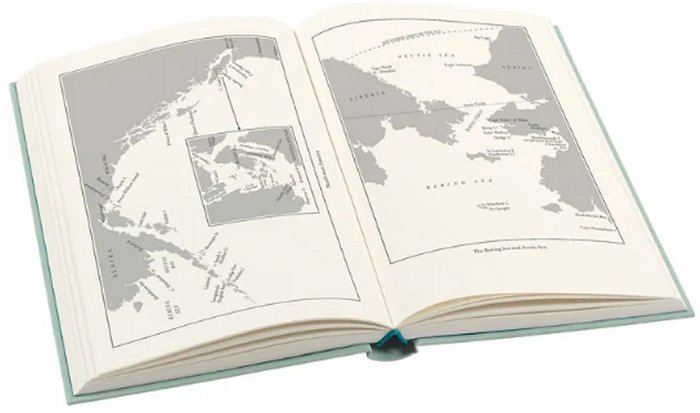
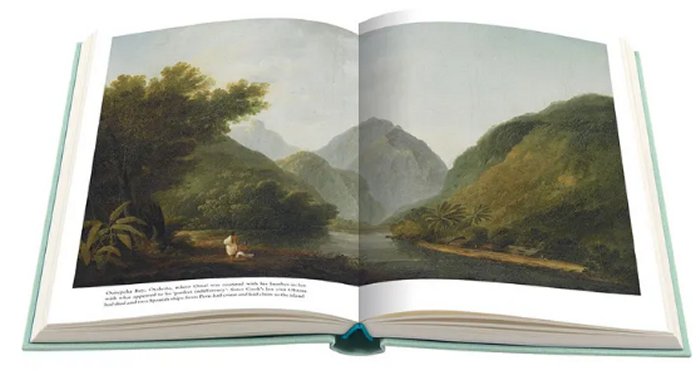
Now at this point the two versions of the book I have separate as the first edition is just two volumes in to a three volume set, the third volume being written by Captain King, whilst the Folio edition pretty well stops here presumably as the set is called the Journals of Captain Cook and he is now dead. The three books that make up the Folio set are however an excellent summary of what should in fact be a much larger nine volume set if you had the full version but it is no less good for that. Anyone interested in voyages of exploration should definitely read Cook and this is one of the most approachable editions being beautifully typeset and therefore a pleasure to read. One oddity of the images that I have used from the Folio Society web site is seen below as the picture of the included maps appears to show them in the middle of the book whilst they are in fact at the front of each volume.

The Second Voyage – Captain James Cook

Continuing with the voyages of Captain James Cook, the second trip had much greater funding than the first and Cook had charge of two vessels, Resolution and Adventure with Cook leading from HMS Resolution and HMS Adventure captained by Tobias Furneaux. They were charged with trying to discover the supposed great southern continent then known as Terra Australis, modern day Antarctica as opposed to Australia which was called New Holland at the time. It was believed by many scientists that such a mass of land must exist, if only as the source of the icebergs. The other thing that Cook and Furneaux were to study was on behalf of the Board of Longitude. Calculating latitude, how far up or down you are in the world was relatively easy however longitude, how far round the world you are, was much more difficult and ideally needed accurate knowledge of the time back where you started and clocks and watches were highly susceptible to temperature and climate variations. Cook therefore had a watch made by Larcum Kendall which was a copy of that designed by John Harrison and alongside this a watch made by John Arnold, Ferneaux had two watches made by Arnold, these were to be tested at sea and their accuracy determined, Cook and Ferneaux duly set off in May 1772. I’ll be reading more about the search for accurate longitude in the fourth book of this months theme ‘Longitude’ by Dava Sobel.

Cook duly sailed south and spent months skirting ice fields, with the two ships becoming on the 17th January 1773 the first from Europe to cross the Antarctic Circle and the following day getting to seventy five miles from the continent itself but without spotting land due to the amount of ice between them and Antarctica. Cook describes himself as surprised that the ice they recovered from the ocean in order to replenish the ships water stocks was fresh with only a small salty coating which would soon melt off and wonders how sea water freezes without retaining salt without realising that this is proof of fresh water glaciers further south that have broken off and are simply floating past the ships. One interesting quote a few days earlier gives an idea as to how the crew were faring in the extreme cold again featuring Cook’s idiosyncratic approach to spelling.

Monday 4th January 1773: First and middle parts strong gales attended with a thick fogg, sleet and snow, all the rigging covered with ice and the air excessive cold, the crew however stand it tolerably well, each being clothed with a Fearnaught jacket, a pair of trowsers of the same, and a large cap made of canvas and baize, these together with an additional glass of brandy every morning enables them to bear the cold without flinshing.

Cook would make another trip south in December 1773 after spending time in New Zealand along with Tahiti and Tonga amongst others repairing and re-equipping his vessels, and indeed getting back with HMS Adventure as the two ships had lost one another in thick fog in February 1773. Fortunately anticipating such an occurrence there had agreed to meet at New Zealand if they parted in the Antarctic ice. This trip round the South Pacific islands enabled Cook to also reacquaint himself with people he had met on his first voyage and pass on the bad news that the islander who had accompanied Cook on that voyage had sadly died on his way from Indonesia to South Africa and had therefore never seen Europe.

The second trip in search of Antarctica was no more successful than the first and Cook became convinced that there was no great southern continent, what he did however prove was that none of the lands known and partly mapped reached down through the ice to the far south. Indeed there would be no confirmed landing on Antarctica until the Norwegians got there in 1895 but to my surprise Cook is definitely a pioneer of Antarctic exploration getting far further south than anyone else in his time, something I hadn’t realised until I read this book. I had always though of Cook sailing in warmer climes so to read the battles with ice in this volume was fascinating but by February 1774 he finally turned north again eventually arriving at Easter Island in the hope of trading for more supplies. However Easter Island was to be a disappointment, the rich fertile land described by the first European visitors, the Dutch, in 1720 had gone and the people were reduced to a subsistence existence, the population also appeared to be greatly reduced, clearly something had happened here but Cook didn’t have the time, or the inclination, to find out what as he needed supplies so headed back to Tahiti.

Cook would make a further attempt to head south in 1775, this time in the South Atlantic having passed the southern tip of South America and would briefly visit South Georgia. By this time although he still hadn’t seen land to the far south he was convinced there was something as he had realised that it was needed to be a source of the ice. He wrote on 6th February 1775:

We continued to steer to the south and SE till noon at which time we were at the Latitude of 58 degrees, 15 minutes South, Longitude 21 degrees 34 minutes West and seeing neither land nor signs of any. I concluded that what we had seen. which I named Sandwich Land was either a group of islands or else a point of the continent, for I firmly believe that there is a tract of land near the Pole, which is a source of most of the ice which is spread over this vast Southern Ocean.

From the South Atlantic Cook finally turned north and sailed back to England, arriving in July 1775. The illustrations shown above are from Tanna, in the New Hebrides, now Vanuatu including a portrait of a native islander whilst below is the map that comes with this set which folds out to quite a good size.

The First Voyage – Captain James Cook

August is the month I read a theme and this year I have decided to tackle the journals written by James Cook describing his various voyages round the world. To do this I am starting off with the excellent abridged collection published by The Folio Society which is based on the JC Beaglehole version first published by The Hakluyt Society between 1955 and 1967. Beaglehole went back to Cook’s original manuscripts and ships logs and especially for the first voyage removed a lot of the extraneous material added by the Admiralty’s appointed editor which so annoyed Cook when he first saw the published work when he returned from his second voyage.

The barque HMS Endeavour set sail in August 1768 with 94 people aboard on what would be an almost three year voyage of exploration, both geographic and scientific as amongst the ships passengers were the eminent naturalist and Fellow of the Royal Society, Joseph Banks, and astronomer Charles Green specifically there to observe the transit of Venus from Tahiti. There were also other scientists to assist in the collection of specimens and a couple of artists, Sydney Parkinson and Alexander Buchan, sadly neither of which survived the trip. First port of call after leaving England was the island of Madeira for further provisions and where amongst other things they took on 3,032 gallons of wine (presumably the local fortified variety), twenty pounds of onions per man, 270 pounds of beef and amazingly a live bullock. I dread to think how killing the beast and its subsequent butchery were accomplished whilst crossing the Atlantic to Brazil on a crowded ship which was less than 100 feet (30 metres) long.

The first target destination was Tahiti for the observation of the transit of Venus due on Saturday 3rd June 1769 this was, as far as the Royal Society was concerned, the primary reason for the voyage because from this observation along with ones made in England and seven other locations around the Earth, it would be possible to accurately calculate for the first time the distance from the Earth to the Sun. Tahiti was chosen as one of the main points due to its distance from Europe, being the other side of the world therefore improved the accuracy of the calculation. By the time all the calculations were done the value was 93,726,900 miles, the modern value is 92,955,000 miles so remarkably close and within the variation of distance due to the fact the Earth does not orbit the Sun in a circle. Cook and his crew spent three months in Tahiti establishing a fortified base to make the observations from, this was necessary due to large amount of thefts that occurred from the natives who seemed to take things regardless of whether they were any use to them.

Leaving Tahiti the expedition was to search for the the legendary southern continent, but what they instead encountered was New Zealand, which had already been discovered by Abel Tasman the Dutch explorer. However over the next six months Cook would circumnavigate both the North and South Islands establishing that they were islands and mapping the coasts of them for the first time. Cook’s encounters with the Maori were fraught with disaster from the start with numerous native people being killed as they were deemed to pose a threat to either the ship or crew that landed in search of water, wood and fresh food. It is worth saying at this point that the quite small ship had by this time also taken on board some sheep as there are numerous mentions of grass being cut to feed them so it was not just the crew that needed sustenance. Cook’s interactions with the Maori people also seem to improve over the months there and there are far fewer documented fatal encounters beyond the initial landings.

After New Zealand Cook held a meeting to determine where they should go next and it was decided to sail west still looking for the southern continent. After sixteen days at sea they arrived at Australia, then called New Holland, and sailed up the north east coast of New South Wales and it is from Botany Bay that the animals shown in the plates above were seen. However whilst travelling up the coast disaster struck when on the 11th June 1770 the ship struck the Great Barrier Reef, which in this part of Australia comes very close to the shore, and was holed. After a few days they managed to get loose from the coral by dumping 40 or 50 tonnes of stores and the larger guns overboard. There then follows an interesting passage of around a month where Cook managed to beach the ship so that repairs could be undertaken and at least the large hole was repaired but the sheathing to protect the timbers was irreparable they also had considerable difficulty refloating the ship and getting back out of the trap they had found themselves in as the winds were against attempts to sail back south. Whilst trying to free themselves from a stretch of water deemed ‘The Labyrinth’ by Cook they finally managed, on 14th July 1770, to shoot one of the strange creatures spotted several times at a distance and therefore unidentifiable to find a odd animal.

The head, neck and shoulders was very small in proportion to the other parts; the tail was nearly as long as the body, thick near the rump and tapering towards the end; the fore legs were 8 inch long and the hind 22, its progression is by hopping or jumping 7 or 8 feet at each hop upon its hind legs only, for in this it makes no use of the fore, which seem to be only design’d for scratching in the ground etc. Its skin is cover’d with a short hairy fur of a dark mouse or grey colour. Excepting the head and ears which I thought was something like a hare’s it bears no sort of resemblance to any European animal I ever saw.

The entry for the 15th July includes the following observation “Today we din’d of the animal shott yesterday & thought it was excellent food”. So ended the first kangaroo examined by Europeans. The odd spelling is by the way directly from Cook’s journal, although a great seaman he was not highly educated and the spelling throughout the books is eccentric to say the least.

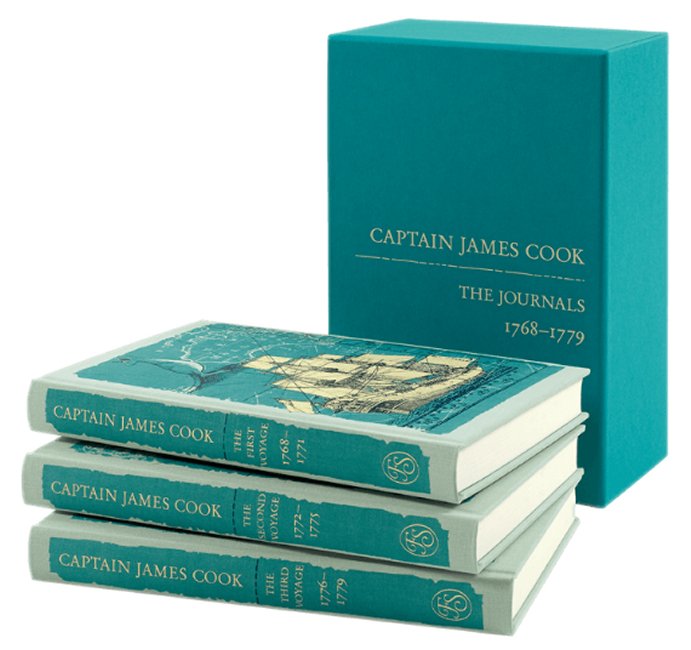
Above can be seen the Folio Society boxed set of the three voyages I am reading this month, I have the second printing from 2002.

The Ship Beneath The Ice – Mensun Bound

Mensun Bound was the Director of Exploration for the two trips to the Weddell Sea where they ultimately found Endurance so he is ideally placed to tell the story of finding the wreck. In a decades long career as a marine archaeologist (he is now seventy years old) he has been involved in the discovery of many famous shipwrecks and he tells the story in the beginning of this book of being in a coffee shop with a friend ten years ago and how he came to be looking for Endurance.

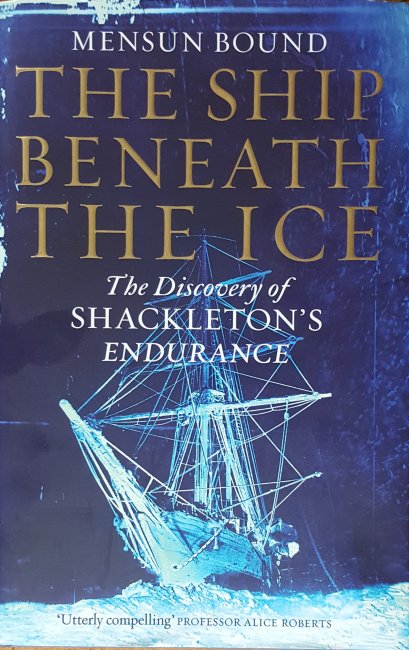
The book is actually two books, the first is about the unsuccessful 2019 expedition and was written by the author during the 2021 Covid lock down in Port Stanley, capital of The Falkland Islands which is where he was born. At the time he wrote it he never expected to get a chance to go back and try again so after 204 pages it ends with him and his team defeated. The second half of this volume recounts the unexpected return and the elation of success in 2022 and was written partly on his way back from Antarctica and completed at his home in Oxford. I’ll deal with the two parts separately. The combined book, the first section wasn’t printed independently, was first published by Macmillan in 2022 and my copy is the sixth impression which shows that this was a story a lot of people were interested in. The front cover features a famous floodlit night-time photograph taken by Frank Hurley of Endurance stuck in the ice shortly before she was finally sunk by the enormous pressure on the hull.

The Weddell Sea Expedition 2019

This trip was run under the auspices of Netherlands based The Flotilla Foundation and was mainly a scientific expedition with the search for Endurance added on the end once the data on climate change, species proliferation and ice core sampling in The Weddell Sea had been accumulated by the scientific team. Starting on the 1st January 2019 and in a day by day diary format Bound describes the work of the crew, discoveries made and provides comments as to Shackleton and his crew’s movements over a hundred years earlier. Like Bound I’ve been fascinated by Shackleton and his expeditions since an early age and have numerous books on Antarctic exploration a couple of which I have previously reviewed, see a list at the end of this blog. Most of January is dedicated to getting to Antarctica from South Africa and the scientific research which Bound wasn’t involved in so it is referred to but not in much depth. Where he does get involved is the use of the Remote Operated Vehicle (ROV) and the two Autonomous Underwater Vehicles (AUV). ROV’s are controlled via a long cable back to the ship, AUV’s are robots which operate on their own for hours on end before returning to the ship for downloading of the data they have gained, both have advantages. ROV’s provide a continuous stream of data back to the ship but are restricted by where the cable lets them go, AUV’s can go anywhere and as the search area in the Weddell Sea for Endurance was under the pack ice this was vital however they aren’t in communication with the ship so you don’t know what they found until they get back. The expedition was to have serious problems with both sorts.

It was the 25th January before the scientific work completed and the ship set out for the last ‘known’ position of Endurance, it’s latitude and longitude had been taken by its captain, Frank Worsley, just before it sank and he was one of the finest navigators at the time but working in very difficult conditions with no readily available flat horizon and very little sight of the sun due to poor weather, how accurate had he been? One of the AUV’s was no longer available after failing during the scientific surveys and on the way to Worsley’s position it was decided to do a test dive with the ROV to the depth of Endurance (approximately 3000 metres), just before it got there the ROV catastrophically failed, this was now the 30th January, time was running out and so was the equipment. It was decided to try to repair the ROV but this meant abandoning the voyage to the search area and heading off to the nearest ice airstrip to get parts which were going to be flown to them. This used up days of possible search time and ultimately failed as the plane couldn’t reach them due to bad weather. Finally deciding to just use the remaining AUV they went back to the search site with just fifty hours of possible dive time available before they had to leave or be locked in the ice just as Endurance had been. We will never know if the AUV found Endurance as it never returned from it’s dive, it also failed. This part of the book ends in dejection all round, but it’s still a fascinating story and if it had been published with no follow up I would still have really enjoyed the book, however better news is to follow.

The Endurance22 Expedition 2022

As can be told by the expedition title this was an all out attempt to find Endurance and was funded by the Falklands Maritime Heritage Trust. It is hardly giving anything away to say that they succeeded, news reports early last year went round the world that the ship was discovered and it’s plastered all over the front cover of the book. But that’s not to say there were no doubts as the days went on and very little was found. This time the brand new SAAB built autonomous vehicles were on armoured fibre optic cables so real time images were retrieved and if necessary the cables could be hauled back to retrieve the submarine. The ice conditions were a lot better for exploration as well with significant breaks so they were on station a couple of days earlier than planned and moving around was much less fraught but even so it looked like time was going to run out before the ship was discovered as the Antarctic winter was setting in and they were in to the last few days that they could remain on station before they found her. Again it is diary entry format so you can follow along with the highs and lows.

The ship was just three miles south from where Worsley had said she was and within the search box defined for the 2019 expedition by Mensun Bound which shows what a superb set of calculations both men had made but there was one very odd coincidence that was only spotted the day after the discovery and that was the date. Shackleton was buried on South Georgia on the 5th March 1922 after dying of a heart attack on his rather nebulous Quest expedition. Endurance was found on the 5th March 2022 exactly one hundred years later. It gets stranger, according to contemporary news reports his funeral service was at 3pm and allowing for a half hour service, regrouping of attendees and the twenty plus minutes to get the coffin from the chapel up to the graveyard they probably got there around 4pm, a few last words at the graveside and Shackleton was probably buried a few minutes after 4pm, Endurance was found at 4:04pm.

It’s a brilliant book, I was hooked all the way through and thoroughly recommend it as a read.

Other Antarctic blog entries

Biography of Tom Crean – who sailed with Scott and Shackleton and was one of the crew members of the James Caird, the lifeboat sailed from Elephant Isle to South Georgia to get help for the rest of the crew of Endurance.

Biography of Sir Ernest Shackleton – written by fellow Antarctic explorer Sir Ranulph Feinnes

Eight Men and a Duck – Nick Thorpe

Phil Buck is an American adventurer and admirer of Thor Heyerdahl who conceived of a plan to sail from Chile to Easter Island in a primitive reed boat back in 1999, something Heyerdahl himself never managed, and this is the story of how eight men (and a duck) amazingly made the 2,500 mile journey in 44 days starting in February 2000. Nick Thorpe was travelling round South America submitting pieces of journalism back to his home in the UK when he found out about this great adventure and wangled himself aboard on the basis of having a little sailing experience but more importantly being able to document the trip after the original journalist pulled out. The book, Nick’s first, is a surprisingly candid story of how eight men, from various nationalities and wildly diverse personalities came to bond together in adversity as their ship, the Viracocha (named after the creator god of Inca mythology), slowly became waterlogged and started sinking around them. That the boat was going to get waterlogged and either sink or break apart at some point was well known to all who sailed on her, the hope was that she would do so after completing the voyage rather than during.

The ship was just 64 feet long and 16 feet at its widest point so it was pretty cramped on board especially with all the provisions and extra reeds and wood needed to make emergency repairs stashed on board and this inevitably led to conflicts between the crew which needed to to be sorted out as soon as possible because of the lack of space and the need for everyone to work together as much as they could but largely the crew got on with each other although Nick doesn’t shy away from discussing issues that did arise between them. Having said that the book is largely positive and is a fascinating tale of daring do by a group of men who had little if any seafaring experience just a lot of determination to be the first to sail a primitive boat across the South Pacific in modern times, not so much to prove that it had been done in the distant past leading to the original settlement of Easter Island but to prove that it could be done. Sadly for the non human part of the crew they started off with two pet ducks but one escaped and jumped ship about a thousand miles from the South American coast so only one duck made the complete journey, hence the title of the book.

Phil Buck has since had two more goes at crossing the Pacific in reed boats, in Viracocha II (2003) and Viracocha III (2019) both of which intended to get all the way to Australia from Chile. The second vessel was damaged during launch but still managed to get to Easter Island whilst the third sailed for 86 days before being caught up in a storm and eventually abandoned as no longer seaworthy near Tahiti. Sadly there doesn’t appear to have been any follow up books documenting these voyages, Nick Thorpe wasn’t part of the crew for either trip and neither was anyone else on board up to writing a companion volume. Thor Heyerdahl would not have been impressed, his books led to his worldwide fame and whilst his theories about early migration are, to say the least, not widely accepted the books raised money and his profile to enable funding of further voyages and other projects.

This book was a paperback original published by Little, Brown in 2002.

Shackleton – Ranulph Fiennes

This fascinating biography of Sir Ernest Shackleton is written by Sir Ranulph Fiennes both knighted for their services to exploration and it is particularly interesting that Fiennes is able to add his own experiences of polar expeditions to accounts of Shackleton’s. He has previously written a biography of Sir Robert Scott, Shackleton’s original polar commander and then major rival in attempts to reach the South Pole and he treats each man fairly unlike the earlier biographies of Scott and Shackleton by Roland Huntford who was very much against Scott and pro Shackleton.

At 375 pages plus extensive index, appendix and bibliography this book could well be seen as the definitive biography of one of the foremost polar explorers of the so called ‘Heroic Age’, i.e. the early 20th century even though he never actually made it to the South Pole. The closest he got was one hundred miles away from it, setting at the time the record for furthest south on 6th January 1909 along with Jameson Boyd Adams, Eric Marshall and Frank Wild. This record would not be beaten until Roald Amundsen actually reached the pole on 14th December 1911. Fiennes makes the point that if he had been on his own Shackleton would probably have risked another 6 to 10 days march to the actual pole but concern for his men made him turn back due to the low level of rations still available to them. This for me is one of the defining differences between Scott and Shackleton, the disappointment on not achieving his goal was considerably offset by the fact that they all made it home safely, unlike Scott who two years later chose to press on and ultimately this cost not only his own life but that of his team members. Fiennes at this point is able, through his own experiences, to give an excellent account of just what happens to the body in the extreme cold pulling sledges as the daily rations have to be reduced in order to complete a goal. He never got as extreme as Shackleton but the explanations as to just how tough the going must have been are given extra colour by having this happen to himself and his team mate Mike Stroud.

Shackleton is however probably most famous for his third expedition, which turned into his biggest disaster as his ship, Endurance, was torn apart by the ice and he was forced to lead a completely different expedition to that intended as he rescued all his men from what seemed like certain death including the amazing crossing of the Weddell Sea in a tiny boat, less than 23 feet long. Here Fiennes’s descriptive powers really come into their own giving a fuller understanding of just what Shackleton and his five compatriots went through, including Tom Crean who I wrote about back in March 2019. Fiennes has also crossed the ocean in a small boat as part of his five year Trans Globe expedition which visited both poles travelling over land and sea although not the extremely hazardous 800 mile trip from Elephant Island to South Georgia undertaken by Shackleton and his men to get help for those left behind.

Sir Ranulph Twisleton-Wykeham-Fiennes, to give him his full name, has written twenty five books mainly about his expeditions or biographies of fellow explorers and is an excellent story teller, really involving the reader in the hardships and triumphs of global exploration whilst seeking to rediscover the men behind the stories. He is frank about Shackleton’s appalling business sense which left him always short of funds and never as fully equipped as he should have been for any of his expeditions whilst making the point that the Royal Geographic Society, which could have been a potential major backer was very much committed to Scott so were positively against any support for Shackleton. His dalliances with other women outside of his marriage are also conjectured, along with the never ending support of his long suffering wife with a husband who was rarely even in the same country never mind at home. This is not a painted over all goody goody biography and is all the better for show all aspects of Shackleton’s character. The book was published by Michael Joseph at the beginning of the month and I have a signed copy.

I’d like to finish this review exactly as Fiennes does with a quote from another polar explorer and geologist from the ‘heroic age’ Sir Raymond Priestley who was part of expeditions by both Shackleton and Scott which I think perfectly sums up why I have a lifelong admiration for Shackleton.

For scientific leadership, give me Scott. For swift and efficient travel, Amundsen. But when you are in a hopeless situation, when there seems to be no way out, get on your knees and pray for Shackleton.

An Unsung Hero: the remarkable story of Tom Crean: Antarctic Explorer – Michael Smith

20190312 Tom Crean 1

Roald Amundsen, Robert Scott, Ernest Shackleton, Tom Crean. The first three Antarctic explorers listed are household names but Tom Crean is, as the title of the book implies, largely unknown. But he should be celebrated, as he took part in three of the main British Antarctic expeditions during what became known as The Heroic Age of Antarctic Exploration during the first two decades of the 20th century.  He  was with Scott and Shackleton on the Discovery Expedition from 1901 to 1904 which at the time set the record for furthest south at 82° 17′. He was then with Scott on his ill-fated Terra Nova expedition from 1910 to 1913 and Scott’s attempt on the South Pole, where he was beaten to it by Amundson and died on his way back to the ship. Crean was later with Shackleton on his failed Imperial Trans-Antarctic expedition on the Endurance from 1914 to 1917 where the Endurance sank early in the venture. Shackleton walked his men to Elephant island and then chose four to go with him for help in an open boat across over eight hundred miles of the South Atlantic to South Georgia and Crean was one of those who was part of possibly the greatest feat of seamanship seen in the last hundred years.

So why is he so barely known, apart from those of us with a fascination with Polar exploration? Well part of the reason is that Crean was really only semi-literate, so he left no diaries or any other documentation for posterity; he also never gave any interviews and the four medals he earned in the Antarctic weren’t displayed. Apparently he never even told his daughters about his exploits in Antarctica. The sole hint that here was a man with his background in exploration was that when he left the navy in 1920 he opened a pub in his home town of Annascaul in Southern Ireland which he called The South Pole Inn. The pub is still called that and in 2003 a statue of Crean was erected in the town, so maybe wider recognition is finally happening for this quiet and self-assuming man and it may well have been helped by this excellent book which was originally printed in 2001, my copy is the first paperback edition from 2002 also published by Headline.

Despite the lack of much documentary evidence from Crean himself Michael Smith has done an excellent job of research to piece together his life from lots of sources. Sixty six books are listed in the bibliography, quite a few I already have in my small Polar library and this list has pointed me to others that sound worth adding to my collection. There are also numerous letters, unpublished diaries and other documents that have been consulted. All this has made a beautifully illustrated book of over three hundred pages which tells not only the story of Tom Crean but also the expeditions that he took part in.  He was in the group of the last eight men on the Beardmore with Scott when he chose the last five to make the final push for the pole. That Scott decided not to chose him may well have been an error as Crean was still fit and strong unlike Oates who had an injured leg and Taffy Evans’ badly cut hand, both of which for reasons of his own Scott decided to take with him. That this undoubtedly saved Crean’s life and allowed him to continue his polar explorations with Shackleton a few years later. What can only be wondered is if Scott had taken the fitter Crean then would his party made it back to the food depot they were aiming for when they died on the ice. We will never know, Michael Smith makes it quite clear where his opinion lies:

Scott, it must be said, made two basic mistakes in selecting his final party to reach the pole. First, he chose the men at the wrong time and second he chose the wrong men.

Shackleton on the other hand greatly valued the taciturn and powerful Irishman, not only selecting him for the crew of the Endurance but picking him as one of the four to go for help with him in that open boat when the expedition became a rescue mission. I’ll cover this in a later blog as I have been in awe of that journey since first reading about it as a child. After returning from the expedition Crean joined the war effort and Shackleton encouraged him to get promotion, along with writing to the First Lord of the Admiralty personally recommending his promotion. This he duly got and after the war ended up with a reasonable pension, which along with money sent to him by Shackleton enabled him to open the South Pole Inn. Shackleton tried to convince Crean to join him again on a trip south but by this time he was a family man with two daughters and declined, his exploring days were behind him.

Michael Smith has written a hugely enjoyable book about one of the lesser known great Polar explorers and even if you know nothing about the history of the time it is well worth reading.