Collection du Vieux Chamois

I have recently managed to complete my collection of these sixteen children’s books, most of which were printed in 1947 in cooperation between Penguin Books in England and Fernand Nathan in France. The last two titles VC15 and VC16 are translations of books that originally came out in England in December 1947 and August 1948 respectively so presumably the French versions were later. After the war Penguin were keen to restart their international publications and came up with the plan of altering the text for a small number of Puffin Picture Books into French and printing them in England to avoid having to ship the lithographic plates abroad. This would still require a considerable amount of work to blank out the existing English text and replace it with a translation as the whole page is printed as one unit. This would therefore have been difficult enough but there were also some illustrations altered, some of which were done for obvious reasons others are more obscure.

The books were printed in editions of 20,000 copies per book and none appear to have been reprinted. In the intervening, almost eighty, years this relatively small production number along with the fragility of books consisting of eight folded sheets stapled down the centre making a thirty two page book meant that few have survived to the present day. Although they are a reasonably practical series of children’s books to collect and it has only taken me around five or six years to accumulate them all mainly from French second hand book dealers online. Interestingly none of the books mention who did the translation, presumably somebody at Fernand Nathan, or who made the alterations to the pictures, possibly the original artists. It is also somewhat ironic that the French translations were created, as one of the original inspirations for the Puffin Picture Book series was the French series ‘Albums du Pere Castor’.

I am indebted to the Penguin Collectors Society for their invaluable Checklist of Puffin Picture Books which includes a full listing of these books so that I could check each one as I obtained it, and the checklist is the source of a lot of the information in this blog. Whilst this book lists most of the differences between the English and French illustrations it doesn’t show the variations, so below I will do so as I think it is interesting to see just what cultural differences were picked up in the changes. Firstly let’s list the seven books where it is simply a text translation difference and as you will quickly spot there are several obvious title changes:

  • VC2 – Les Animaux de notre hémisphère – originally PP7 Animals of the Countryside
  • VC5 – Vacances a la Campagne – originally PP33 Country Holiday
  • VC7 – Les Abres de mon pays – originally PP31 Trees in Britain
  • VC9 – Merveilles de la Vie Animale – originally PP44 Wonders of Animal Life
  • VC10 – Comment Vivent les Plantes – originally PP58 The Story of Plant Life
  • VC13 – Les Chiens – originally PP56 Dogs
  • VC16 – La Péche et les Poissons – originally PP53 Fish and Fishing

Now let’s look at the ones with illustration changes which will also give you a chance to see how lovely this series of books are, either in the original 119 titles in English or these 16 in French:

VC1 – Les Oiseaux du village – originally PP20 Birds of the Village

This one is a mistake rather than a deliberate change, but page eight has a number of birds each identified in the adjacent text by a number. However in the French version the numbers within the illustration have been removed which makes the text meaningless. The alteration is omitted from the checklist which regards this book as a translation only.

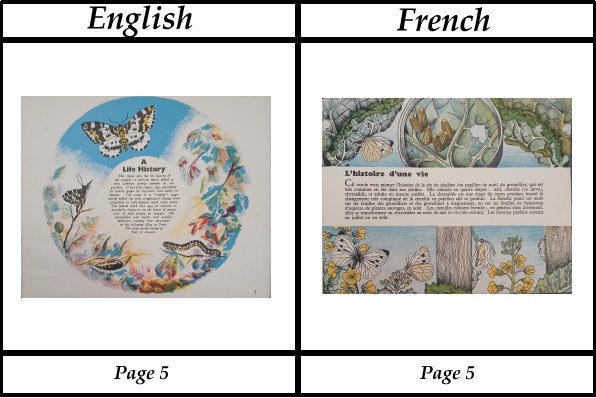
VC3 – Les Insectes – originally PP5 A Book of Insects

Two pages within this book are completely changed with totally new designs. The first one makes sense to change as the French text appears to be significantly longer than the English and therefore difficult to fit into the circular gap. The second one is less obvious why it was altered to a much more scientific form.
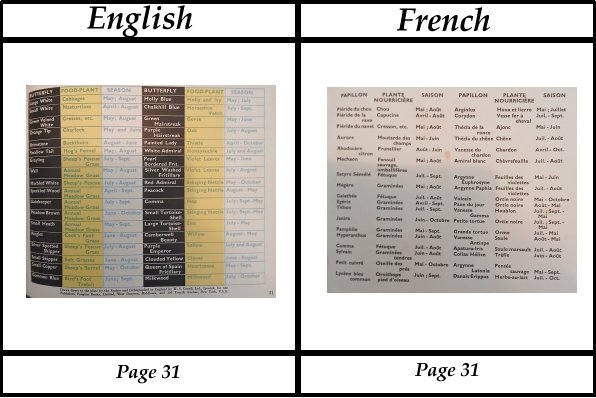
VC4 – Jolis Papillons – originally PP29 Butterflies in Britain

The change for this book is perfectly understandable as it is simply the table on the last page and changing all the text and replicating the original format is probably unnecessary. The deformation of the left hand side of the English text is simply because I didn’t want to force the page flat and possibly loosen the staples. This lack of formatting is not mentioned in the checklist which again regards this book as a translation only.
VC6 – A la Ferme – originally PP4 On the Farm

The biggest difference before the two versions is on the first page where the British farmer is replaced by a man more obviously at work.

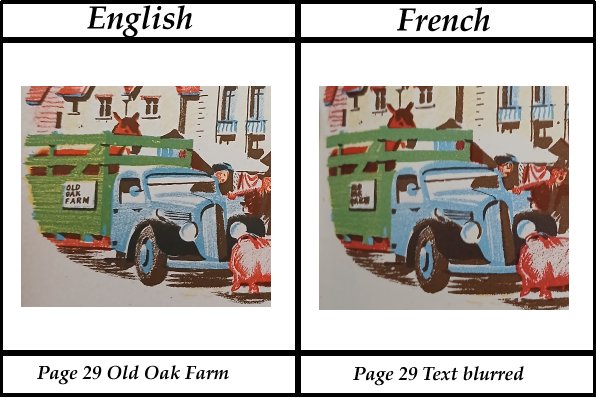
The other change is not included in the checklist and it is the amendment to the sign on the side of the lorry on the page dealing with going to the market, where the English text has simply been blurred out.
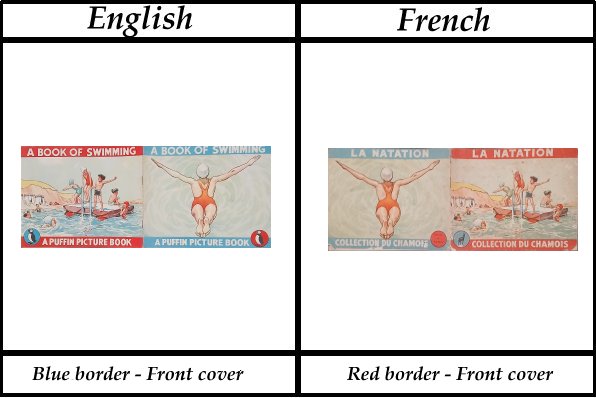
VC8 – La Natation – originally PP48 A Book of Swimming

Strangely this change isn’t in the checklist either although it is a pretty significant alteration, with the front and rear covers being transposed.
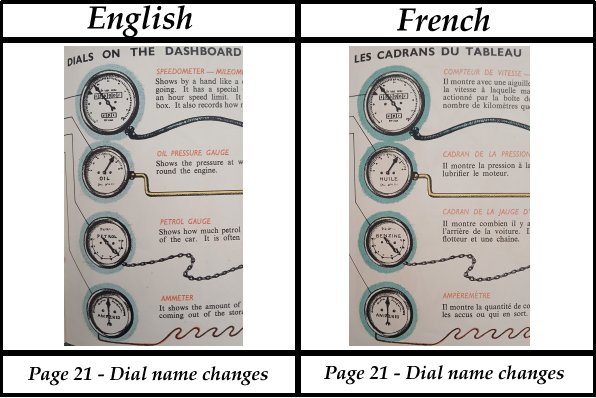
VC11 – L’Auto et son Moteur – originally PP38 About a Motor Car

The two small changes to this book are so small that they were ignored by the checklist, the first one is quite amusing and is a text alteration on the middle page spread where in the English version after the word chassis it points out that this is a French word, quite rightly the French edition doesn’t bother with this explanation. The other change is shown below and is an amendment to the text on the gauges.
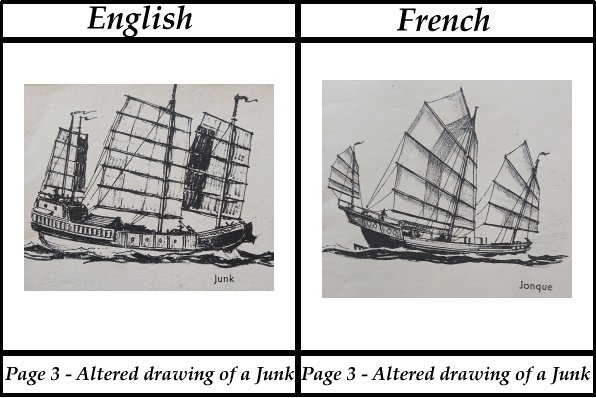
VC12 – Les Bateaux – originally PP11 A Book of Ships

Now we get to the book with the most changes between the two versions, all of which are included in the checklist and we start on page three with a new drawing of a Chinese Junk.
The very next page has the British naval flag, the Red Ensign, altered to be unrecognisable in the French version. This also occurs on page 24 but I’ve just included the one example here.

Next comes a change of headgear between two sailors

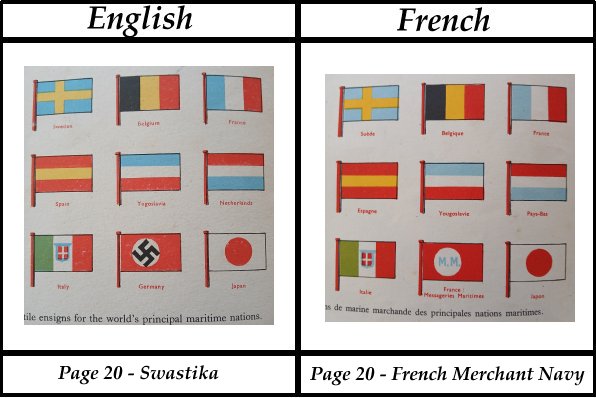
We then get a change that needed to be made from the original British edition, which was printed in June 1942, when the German flag would logically appear, to 1947 when it wouldn’t, or at least not in that form. The British book would be completely redesigned when it was reprinted in 1952 and no swastikas appear in that either.
Finally we come to page 27 where the illustration at the top of the page is reversed and indeed looks like it was completely redrawn.

VC14 – Les Merveilles du Charbon – originally PP49 The Magic of Coal

With this book only the front cover is amended to change both the helmet, the French version is more rounded and doesn’t have a lamp, and also the miner’s tattoo on his chest. This goes from St George and the dragon on the British miner to the symbol of France, the Gallic Rooster, in the French version. Whilst compiling this list I also realised for the first time that this book is slightly, but noticeably, larger than most of the other Puffin Picture Books or indeed the Vieux Chamois.

VC15 – Le Théatre – originally PP75 The Theatre at Work

The final set of changes involve a couple of uniforms at the theatre both of which are in the checklist, firstly the doorman.
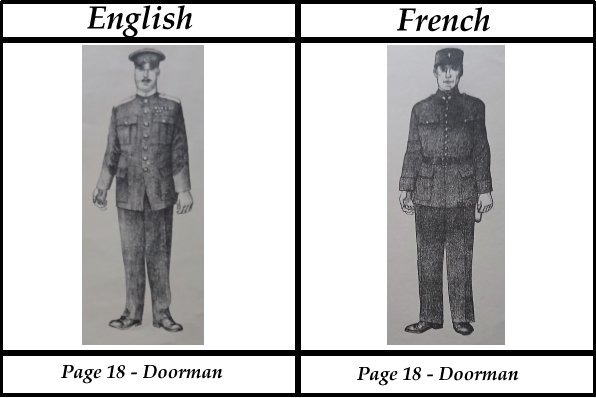
and finally the fireman who looks more prepared for disaster in the French version

That brings us to an end of this overview of the Vieux Chamois series, I’d love to know why they were called Old Chamois but I doubt that I’ll ever find out.

Memoirs From Beyond the Tomb – François-René de Chateaubriand

I was going to call this an autobiography, but it is so much more than the history of one man, for example there are over a hundred pages that detail the rise and fall of Napoleon from his early days in power when Chateaubriand was in various roles including Secretary to the Holy See until their split over the execution of the Duke of Enghien and then onwards to Moscow, exile to Elba, his return and ultimate defeat at Waterloo and final exile to St Helena. None of these later actions after his diplomatic roles ended involved Chateaubriand except as an observer on the impact in his beloved France. Chateaubriand is an excellent historian and writer but with considered views on the results of that history on himself, those around him and the wider public which add considerably to his narrative. But if you don’t know of him a section from his preface will give an idea of the breadth of his experience:

I have met nearly all the men who in my time have played a part, great or small, in my own country or abroad: from Washington to Napoleon, from Louis XVIII. to Alexander, from Pius VII. to Gregory XVI., from Fox, Burke, Pitt, Sheridan, Londonderry, Capo d’Istrias to Malesherbes, Mirabeau and the rest; from Nelson, Bolivar, Mehemet Pasha of Egypt to Suffren, Bougainville, La Pérouse, Moreau and so forth. I have been one of an unprecedented triumvirate: three poets of different interests and nationality, who filled, within the same decade, the post of minister of Foreign Affairs—myself in France, Mr. Canning in England, Señor Martinez de la Rosa in Spain. I have lived successively through the empty years of my youth and the years filled with the Republican Era, the annals of Bonaparte and the reign of the Legitimacy.

It should be pointed out at this point that this 2016 Folio edition is a reprint with some amendments of the abridged 1961 Hamish Hamilton Ltd. version, later a Penguin Classic, selected and translated by Robert Baldick and even at 367 pages doesn’t have room for Chateaubriand to encounter all the people listed above but it is still a substantial read covering an important part of French history from the Revolution through the entire time of Napoleon and beyond to the restoration of the Bourbons with Louis XVIII and Charles X and their subsequent fall. I have to admit that apart from the British view of Napoleon and the basic knowledge from school of the French Revolution I didn’t know much about this period of French history and Chateaubriand is in a unique position to expand my knowledge. As members of the nobility his eldest brother and wife were executed during the revolution and a lot of his family, including his mother were imprisoned, Chateaubriand was the tenth child, so as he was not seen as important at the beginning managed to escape France and lived in poverty in London, a time he writes about decades later in this book whilst a famous author and French Ambassador to the UK. The juxtaposition of his various positions through his life is one of the things that make the story so fascinating, he left the ambassadors role to become a member of the French government as Minister for Foreign Affairs in 1822.

I found myself constantly learning French history as I read Chateaubriand’s story of riches to rags, back to riches, obscurity to fame and a return to relative obscurity in his later life as he largely became a recluse trying to complete the four sets of volumes (there is a total of forty two ‘books’ each of which form part of a published volume) that this work became. as the range covered kept expanding and he was also busy with many other projects. Originally he planned for these books to be published fifty years after his death but in fact the first part appeared just a year after he died with the rest published the following year. This was to be his masterpiece and it is a fascinating read. It sealed his place as one of the founders of French romanticism and influenced French writers for decades.

Fairy Tales – Charles Perrault

Frenchman Charles Perrault was one of the earliest collectors of fairy tales predating the German Brothers Grimm by over a century and these were well before the Danish Hans Christian Anderson and it is in this collection that we find some of the earliest published versions of such classics as Cinderella, The Sleeping Beauty, Little Red Riding Hood and Puss in Boots. Not that anyone brought up on the sanitised modern versions would recognise much of what they believe is in the story. A prime example of this is Little Red Riding Hood, which is much shorter than the tale I first read as a child, basically the wolf meets the young girl on her way to Grandmother’s house, establishes where she is going and gets there first. The wolf immediately eats the grandmother when he gets in the house and gets into the bed waiting for Little Red Riding Hood, when she arrives he tells her to undress and get into the bed at which point he eats her and the story ends just five pages after it starts with a moral that ‘plausible wolves are the most dangerous kind’ a clear warning to young ladies to beware of some men.

The most striking example of dangerous men preying on females is a story which I have never thought of as a fairy tale but it is included here and that is Bluebeard. I first came across this horror story in the opera by Hungarian composer Bela Bartok which is largely faithful to the Perrault version at least initially. A young woman visited one of the many fine homes of a wealthy man along with her family and they were all royally entertained for several days, so much so that she agreed to marriage. About a month after the wedding he has to go away on business but suggests she invites her family and friends round and gives her the keys to the house and the strong boxes, she can go and do anything but tells her never to enter the room at the end of a corridor. However she cannot resist and when she goes in finds dried blood on the floor and the bodies of his previous brides hanging on the walls, in her horror she drops the key which becomes coated with blood. Bluebeard unexpectedly returns that evening and finds blood on the key so knows she has been in the forbidden room and therefore determines that she has to die like the others. Fortunately for the young bride her brothers arrive and kill Bluebeard before he can kill her. Again there are morals to be learnt from the story at its conclusion the second of which says that the story is from long ago and nothing like this happens anymore indeed nowadays it is the wife to be afraid of not the husband.

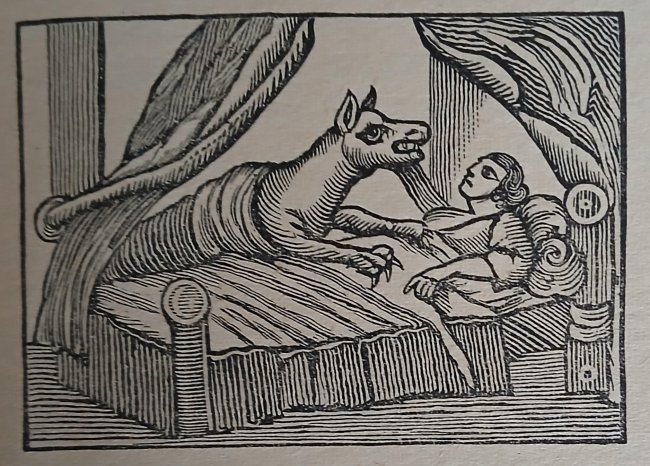
Geoffrey Brereton as well as translating this book wrote a very interesting introduction going back to the even earlier Italian collections of fairy tales although they weren’t called that back then and taking the reader through the development of the stories such as Cinderella which in the Grimm version has the ugly sisters mutilating their feet to try to get the slipper on and having their eyes pecked out when they try to go to the castle after the wedding whilst Perrault has Cinderella forgive her sisters and invite them to live in the castle. Brereton was a freelance translator and writer specialising in French and to a lesser amount Spanish literature as such he was ideal for this 1957 translation and his erudition regarding the history of fairy tales is shown in his excellent introduction, which alone would make reading this book worthwhile. The book has reproductions of woodcuts from the first English edition of Perrault’s Fairy Tales dated 1719 before each story as in the example below for Little Red Riding Hood.

The Mystery of Orcival – Emile Gaboriau

Emile Gaboriau is largely forgotten now, especially in English translation, but he was a near contemporary of Sherlock Holmes creator Arthur Conan Doyle and his detective Monsieur Lecoq who appears in five novels and one short story by Gaboriau along with four novels by other writers all produced after Gaboriau’s untimely death at the age of just thirty six in 1873. Indeed Gaboriau was well enough known for Doyle to refer to him directly in the very first appearance of Holmes in the novel ‘A Study in Scarlet’ in 1887.

“Have you read Gaboriau’s works?” I asked. “Does Lecoq come up to your idea of a detective?”

Sherlock Holmes sniffed sardonically. “Lecoq was a miserable bungler,” he said, in an angry voice; “he had only one thing to recommend him, and that was his energy. That book made me positively ill. The question was how to identify an unknown prisoner. I could have done it in twenty-four hours. Lecoq took six months or so. It might be made a text-book for detectives to teach them what to avoid.”

A Study in Scarlet – Arthur Conan Doyle

Watson is upset at having two of his favourite detective writers dismissed as such amateurs, Gaboriau’s Lecoq along with Edgar Allen Poe’s Dupin

I felt rather indignant at having two characters whom I had admired treated in this cavalier style. I walked over to the window, and stood looking out into the busy street. “This fellow may be very clever,” I said to myself, “but he is certainly very conceited.”

A Study in Scarlet – Arthur Conan Doyle

To be fair to Holmes Lecoq is certainly an unusual character even wearing disguises at work so that his enemies, presumably people he has prosecuted and their associates, cannot find him to exact revenge “I have been a detective fifteen years, and no one at the prefecture knows either my true face or the colour of my hair.” He is clearly very intelligent and like Holmes sees inferences in the slightest clue which enables him to leap ahead of the other people on the case, what he lacks is a Watson where the conversations between the two keep the reader up to date with the plot. I enjoyed my first encounter with Lecoq in this his second novel although I also own a copy of his first appearance ‘L’Affaire Lerouge’ so I doubt it will be my only dalliance with this early policeman, and indeed the first time in fiction of a French detective. 

If I have one criticism of the novel it is the sudden appearance of a lot of back story, which in my copy starts on page 109 and runs until page 195, almost a third of the entire novel, and which kills the entertaining narrative up until then, effectively providing a pause in the story. This would probably have been better handled in an earlier part of the novel rather than pull the reader back to a time before the various crimes have been committed and deal with the relationships between the various characters, some of which are already dead by the time this extra information is provided. The sheer length of this section became frustrating as up until then the story had proceeded apace but suddenly we became bogged down in apparently irrelevant details, some of which do prove to be extremely relevant later. Yes we need this information to make full sense of the story but I don’t think it needed to be done in this way. This however is my only criticism of the novel, the various twists, that are revealed are very well done and whilst the reader can congratulate themselves in spotting the main suspect very early on the fact that this is confirmed just ninety pages in shows that you are probably supposed to work out the original protagonists according the provincial justice department were just red herrings.

The story when it eventually restarts at the case in hand is just as fast moving and ingenious as it was previously with Lecoq in control of chasing down the murderer whilst also willing to bend the law to protect the woman he is with, who would surely otherwise be dragged through the courts with her honour besmirched unnecessarily. Apart from the slow mid section of the novel I greatly enjoyed this early detective story from the 1860’s and Gaboriau was clearly an extremely capable pioneer of the genre who deserves to be far better known today than he is.

À rebours – Joris-Karl Huysmans

It was the strangest book that he had ever read. It seemed to him that in exquisite raiment, and to the delicate sound of flutes, the sins of the world were passing in dumb show before him. Things that he had dimly dreamed of were suddenly made real to him. Things of which he had never dreamed were gradually revealed.

It was a novel without a plot and with only one character, being, indeed, simply a psychological study of a certain young Parisian who spent his life trying to realise in the nineteenth century all the passions and modes of thought that belonged to every century except his own, and to sum up, as it were, in himself the various moods through which the world-spirit had ever passed, loving for their mere artificiality those renunciations that men have unwisely called virtue, as much as those natural rebellions that wise men still call sin.

The Picture of Dorian Gray (chapter 10) – Oscar Wilde

When I recently read ‘The Picture of Dorian Gray‘ I assumed that the book referred to as the inspiration of Gray’s sensual explorations and obsessions was simply a device invented by Wilde, so I was surprised to discover that in fact the book actually existed. Wilde confirmed that À rebours by Huysmans was the book during his failed libel trial against the Marquess of Queensbury in 1895, and I found that not only did it exist but that a copy was already on my shelves, and had been for probably twenty years although sadly neglected, in form of the Penguin Books translation of 1959 with its title translated as ‘Against Nature’, it is also known as ‘Against the Grain’.

Charles-Marie-Georges Huysmans, who wrote as Joris-Karl in a tribute to his father, was a career civil servant, author and art critic living in Paris between 1848 and 1907 and was far from the character of the aesthete, Des Esseintes, who is the ‘hero’ of Against Nature. I put the word hero in quotes advisedly as the Duc Jean Des Esseintes is far from heroic being “a frail young man of thirty, who was anaemic, with hollow cheeks, cold eyes of steely blue, a nose that turned up, but straight, and thin papery hands”. This then is the subject of the book with other characters reduced to mere cyphers as he keeps himself away from all other human contact as far as possible. Even arranging that his two servants rarely see him and they live in a sound deadening apartment in a separate part of the house so that their existence doesn’t impinge on the solitude and quiet so desired by their master. Huysmans is clearly highly educated and very well read as demonstrated by the third chapter of the book, in this edition at least as translations vary between the chapter breaks, which is largely a harangue on the Latin writers from Virgil, just before the Christian era, to the eighth century Anglo-Saxon ecclesiastical authors whilst featuring the Des Esseintes library.

It is only fair to add that, if his admiration for Virgil was anything but excessive, and his enthusiasm for Ovid’s limpid effusions exceptionally discrete, the disgust he felt for the elephantine Horace’s vulgar twaddle, for the stupid patter he keeps up as he simpers at his audience like a painted old clown was absolutely limitless.

Sallust, who is at least no more insipid than the rest, Livy who is pompous and sentimental Seneca who is turgid and colourless, Suetonius who is larval and lymphatic, Tacitus who with his studied concision, is the most virile, the most virile, the most sinewy of them all. In poetry, Juvenal, despite a few vigorous lines, and Persius, for all his mysterious innuendos both left him cold. Leaving aside Tibullus and Propertius, Quintilian and the two Plinies, Statius, Martial of Bilbilous, Terence even and Plautus whose jargon with its plentiful neologisms, compounds and diminutives attracted him, but whose low wit and salty humour repelled hm.

Translation by Robert Baldick – Penguin 1959

Well that just about sums up most of the famous ancient Roman writers and presumably these are not just the supposed opinions of Des Esseintes but that of the author as well, the denigration of the Latin poets and later biblical scholars continues for several more pages as he moves through history. Two more chapters near the end of the book perform similar attacks on French literature but as these concentrate on liturgical authors and what Huysmans himself describes as minor writers I found these far more difficult to read as I wasn’t familiar with the works discussed. Another chapter represents the Des Esseintes art collection where Huysmans has him own Gustave Moreau’s ‘Salome Dancing Before Herod’ and ‘The Apparition’ both of which are described at length along with prints by Dutch artist Jan Luyken of medieval torture scenes along with other works. We are now roughly a third of the way through the book and I can see the fascination that this book must have had for Oscar Wilde, the descriptions are sumptuous, if at times macabre, but the book is so unlike anything else I have read apart from the work that it clearly inspired, that of Dorian Gray. Here we have a character determined to absorb all they can from the great art and literature to the exclusion of anything and anyone else, a man with a fine eye to colour and the effects that different lighting has upon it and a determination to appreciate all that he sees as good. A man who lives almost entirely in artificial light as he wakes in the evening and breakfasts then does as he pleases before dining in the early hours and going to bed as the sun rises so what looks good by candlelight is an essential consideration.

Later chapters cover, amongst many other things, his fascinating, although short lived collection of hot house flowers, deliberately chosen to look fake in texture and colours in contrast to his existing man-made floral displays that are masterpieces of realism. A detailed account of his bedroom also features where again artifice triumphs over nature with fine materials displayed to mimic the austerity of a monks cell such as the yellow silk on the walls to represent the paint on plaster of his original subject. All in all I loved this book and I’m glad I read it after ‘The Picture of Dorian Gray’, its very obscurity up until then had caused me to bypass in my shelves until I was truly ready to read it. I must admit I expected a difficult read and was pleasantly surprised as to how quickly I was absorbed in the work and apart from the previously noted French literature issues the 200+ pages largely flew past. Admittedly with several pauses where I looked up various things such as some of the paintings or flowers itemised by Huysmans which I was not familiar with, but that he had piqued my interest with to make sure I fully appreciated the points he was making and the exactitude of his representations of them,

Voyages to the Moon and the Sun – Cyrano de Bergerac

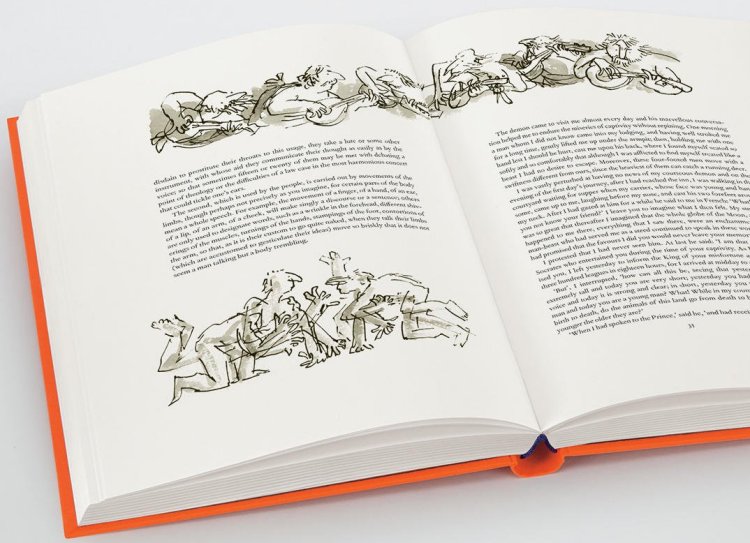
For a long time I believed that the author of this book wasn’t a real person but had been made up in some obscure French novel and that the character had lived on beyond the original work, so to find that Cyrano de Bergerac was not only real but an author as well as the famous soldier and duellist was a pleasant surprise. His life is however poorly documented, but this work can be dated reasonably well as it mentions the death of the philosopher Descartes, which happened in 1650 and de Bergerac himself died in 1654. My copy is the Folio Society edition published in 2018, illustrated by Quentin Blake and rounds off my selection of works translated from French that I have been reading throughout August. The illustrations to this blog were taken from the Folio Society web site entry on the book.

The book is in three sections so I’ll review it in the same way:

Journey to The Moon

The time that de Bergerac was writing in was a period of considerable scientific advancement as people moved away from the ancient Greek science towards the start of physics as we know it but there was much that was still up for debate such as if the Earth was the centre of the universe with everything else revolving around it. It is clear right from the start that de Bergerac had moved on from this notion and he understood that the Earth rotated, that the Moon orbited the Earth and that together they orbited the Sun. Journey to the Moon starts with the hero trying to reach the Moon by means of dew collected in jam jars. The reasoning is fair, dew rises in the morning so if you could collect enough of it and attach it to your body then it should take you with it, this he duly does and rises up into the air from Paris one morning. After a few hours he decides to land, releases the dew and is surprised to find it is still morning and he is in Canada as the Earth has rotated underneath him, de Bergerac didn’t consider that the atmosphere also rotates with the land beneath. Later he builds another machine this time powered by fireworks which does lift him to the Moon, leaving from Quebec.

The Moon he arrives at is however unrecognisable from the one we know as he finds the Garden of Eden there along with several old testament prophets and here the book starts to fail as he indulges in pages of theological arguments which drag the pace so much that I almost gave up at this point and began searching for another book to read, however I’m glad I persevered. Ultimately he leaves religion behind and goes on a fantastical exploration of his version of the Moon before returning to Earth by catching hold of the Devil on his way to deposit an inhabitant of the Moon to Hell and of course he has to pass the Earth on the way.

Journey to The Sun

For a long time it looked as if Journey to the Sun wasn’t actually going to get there, for the first twenty five pages it covers being persuaded to write up and publish Journey to the Moon and his subsequent denouncement as a sorcerer. Which leads to him being jailed, escaping and undertaking a very funny chase sequence which results in him accidentally running full circle and seeking shelter from his pursuers through the back door of the very jail he had escaped from. Eventually he builds a contraption which uses the power of sunlight via lenses to build up lift so that he can escape again, however he misjudges the power of his invention and instead of just rising and then landing again he is drawn all the way to the Sun and aims to land on a sun spot which he takes to be an area of land floating on the sun’s surface. The Sun in the book is not the flaming ball of gas that we understand but simply a larger globe that it is perfectly possible to traverse.

Eventually he meets a tiny king who with his subjects can transform themselves into anything they wish either singly or as a group to make something as large as a tree and in this tree is a Nightingale who leads him to the Kingdom of the Birds.

Story of the Birds

On arrival in the Kingdom of the Birds he is arrested and put on trial for the heinous crime of being a man and therefore a destroyer and killer of birds. Here de Bergerac demonstrates his ecological credentials and tries our hero for the damage mankind has done to the Earth and the wanton killing of bird life. He is ultimately sentenced to be eaten to death by insects but is reprieved when a parrot that he once set free from its cage speaks up in his defence.

Various adventures follow his release as he travels towards the Kingdom of Philosophers, although again de Bergerac gets distracted and spends pages retelling Greek myths without progressing with the story. Eventually this rather tedious section finishes and the hero continues on his way, meeting people from the Kingdom of Truth and the Kingdom of Lovers before the book suddenly finishes mid paragraph.

Overall I enjoyed the book but the large sections of ‘philosophising’ I could definitely have done without.

The Nun – Denis Diderot

The story behind this book is as fascinating as the novel itself and it would probably be good to start there, because it all grew out of an elaborate practical joke which was based on a real incident. In 1758 a young nun, Marguerite Delamarre, tried to get herself extricated from the vows she had taken in a Paris convent and returned to the outside world. However it was almost impossible for this to happen at the time and she duly failed but not before it had become the talk of the city. She ended up living her entire life, presumably unhappily, in the convent. Her story suggested itself to Diderot and a group of his friends as a means of persuading another of their company who had retired to the countryside to come back to Paris. They duly started a correspondence with him in 1759 pretending to be Suzanne Simonin, a nun who had escaped the cloister but needed assistance to avoid being forcibly taken back. They also included fake letters from Madame Madin, who was known to both parties and was supposedly sheltering the girl. Unfortunately for the friends of M. de Croismare he fell for the story rather too well and offered Suzanne a place in his household, even going so far as to try to arrange transport for her. They were forced to claim she was ill and then when he became more insistent that he wanted to help her they made the illness more severe and killed her off.

In a postscript, eight years later M. de Croismare did come to Paris and met Madame Madin and was surprised to find that she knew nothing of the whole episode. The story should have ended as a practical joke but Diderot had by now been so fascinated by their tale of woe that he decided to write Suzanne’s autobiography from childhood to how she ended up in the convent and then to her escape and he worked on it through most of 1760 although with no intent to publish, however once he found out that the joke was exposed he did finally publish in 1770.

To provide a reason for Suzanne to be shut up in a convent from the age of sixteen she had two slightly older sisters but it was becoming clear that potential suitors for them were getting more interested in Suzanne so she was put out of the way. This decision by her father was driven more by his (correct) suspicion that he was not actually her biological father and he wanted to prevent her having any call on the families money. He therefore determined that she should be got rid of in the most convenient way and as the story of Marguerite Delamarre proved it was almost impossible in 18th century France for a girl to leave a convent once she had been made to take her vows. However at the first convent she was sent to Suzanne refused to take her vows and created a scene in the church for which she was punished and later taken to a second convent.

At this second convent she was persuaded to take her vows despite protesting she had no vocation to become a nun and so started a horrific experience of neglect, beatings, sleep deprivation, etc. as the Mother Superior had a sadistic side and was determined to beat and torture a vocation into the young girl. Several of the illustrations in the book are based around these episodes and it is the one failing of this edition that the artist appears to be mainly interested in the voyeuristic depictions of a naked and half naked Suzanne than a more balanced view of the plot and the other sufferings she endures at the hands of this Mother Superior and her coterie of similarly sadistic senior nuns.

Eventually she is assisted to go to a third convent and here although the beatings and humiliation are not present she becomes the object of affection of the lesbian Mother Superior much to the confusion of the innocent Suzanne. Diderot appears keen to heap all the exploitative possibilities of a cloistered group of women some of whom are driven half mad by the regime and being locked away from the outside world from such a young age. It is not an easy book to read as it is written entirely from Suzanne’s viewpoint, but I’m glad this session of French works has persuaded me to get it off the shelves.

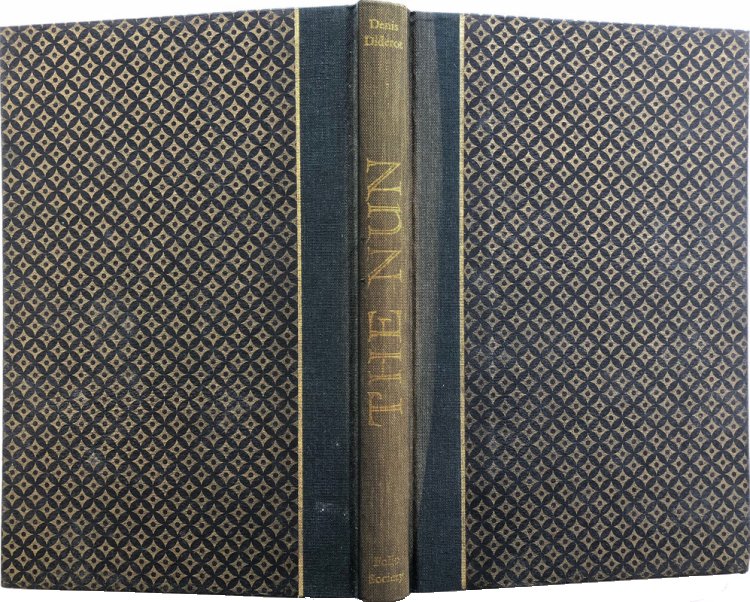
My copy is the Folio Society edition from 1972 and is notorious for its fading cloth spine, all copies I have ever seen are this badly faded, the rest of the book being protected by a slipcase. It is illustrated by Charles Mozley and translated by Leonard Tancock and is the fourth in my selection of books translated from French for August 2021.

Clochemerle – Gabriel Chevallier

Just possibly the most fun book I have read this year, it is delightfully written with the author taking the role of narrator and introducing us to the small Beaujolais town of Clochmerle and it’s comical inhabitants in the way of a consummate storyteller. Every character and place is beautifully described, and at length, so that you can fully realise in your minds eye each and every one of them. It is the third in my August book theme of ‘translated from French’ and it has been an absolute joy to read even though it clocks in at 320 pages.

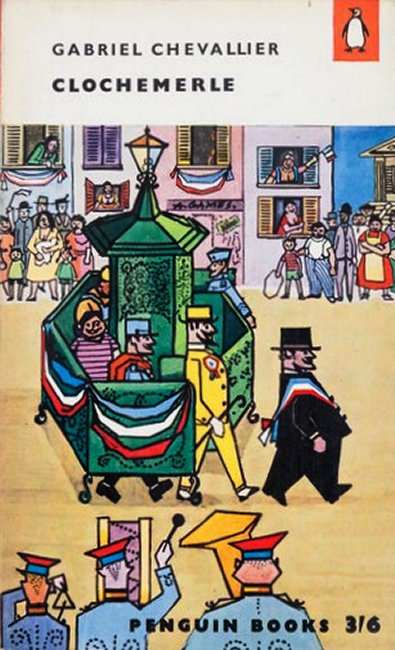
It all starts with the decision of the local mayor to bring progress to his sleepy town by building a public urinal and due to the odd geography of the place the best location is half way up the main street which places it firmly outside the church. Although not as indicated on the cover of this Penguin edition as it is placed not in the centre of a square but up against a wall adjacent to the Beaujolais Stores on an alley leading up to the church itself. To get a feel for the wonderful descriptions in the book let’s look at page one and the two men walking down the road from the square to where the urinal is to be situated.

One of these men, past fifty years of age, tall, far-haired, of sanguine complexion, could have been taken as a typical descendent of the Burgundians who formally inhabited the department of the Rhone. His face, the skin of which was dented by exposure to sun and wind, owed its expression almost entirely to his small, light grey eyes, which were surrounded by tiny wrinkles, and which he was perpetually blinking; this gave him an air of roguishness, harsh at times and at others friendly. His mouth which might have given indications of character that could not be read in his eyes, was entirely hidden by his drooping moustache, beneath which was thrust the stem of a short black pipe, smelling of a mixture of tobacco and of dried grape-skins, which he chewed at rather than smoked. Thin and gaunt, with long, straight legs, and a slight paunch which was more the outcome of lack of exercise than a genuine stoutness, the man gave the impression of a powerful physique. Although carelessly dressed from his comfortable, well-polished shoes, the good quality of the cloth of his coat, and the collar which he wore with natural ease on a week-day, you guessed that he was respected and well-to-do. His voice, and his sparing use of gesture were those of a man accustomed to rule.

And there we have a perfect pen-portrait of Barthélemy Piéchut, mayor of the town, a man of ambition to go far in the party and for which mayorality of a small provincial town was to be just a stepping stone. His fellow walker is Ernest Tafardel the schoolmaster and a far more devout republican than his friend although not destined to rise any higher than his current role. Against these two redoubtable men of the Third Republic there is the powerful Catholic Church although represented in Clochemerle by the Curé Ponosse a man who joined the priesthood for a quiet life and is definitely not the man for the crisis to come. However there is also the old maid, Mademoiselle Putet, full of religious fervour with nothing else to drive her forward now it had become quite clear she was destined to remain a Mademoiselle and untouched by the male sex rather than a married Madame. She it is that stirs up the trouble between the church and the state, initially over the urinal which as she lives by the church at the end of the alley where it is placed she sees as a personal affront to her dignity, but later as she interferes in the various goings on of the population.

The stage is set for a farcical ‘war’ between to two sides which is reflected in another conflict also in the location of the urinal between the two most attractive women in the town who run the Beaujolais Stores in the case of Judith and the bar of Torbayon in the case of Adéle which are directly opposite one another. Judith is well known for being free with her charms so to speak and Adéle flaunts hers rather than directly engaging in extra-marital affairs unlike Judith but this all changes when Judith’s particular favourite, who is staying at the Torbayon Inn, is taken ill and nursed by Adéle who takes advantage of his bed ridden state to discover exactly what she is missing in her own marriage. All this takes place in the long, hot summer of 1923 when tempers are getting frayed due to the heat and the annual fete is the cause of excessive drinking on all sides. The cast of minor characters is beautifully drawn and all have part to play in the ultimate fiasco and its resultant tragedy from the washerwomen of the lower town to the baroness in her chateau above the town, through the government officials more interested in cars and their private dealings and the military who can’t be bothered to intervene.

The book ends with an overview ten years after the calamities of 1923 by bringing us up to date with the happenings to most of the protagonists since then and all is well with most of them and the town now boasts three urinals, a great step forward indeed. There are apparently two sequels 1951’s Clochemerle Babylone and from 1963 Clochemerle-les-Bains both of which at least were available in Penguin so I can definitely see me hunting these out for future reading even if they are out of print which they appear to be.

Candide – Voltaire

What on Earth have I just read? I don’t really know what I was expecting from the fourth book issued in the Penguin Classics series, maybe a serious French novel, but it certainly wasn’t this surreal fantasy adventure. Penguin Classics started in 1946 with Homer’s Odyssey and then followed that with a collection of short stories by Guy de Maupassant and then the Theban plays by Sophocles, all solid classics as expected and then came this truly bizarre narrative at the end of 1947. This is the second of the blogs making up my August theme for 2021 which is ‘translated from French’, as I have already featured Boule de Suif and Other Stories by Maupassant I selected this book as the second French book in the Penguin Classics without knowing anything at all about it before I started reading this week.

The only book I can think of that has such fantastical episodes is Jonathan Swift’s Gulliver’s Travels and like that other classic this is a satirical parody, however unlike Swift’s book which is set in various fantasy lands Voltaire has set his amongst contemporary events and real people. The problem with both books is that they are over two hundred and fifty years old so the politics and philosophies they are parodying are long gone and the messages that would have been clear to readers at the time are obscure at best or completely lost to the modern reader. This if anything makes them even stranger. Still on with the review of the book in hand, which was first published in 1759.

As is my usual practice with books which have an introduction I didn’t read it first but after I had completed the novel. As usual I’m glad I did as the introduction not only gives away large parts of the plot whilst trying to explain the references it also totally reveals the ending. However the introduction is essential after reading the book because it answers so many questions the modern reader has, such as why does Professor Pangloss teach that this is “the best of all possible worlds” and anything that happens must ultimately be for the best despite the continuous disasters that surround him and his pupil Candide; including in Pangloss’s case being hung as part of a Portuguese auto-de-fe following the 1755 Lisbon earthquake which killed tens of thousands of people. It turns out that Voltaire was mercilessly sending up the Theodicy by Gottfried Leibniz which takes as it central premise that exact philosophy.

The book starts with Candide and Pangloss at the Baron Thunder-ten-tronckh’s country seat in Westphalia along with the Baron’s family, especially his seventeen year old daughter Cunégonde who Candide is madly in love with, all is well with the world. Cunégonde sees Pangloss making love with one of the maids and decides to entice Candide but this is seen by the Baron who kicks Candide out of the house before he can make a move. Candide is then captured by the Prussian army, press-ganged into service, flogged almost to death, made to fight in a war with the French and nearly executed before escaping to Holland, Here he meets Jacques the Anabaptist and then runs into Pangloss who is now a beggar with syphilis which he caught from the maid and who informs Candide that soon after he left the castle was over-run by the Prussians, Cunégonde was raped before her and all other inhabitants of the place were killed. Pangloss is cured of syphilis by Jacques, losing an eye and an ear during the treatment. We are now on page ELEVEN. The frenetic pace continues through the rest of the book along with the rapidly rising death toll and never ending coincidences and disasters surrounding the characters. Throughout it all Candide and Pangloss maintain the Leibnizian philosophy of this is the best of all worlds.

The other protagonists in the book are increasingly strange especially the ‘old woman’ whose tale is the most bizarre of all and acts as a balance to Candide as she certainly doesn’t believe that this is the best of all worlds after the life she has had. Starting as the illegitimate daughter of Pope Urban X and ending as a servant in Lisbon by the time she meets Candide, on the way seeing her mother drawn and quartered, becoming a slave and having a buttock cut off to feed starving Janissaries during a siege amongst other experiences. The surreal happenings to all the characters continue throughout the book which travels to South America and back to Europe via El Dorado dropping in at England just long enough to witness the execution of Admiral Byng for failing to prevent the fall of Minorca to the French and deciding that England was just too crazy a place to stay, which bearing in mind the things that had already befallen them by then was a pretty damning indictment.

I think I need to read Candide again in a few months just to fully resolve in my mind all that happens but if you like books at a mad pace then Candide is for you. I also have a copy as part of the Penguin Drop Caps series, translated by Theo Cuffe.

From the Earth to the Moon & Round the Moon – Jules Verne

These two novels by that early master of science fiction Jules Verne mark the start of my annual August reading block of books with a link between them and this year I have decided on ‘translated from French’ as my theme. The plan is to top and tail the five essays with these two and an even earlier pair of French science fiction novels with some more ‘classic’ works in between.

The two books were published four years apart, ‘From the Earth to the Moon’ in 1865 with ‘Round the Moon’ being serialised in 1869 then coming out in book form in 1870 but they really have to be read together to get anything like a satisfying resolution. I will also refer to the second book as ‘Round the Moon’ as that is the title in this edition, ‘Autour de la Lune’ is more commonly translated as ‘Around the Moon’. Although my book is just entitled ‘From the Earth to the Moon’ on the spine it does actually include both novels.

From the Earth to the Moon

The story is set in a fictional Baltimore Gun Club whose members had been developing ever more powerful cannons and artillery pieces during the recently concluded American Civil War. Disappointed that there was no longer an outlet for their talents following the cessation of hostilities the mood in the club had been somewhat downbeat until the President, Impey Barbicane, decides on an audacious plan, they would build a gun that could fire a projectile to the moon. The book then follows a series of progressions as the projectile becomes modified to become a capsule following the arrival of a Frenchman whom is determined to ride within it after hearing the worldwide publicity. It is quite difficult to avoid giving away a lot of the plot, especially as I also need to cover the second novel, but what is interesting is that Verne did some surprisingly accurate calculations and there are also some remarkable coincidences between the fictional trip and the Apollo program a century later including taking his crew up to three as not only does Frenchman Micheal Ardan go but so does Barbicane and his rival Captain Nicholl who had bet Barbicane that the project couldn’t be done.

Verne to his considerable credit correctly worked out escape velocity and realised that the optimum launch site whilst still remaining within the USA mainland is Florida due to it being the closest to the equator. He also gets the time taken to get to the moon remarkably close and therefore where the moon should be at the time of the launch. The dimensions of his capsule for the three men travelling in it is amazingly not far from that of the Apollo command module. What wouldn’t work is his launch method of a huge cannon barrel sunk into the Earth as the massive forces applying on them would simply crush the occupants regardless of the sprung beds and the quite ingenious water cushion that he came up with to soften the acceleration.

Round the Moon

It is in his much requested follow up novel that science quite literally goes out of the window. Verne needed to write a sequel as he leaves his heroes apparently orbiting the moon having being diverted off their intended route by a large asteroid that they encounter soon after leaving the Earth. Their original plan was to have settled in valleys on the Moon as it was assumed at the time that there may be an atmosphere surviving in the lowlands. In fact at the end of the first book it is not even known if they are still alive as the entire narrative takes place from the viewpoint of people on Earth. This second book instead takes us with the astronauts, picking up their side of the story from just before the launch. Unfortunately despite Verne’s cleverness in getting the launch almost right he then has his astronauts sitting down to eat ordinary meals washed down with bottles of wine and disposes of the rubbish by simply opening a window and throwing it out. To those of us reading the book now this is clearly nonsense and detracts from an otherwise excellent tale but for his Victorian era readers this was presumably perfectly reasonable.

That they used the planned means of safe landing on the Moon to manage to get back to Earth is reminiscent of Apollo 13 although in a completely different way and again even assuming that it was possible to survive the launch as depicted by Verne there is no way they could have survived the return journey and splashdown.

I first read these two short novels as a child in a rather nice illustrated edition which I borrowed from the local library. My current copy is from the International Collectors Library and has no illustrations, no publication date and not even the name of the actual publisher. There were over four hundred titles published by Doubleday as a discount line in America as ICL editions, almost all of which have fake leather look bindings and are designed to look expensive whilst actually being quite cheap. The real giveaway as to the cheapness is the poor quality of the paper which in this edition has been rough cut to resemble handmade paper but clearly isn’t. Rereading them I enjoyed these so much I think I ought to invest in a nicer copy which will perhaps encourage me to read them more often because despite their scientific shortcomings it is a really fun story.