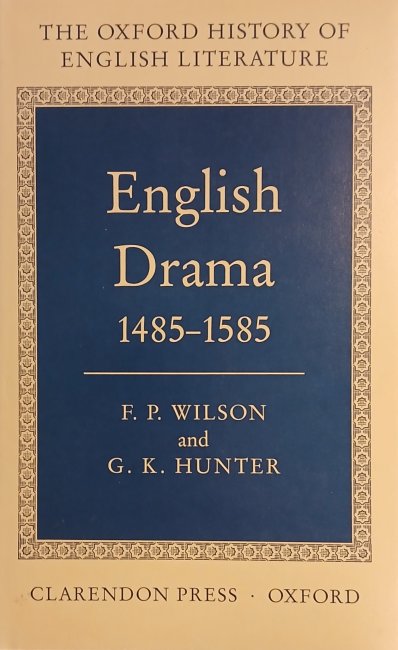
English Drama 1485–1585 – FP Wilson and GK Hunter

I’ve always liked Shakespeare, whose first play was performed in the 1590’s, but didn’t really know much about who came before him so decided to pull this volume from The Oxford History of Literature off the shelf and actually read it, rather than my usual use of books from this set which is as reference material. I was quite surprised to discover that this volume at least is quite readable so I’m now tempted to complete the set, as I currently only have ten of the fifteen volumes that take the history of English literature from Middle English in 1100 to 1400 through to the early twentieth century and DH Lawrence. Firstly a little bit about the history of the hundred years covered in this book as the choice is quite deliberate. The year 1485 saw the crowning of Henry VII after the fall of Richard III at the Battle of Bosworth Field and the end of the War of The Roses between the houses of York and Lancaster over which should rule England. Henry VII (Lancaster) married Elizabeth (York) linking the warring families and founded the Tudor dynasty which would rule for the next 118 years. We then see Henry VIII, Edward VI, Mary I and finally Elizabeth I, who was the last Tudor monarch, reigning from 1558 to 1603, so the period covered in this book is almost the entire Tudor dynasty but ending before the great flowering of English drama at the end of the reign of Elizabeth I as this has its own volume.

The period starts with the tail end of the countrywide performances of religious Mystery and Passion plays which had started as instruction to the populace centuries earlier (think of the still performed decennial Oberammergau Passion Play for a modern example) and leads us through the development of other subjects beyond religion becoming the basis of performances both comedy and tragedy along with the first appearance in England of professional actors. In 1485 there were no companies of players, plays were normally performed by children, often cathedral choristers or pupils of the Grammar schools, which would be given at the royal court or in their own halls. For adult performances there would be plays by teachers at the universities (primarily Oxford and Cambridge) and oddly by members of the four Inns of Court, presumably due to the eloquence of professors and barristers. Indeed members of both the Inner Temple and Middle Temple are referred to many times throughout the book as performing plays especially at Christmas. No dedicated theatre as such existed in England until the last decade or so covered by this book and it was only then that adult actors started to outnumber child performers and professionalism began to gain ground.
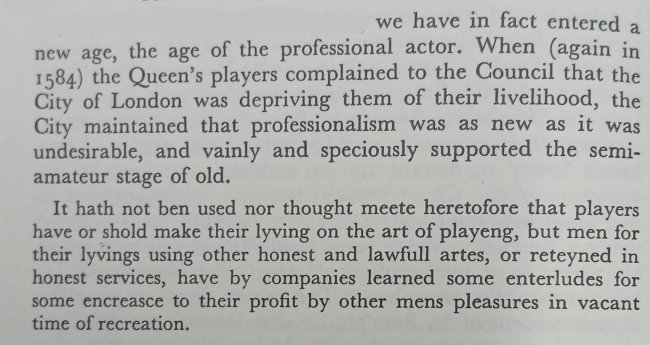
But let’s get a flavour for the plays being performed, these were often inspired in structure and sometimes in subject by the Roman playwrights Terence and Seneca with the latter being the dominant influence as the century progressed, at the end of the 1400’s Latin was still used but the English language was beginning to be more common for plays. driven by its rise in poetry and song. For an example of the sort of thing you would have encountered at the end of the 15th century with a playwright better known as a poet John Skelton’s Magnificence, a five act play of 2,567 lines with a distinct moral theme.

One aspect of plays of this period is that characters rarely had ‘normal’ names instead they would be called after the vice or virtue that they represent, a good (or possibly bad as I’m sure I wouldn’t want to see the play) example of this is Lupton’s ‘All for Money’ the essence of the plot is described below:

etc. I’m sure you get the idea. The plays would be in verse, with probably the most clunky format, the fourteener, which was very popular at the time. Blank verse would not make its appearance until the late 1550’s and even then would barely have an impact in the morality plays which were still being written.

The comedies that start to appear in the 1540’s by playwrights such as Udall from Eton College who wrote Jack Juggler and Roister Doister, two of the better plays of the period that would stand up to modern performance which frankly most of the works covered in this book would not. Tragedies however would need to wait for later writers before becoming suitable and not something that audiences would probably walk out of from boredom. A lot of the plays of the period only exist as titles, so much has been lost but the authors of the book are not dismayed by this as they say themselves:
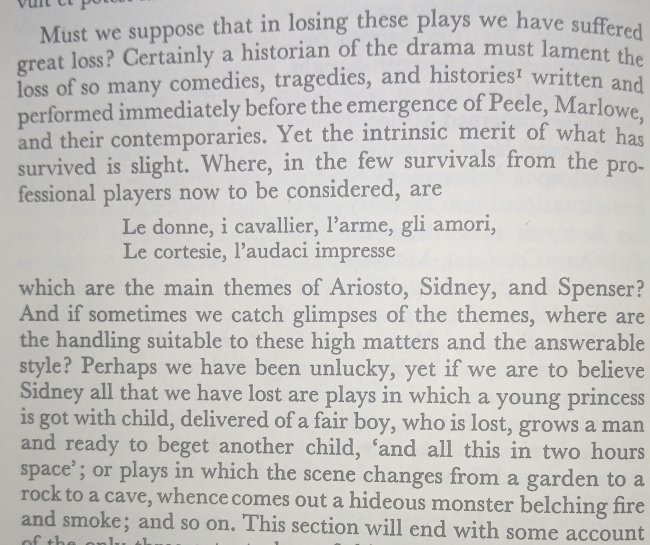
Dramatically the hundred years covered here yield little of real substance but they set the ground for what was to follow and as the Elizabethan proverbs say “a bee sucks honey out of the bitterest flowers” and “out of a little spark came a great flame” within a decade we would have Christopher Marlowe (Dido and Tamburlaine both 1587), Ben Jonson (various minor plays he didn’t really get going until the late 1590’s) and of course William Shakespeare (first play Richard III – early 1590’s date uncertain). It has definitely been an interesting read even though it has given me little in the way of encouragement to delve into the plays of this time themselves. The massive leap in quality of play-writing and indeed performance at the end of the Elizabethan period is remarkable and it is no wonder that Shakespeare is still the most widely performed author in the world.

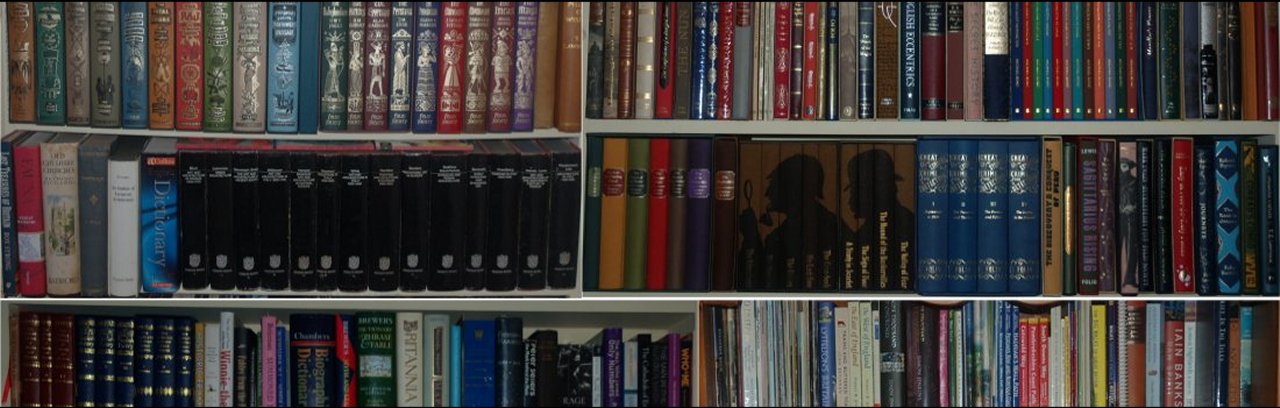
The volumes I have so far, quite an attractive set.

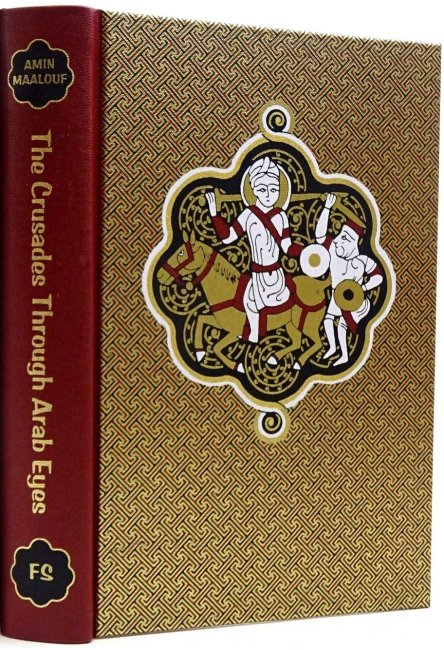
The Crusades Through Arab Eyes – Amin Maalouf

I’ve read several accounts of the Crusades but all from the perspective of the Christian west so it was fascinating to read this version from the Islamic side. The first thing you discover is that the invaders were not taking on established states, but rather what was mainly individually controlled cities and towns which were sometimes in loose alliances but more often were warring amongst themselves making them relatively easy prey for the more organised crusader forces. Certainly for the first hundred years or so of the crusader conflicts whenever an Islamic ruler died there would invariably not be a clear successor so internecine warfare would break out making the city and its surrounding territory ripe for conquest by not only the crusaders but also the neighbouring city states that were, in theory at least, on the same side. What the Islamic forces lacked was a leader that most of them would follow and this was why the crusaders found the invasion of the holy lands relatively easy in the beginning and with a couple of short lived exceptions this would be the case until the rise of the Kurdish officer Salah al-Din Yusef known in the west as Saladin, who had gone to Egypt with his father in 1173 as a young man despite having no appetite for warfare and ended up the effective ruler of Egyptian lands but still nominally under the control of Nur al-Din from Syria who had sent the army in the first place. The complex interrelationships between the various states and warlords with the added mix of a fanatical sect founded in the 1070’s by Hasan Ibn al-Sabbah who became known as the Assassins. Although these killers would operate independently they were often paid by various rivals, or even other family members to remove people in the way of their own rise to power. How these original assassins operated is described in the book.

Although the preparation was always conducted in the utmost secrecy, the execution had to take place in public, indeed before the largest possible crowd. That was why the preferred site was a mosque, the favourite day Friday, generally at noon. For Hasan, murder was not merely a way of disposing of an enemy, but was intended primarily as a twofold lesson for the public: first the punishment of the victim, and second, the heroic sacrifice of the executioner, who was called fida’I or ‘suicide commando’ because he was almost always cut down on the spot.

This constant warfare amongst the various states and cities lasted long into the Crusade period and the various parties rarely agreed on alliances to take on the invaders and when they did, at least initially had nothing that would allow them to ambush knights in armour as they had no equivalent defences so hadn’t developed weapons to defeat them. But the book is not all negative regarding the Islamic resistance there were leaders who could push back the Crusaders, at least temporarily, before Saladin and he had a bad habit, at least in a war leader, of being too merciful to those he defeated often simply sending them away, along with their armaments, leaving them free to attack again at a later date or surrendering territory in the hope of achieving a more lasting peace

The book is fascinating, especially if you have read any of the various western accounts of the period, I will be reading The Chronicle of the Crusades by Geoffrey of Villehardouin and Jean de Joinville at some point next year, the book is already on my shelves, and this will round off the overview of the Crusades I started with T.E Lawrence’s book on Crusader castles which I read at the start of this year. It’s a period of history I remember reading a lot about whilst at school both as set texts and independent study and this book has certainly given me a lot to think about with its alternative viewpoint.

Crusader Castles – T E Lawrence

Originally written as Lawrence’s thesis for his Bachelor of Arts degree in Modern History at Oxford University in 1910 this was his first time in the Middle East, a part of the world that would become forever linked to him during the First World War as he became famous as Lawrence of Arabia. It doesn’t only deal with Crusader castles however as the year before he had cycled extensively in France exploring the castles there and this is also made use of in his paper. The basis of the thesis is exploring the differences and similarities of European castles with those constructed in the Middle East as part of the Crusades to determine if the castle builders in the East took their inspiration from Byzantine castles they found there, as was the belief of scholars at the time, or if they were more heavily influenced by the western European castles they had left behind. Lawrence was firmly of the opinion that the European castles drove the design of the Crusader castles and his thesis was instrumental in changing the opinion of academics in the subject as it was so well researched and full of examples making his case, most of which hadn’t been studied first hand before, that it ultimately resulted in his First Class degree. This sounds like it could be quite a dry subject but actually it is surprisingly well written and one of his tutors encouraged him to get it published soon after it was submitted, however the sheer number of photographs and drawings, none of which could sensibly left out, would have made such a project financially unviable in the 1910’s.

One interesting feature of the book is the addition of Lawrence’s notes alongside the text from his planned revisions in the 1930’s, these sometimes add to the text but quite often are almost his thought processes regarding what he has written. The section of the book reproduced below, which is discussing the fortifications at Carcassonne in France shows both these types.

Sometimes the notes are somewhat ironic, where he either no longer agrees with what he wrote or how he wrote it, or even the references he cites. I have long had an interest in castles and architecture mainly from having been taken to most of the extant castles in Wales as a young boy with my family. I do love the chance to visit castles I haven’t been to before and a trip to the Levant in 1996 allowed me to follow, if only briefly, in Lawrence’s footsteps.

Below is one of my photographs of Krak des Chevaliers in Syria, described by Lawrence “as a finished example of the style of the Order (The Order of Knights of the Hospital of Saint John of Jerusalem, commonly known as the Knights Hospitaller) and perhaps the best preserved and most wholly admirable castle in the world”. This castle is truly enormous, as can be appreciated from the barely visible person standing on top of the Warden’s Tower, a place I had been an hour or so earlier. Lawrence dedicates many pages to this castle in the thesis with extensive descriptions, plans, photographs and drawings, the result of spending five days intensively studying the castle.

The book concludes with several of the letters Lawrence wrote during his travels in the UK and Europe, almost exclusively to his mother but dealing more with the architecture and military history he was learning about. These were originally published, with a foreword by his mother, as the second volume of the Golden Cockerel first edition of this work printed in 1936, a year after Lawrence’s untimely death in a motorcycle accident. But nowadays they are normally included with the main text in one volume as in this lovely Folio Society edition from 2010.

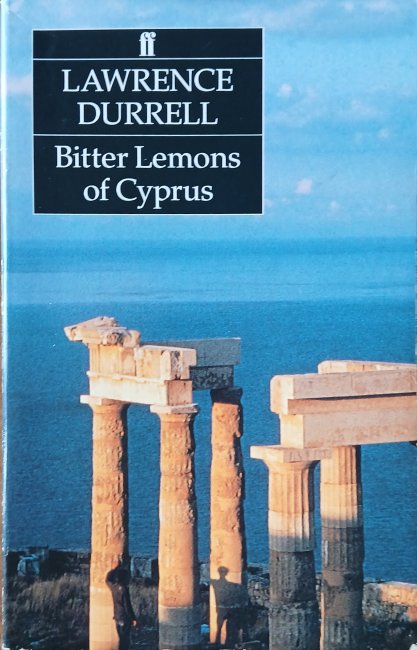
Bitter Lemons of Cyprus – Lawrence Durrell

Following on from his brother Gerald’s book last week, this is one of Lawrence Durrell’s travelogues and covers the years he spent in Cyprus from 1952 to 1956 after he left the British Council in Belgrade and planned to restart his novel writing, hopefully inspired by returning to a Greek island. Although he was there with his very young second daughter Sappho, born 1951, and without his wife who had been hospitalised back in England with post-natal depression you wouldn’t really know it as he largely avoids his family problems in the book. Indeed apart from a brief mention of Gerald, whom he claims had died in Thermopylae fighting alongside the Greeks in order to calm down a somewhat drunk Greek in a bar there are very few family references.

Sappho makes her first (and unnamed) fleeting appearance on page 102 and then only to note that she could see Turkey from an upstairs window of the house Lawrence is having renovated. Lawrence’s mother even makes an appearance, mainly I suspect to look after Sappho whilst Lawrence is working away to support the renovations, and Gerald threatens to appear, which as Lawrence points out would be awkward due to his apparent death at Thermopylae. One odd thing did occur to me at this point, why could the brother who died fighting not be thought of as Leslie, anyone who has read Gerald’s accounts of growing up in Corfu knows that there is another brother but Lawrence seems determined to ignore his existence, much as Gerald left out Lawrence’s first wife Nancy whom he lived with throughout the time the family were in Corfu and not with the rest of the Durrell family as stated in the books, and with whom he had his first daughter, Penelope.

Back however to this book, chapters vary wildly from good humour and even hints of farce when considering the purchase of the house and the crazy driving from person to person to get the legal process complete before they are caught up with by the rest of the sellers family who don’t think she is getting enough money for the property; to extremely serious such as the chapter entitled ‘A Telling of Omens’ which deals with the issue of Enosis, or the proposed union of Crete with mainland Greece and thereby ending the British rule, which was still in place whilst Lawrence was there. You can tell when reading this chapter that Lawrence initially didn’t believe that this would such an issue and neither did the Cypriots he lived amongst. It is only from the older students he started teaching English to in order to raise money to complete the house that he starts to see the first flickering of the violent unrest that is less than a few months away. But from this point onwards the tone of the book changes, turning from gentle humour to deadly serious as the situation on Cyprus quite literally explodes.

Lawrence was also a poet and the book ends with his poem Bitter Lemons, as does this review, but the beauty of his text can be seen in this extract describing a beach at dawn.

In the fragile membranes of light that separate like yolks upon the cold meniscus of the sea when the first rays of the sun come through, the bay looked haunted by the desolate and meaningless centuries which had passed over it since the first foam-born miracle had occurred. With the same obsessive rhythms it beat and beat again on that soft eroded point with its charred looking sand: it had gone on from the beginning, never losing momentum, never hurrying, reaching out and subsiding with a sigh.

When Gerald and his wife arrive Lawrence is about to take on a new role as press adviser for the colonial government which would mean living in the capital rather than his out of the way village so he basically left the house in Gerald’s care during the week, only returning at weekends. This role also gives him an insight into the ramshackle government operation which is totally ill prepared for what is to come and it is this summary of the failings of the British administration that makes the book so important as a document of the times. The book changes tone roughly halfway through as Durrell leaves the realm of good natured village life and instead describes the slow disintegration of all that he had come to love about Cyprus and the introduction of thousands of British troops to try to put a lid on the bombings and shootings which would eventually lead to independence in 1960, long after Durrell had left the island.

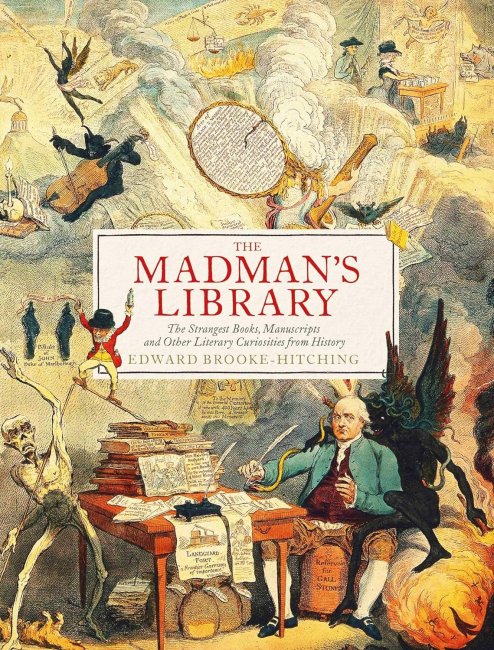
The Madman’s Library – Edward Brooke-Hitching

In July last year I wrote about the second book published by Edward Brooke-Hitching, ‘The Phantom Atlas‘, this more recent volume, first published in 2020 was a gift I received least Christmas, Brooke-Hitching is the son of an antiquarian book dealer and his love of books shines through in this guide to some of the oddest works ever produced from books like The Blood Quran which was written in beautiful calligraphy using around fifty pints of Iraqi dictator Sadsam Hussain’s blood as a major constituent of the ink in 1997 to ones that use arsenic as the dye for the covers so could literally kill the reader as the poison leaches from the boards. It is six years to the day since I started this blog and I think this book about books is an appropriate subject to mark this milestone of three hundred and fourteen articles and almost three hundred thousand words about books in my own library.

The book starts with a fascinating history of books and their precursors such as clay tablets or Sumerian foundation cones along with parchment scrolls including one that was used to wrap an Egyptian mummy. Then there are books that conceal other things such as one with a built in gun for self defence or astronomical equipment or objects that look like books but are actually boxes made from a specific wood with leaves and seeds from the tree inside them. I was reading about these and thinking it would be interesting to own one when the author pointed out the smell of decay that goes with them which somewhat put me off. There is also a long section on literary hoaxes such as biographies of people that didn’t exist or travel books of journeys that never happened several of which I am tempted to track down examples of.

There are further sections on books of the occult and religious oddities which include some of the strange animals depicted in medieval manuscripts and then examples of tiny and gigantic books. I have a love of tiny books, see my blog on the Lilliput Press so this section was particularly interesting and whilst I do have huge books such as the Folio Society’s Temple of Flora I don’t have anything like the atlas made for Charles II which is 1.76 metres tall and 2.3 metres wide when opened and is truly spectacular. There is a special mention in this section for the classic Audubon work ‘The Birds of America’ which exists in several editions but which is most prized for the version where all the birds are depicted life size which as this includes pelicans and flamingos gives some idea as to its immensity.

All in all this is a really interesting compendium of literary oddities, some of which I knew about but a lot that I didn’t and like the other books by Brooke-Hitching is again richly illustrated and it’s well worth a space on the shelf of anyone who loves books.

The Hills of Adonis – Colin Thubron

First published in 1968, Colin Thubron’s second book finds him still in the Middle East, his first book from the previous year ‘Mirror to Damascus’ covered his travels in Syria and for his third which came out in 1969 he stayed in the same geographical region with a book set in Israel entitled ‘Jerusalem’. None of these early works are particularly well known today, especially compared to his more recent travelogues, indeed the most recent publication of ‘The Hills of Adonis’ I can find is from fifteen years ago, whilst my copy was published in 1987 during the last few years of the Lebanese Civil War. Thubron spent four months walking around Lebanon, a country of just 4,036 square miles (10,452 square km) so slightly less than half the size of Wales or for Americans roughly the size of the two smallest states combined (Delaware and Rhode Island) so it was possible to cover most of the sights in the country on foot in this time frame.

Thubron weaves his way up the country from the southern border with Israel, which even in the mid 1960’s was already a dangerous place to be, up to the northern border with Syria visiting most of the significant places on the way. The first part of the book however is also concerned with a breakdown of the mythology prevailing ancient Lebanon and for me this was convoluted and unnecessary in the amount of detail and number of pages dedicated to it. Fortunately after the first few chapters Thubron largely drops the subject and proceeds to describe the history, geography and most importantly the people of this tiny but extremely culturally diverse country. This is where the book really gets into its stride although it can be difficult at times to determine if he is writing about the near or ancient history of a place, he does rather bounce around a lot. But the people he meets are fascinating and because he includes tiny villages as well as the metropolitan centres you start to get a feel for the various peoples, the Maronites and Druze, the remains of ancient and isolated monastic orders, the agricultural people of the mountains and the largely more prosperous people of the coastal regions especially as he moves further north.

In the late 1960’s, at the time Thubron was travelling in Lebanon, it was a place largely at peace. This was before the civil war which would destroy large parts of the country and kill around 150,000 people in the fifteen years from 1975 and Lebanon was still seen as a significant tourist destination in the region. This is what initially drew me to the book, a snapshot of a now long vanished time and place and whilst I was in Lebanon just six years after the civil war ended, the destruction of its once beautiful capital was all too evident when I was there and it would have been impossible to replicate Thubron’s journey as the south of the country was still occupied by Israel and would be until the year 2000. Reading the book and seeing what Lebanon was like, and unfortunately has no obvious way of getting back to, is depressing but at least here is a record of what has been lost.

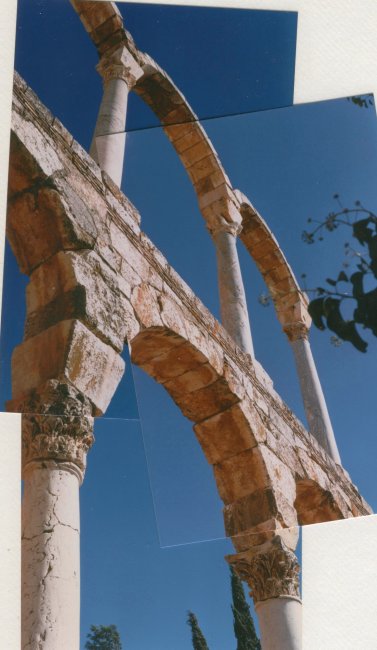
The cover picture, by Mark Entwhistle, is of the ruins of the palace in Anjar in the Bekaa region of Lebanon, which I photographed in September 1996, although from the opposite side of this particular surviving section. When Thubron got there the people were clutching radios tuned to Radio Cairo and waiting for war and he was deeply troubled by his experience there far from the peaceful scene depicted on the cover. Far from ‘driving the Israelis into the sea’ which is what everyone told him would happen the conflict that actually occurred turned out to be Six Days War where Israel defeated most of its neighbours in a series of decisive air strikes largely destroying the air forces of Egypt, Jordan and Syria in one day. But before then Thubron had left Lebanon and was presumably working on this book, which with all its faults is still an interesting read. Below are a couple of my pictures from Anjar.

a closer view of the arches

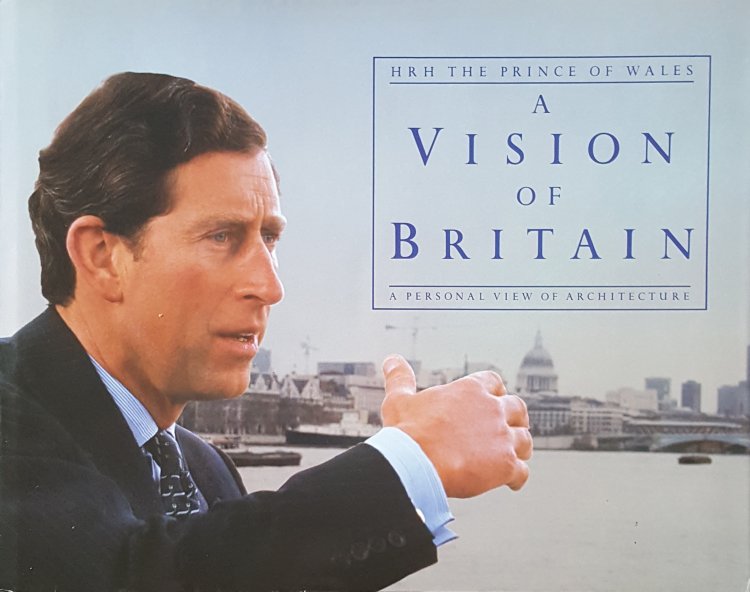
A Vision of Britain – HRH The Prince of Wales

No prizes for guessing what put Prince Charles on my mind this week of his coronation as King Charles III and I knew I had a copy of this book on the shelves where it has been since I bought it new in 1989. The original version of this was a television programme broadcast by the BBC on the 28th October 1988 as part of the a documentary series called Omnibus, the script for this was then expanded and somewhat re-arranged to make the book. The main theme of the book is what Prince Charles sees as the destruction of the built landscape with modernist construction replacing beautiful old buildings especially in London although he does occasionally step outside the capital memorably describing the brutalist central library in Birmingham as

It looks to me like a place books are incinerated, not kept!

Page 32

I must admit that I tend to agree with Charles on that one and it wasn’t much loved by most people in the city which meant that although it was only built in 1973 it has since been demolished, although quite what Prince Charles thinks of the replacement I have no idea. It’s definitely an improvement and I really like the inside which is light and airy rather than the gloomy previous building.

Charles is often regarded as having a rather twee view of architecture, a classic example of which is Poundbury which as it says on the town website.

Poundbury is an urban extension to the Dorset county town of Dorchester, designed in accordance with the principles of architecture and urban planning as advocated by His Majesty, King Charles III, in his book ‘A Vision of Britain’.

Not many books can claim to have been the basis for an entire town of 4,600 people, planned to rise to 6,000 when development is completed in a couple of years. And whilst it is rather fake looking in places it is a viable community with businesses, schools and other civic amenities created within it rather than thought about afterwards which seems to be the current process for new built large developments. Charles is still involved in the overall design plan for Poundbury and whilst I don’t think I would want to live there I can see what he tried to do.

The book is particularly scathing about architectural developments in the UK since WWII and whilst he does find much to praise this is invariably where the architect has looked backwards in history for inspiration. The book is heavily illustrated both of buildings he likes and those derided and you quickly get the feeling for his ten principals for good buildings and design. In summary these are:

  • The Place – respect for the existing landscape
  • Hierarchy – the importance of a building should be obvious
  • Scale – size of buildings in relation to the buildings surrounding them
  • Harmony – buildings should not be jarringly different from their neighbours
  • Enclosure – public squares and enclosed spaces rather than row upon row of similar houses
  • Materials – use local materials where possible, the beauty of our ancient towns and cities constructed of local stone and brick
  • Decoration – there should be some, not the all too common featureless brick walls
  • Art – again have some
  • Signs and Lights – these are necessary but need not be overwhelming and should be well designed
  • Community – building a community with spaces for people to gather is essential

All in all the book definitely expresses a vision for the future even if a lot of it is deeply rooted in the past. Thirty five years after he made the documentary Charles still very much believes in what he said then. There are buildings he hates in the book which I quite like and as I said I wouldn’t want to live in Poundbury but there is a lot to agree with him. There have been some truly awful buildings created and a lot of really lovely ones lost in the last eighty years.

The Clouded Mirror – L T C Rolt

L T C Rolt, also known as Tom Rolt, was one of the best writers on industrial history and the people who made it, and not only did he write about it but he was personally involved in saving a lot of Britain’s heritage from the Industrial Revolution from the eighteenth and nineteenth centuries for present generations to enjoy. In 1946 he was one of the three founders of the Inland Waterways Association, dedicated to restoring and making use of the long neglected canal network that criss-crossed the UK eventually leaving in 1951, by which time he had a huge new project to work on. He was chairman of the Talyllyn Railway Preservation Society which he helped found in 1950 and which was planning on restoring the old Welsh slate mining railway and turning it into the major tourist destination that it is now and it was through reading as a child his excellent 1953 book ‘Railway Adventure’ about his time rescuing the Talyllyn that I first became aware of him. Rolt died in 1974 having been more responsible for the preservation of what remains of the Industrial Revolution than anyone else and on top of the two organisations I have already mentioned he was a trustee and member of the Advisory Council of the UK Science Museum, joint founder of the Association for Industrial Archaeology, vice-president of the Newcomen Society, a member of the York Railway Museum Committee and helped to form the Ironbridge Gorge Museum Trust amongst many other things. He wrote ‘The Clouded Mirror’ in 1955 and this edition is from The Penguin English Journeys series published in 2009.

The Clouded Mirror is actually three works in one book, the first is acually called ‘The Clouded Mirror’ and surprisingly is concerned with two poets from the 1600’s who were based in the Welsh Marches, the border country between England and Wales with Herefordshire to the east and the Black Mountains to the west. Despite having given the book its title this was extremely dull and made me wonder where the rest of the book was going.

The second part, entitled ‘Kilvert’s Country’was an improvement but still a surprise given everything I thought I knew about the author as it is largely autobiographical and deals with his young childhood from the age of four when his family moved to the outskirts of Hay on Wye. This small town is in the heart of the Welsh Marches so this link at least partly explains Rolt’s fascination with the two poets in ‘The Clouded Mirror’. I know Hay very well as it was the world’s first booktown and I have been going there for decades looking for interesting works to add to my collection. Rolt’s childhood summers from 1914 sound idyllic as he gets older and explores the surrounding countryside. He writes with his customary gentle style beautiful descriptions of the places he gets to and his father sounds like a real character, having been in Australia, South Africa and even an unsuccessful prospector during the Yukon gold rush up in north western Canada. His shooting and fishing expeditions made sure that throughout WWI the family never went short of food and Rolt says that when war finished he realised that he had barely noticed that it had been happening as Hay was so remote from anyway directly affected by the conflict.

Finally there is ‘Canal Crusade’ and this is the section that made the book all worthwhile, for me anyway. It tells some of the stories from the early days of the Inland Waterways Association with Rolt travelling up largely derelict and weed clogged canals to highlight the poor state that this important transport network had reached following decades of neglect. This is Tom Rolt at his best, campaigning and writing about industrial heritage, forcing the railway companies that largely owned the canals in the first half of the twentieth century to finally maintain what they were responsible for. It seems amazing to me now, with the excellent condition that the canals are largely in now and their considerable use by holidaymakers that the stories of silted up waterways, collapsed bridges and what seemed terminal conditions are from just seventy years ago so the Inland Waterways Association must be congratulated in its work even if a major disagreement amongst the three founders meant that only one of them was still there by 1950. Fortunately by then Rolt had the Talyllyn to occupy him.

In short the book is worth reading for the second and third pieces but I won’t bother with the first part if I pick it up to read it again.

The Secret History – Procopius

Procopius was born around 500AD and died sometime after 565AD, a period during which the Roman empire was in serious decline. For many years he worked for the celebrated military commander General Belisarius during which time he wrote the work he became known for in the time of the empire ‘History of the Wars’. This series of eight books is a standard document of the campaigns of Belisarius who seemed to be leading his armies, and even the navy at some point, everywhere. It is clear from the level of detail that Procopius was on the scene for most of the battles he describes even though his official role, at least initially, was as legal advisor to the general. Less well known is his work ‘The Buildings’ which is largely a hagiography of Emperor Justinian (527AD to 565AD) as it describes the major construction works undertaken during his reign and exclaims the greatness of Justinian due to these churches and other civil engineering projects. His third work however is the one that I have read this week and it is very different to the rest, not least because it wasn’t available during his lifetime and indeed was only discovered in the Vatican library centuries after his death and finally published in 1623. So why wasn’t it available in the preceding thousand years, well Procopius gives us the explanation in his foreword.

This book is basically a scandal sheet denigrating Justinian as a genocidal leader interested only in the money he could confiscate or swindle out of everyone else and slaughtering tens of thousands of people on a whim whilst losing vast chunks of what was left of the empire. His wife is portrayed as a scheming whore, free with her body from an outrageously young age, stripping off in public places and letting anyone have their way with her as they wished. His former boss Belisarius and his wife are similarly pilloried by Procopius as is the previous emperor Justin who is described as an idiot and little more than a jackass. It is quite clear why he decided not to publish in his lifetime or indeed whilst anyone mentioned in the book was still alive, the repercussions would have been swift and brutal.

One slightly irritating feature of the book is the constant references back to Procopius’s eight volume history, this is usually where he is giving a scandalous reason for something that he had previously written about but which he had glossed over the causes of in the earlier book. This becomes more annoying if, like me, you don’t own ‘History of the Wars’ so can’t refer back, the notes in this edition simply tell you which of the eight volumes the story was first told, it would have been nice if a short precis was available so that the reader can compare the two accounts but that would have made the book probably over long. All in all I quite enjoyed this book though, it is unusual by being a character assassination of a couple of Roman emperors written at the time of their reigns, the only work I can think of that I have read with a similarly blunt although not as brutal or scandalous assessment of the emperors is ‘The Twelve Caesars’ by Suetonius although all the rulers he wrote about were dead before he started work on that.

As can be seen from the foreword the writing style is fairly chatty, although the subject matter with it’s never ending tales of depravity can get a little wearing at times. The translator of this Folio Society edition is Geoffrey Williamson and it was originally published as a Penguin Classic (L182, first published August 1966). The Folio Society first printed it in 1990 and it has gone through several editions since then.

The Life and Times of the Real Winnie-the-Pooh – Shirley Harrison

This week my book choice is a most unusual biography, because although the subject is internationally famous a lot of people don’t know that there is a real Winnie-the-Pooh who was actually owned by Christopher Robin. He has led a very interesting ‘life’ culminating in his retirement along with some of his friends in the Children’s Library in New York and the story is very well told in this entertaining volume. I have to say that I knew some of this story but there was still a lot of material that was new to me. I’ve been a teddy bear collector for over twenty years and a book collector most of my life, now combining both of these interests by occasionally purchasing books signed by A A Milne, E H Shepard, Christopher Robin Milne and even H Fraser-Simson (of which more later).

The bear on the cover is the real Winnie-the-Pooh originally made by probably the finest teddy bear maker in the UK, Farnell, and purchased from Harrods for Christopher Robin’s first birthday in 1921. Over the years he was joined by a cuddly pig named Poglet and later the smaller and easier to carry version named Piglet, Eeyore, Tigger, Kanga and Roo all arrived too in fairly quick succession. Rabbit and Owl who also appear in the books were additions by A A Milne, they were never actual toys owned by Christopher Robin. Those people who have visited Pooh in his retirement home are often surprised that not only doesn’t he look like the Disney version but he also is very different to the one drawn by E H Shepard. In fact the model for the bear in the books is Shepard’s daughters teddy which was probably a Steiff.

New York Children’s Library has Pooh, Eeyore, Tigger, Piglet and Kanga, sadly Roo was lost at the family home of Cotchford Farm well before the toys made their crossing to America in 1947, originally for a short visit which turned into a permanent stay. They were originally held at the offices of Milne’s USA publishers E P Dutton but transferred to the library in 1987. During their time at Dutton they travelled all over America and Pooh even came back to England for three brief visits, including once flying on Concorde when Pooh was invited onto the flight deck to meet the Captain, he really was an international celebrity.

The rear of the book has some of the lovely photos selected to illustrate the story, several of which I hadn’t seen before including top left Christopher Robin starting school alongside his childhood friend Anne and below that an eight or nine year old Christopher Robin with some of the toys, Pooh and Eeyore are on the floor with Tigger under his left arm and Poglet in his right. Piglet is only three inches (7½cm) tall so this is definitely Poglet. In the middle is the original Winnie Bear with his owner Lieutenant Colebourn before he was donated to London Zoo early in WWI, which is where Christopher Robin met him and the then four year old Edward Bear was renamed Winnie in his honour. To the right of that image is the bridge in Ashdown forest where the game Pooh-sticks was played and named. At the bottom of the page is Christopher Robin’s first school bag from when he went to boarding school at the age of nine and marks the end of his time with Pooh as his constant companion. The fact that his father had used his real name in the books led to Christopher Robin being bullied at school and he built up a resentment to the books that he held for a large part of his adult life, only becoming reconciled with the characters and his and their ever growing fame much later on.

The book not only follows Winnie-the-Pooh on his journeys but also summarises the lives of the Milne family including the somewhat surprising decision by the naturally reclusive Christopher Robin to open The Harbour Bookshop in Dartmouth, although he did keep a fairly low profile about his links to the toy animals of his childhood and the books they led to. I do have a complete set of the paperbacks signed by him though which presumably originally came from his bookshop.

Above is Winnie-the-Pooh as drawn by E H Shepard for comparison with the actual cuddly teddy bear show on the front cover.

Winnie-the-Pooh continues to have massive fame around the world, considerably helped by the Disney version which with films and merchandising generates billions of pounds every year, A A Milne in his will left money to his family but also to set up The Milne Trust which uses his royalties from the characters for charitable causes and Disney, to be fair, also donates significant sums to charities. The book ends with a summary of the main beneficiaries. As for H Fraser-Simson, he was a composer who lived near the Milne’s London home and it was he that set several of the poems from ‘When We Were Very Young’ and ‘Now We Are Six’ to music with the tunes that I learnt as a child. At 102 years old Winnie-the-Pooh has now outlived all his compatriots and looks to just becoming more famous as the years go on and this tribute to a much loved bear was a really good read.