
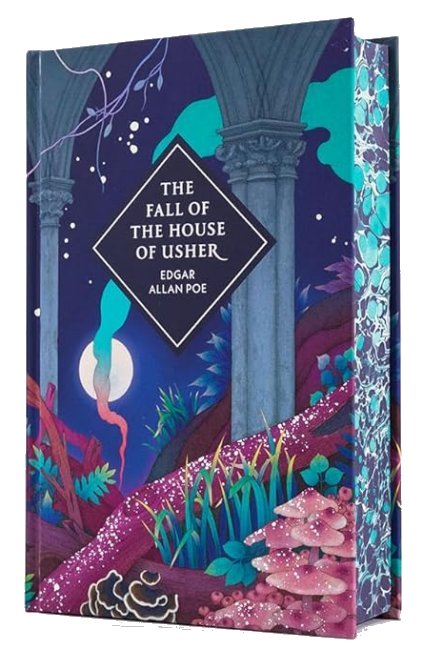
Another beautiful volume from the Vintage Collectors Classic series by Penguin Books and easily the most comprehensive collection of Edgar Allan Poe’s short stories that I have read so far. Below you can see the contents list of this book, which includes thirty one tales including all the most famous ones such as the one that lends its title to this collection ‘The Fall of the House of Usher’ along with ‘The Pit and the Pendulum’, ‘The Masque of the Red Death’ and one of the very earliest detective stories ‘The Murders in the Rue Morgue’. all of which I’ve read before but it was a delight to encounter them again after a gap of several decades.
Poe was an outstanding writer and very much out on his own stylistically in the early 1800’s, he was born in 1809 and died, appropriately in mysterious circumstances, in 1849 after he was found delirious and wearing clothes that didn’t belong to him, but was never sufficiently coherent afterwards to explain what had happened to him before he died. But back to 1831 and after his court martial from West Point military college, which he deliberately engineered as a means of getting out of the army, he turned to journalism to earn a living. He had been writing poetry since 1824 but his first short story was Metzengerstein from 1832 and that story opens this collection and is an indication of the horror/mystery style that would mark most of his subsequent works. I was surprised however by ‘The Man That Was Used Up’, which definitely falls into the category of comedy although with a satirical twist that only Poe would have thought of. I mentioned ‘The Murders in the Rue Morgue’ as an early detective story and in this collection I found the two follow up tales of Poe’s detective Monsieur C. Auguste Dupin of Paris, these are, the largely unsuccessful, and overly long, story ‘The Mystery of Marie Roget’ and the much better ‘The Purloined Letter’. Dupin is so obviously a basis for Arthur Conan Doyle’s Sherlock Holmes including in Rue Morgue a passage where he interrupts his unnamed companion and narrators thoughts just as Holmes does in ‘The Adventure of the Cardboard Box’ written in 1893, fifty two years after Poe’s tale, indeed Doyle references Poe in the story. ‘The Purloined Letter’ also has shadows of Sherlock Holmes but the less said about ‘The Mystery of Marie Roget’ the better, although it does have the distinction of being the first ever fictional detective story based on a real crime.
Still onto the contents list of this collection and a very well collated selection it is too:
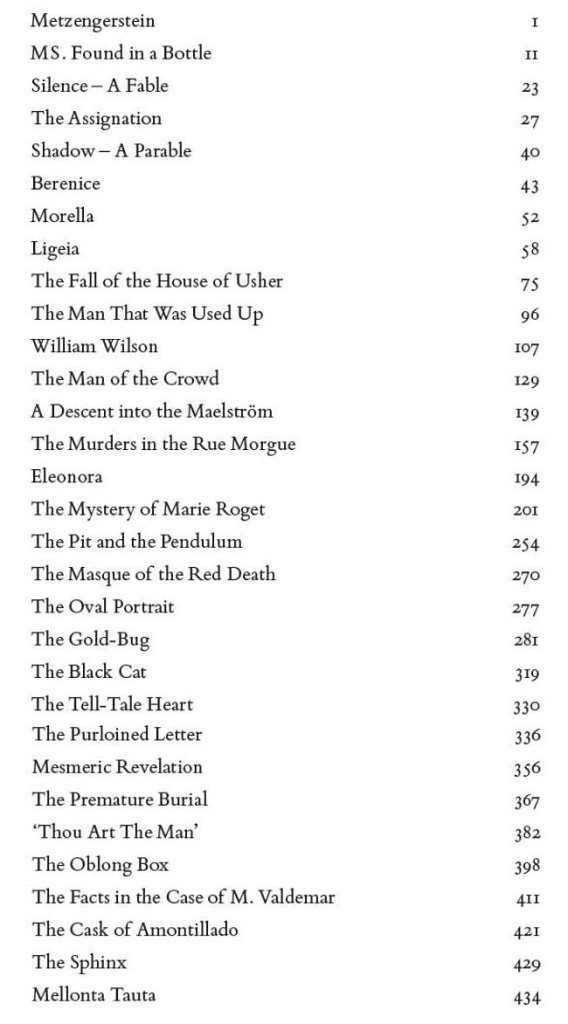
I’m not going to go though all of these stories, I heartily recommend you have a go yourself, some are not as good as others, as you would expect from any book like this but almost all are well worth reading. I particularly enjoyed ‘The Gold-Bug’ which explains simply cryptology on its way to the discovery of pirate treasure and the humour in ‘The Sphinx’ which I cannot explain without giving away the whole story. ‘Mesmeric Revelation’ and ‘The Facts in the Case of M. Valdemar’ both deal with the concept of placing a dying man in a hypnotic state just as he was about to expire although the effects of such a trance is markedly different in the two stories. There are murders aplenty and vengeful spirits abound if you like your reading dark and unexpected then there is much in Poe to explore.
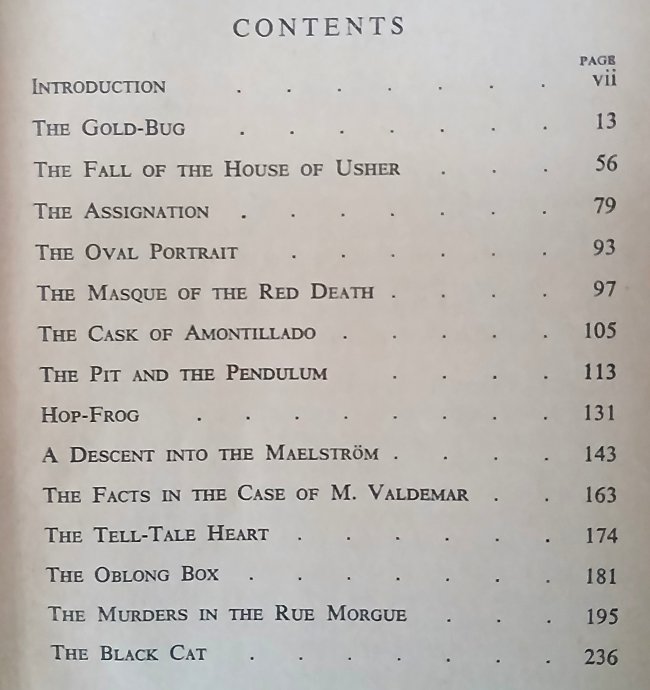
Below is the contents list for the collection I already had of Poe’s writings entitled ‘Tales of Mystery and Imagination’ and published in 1938. As can be seen the best known works are all here along with ‘Hop-frog’ which is the only tale in this volume that is missing from my latest purchase, so I have quickly read again that short story and enjoyed the tale of the revenge of two captive dwarfs who were being abused and made to entertain a medieval king and his courtiers. Yet again Poe surprises with his imagination and this story more than holds its own with the ones in the new book.


 Ramblings on my bookshelves