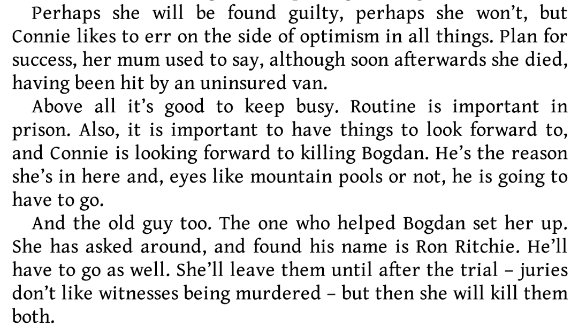
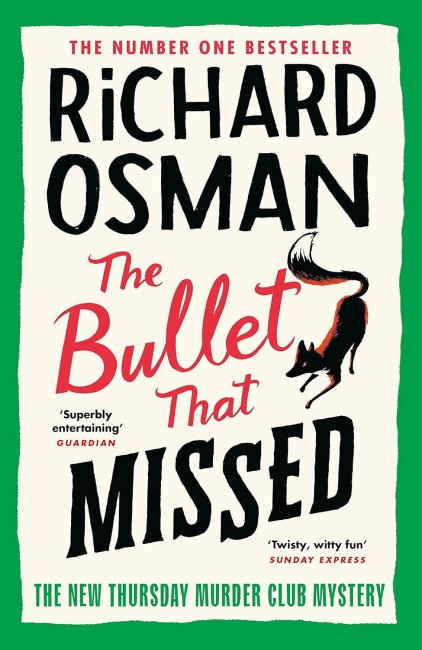
The Man Who Died Twice – Richard Osman

Earlier this year I read Richard Oman’s first novel and thoroughly enjoyed it, so it really was only a matter of time before I got to the second one. This continues the story of the four residents of a senior citizens residential village who originally got together to discuss unsolved murders and have now moved on to solving various current crimes, invariably including murder but not exclusively. One of the things I really liked about this book was the development of the characters from their first adventure, we gain quite a lot of new information on everyone, especially former spy Elizabeth who we now know as Dame Elizabeth Best, the title implying that she was even more senior in the service that previously suggested and from other comments that she had a reputation as one of the finest in her field. Fiery ex trade union leader Ron gets to show his gentle side as his grandson comes to stay, as well as becoming a highly effective ‘field operative’ for the Club and Joyce is braver and more intuitive than previously expected, although still so innocent that she chooses a combination of an old nickname and the year her daughter was born giving @GreatJoy69 as her Instagram user name, fortunately she can’t work out how to access her private messages. Her diary is again used as a mean of filling in story as she can review the days occurrences it’s a clever use of first person narrative in largely alternating chapters throughout the book. Ibrahim, the semi-retired psychiatrist, gets seriously mugged and kicked in the back of the head early on in the book and this puts him off leaving the retirement complex, or even his flat there, for a large part of the book. But it also drives the others to come up with a way of exacting revenge on his mugger in a way only they, and certainly not the police, could.

The remaining three have their work cut out dealing with £20 million worth of diamonds, the American mafia, an international crime go-between, a drug dealer, Elizabeth’s old employer MI6 or possibly MI5 it’s not made clear, and even Elizabeth’s ex husband whom he hadn’t seen for twenty years amongst others. Like the first book the plot is fast paced, full of twists and turns and the body count is surprisingly high for a book about four pensioners. We also find out more about the two local detectives who seem to have been seconded by the Club, Donna and Chris; along with the ever useful Polish builder Bogdan who has certainly gone up in the world since he killed off his main local rival in the first book and therefore got a lot more lucrative work. The book is full of humour as well, again not laugh out loud jokes, but humour nevertheless, it really is a fun read which is probably why less than twenty four hours after starting a 444 page book (I have the Waterstones edition with the extra chapter) I have finished it and am writing this blog.

The fifth book in the series came out last month and is of course already a bestseller, it seems that Osman can do no wrong with his septuagenarian detectives, although Ibrahim at least is now in his eighties and I hope to read many more books about them all. By the way I checked out the Instagram account and it is registered as belonging to Joyce Meadowcroft from the book, well done Richard Osman or possibly Penguin Books for not only having the account but posting pictures of her dog Alan and trips out exactly as I would expect Joyce to do. Much more sensible than Douglas Adams who used his own phone number in the first Hitch-hikers Guide to the Galaxy book and had to get his phone number changed when people started ringing it.

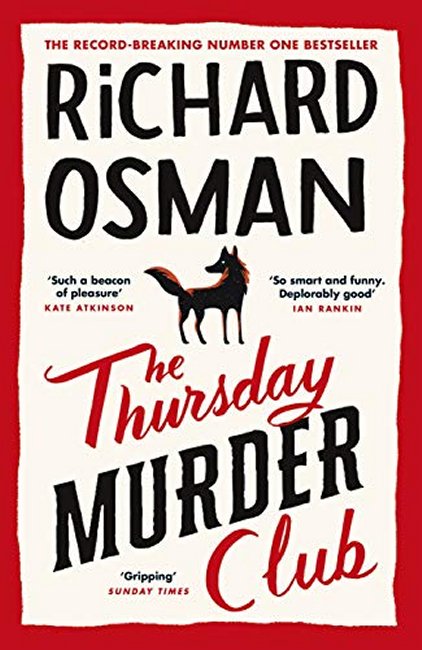
The Thursday Murder Club – Richard Osman

Whilst browsing the shelves of the local charity shop I spotted this book and picked it up immediately as I had been told several times that I would like it and the various people who recommended it were quite correct as I read the 377 pages over the space of two evenings. I probably would have read it in one go but there is a natural break point at page 172 and I decided to follow the structure of the book and reflect on what we had been told so far and the latest surprise murder that had just occurred.

Richard Osman himself helpfully summarised the four members of The Thursday Murder Club and what the club is all about in his notes for American reading clubs:

I am writing to you from England, home of Agatha Christie, Hugh Grant, and books about being murdered in quaint country villages.
Welcome to ‘The Thursday Murder Club,’ a group of very unlikely friends in their mid 70s. There is Joyce, a quiet but formidable former nurse; Ron, a retired Labour activist, still on the look out for trouble; Ibrahim, a psychiatrist and peacemaker, and Elizabeth, a . . . well no one is quite sure what Elizabeth used to do, but she seems to have contacts in very high places.
Once a week our four unlikely friends, all residents in a luxury retirement community, meet up to investigate old unsolved police cases—usually accompanied by friendly arguments and many bottles of wine.
One day the peace of their community is shattered by a real-life killing, and ‘The Thursday Murder Club’ decide they are just the people to solve the case.

For a murder mystery it’s quite funny with the interaction between the various characters being beautifully written as an example there is one murder where the victim was injected with Fentanyl whilst in close proximity to sixty odd residents of the retirement village and Joyce says ‘It would have to be someone with access to needles and drugs’ only to be told ‘That’s everyone here’ by Elizabeth, simply pointing out that due to age a lot of the residents are self medicating for diabetes amongst other conditions and what would normally be seen as a clue in this case definitely isn’t. But there is a lot of wisdom and experience in our team of self appointed detectives and with Elizabeth’s range of contacts all over the place they can do things the Police can’t either because they would be too obviously looking into things or because it would be either illegal or nearly so. Chris and Donna, the police officers assigned to the original murder gradually come to respect the Thursday Murder Club and their effective, if unorthodox, methods of getting information. The clues range from decades old gangland killings to links with Cypriot criminal families and always the club members are at least one step ahead of the police. I don’t want to say more in case I accidentally say too much but I heartily recommend The Thursday Murder Club and I suspect that recommendation would also apply to the subsequent novels that Osman has written about them.

This was Osman’s first novel, which he wrote over ten months whilst keeping the fact he was writing it a secret from most of the people who know him. But when he revealed its existence to publishers there was such a bidding war that he had a seven figure advance from Penguin Random House to get the book for their Viking imprint. Until the smash hit of his Thursday Murder Club series of books Osman was better known as a television producer, initially for Hat Trick Productions and then as Creative Director of Endemol. During which time he created the TV quiz Pointless for which he ended up the other side of the camera for the first time as the co-presenter after taking the role in the demonstration version for the B.B.C. and then worked with Alexander Armstrong on the programme for twenty seven series before quitting to concentrate on writing.

Paint Your Dragon – Tom Holt

Chosen by way of a comedy interlude between two serious works, I actually have no memory of acquiring this book although I suspect it was part of a job lot of second hand fantasy novels I bought in the early 2000’s most of which have been read and passed on to other people who might be interested. This is the only book by Tom Holt I own, although he has written over seventy novels along with numerous novellas and short stories in his own name and that of K J Parker since giving up his original job as a solicitor in Somerset. As I have probably owned this book for a couple of decades it seems only right to finally read it especially when I read the back cover and it sounds intriguing…

To my surprise this retelling of the George and the dragon story is largely set in modern day Birmingham (England not USA). The local council has commissioned renowned sculptor Bianca Wilson to create a grand statue for the square outside the town hall and much to her amazement she finds herself selecting George and the dragon as the subject, very different to previous works of hers. It’s as though she is being led into the subject, and that’s because she probably is. One of the main premises of the book is that it is possible for the dead to inhabit a statue and effectively come alive again with the statue returning to flesh and blood when it is possessed. The first inkling that Bianca gets that something is amiss is when she and her friend Mike arrive in her studio one morning and on the plinth is just St George, several tonnes of Carrara marble in the shape of a dragon has vanished overnight with no trace of the mechanical equipment that would have been needed to cut it from the plinth or lift it onto presumably a flat bed lorry. Even more oddly the next day the dragon is back and George goes missing and there is a bit of toing and froing over the following days before both statues disappear. In the meantime we are introduced to some more protagonists, to wit five demons that got left behind in the Cotswolds region of England on their way on holiday from Hell to a country music event in Nashville.

I really enjoyed the interplay between the demons, one of which is female and is attracted to the effective leader of the stragglers much to his obvious concern and the situations they get into when they get recruited by St George to help him win the big rematch with the dragon, because who says the saint has to be the good guy after all? The other main characters include Chubby who makes his money selling time to people who need it along with his worryingly sentient computer and Kurt, a professional hit-man who may or may not be dead already. Holt manages to keep the various sub-plots moving at a rapid pace but not so that you lose track of who is doing what, where and why and I loved that the most likeable characters are the least obvious contenders for that position and that St George is clearly a nasty piece of work who apparently won the first contest with the dragon due to a fix with a gambling syndicate so you are rooting for the dragon almost from the start of the book.

I really enjoyed this book and am now surprised I haven’t any more works by Tom Holt. From the evidence of this book he seems to fall into much the same comic fantasy genre as Robert Rankin with unbelievable things happening in a fully believable modern setting.

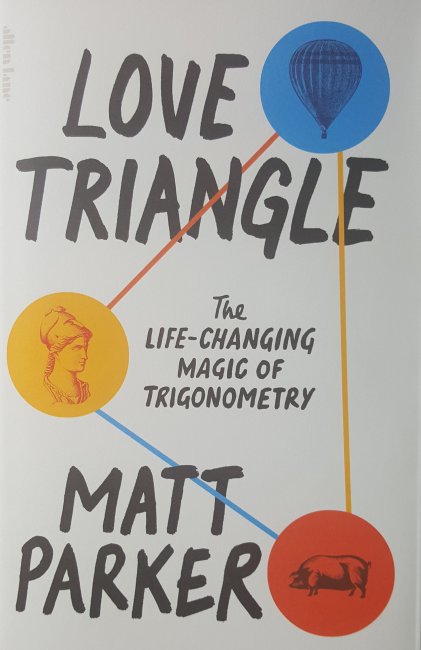
Love Triangle – Matt Parker

Yes this is a book about trigonometry, well actually it’s more about triangles and how important they are as we don’t get sines, cosines and tangents properly introduced until chapter seven entitled ‘Getting triggy with it’ which tells you all you need to know regarding the wordplay dotted throughout the book. I’ve covered one of Matt Parker’s maths books before, ‘Humble Pi‘ which deals with mathematical errors and like this book I bought it direct from Matt via his website which is full of things that no maths nerd should be without. The extra bonus of being one of the early orders is detailed below but of course the first extra you gain is that books ordered from the site are signed.

The first maths joke you encounter is the price which is £24.85 rather than the expected, and far more normal, £24.99 this is because 2485 is a triangular number of pennies, in this case a triangle with seventy coins on each side. If you’re not familiar with triangular numbers think of the snooker, or pool if you prefer, original setup with fifteen balls in a 5 x 5 x 5 triangle so fifteen is a triangular number with five on each side.

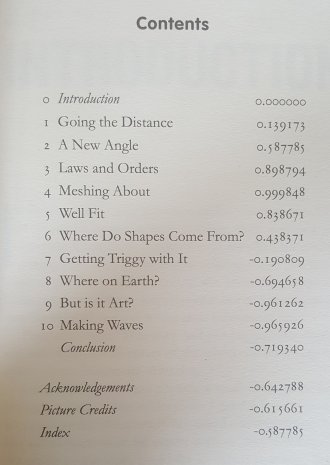
Below you can see the index and immediately you will spot something a little odd because, as he did in ‘Humble Pi’, the page numbering is a somewhat strange. In that book we start at page 314 and count down before hitting an overflow error and leaping up to a huge value, with this book the page numbers are the sine of the angle represented by the page number expressed to six decimal places so they start at zero range up to one and then slowly fall to minus one before rising again to -0.390731 (page 337 in a ‘normal’ book) and yes that does mean that most page numbers occur twice so finding things in the index is a little more tricky than you might expect, more on that later. I knew most of the maths covered in the book although I haven’t used trigonometry seriously for over forty years so a refresher course was interesting. I last had a practical use for trig about ten years ago when I was trying to hang sixteen pictures on a wall in a pleasing display of five on the top and bottom with six evenly spaced across the middle and needed to work out where all the nails should go, preferably before knocking holes in the wall.

The one ‘new’ formula that I hadn’t seen before, even though it is two millennia old was the truly ridiculous Heron’s formula, which gives the area of a triangle, normally expressed as ½ x base x height, but using only the lengths of the three sides a, b, and c without having to calculate the height. Instead you add the three values together, then add any two and subtract the third (for all 3 combinations) then multiply these four values together, extract the square root and divide by four.

Matt actually says “You might need to take a moment to sit down upon hearing that for the first time, I know I did”. Personally I was so confused by what appears to be a series of arbitrary calculations that I sat down and worked out some areas of triangles using ½ x b x h alongside Heron’s formula just to convince myself that it really worked.

And now we come to the index and here Matt has gone a little mad, in ‘Humble Pi’ the index gave the decimal position of the word you are trying to look up, so something given an index value of 23.5 would be half way down page 23. In this book Matt has gone for polar coordinates which is explained at the top of the index. This means that to use it properly you really need a protractor to determine the angle from the bottom left corner of the page. It would also help if he had somehow indicated which of the two possible pages had the page number referred to, for example the first entry ‘A Problem Squared’ is on the second occurrence of page 0.669131. Maybe a suffix r or f for rising or falling as you move along the sine wave of page numbers would work, in this case changing the page number, at least in the index, to 0.669131f

One fun section deals with British road signs that indicate the gradient of an approaching slope in the road. These are normally given as a percentage such as 20% for a 1 in 5 incline however apparently there are still signs which express the value as a ratio and Matt has deliberately left a gap in the text to insert a photo of him pointing at the sign as he fully expects readers who know where one of these is to tell him so he can go there.

Now onto the other reason for buying the book direct from Matt and that is the limited edition alternate covers available. Each of the first 8020 books bought from Maths Gear come with an extra cover with a special design and are all of these are initialled and numbered by Matt, see below.

To explain the extra cover I can do no better than to quote Matt’s website.

As a bonus for anyone who orders direct from me on Maths Gear, I have commissioned three (special, limited) × edition book covers as a collaboration between me and print-artist Paul Catherall. They’re pretty special. You’ll get one free while stocks last.

All books will be signed by me. All book covers will be signed and numbered by me. The first 1,001 orders will get a free “simplex edition” cover, the next 2,024 covers will be “tetrahedron edition” and the remaining 5,995 covers are the “triangle edition”. They will be assigned to orders in that order, so earlier pre-orders get the more-limited cover. Once the covers run out, people will have to be satisfied with just a signed first edition of the book.

I was early enough to get number 219 of the simplex edition, a simplex is the expression of a triangle in n-dimensions, in two dimensions you get a triangle, in three a tetrahedron, in four dimensions it’s a pentachoron etc. At the point of writing this there are still limited edition covers available but you would have to make do with the triangle design. Sadly 219 is not a triangular number, coming between 210 and 231 however there had to be something special about the value and a bit of digging revealed that 219 is the smallest number that is the sum of four positive cube numbers in two different ways i.e. 1 + 1 + 1 + 216 = 219 and 27 + 64 + 64 + 64 = 219. Thanks to the On-line Encyclopedia of Integer Sequences.

If all of this mathematics has potentially put you off, don’t be. Matt is an excellent presenter of mathematical examples and you really don’t need much grasp of mathematics to follow the majority of the book and you may well learn something, even if it is the crazy formula first written down by Heron of Alexandria over two thousand years ago and which apparently is used today when doing the conversion of file format from a digital image on a phone or digital camera to something that can be printed. So something that ridiculous turns out to have a modern practical application, and yes it surprised Matt as well.

Dear reader, I need you to believe me that I had already written the chapter about triangle laws where I called Heron’s Formula stupid (because it is) when I read the official HP documentation for this technique, and came across the sentence ‘The area of a triangle is given by Heron’s formula’. I honestly just pushed back my chair, stood up and silently left the room, for a walk outside.

Adolf Hitler My Part in his Downfall – Spike Milligan

Spike Milligan’s memoirs of his time in D Battery of the 56th Heavy Artillery during World War 2 are as he says in the preface accurate “All the salient facts are true, I have garnished some of them in my own manner, but the basic facts are, as I say, true”. I would say that most of the ‘garnishing’ is down to hindsight allowing more humour to come through than was probably the case at the time. Milligan kept a diary right trough his service years and kept in touch with many of the men he served with over the following years, not just at the annual D Battery dinner which he attended regularly, but also to cross-reference his own memories. He therefore used to get very annoyed with critics who, especially in the later volumes, accused him of making things up. The preface also says that it was planned to be a trilogy although ultimately he wrote seven volumes, of which I have the first four which cover his active service and were all written in the 1970’s. The remaining books “Where Have all the Bullets Gone?” (1985), “Goodbye Soldier” (1986) and “Peace Work” (1991) deal with his time being hospitalised after being wounded at Monte Cassino through to eventually being demobbed and the early days of his career in entertainment building on his skills honed as a trumpeter and guitar player in the battery, and later the NAAFI, bands.

This volume deals with the events from the outbreak of war in September 1939 through joining his regiment in June 1940 to his arrival in Algiers in January 1943. As you can tell from these dates he spent a large part of the war at various camps along the south east coast of England before finally being posted to North Africa to see active service where he worked as a signaller for the battery. As you would expect from a comedy writer of Milligan’s ability the stories of his military experiences are told with humour as are his various attempts at relationships with the opposite sex, some successful others less so, never rising above the dizzy heights of lance bombardier, and that only whilst in Europe, somewhat cramped his style with the ladies whom tended to prefer the officer class if available but he does document a few successes and their aftermath, the following section covers a couple of those successes and also gives a hint as to the style of the rest of the book.

“have been having it off in the back of a lorry, and I got carried away”. He doesn’t explain how Sergeant Hughes managed to get back from Hastings, presumably he didn’t care.

There are also a lot of descriptions of the banality of life in camp and the things that were done in order to relieve the boredom all of which are highly entertaining to read about. Milligan got jankers (disciplined for breach of regulations, usually being confined to barracks and assigned various menial jobs) on more than one occasion and describes his first punishment in the book. He was attempting to get coal up to his first floor barrack room by means of a bucket on a rope with the assistance of his good friend Harry Edgington, who loaded the bucket from the stores however this was on a day when fires were not permitted when there was a surprise inspection. Spike therefore stopped hauling on the rope but Harry misinterpreting this sudden pause yanked on the rope and pulled Spike backwards out of the window which was a bit of a giveaway.

A later section, on board the troop ship approaching Algeria gives a hint of the sort of humour that would make Spike Milligan famous whilst writing The Goon Show scripts for the BBC in the 1950’s with their lunatic extensions of logic.

It has been great fun reading this memoir again and I’m now inspired to read the other three that I have. I suspect the three final post active service volumes will be quite a bit darker as they will have to deal with his ongoing problems with mental health which saw him hospitalised several times.

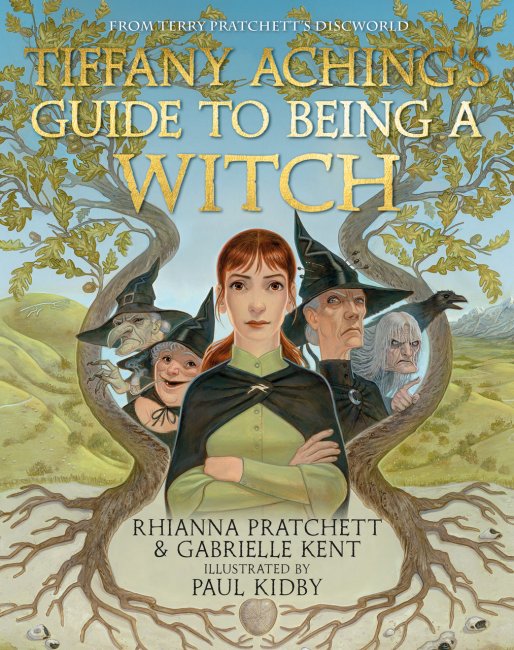
Tiffany Aching’s Guide to Being a Witch – Rhianna Pratchett & Gabrielle Kent

I’m writing this on Friday 10th November having received my copy of this book on the morning of its publication day, yesterday, and spent several happy hours reading it, finishing around 2:30pm yesterday afternoon. I think that tells you how much I enjoyed this first foray into her father’s literary world made by Rhianna and I hope that there will be more to come. When Sir Terry died Rhianna said that she would definitely not be continuing her father’s Discworld novels, and despite initial appearances this book does indeed stick to that line as it is another of the ancillary Discworld books such as Mrs Bradshaw’s Handbook, The World of Poo, the various atlases, or even the assorted diaries, maps, plays and guides all of which were written by people other than Terry Pratchett but based on his works with his approval and undoubted tinkering. Sadly Terry is no longer with us to give his blessings to this book but I’m sure he would have done so as Rhianna has stepped carefully into her father’s legacy with the assistance of Gabrielle Kent, whom I admit not knowing anything about other than she writes the Alfie Bloom series of childrens books, and the wonderful artwork of Paul Kidby who has signed my copy.

Based on the five ‘young adult’ Tiffany Aching books written by Terry , which include his final novel ‘The Shepherd’s Crown’, the book is beautifully designed as a guide to witchcraft by Tiffany but with apparently hand-written notes by other characters from these books such as witches Esme Weatherwax, Nanny Ogg, Miss Tick and the Feegle Rob Anybody along with additional notes from the witch Mrs Letice Earwig inserted so she can complain. Do you need to have read the books before reading this one? Frankly yes. Not only will you understand better what is being covered in the two hundred pages of this work but it basically consists of a huge number of spoilers for the other five books so you definitely don’t want to start here. Below is one of the pages from the main text (carefully chosen so as not to include any spoilers), all of which are full colour and covered in illustrations by Paul Kidby, it really is a pleasure to read the book and admire the artwork.

If you are intrigued by the illustration of the carved chalk figure behind the Feegle it is an accurate depiction of the 180 feet high (55 metres) Cerne Abbas Giant carefully censored by the appearance of the Feegle head to hide his most obvious feature and keep the book child friendly.

The text does contain a lot of original content but also consists of retelling, from Tiffany’s viewpoint, stories from the five Tiffany novels and also other tales from the Witches series of books going all the way back to the third Discworld title, ‘Equal Rites’ in 1987. Equal Rites told the story of Eskarina Smith, the only female wizard, whilst the forty first and final Discworld novel, ‘The Shepherds Crown’ in 2015, in a neat closing of a vast circle includes Geoffrey Swivel the only male witch, both of these characters feature in the new book. The pictures also go back over the decades with old illustrations intermingled with brand new work, some of the older depictions of the characters come from the now difficult to find calendars and diaries so it is good to see them re-used in a book where they can be appreciated by more people, Paul Kidby first started working with Terry back in 1993 doing artwork for the calendars and diaries and various other books but not the novel covers as these were the work of Josh Kirby, sadly Kirby died in 2001 and Kidby took over as the artist of choice by Terry for the novel covers and almost everything else and it is his depictions of the characters and places that are now most familiar to people.

I hope you enjoy the book as much as I did but make sure to read the five Tiffany Aching books first. These are, in order, ‘The Wee Free Men’ (2003) ‘A Hat Full of Sky’ (2004) ‘Wintersmith’ (2006), ‘I Shall Wear Midnight’ (2010) and ‘The Shepherd’s Crown’ (2015). You don’t need to have read any of the earlier Witches series of books before tackling these but they are good so why not? There is a final joke that I almost missed as it is on the back of the dust wrapper. Feegles will steal anything and here they are making off with the barcode block.

The Coronation of Haile Selassie – Evelyn Waugh

I’m planning on reading ‘Scoop’, Evelyn Waugh’s comic novel about the life of a foreign journalist in the coming months but remembered I had on the shelves an example of Waugh’s own time as a foreign reporter, namely his account of attending the coronation of Emperor Haile Selassie in Abyssinia, now Ethiopia. This occurred in 1930, eight years before he wrote ‘Scoop’ during which he was submitting stories for several newspapers in a freelance capacity. The main inspiration for ‘Scoop’ was when he was back in Abyssinia in 1935, this time on behalf of the Daily Mail covering the second Italo-Abyssinian war. Whilst he was not a great war reporter he did get plenty of material for his subsequent novel. But this link does make reading his stories about reporting in 1930 an ideal prelude to tackling ‘Scoop’.

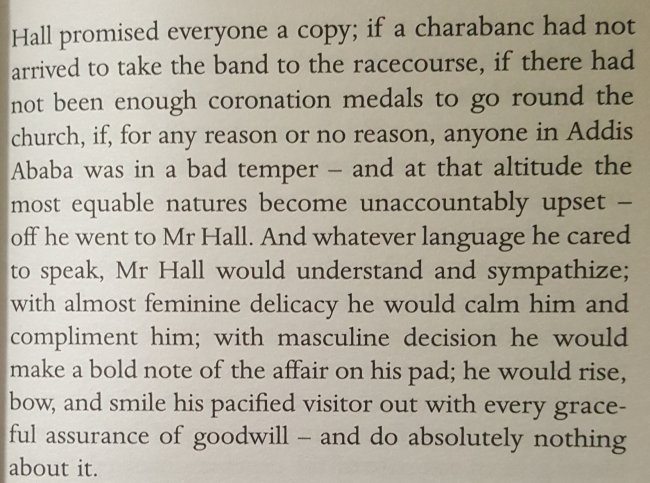
This Penguin 70 book is actually a couple of extracts from his 1931 travelogue ‘Remote People’, a book I’m now keen to track down to read more fully, but for now the two sections included here regarding the coronation and the apparently interminable journey to get home from it are all I have and I have loved the dry humour and observation of detail that are a trademark of his writing. He starts off by introducing a few of the people he has dealings with or are directly involved with the coronation or in several cases both in particular who was originally in Abyssinia as a trader but had somehow ended up as chief, and apparently only member of the bureau of foreign affairs and had an office in the centre of Addis Ababa, the country’s capital. Described as extremely handsome of German and Abyssinian descent he was also an excellent linguist and could apparently arrange anything even finding copies of the apparently non-existent coronation service…

In this last statement Mr Hall appears to be no different to anyone else Waugh has to deal with or indeed just observes. Addis had been the capital for almost forty years by then but large parts of it was still under construction. The hotel the British Marine band had been quartered in lacked a roof and building work all over the city was making very little progress as the workmen would apparently simply stop if they weren’t under constant supervision. Throw into this chaos the organisation of a coronation and the consequent arrival of foreign dignitaries along with the world media to cover it and the difficulties of communication both inside and outside the country and it’s a wonder anything progressed to any sort of a plan. This is where Waugh had an advantage over his fellow representatives of the press he didn’t have a daily newspaper to serve that needed something all the time he could wait and write accurately what happened unlike others he derided such as Associated Press which sent in totally fictitious accounts of the ceremony because of time constraints needing copy before it had even started. Mind you those members of the press that waited to get at least accurate reports of the first part of what turned out to be an interminable event discovered that the only telegraph office in the city had closed for the day so they couldn’t send their reports anyway.

The book doesn’t have any of Waugh’s actual reports in it, rather it is a diary of his experiences both in the lead up to and being at the coronation and the six days of feasting and celebration that followed for the royal family and the numerous tribal leaders that attended and it is at times both an important historical document and also extremely funny. The second account included in the book is entitled ‘First Nightmare’ and describes how Waugh attempted to get at least part way home with ships and trains being either cancelled, not turning up even when expected or even taken over by a Princess and her retinue who could just bounce all the passengers who had managed to find seats out of Abyssinia back out of them again. In all Waugh takes four days to go from Harar to Aden, a distance of 311 miles (500km) with numerous hold ups and false hopes of possible means of moving forward and you can feel his frustration building. At the time Aden was part of the British Empire and regular ships travelled back to the UK all he had to do was get there but it proved incredibly difficult.

I’ve really enjoyed this short book and am now looking forward to reading ‘Scoop’, probably early next year by the look of the planned reading list I already have for the rest of 2023.

Confessions of a Bookseller & Remainders of the Day – Shaun Bythell

Shaun Bythell’s first book, ‘The Diary of a Bookseller‘, was one of the very first books I reviewed on this blog back in January 2018. Since then he has written three more books, two of which continue his diary of owning the largest secondhand book shop in Scotland, which is in Wigtown and it is these two books I have read this week. The diaries cover the following periods:

  • The Diary of a Bookseller – Published 2017 – covers Wednesday 5th February 2014 to Wednesday 4th February 2015.
  • Confessions of a Bookseller – Published 2019 – covers Thursday 1st January 2015 to Thursday 31st December 2015
  • Remainders of the Day – Published 2022 – covers Friday 5th February 2016 to Saturday 4th February 2017

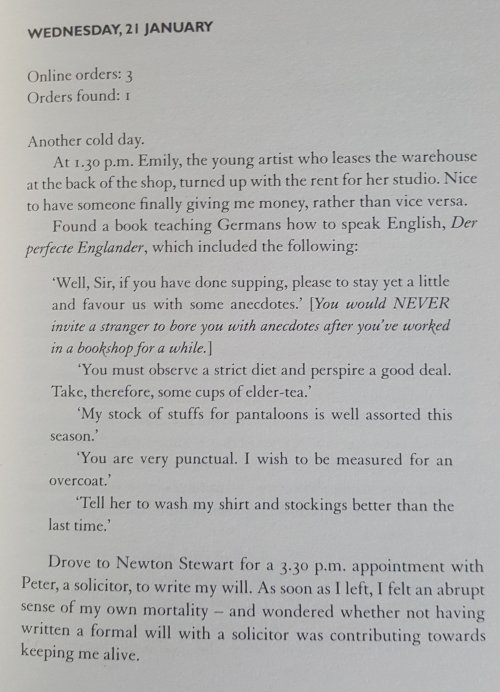
It was only as I typed the list above that I realised that there is a five week overlap between the first two books so had to get ‘The Diary of a Bookseller’ off the shelf to compare the entries. They are completely different even down to the number of orders, customers and shop takings.

Wednesday 21st January – Diary of a Bookseller

Wednesday 21st January – Confessions of a Bookseller

As the third book, like the first, starts on the 5th of February I’m left wondering if the 1st January to 4th February in Confessions and which are clearly labelled 2015 are actually entries for 2016 transposed to the start by an overzealous editor who assumed that a diary should be for a calendar year.

The books are quite long, 328 pages for Confessions and 377 for Remainders but reading them just flies by and I finished both books inside four days. As I mentioned in my review of his first book I also own and run an independent specialist shop so the interactions with customers he details are frighteningly familiar and all the funnier for that. He has also noticed that anyone who comes through the door and says out loud “Oh I’m in heaven, this is just the sort of shop I love”, or words to that effect never buy anything, but will inevitably spend a lot a lot of time wandering round the shop and moving stock from shelf to shelf whilst not doing so. This means that you then have to spend even more time putting things back where they should be so that actual customers have a chance of finding them. I’m going to lend the books to my staff as I’m sure they will appreciate them as well and I’m thankful I don’t have staff as mad as Shaun seems to.

A few months after writing my review of The Diary of a Bookseller in 2018 I met Shaun in Hay on Wye, the Welsh book town that Wigtown has modelled itself on, lots of book shops all in one small place may sound like overkill but it really works by making the town a specific destination for collectors and there are few things I love more than wandering round book shops. Shaun was being interviewed by Jasper Fforde as part of a book collectors Instagram event which the owner of my local secondhand bookshop and I had also given a talk at a couple of days earlier on the subject of collecting Penguin books. Shaun came over as a really nice person but then again I wasn’t trying to buy a book off him at the time, I still haven’t made it to Wigtown but I’m determined to get there, in fact I just checked and it’s 285 miles from where I live and would take just over five hours to get there, the Google maps picture of the shop is from this month and shows a copy of Remainders of the Day in the right hand window along with the inevitable large number of boxes of more stock just inside the door and by the other window.

The Struggles of Brown, Jones & Robinson – Anthony Trollope

The Struggles of Brown, Jones & Robinson, as the book is properly titled, is one of Trollope’s less well known and even lesser read novels. I don’t know why The Folio Society in their complete Trollope novels series decided to drop ‘The Struggles of’ from the title other than the probable difficulty of fitting all the words into the standard spine layout for the series. That this is a relatively unknown work can be judged by its sporadic printing history and the fact that even The Trollope Society themselves largely dismiss it in a single paragraph write up and that the list of primary characters on that web page fails to mention any of Mr Brown, Mr Jones or Mr Robinson. I mentioned the printing history because it is so odd for a novelist of the stature of Trollope, Longman along with Chapman & Hall both declined the novel and it first appeared in eight monthly parts in The Cornhill Magazine in 1861/2. Despite being written in 1857 it didn’t appear as a book until American publisher Harper’s Library issued a copy in 1862, the first British edition was Smith, Elder’s (who also published The Cornhill Magazine) copy in 1870, there then followed another American edition in 1882 and then nothing for ninety nine years!

It largely seems to have been reprinted since 1981 as part of sets of complete works with no publisher judging it sufficiently commercial to make it a stand alone book in its own right. Indeed even The Folio Society, whose copy I have, left it to the last to be printed of the forty seven Trollope novels in their complete set which they started in 1989 with ‘Can You Forgive Her?’ and finally finished in 1999 with this book and then topped off the collection with Trollope’s autobiography. There isn’t even a Wikipedia entry for the novel. With all that in mind it was with some trepidation that I decided to see if it was really that bad.

Happily the answer is no, and whilst it isn’t a great novel I definitely enjoyed it both as a satire of the advertising industry and a tale of intertwined relationships. To set the scene Mr Brown becomes a widower at the start of the book and gains control of his wife’s butter business which he has no interest in so subsequently sells. He has two daughters Sarah Jane who had married Mr Jones and Maryanne who is single but has promised marriage to Mr Brisket, the butcher. Mr Robinson has fallen in love with the flighty Maryanne to the extreme annoyance of the much larger butcher who several times threatens him with violence if he doesn’t stay away from her. Oddly the three title characters subsequently start a business together selling haberdashery which none of them know anything about, with Brown putting up the money, Jones being the floor manager and Robinson in charge of advertising, he also takes charge of the decor and uniforms in the shop which is themed around the recently invented colour, magenta. The original capital in the business is stated as £4,000, which is the equivalent of around £365,000 today, a massive sum to start a small business with, but right from the off the partners, encouraged by Robinson, planned big with significant premises at 81 Bishopsgate Street and a significant amount of staff to match. What they didn’t have was much stock as Robinson was convinced that spending a lot on advertising would bring people in and then you could sell them what you had, rather than what you had promised you had.

It is not only Robinson’s extremely expensive advertising ploys, which range from horse riding knights in armour, to liverymen handing out leaflets but Jones’s dodgy selling which involved putting high quality items in the windows with low prices then actually selling similar looking but lower quality items to the customers for the same price which leads to the reputation of the business starting to fall away. Brown meanwhile is still dealing badly with his two daughters who see their inheritance frittered away in the business whilst he banks less than the actual takings and salts some away from himself. It’s difficult to find a single likeable character in the book with the possible exception of Robinson who is more naive than criminal, Brown’s two daughters are truly horrible and I rejoiced when Maryanne, after playing Brisket and Robinson off one another throughout the book ends up with neither of them and both count themselves lucky to be rid of her.The firm needless to say burns through the large amount of capital it started with in about a year and goes bust, a story that could be applied to numerous businesses that have more ideas than plans or solid foundations. It would have been interesting to see what Trollope would have made of the various overinflated dotcom and IT companies and dodgy banks built on loans to them over the last twenty years but ‘The Struggles of Brown, Jones and Robinson’ is an excellent primer on dubious companies living well beyond their means but believed to be sound right up until they crash. It may not ever have been rated highly but it should be read by anyone looking to start, or invest, in a company in the present day.

The forty eight Trollope books in the complete works set by the Folio Society.

Dirk Gently’s Holistic Detective Agency – Douglas Adams

This is the 275th entry in this blog so by way of something different this is not so much a ramble along my bookshelves as a wander through my record collection. But it does concern two books, specifically the two Dirk Gently novels by Douglas Adams in the form of the wonderful adaptations done by Dirk Maggs and John Langdon for B.B.C. radio in 2007 and 2008 and first released on vinyl by Demon Records in 2020 and 2021. Each is a triple album with an episode a side so a total of six hours of listening pleasure and boy is it a pleasure. Dirk Gently is a Holistic detective in that he uses apparently unrelated objects and experiences in order to solve his cases, the stories are also very funny. The pressings are high quality coloured vinyl which along with the design of the sleeves and liners add considerably to the joy when I first unpacked them.

The cast is also superb with Harry Enfield playing Dirk Gently, Olivia Colman is Janice his long suffering secretary, Billy Boyd is Richard MacDuff and Jim Carter is Detective Sergeant Gilks. These four appear on both sets of records with other cast members including Andrew Sachs, John Fortune, Jan Ravens and Peter Davison to name just a few. There are also several stalwarts of the Hitch-Hikers Guide to the Galaxy radio series, the original scripts of which I reviewed here, such as Stephen Moore, Michael Fenton Stevens and Philip Pope who also wrote the incidental music for both Dirk Gently series. By the very nature of cutting both books down to three hours each when the Audible recordings of the books being read are just short of eight hours each clearly a lot has been lost, but this is true of any dramatisation and frankly I largely prefer the audio dramatisations to the books, especially The Long Dark Tea-Time of the Soul for reasons I will explore when I get to that section.

Dirk Gently’s Holistic Detective Agency

This was probably originally Douglas’s attempt to get some use out of a script he had written for Doctor Who called Shada which had been abandoned shortly after filming had started due to a strike by B.B.C. technicians. The similarities between the two works are obvious and whilst Douglas removed the specific Doctor Who references and merged in part of the plot of City of Death, another Doctor Who serial he wrote, the central character of Cambridge professor Chronotis having a time machine and living for centuries remains the same. In Shada he was a Time Lord, in Dirk Gently it is never explained who or what he is but they do use his time machine, which is actually his rooms in college, to travel to an ancient spaceship orbiting the Earth and back in time four billion years to the start of life on the planet. The new material concerns a character Gordon Way who is killed right at the start but continues to appear as a ghost trying to contact the living and explain what happened and it is his death that Dirk Gently ultimately solves in proving that his client Richard MacDuff didn’t do it and Way was actually killed by an ancient and malfunctioning robot from the orbiting spaceship.

This adaptation is pretty faithful to the original book, which can not be said of the second recording for reasons explained below.

The Long Dark Tea-Time of the Soul

The title of this book comes from another of Douglas’s works, the third of the Hitch-Hikers books, and is said of Wowbagger the Infinitely Prolonged, an immortal character who was not born to immortality and was therefore not prepared for it.

In the end, it was the Sunday afternoons he couldn’t cope with, and that terrible listlessness which starts to set in at about 2:55, when you know that you’ve had all the baths you can usefully have that day, that however hard you stare at any given paragraph in the papers you will never actually read it, or use the revolutionary new pruning technique it describes, and that as you stare at the clock the hands will move relentlessly on to four o’clock, and you will enter the long dark teatime of the soul.

Life, The Universe and Everything – Douglas Adams

The original book is somewhat complicated and jumps around rather a lot as Douglas keeps track of the various characters and this meant that Dirk Maggs had to do a severe rewrite in order to produce something that would work in six episodes without completely confusing the listener. He also brought back Richard MacDuff, who doesn’t appear in the book, and made him a character in this version, there are also a lot of added Hitch-Hikers Guide to the Galaxy references as Dirk had recently adapted books three, four and five of that series into radio productions. It also features a fridge that has not been cleaned for months and eats the person who first tries to do so. A client for Dirk is later found ‘listening’ to an album but unfortunately it is jumping mainly because the arm is bouncing off his severed head which is now on top of the turntable. There are also major character appearances for Odin and Thor and the explanation as to where Asgard can be found in modern London and how Janice, now an innocent Heathrow airport check in clerk, became cursed and turned into a drinks machine.

Douglas Adams had been working on and off on a third Dirk Gently book intended to be called The Salmon of Doubt up until he died, and this work, along with other unfinished pieces was eventually published as The Salmon of Doubt in 2002. Dirk Maggs originally intended to dramatise this as well but plans were shelved by the B.B.C. before any work was done on this.