Summoned by Bells – John Betjeman

20190514 Summoned by Bells 1

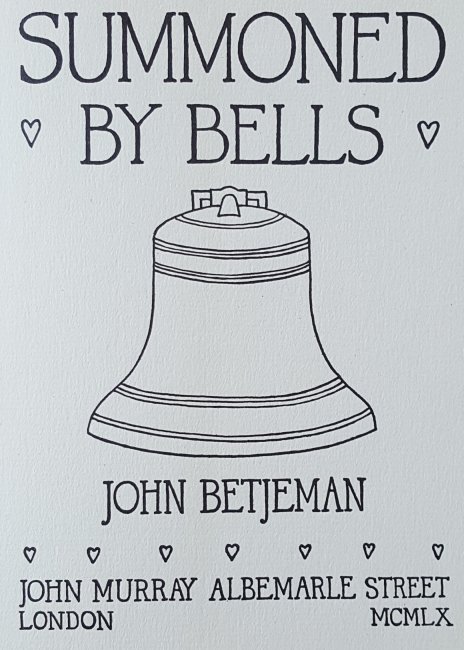
This autobiography in verse covers Betjeman’s early life from his Edwardian childhood (he was born in 1906) to his university days at Magdalen College in Oxford where he was taught by C.S. Lewis. The book was first printed in 1960 just as Betjeman was getting serious recognition as a poet with a dozen volumes published before this and it is also the year he received The Queen’s Medal for Poetry and was made a CBE. The verse has his characteristic humour but also darker times like describing being bullied at school. It is uncharacteristic also in being, for the most part, blank verse, though he can’t stop himself at times, from adding in some parts in rhymes. The book is split into nine chapters as we follow him growing up.

We start in Highgate where the family had moved when he was three years old, they were clearly relatively well to do as they owned a four wheeled carriage and regularly holidayed in Cornwall. Apart from Maud, his overbearing nurse, who seemed to delight in punishing him for slight misdemeanors he appears to have had a happy childhood up until he went to school. Apart from one traumatic incident that clearly haunted him right up to his fifties when he wrote the lines on just the second page of Summoned by Bells.

Safe were those evenings of the pre-war world
When firelight shone on green linoleum;
I heard the church bells hollowing out the sky,
Deep beyond deep, like never ending stars,
And turned to Archibald, my safe old bear,
Whose woollen eyes looked sad or glad at me,
Whose ample forehead I could wet with tears,
Whose half-moon ears received my confidence,
Who made me laugh, who never let me down,
I used to wait for hours to see him move,
Convinced that he could breathe. One dreadful day
They hid him from me as a punishment:
Sometimes the desolation of that loss
Comes back to me and I must go upstairs
To see him in the sawdust, so to speak,
Safe and returned to his idolator.

His father was the third generation owner of a silversmith and cabinet making business and was very disappointed in John because he refused to carry on the firm and all this is covered in the second chapter of the book. In this edition each of the chapters has a small line drawing by Michael Tree and a brief summary of what will be covered. The description of the workshops for the business in this section and the hours that John spent clearly enjoying himself with the craftsmen employed there made it all the more galling for his father when he later expressed no interest in continuing it

To all my father’s hopes. In later years,
Now old and ill, he asked me once again
To carry on the firm, I still refused.
And now when I behold, fresh-published, new,
A further volume of my verse, I see
His kind grey eyes look woundedly at mine,
I see his workmen seeking other jobs,
And that red granite obelisk that marks
The family grave in Highgate cemetery
Points an accusing finger to the sky.

20190514 Summoned by Bells 3

Chapter three has him at school and being bullied at both his junior schools, he seems unclear why at the first one but at the second his apparently German surname in 1913/4, spelt then Betjemann, led to him being picked on by gangs and having to come up with various routes home to avoid them. Ironically the family was actually originally Dutch and the additional ‘n’ was added when they came to the UK over a century earlier but soon Britain was at war with the Netherlands, so they wanted to appear German. During WWI the second ‘n’ was quietly dropped again. Chapter four and the family is on holiday in Cornwall leading to the start of the young Betjeman’s love affair with railways and the English countryside.

20190514 Summoned by Bells 2

Chapters five and seven describe his private education, first at Dragon preparatory school in Oxfordshire and then Marlborough college in Wiltshire. His time at Dragon appears to have been pretty happy and exploring by bicycle leads him to churches and that other great love of his throughout his life, architecture. Marlborough however was a more difficult time, there are stories of beatings and the prefects birching the boys and terrorising them as a group known to the younger boys as “Big Fire” because of where they sat in the evenings. A boy who had transgressed would be called to “Big Fire” for a beating or sometimes worse. I skipped chapter six which covers being back in London during holidays exploring the London Underground and buying books, the family had moved to Chelsea and the bookshops abounded

Untidy bookshops gave me such delight,
It was the smell of books, the plates in them,
Tooled leather, marbled paper, gilded edge,
The armorial book-plate of some country squire

I’m with Betjeman all the way with those sentiments.

20190514 Summoned by Bells 4

The summary above of chapter eight pretty well covers it, his father is even more dominating than before but now John is big enough to escape and does so on long cycle rides round the area discovering yet more churches.

The final section deals with his years at Oxford, a place he freely admits to doing little or no work at and certainly not studying for his degree. Instead he builds a wide social network which become extremely useful to him in later years

No wonder, looking back, I never worked.
Too pleased with life, swept in the social round,
I soon left Old Marlburians behind.
(As one more solemn of our number said:
“Spiritually I was at Eton, John”)
I cut tutorials with wild excuse,
For life was luncheons, luncheons all the way-
And evening dining with the Georgeoisie

How much of this lack of drive towards his degree was down to the mutual dislike between himself and C S Lewis it is difficult to tell, it’s quite possible that even with a more sympathetic tutor who may have got more out of him he would still have left without a degree. In the poem he blames a failure of the compulsory divinity course but in reality he really put so little effort into his studies that he was never going to pass.

The book is a fun read and so unusual in the use of verse throughout. I first read it many years ago and had forgotten how much I enjoyed it.


Toad of Toad Hall – A A Milne

20190507 Toad of Toad Hall 2

What could be better than a play written by one of the English language’s best known children’s authors based on the book by one of the others. A A Milne whilst famous for his tales of Christopher Robin, Winnie the Pooh and all his friends in The Hundred Acre Wood was also a prolific playwright and in 1929 he adapted Kenneth Grahame’s famous 1908 tale The Wind in the Willows for the stage. This year marks ninety years since the first production and the copy I have is the first American edition also from 1929 printed by Charles Scribner’s Sons of New York. The introduction is particularly interesting as Milne deals with the problems of adapting a book, particularly one as well known as The Wind in the Willows.

There are two well-known ways in which to make a play out of a book. You may insist on being faithful to the author, which means that the scene in the aeroplane on page 673 must be got in somehow, however impossible dramatically, or, with somebody else’s idea in your pocket, you may insist on being faithful to yourself, which means that by the middle of act III everybody will realise how right the original author was to have made a book of it. There may be a third way, in which case I have tried to follow it. If, as is more likely, there isn’t, then I have not made a play of The Wind in the Willows. But I have, I hope, made some sort of entertainment, with enough of Kenneth Grahame in it to appease his many admirers, and enough of me in it to justify my name on the title page.

Milne’s solution to condensing the book is to focus on the parts that feature Mr Toad. this means that a consistent central cast is established although Toad is actually only in roughly half of the original book. He also gets round the problem of just how big is everyone, after all Toad drives cars and owns a horse drawn caravan but is definitely smaller than Badger whom we know lives under a tree in the Wild Wood so must be ‘normal sized’ at least most of the time. by having the start of the first act and also the epilogue make it clear that all the action is actually the dream of a young girl called Marigold sitting with her nursemaid on the banks of the river on a warm spring morning, neither of which are in the original story.

In reading the book, it is necessary to think of Mole, for instance, sometimes as an actual mole, sometimes as such a mole in human clothes, sometimes as a mole grown to human size, sometimes as walking on two legs, sometimes on four. He is a mole, he isn’t a mole. What is he? I don’t know. And, not being a matter of fact person, I don’t mind. At least I do know, and still I don’t mind

This quote, also from the introduction, gets to the heart of the ‘problem’ with The Wind in the Willows. But the reason why I put the word problem in quotes is because it isn’t a problem and never has been to readers of the book who are just swept up in the story. But put it on a stage, with humans playing the characters, and the stage director definitely has a potential problem. This is solved by the dream concept and allows the tale to unfold seamlessly with everyone being human sized yet still being Mole, Ratty, Badger, Toad et al.

For all of Milne’s protestations above the play is actually remarkably faithful to the parts of the book being dramatised and the humour is wonderful. Especially for my mind those lines given to Alfred, the sarcastic, and feeling much put upon, horse pulling Toad’s caravan. Anyone who loves Eeyore in the Winnie the Pooh stories will love Alfred, he was created by Milne as the horse isn’t named and is only a bit and indeed silent player in the book but here he really comes alive…

Enter a horse pulling a gaily painted wooden caravan

ALFRED Oh, there you are. I’ve been looking for you everywhere
TOAD (excitedly) Now isn’t this lucky? Just at the psycho – psycho – what’s the word?
ALFRED (hopefully) Encyclopaedia, That is, if you ask me
TOAD I didn’t ask you. Ratty you know the word–
ALFRED Introduce me to your friends, won’t you? I do get so frightfully left out of it
TOAD My friends Mr. Rat and Mr. Mole this is Alfred
ALFRED Pleased to meet you. If you are coming my way, you must let me take you. Only I do like a little conversation (To Toad) Encyclopaedia, that was the word you wanted
RAT (Sadly) So this is the latest?
TOAD (Eagerly) Absolutely the very latest. There isn’t a more beautiful one, a more compact one, a more – what’s the word?
ALFRED Heavy
TOAD A more up to date one, a more –
RAT So this is the latest craze! I understand. Boating is played out. He’s tired of it, and done with it
ALFRED Don’t blame me. I wasn’t consulted about this at all; but if I had been, I should have said boats. Stick to boats.
TOAD My dear old Ratty, you don’t understand. Boating – well – a pleasant amusement for the young. I say nothing against it. But there’s real life for you (he waves a paw at the van) – in that little cart. The open road, the dusty highway, the heath, the common, the hedgerows, the rolling downs!
ALFRED And the ups. However nobody consults me. Nobody minds what I think.

The play starts with Marigold on the phone (actually a daffodil) pretending to call Mr. Rat who she eventually gets through to and sets the basis of the play as her fantasy as regards the main characters. Suddenly we hear elfin music, the stage goes dark, Marigold and her nurse vanish and the magic of the story unfolds with Mole appearing out of his hole and meeting Ratty for the first time. We are soon afterwards introduced to Badger and then Toad and the tale continues with the arrival of Alfred so they can go on a caravanning trip. Sensibly Badger declines to be involved. Caravanning doesn’t last long however, they are forced off the road by a furiously driven car and the only thing Toad can think of after that is having one of those; “Poop Poop” is all they can get out of him for quite a while. And so ends the first act.

Act two is set entirely within the Wild Wood home of the dangerous Stoats and Weasels. Initially with Mole getting lost whilst exploring in the snow and scared of the woods inhabitants before being rescued by Ratty. Then the two of them stumble over Badger’s house and decide to take refuge from the bad weather and the ever present danger from attack when wandering at night in the wood. Inside Badgers home all is comfortable and settled as you would expect from the residence of an older gentleman content in his own company. The three friends start talking about Toad and his motoring exploits, apparently he has already owned (and crashed) seven cars, they are just discussing what they should do to save him from himself when Toad himself arrives. He has crashed car number eight… Badger decides to keep Toad at his house until this current craze has passed but after a few weeks Toad manages to trick Ratty into leaving him alone and the act closes with Toad running off singing about how clever he is.

Act three starts in a courthouse with Toad on trial for stealing a car and then calling a policeman fat-face. Sentenced to twenty years for these heinous crimes, especially the being cheeky to a policeman we then find him in a cell. He makes his escape with the help of the jailers daughter and her washerwoman aunt who they bribe to let him wear her clothes and after a series of adventures, including stealing a bargee’s horse he heads for the river.

The final act starts with Toad at Ratty’s home where he is informed that during the four weeks he was incarcerated the Stoats and Weasels have taken over Toad Hall and a daring plan is formed by Badger to take it back. The final scene of the battle and aftermath is actually the only time Toad Hall appears in the play despite being in the title. Finally the short epilogue as mentioned earlier has Marigold asleep amongst the daffodils as her nurse wakes her to go home.

As can be seen from the above précis the play follows the book pretty well, and it is sometimes difficult to spot which author is responsible for what. Indeed I will leave the last word to the summary on the dust wrapper of the first US edition and a photo of the front of the dust wrapper which is a paler version of the book cover shown at the top of the blog

we in turn, might ask ourselves after reading this play: “Is it Kenneth Grahame? Is it A. A. Milne?” We don’t know, but it doesn’t at all matter, for it is perfect

20190507 Toad of Toad Hall 1

The Eyre Affair – Jasper Fforde

Jasper Fforde’s first novel also introduces his main protagonist, Thursday Next, an agent for LiteraTec Special Operations who has now appeared in seven books by Fforde. The books exists in an alternate history where, in the case of this book, the year is 1985 and the Crimean War is now into its 135th year, there are companies commercially genetically engineering extinct species so a popular pet is a dodo and Special Operations includes division 27 which looks after works of literature. In fact literature seems to dominate society with people changing their names to that of famous authors to such an extent that they are legally obliged to have a number tattooed on them to identify which John Milton you are talking to for example. There is also the Goliath Corporation a firm that has made billions in financing the Crimean War and seems to have various shadowy sidelines of it’s own which are strictly for the good of the corporation.

A running trope through this book is “Who wrote the plays attributed to Shakespeare?” sometimes there are short discussions regarding Bacon or Marlowe and in one tedious section which ruins the flow of the plot a whole series of pages are dedicated to this discussion for no good reason whatsoever.

20190423 The Eyre Affair 1

The book after all is theoretically about Jane Eyre, although in fact for almost half the story it is about Martin Chuzzlewit. The basic conceit of the book is that there is a master criminal who obtains a machine invented by Thursday’s uncle Mycroft which allows people to travel in and out of works of literature. Archeron Hades steals the original manuscript of Charles Dickens’ work, removes one of the minor characters and has him killed in the present day. This changes all copies of the book, even those already printed, and he threatens to do the same to Chuzzlewit himself unless a ransom is paid.

For various reasons the plot is foiled and the ransom not paid but Hades escapes to the fiercely independent Republic of Wales where he cannot be followed by English justice, only to try again by this time stealing the original manuscript of Jane Eyre and kidnapping Jane herself immediately before she rescues Mr Rochester from his flaming bed. All copies of the book are therefore much shorter and there is uproar. Thursday Next is sent to get Jane and the book back together.

As implied above there are numerous sub plots, in fact far too many sub plots, as the book is overly complicated by them. You get the feeling that Fford is trying to show off his literary erudition at the expense of just telling a good story and there is definitely a good story to be found in there if you work at it. I’m inclined to forgive him as this is his first published work and I will definitely read at least the next volume about Thursday Next entitled “Lost in a Good Book” which is set a few months after “The Eyre Affair”.

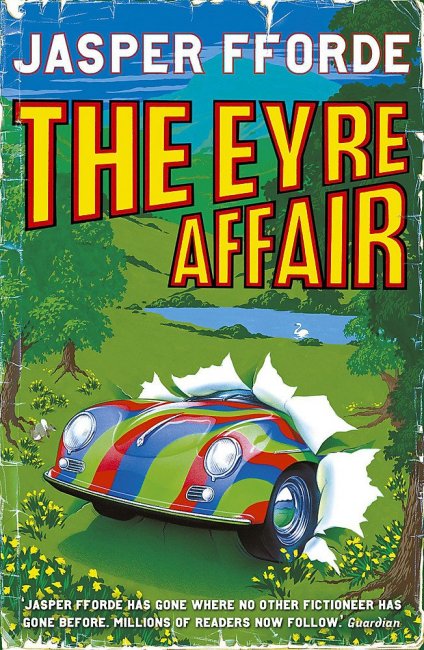
The book cover by the way is printed to look as though it is rather dog-eared, my copy is brand new.

Chapter 13

There is an ongoing joke in Fforde’s books regarding chapter thirteen or rather the lack of one. If there are numbered chapters then there is always one listed in the contents at the start but in fact chapter 14 always immediately follows chapter 12 and the page given for chapter 13 to start is either blank or part way through chapter 12. They do however have titles:

  • The Eyre Affair – The church at Capel-y-ffin
  • Lost in a Good Book – Mount Pleasant
  • The Well of Lost Plots – Reservoir near the church of St Stephen
  • Something Rotten – Milton
  • First Amongst Sequels – Cross Lewis’ number
  • One of Our Thursdays is Missing – 14th May 1931
  • The Woman Who Died a Lot – A Penguin
  • The Big Over Easy – First on the right
  • The Fourth Bear – 111110000

Note: assuming 111110000 is binary then the decimal equivalent is 496, it is anyone’s guess if this is significant or if there is any meaning to the choice of titles for the missing chapters; although the 14th May 1931 was a Thursday.

The Antipope – Robert Rankin

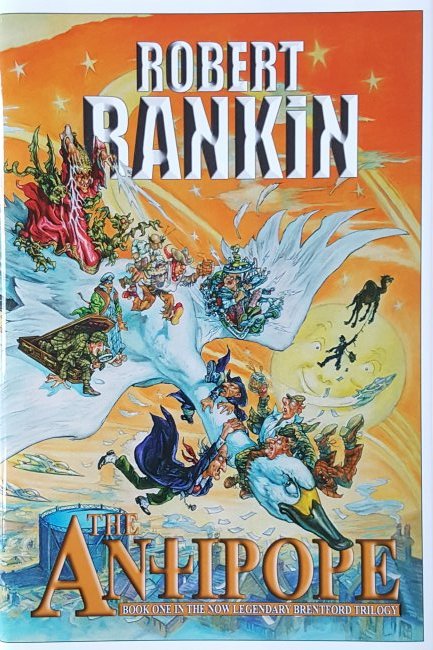
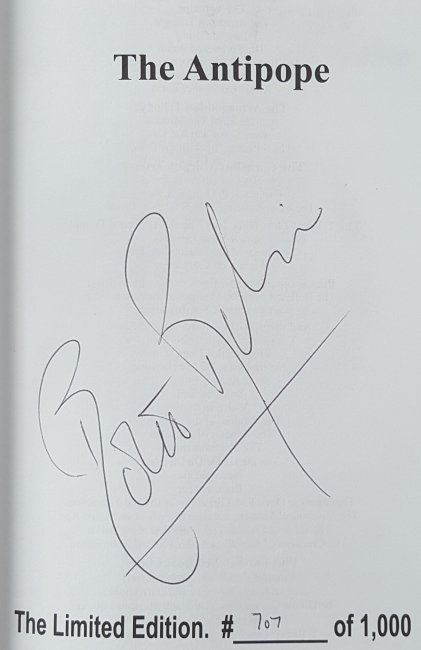
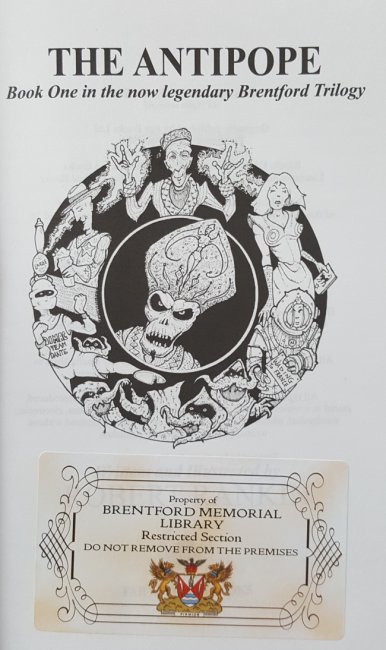
The first in the increasingly inaccurately titled Brentford Trilogy (currently eleven books with at least one more to come, which is claimed to be the last of the series) The Antipope also has the most straight forward title. Rankin has a passion for punning titles but as this was also his first ever book, originally published in 1981, maybe he felt something more mainstream was required. My copy is the 35th anniversary limited edition privately published by Rankin and signed by him, it is also the first time the book has appeared in hardback. Rankin himself describes his work as far fetched fiction, indeed his privately published volumes are by Far Fetched Books, at the time of writing the limited edition of The Antipope was still available and is illustrated internally by the author, the cover is by the brilliant Josh Kirby

20190402 The Antipope 1

The full list of Brentford Trilogy books so far is as follows; and from this you can see his love of wordplay with other book titles and songs:

  1. The Antipope (1981)
  2. The Brentford Triangle (1983)
  3. East of Ealing (1984)
  4. The Sprouts of Wrath (1988)
  5. The Brentford Chainsaw Massacre (1997)
  6. Sex and Drugs and Sausage Rolls (1999)
  7. Knees Up Mother Earth (2004)
  8. The Brightonomicon (2005)
  9. Retromancer (2009)
  10. The Lord of the Ring Roads (2017)
  11. The Chronicles of Banarnia (2018)

The Brightonomicon and Retromancer (2009) are included above although they aren’t in the list of Brentford Trilogy books at the front of this book which only has the first seven but equally on the dust wrapper it says:

The Antipope was the first book in the Brentford Trilogy which now includes at least nine books and will feature one more with the launch of The Lord of the Ring Roads – the first book in a new Brentford Trilogy – some time in the not too distant future.

The reason for the confusion in the number of books to be officially counted in the series is probably due to the appearance of several characters from the set appearing in other books by Rankin which means that those may, or may not, be part of the canon. The books also do not appear to have a specific reading order; things that happen in one book are ignored in later volumes, characters even reappear when they were apparently killed off or written out in earlier books and never with any explanation. Individual volumes are consistent within themselves however just don’t expect a sweeping narrative across them all.

20190402 The Antipope 2

Brentford itself is one of the least eventful places in the UK and certainly contests strongly for the top spot for this amongst towns within Greater London. Looking on the time line on the wikipedia page reveals that the only act worthy of mention in the last ninety years is the 1965 opening of the elevated section of the M4 motorway, an opportunity the express road took to bypass Brentford entirely. This makes the location all the funnier for the ‘far fetched fiction’ that Rankin has take place there and the cast of odd characters that populate the books. Chief amongst these are John Omally and Jim Pooley who are the reluctant, and frequently drunk, heroes of the book. They are never happier than when enjoying a pint of large in The Flying Swan served by Neville the part time barman at that establishment. It should be noted that Neville appears to be the only barman at the Flying Swan so he does seem to be full time although is always described as the part time barman. The other main characters for this tale are Professor Slocombe who understands more than most what is going on and guides the characters to the ultimate defeat of the Antipope; Norman Hartnell (always described as not to be confused with the other Norman Hartnell) who is a mad inventor and runs the newsagents; Soap Distant explorer of the inner Earth; Captain Carson from the Seaman’s Mission and Archroy who, at least at the start of the book, is working at the local rubber factory.

20190402 The Antipope 3

The plot starts with the arrival in the Flying Swan of

a beggar of dreadful aspect and sorry footwear

All those who encounter him feel compelled to cross themselves even if they are not Catholic and he slowly encounters most of the main protagonists most especially Captain Carson as he moves in and then takes over the Mission house. Quite what a seaman’s mission is doing in Brentford is also a mystery, the town is on the Thames but a long way from the sea. The plot gets odder and odder with each flight of fantasy by Rankin including ‘magic’ beans, vast underground chambers, an attempt to wade the English Channel and a cowboy night nobody will ever forget amongst other things.

Now I’m going to have to read the others in the series…

To conclude with Robert Rankin’s own explanation of Far Fetched Fiction from a 1999 interview in Dublin

 I’ve said this before, when I went into writing I wanted to create a new genre of fiction that wasn’t like anybody else’s. It was going to be called Far Fetched Fiction, I would have my own book shelf in Smiths, with just my books in them and it would be bliss. But it didn’t quite work out like that, I ended up in a general fiction section, and then they realised that I didn’t write general fiction and I ended up in science fiction, which I feel a bit of a fraud for being there. Because people who write science fiction don’t know what I write, and… I’ve forgotten what I was going to say, what was I going to say?

Sourcery (book proof) – Terry Pratchett

20190205sourcery1

The fifth Discworld novel by Terry Pratchett was published on 26th May 1988, before that however Gollanz released a sample for book reviewers and this was the only time that the book proof of one of Terry’s works was not the complete book. Instead what you got was just the first 61 pages and an essay from Terry explaining Discworld as it was still not well known. It is this short essay that makes this book so interesting as it has never been reprinted so you can only read it is you are one of the lucky few people that own a copy. It is not known exactly how many were printed but the proofs of books four and six in the series were both only of circa 100 copies produced so it is not unreasonable to assume that it is also the case for this example. The poor production value of what is basically a pamphlet with what looks like a bad black and white photocopy of the cover for an author who was not then famous would also suggest that not all of the printed editions were kept.

When Sourcery was printed for real the first edition (see below) ran to 7,600 copies, ten years later Carpe Jugulum (printed 5th November 1998) would have a first edition print run of 160,000 in the UK alone although the proof for that book was still only 148 examples. Pratchett UK book proof collecting takes a lot of looking to find copies and they are all rare.

20190205sourcery2

But back to the sample book proof, the essay inside describes how Terry saw the Discworld at the time, over the years this evolved and it is fascinating to read his views then, just four and a half years after the first book in a series that would eventually run to forty two novels, along with numerous other books, maps, plays etc. that added to the Discworld universe. The essay is headed

An Introduction to the series, composed by the Author, and included to make this special preview sample of Sourcery even more valuable as a collector’s item

In it he gives this description of why he invented Discworld in the first place

 It was created as an antidote to all those trilogies whose worthy heroes stagger across three volumes in order to do whatever it is that the fates have decreed that a hero must do. But fairy tales and folklore and all the feedstocks of fantasy have been dragged into it, and the humour gently teased out of them by the simple process of taking them seriously and staffing them with real people. This is very unfair on them, because it is like turning loose a large herd of cows in a small pottery.

This was indeed the case in the early Discworld books, the story is played for laughs and there is a strong sense of parody about the writing particularly in the ones up to and including Sourcery. The name of the novel by the way is also a joke and is deliberately spelled that way rather than Sorcery. The concept is that the eighth son of an eighth son is automatically a wizard of power but if he then goes on to have children each son would be as powerful as any existing wizard and if he has an eighth son then he would be a wizard squared and be all powerful with access to the source of all raw magic on the Disc hence a Sourcerer rather than a sorcerer. This duly happens and wizards start building towers to fight with one another, laying waste to the lands and peoples between; does this remind you of any three volume series by any chance? Pratchett specifically mentions Tolkien a little later.

Thus on the Discworld, wizards smoke. Nothing new about this Tolkien revealed to the world that wizards smoke. But on the Disc they really smoke, you can tell a wizard by his golden fingers, stained beard, tendency to cough when walking upstairs and, in the dark, by his little red glow.

The book goes on the amplify to the ridiculous numerous tropes of the fantasy novels up until then, barbarian heroes that are either like Cohen at 87 years old and sometimes needs to be carried off by the young maidens he has just rescued from sacrifice or patently unsuited for the role they have chosen such as Nijel who is far too polite for this sort of thing with his battle cry of “Erm, excuse me”. The book is very funny especially if you are well read in the sort of books that Pratchett is mercilessly parodying.

People keep asking for maps of the Disc, on the basis that all fantasy world have to have a map, but I retreat into my Somerset bunker and refuse on the ground that I may decide to move places around a bit if it makes a better joke.

As stated above there are now maps not just of the Disc itself but also specific regions but they weren’t created by Terry, instead Stephen Briggs eventually convinced him that it could be mapped, starting with the city of Ankh-Morpork and eventually the whole world and yes it did prove difficult because there wasn’t a map when the books were written and the lost continent of XXXX had to have a huge extension added just so that one of the books worked. The later books are also less parody of fantasy novels and more a humorous parody of life on Earth, back then Pratchett could never have seen where his work would take him and the millions of books he would sell, indeed he was somewhat bemused that it was as popular as it was even then.

the evolution of the books into a cult has rather perplexed me.

20190205sourcery3

At the time of writing there is a copy available on Abebooks should you be interested at a quite reasonable (considering its rarity) £225

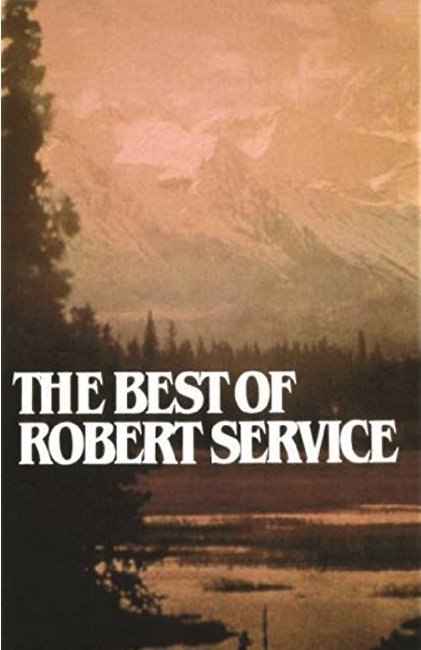
The Best of Robert Service

THE SPELL OF THE YUKON

I wanted the gold, and I sought it;
   I scrabbled and mucked like a slave.
Was it famine or scurvy—I fought it;
   I hurled my youth into a grave.
I wanted the gold, and I got it—
   Came out with a fortune last fall,—
Yet somehow life’s not what I thought it,
   And somehow the gold isn’t all.

No! There’s the land. (Have you seen it?)
   It’s the cussedest land that I know,
From the big, dizzy mountains that screen it
   To the deep, deathlike valleys below.
Some say God was tired when He made it;
   Some say it’s a fine land to shun;
Maybe; but there’s some as would trade it
   For no land on earth—and I’m one.

So begins the opening poem of this selection; I fell in love with Service’s verses and the land that inspired them at the same time over twenty years ago. Robert Service was an English born poet and novelist who emigrated to Canada at the age of twenty one and ended up in Whitehorse, Yukon nine years later in 1904 working as a bank clerk. Although he had been writing verse since before he left England it was the environs of Whitehorse and the gold prospectors that he would meet there that inspired him to write his most famous works and it was these that first introduced me to Service. Although “The Best of Robert Service” includes works from several of his books I want to concentrate on the ones that were taken from his first book “Songs of a Sourdough”, this is for two reasons, firstly I bought the book in Whitehorse before setting off to kayak down the Yukon river in 1995 following the trail of the gold prospectors from Service’s day and secondly I want to cover another of his books in a later blog as it has an interesting structure.

20181218 Robert Service 1

So why write about this book now? Well this is the 50th essay I have written for this blog so that brought the subject of gold to mind and frankly I’ve been meaning to write about it for some time. Songs of a Sourdough was an immediate hit, Service had intended it to be a small privately printed volume which he was going to give to friends and family but the printers that it was sent to loved it so much that they wanted to publish it properly and it went to numerous editions within the first year. He would eventually make over one hundred thousand dollars (more then two and a half million today) just from his first book and he became one of the richest authors of his day. Service can justifiably be compared to Rudyard Kipling, like him he was enormously popular but the critics of the day were rather sniffy about his work as they regarded his verse as little more than doggerel.  His most famous work is probably

The Cremation of Sam McGee

There are strange things done in the midnight sun
By the men who moil for gold;
The Arctic trails have their secret tales
That would make your blood run cold;
The Northern Lights have seen queer sights,
But the queerest they ever did see
Was that night on the marge of Lake Lebarge
I cremated Sam McGee.

Now Sam McGee was from Tennessee, where the cotton blooms and blows.
Why he left his home in the South to roam ’round the Pole, God only knows.
He was always cold, but the land of gold seemed to hold him like a spell;
Though he’d often say in his homely way that “he’d sooner live in hell.”

On a Christmas Day we were mushing our way over the Dawson trail.
Talk of your cold! through the parka’s fold it stabbed like a driven nail.
If our eyes we’d close, then the lashes froze till sometimes we couldn’t see;
It wasn’t much fun, but the only one to whimper was Sam McGee.

And that very night, as we lay packed tight in our robes beneath the snow,
And the dogs were fed, and the stars o’erhead were dancing heel and toe,
He turned to me, and “Cap,” says he, “I’ll cash in this trip, I guess;
And if I do, I’m asking that you won’t refuse my last request.”

Well, he seemed so low that I couldn’t say no; then he says with a sort of moan:
“It’s the cursèd cold, and it’s got right hold till I’m chilled clean through to the bone.
Yet ’tain’t being dead—it’s my awful dread of the icy grave that pains;
So I want you to swear that, foul or fair, you’ll cremate my last remains.”

A pal’s last need is a thing to heed, so I swore I would not fail;
And we started on at the streak of dawn; but God! he looked ghastly pale.
He crouched on the sleigh, and he raved all day of his home in Tennessee;
And before nightfall a corpse was all that was left of Sam McGee.

There wasn’t a breath in that land of death, and I hurried, horror-driven,
With a corpse half hid that I couldn’t get rid, because of a promise given;
It was lashed to the sleigh, and it seemed to say: “You may tax your brawn and brains,
But you promised true, and it’s up to you to cremate those last remains.”

Now a promise made is a debt unpaid, and the trail has its own stern code.
In the days to come, though my lips were dumb, in my heart how I cursed that load.
In the long, long night, by the lone firelight, while the huskies, round in a ring,
Howled out their woes to the homeless snows— O God! how I loathed the thing.

And every day that quiet clay seemed to heavy and heavier grow;
And on I went, though the dogs were spent and the grub was getting low;
The trail was bad, and I felt half mad, but I swore I would not give in;
And I’d often sing to the hateful thing, and it hearkened with a grin.

Till I came to the marge of Lake Lebarge, and a derelict there lay;
It was jammed in the ice, but I saw in a trice it was called the “Alice May.”
And I looked at it, and I thought a bit, and I looked at my frozen chum;
Then “Here,” said I, with a sudden cry, “is my cre-ma-tor-eum.”

Some planks I tore from the cabin floor, and I lit the boiler fire;
Some coal I found that was lying around, and I heaped the fuel higher;
The flames just soared, and the furnace roared—such a blaze you seldom see;
And I burrowed a hole in the glowing coal, and I stuffed in Sam McGee.

Then I made a hike, for I didn’t like to hear him sizzle so;
And the heavens scowled, and the huskies howled, and the wind began to blow.
It was icy cold, but the hot sweat rolled down my cheeks, and I don’t know why;
And the greasy smoke in an inky cloak went streaking down the sky.

I do not know how long in the snow I wrestled with grisly fear;
But the stars came out and they danced about ere again I ventured near;
I was sick with dread, but I bravely said: “I’ll just take a peep inside.
I guess he’s cooked, and it’s time I looked”; … then the door I opened wide.

And there sat Sam, looking cool and calm, in the heart of the furnace roar;
And he wore a smile you could see a mile, and he said: “Please close that door.
It’s fine in here, but I greatly fear you’ll let in the cold and storm—
Since I left Plumtree, down in Tennessee, it’s the first time I’ve been warm.”

There are strange things done in the midnight sun
By the men who moil for gold;
The Arctic trails have their secret tales
That would make your blood run cold;
The Northern Lights have seen queer sights,
But the queerest they ever did see
Was that night on the marge of Lake Lebarge
I cremated Sam McGee.

After three years in Whitehorse, he was transferred to the bigger branch in Dawson City which had been the centre of the gold rush, here he got to know more of the veteran prospectors and gained more tales to feed into his poetry. The Cremation of Sam McGee was based on a real incident that he heard about and apparently he composed the work that night. After a year the bank wanted him to move back to Whitehorse as manager of the branch but by now he was earning a good living as a poet so quit and became a full time writer from that point on. Service was not only a poet, he wrote several novels and lived most of his life in France after moving there as a journalist in 1913. After the war he enjoyed the high life as a wealthy author around Paris The book that features in this essay was published in Canada by McGraw-Hill Ryerson who sound like a character from one of his works and there are 101 poems featured giving a good overview of his output.

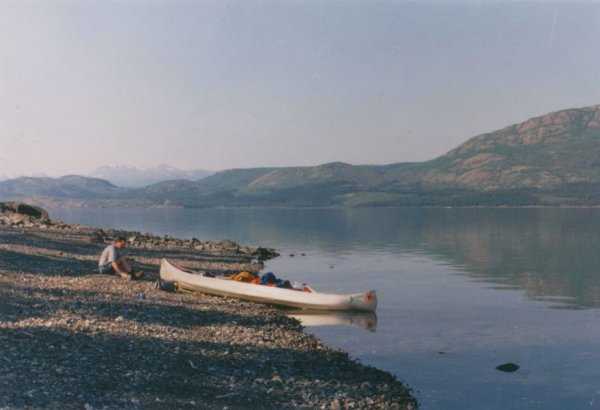
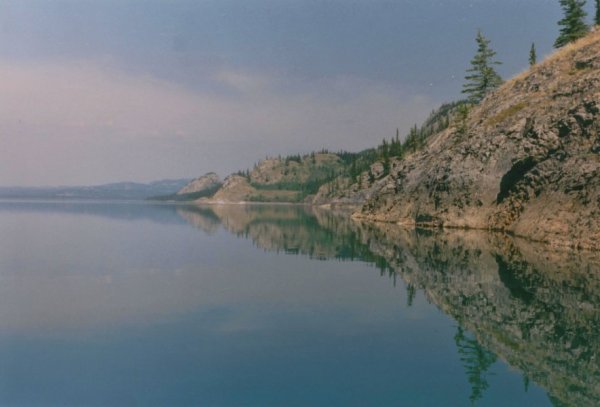
Sadly Robert Service seems to have slipped from the public conciousness nowadays, certainly I had never heard of him before picking the book up as something to read around the camp fire on the trip Dave and I made all those years ago, so just to give a feel of the beauty of the place where we went several days without seeing another human I’ll finish with some of the photos we took starting with me paddling at the front of the kayak. You can see why the place inspired Robert Service.

20181218 Robert Service 8

On the shore of Lake Labarge

20181218 Robert Service 3

More Lake Lebarge (it’s a very big lake)

20181218 Robert Service 4

Bald Eagle by the Thirty Mile River

20181218 Robert Service 5

Trappers hut at Hootalinqua

20181218 Robert Service 6

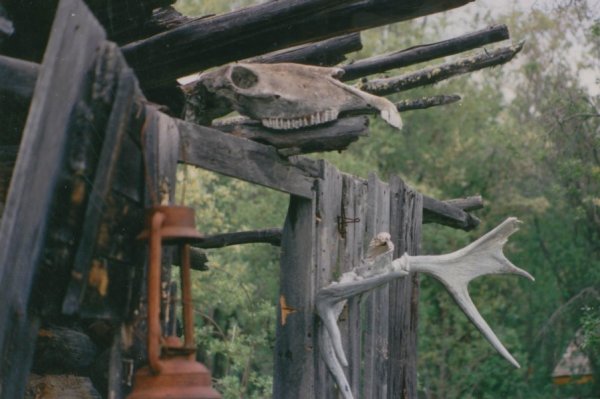
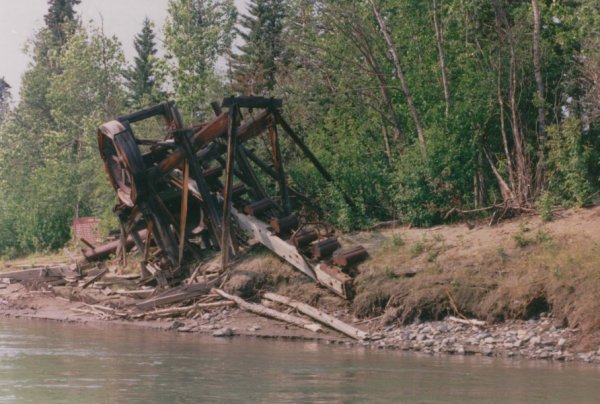
Cyr’s dredge, an abandoned gold dredging machine, when it broke it was just too expensive to fix or take back from the river so it has sat there for decades.

20181218 Robert Service 7

The Frogs – Aristophanes

20181106 The Frogs

For November I’ve decided to read a selection of plays and the first one is The Frogs by Aristophanes. Normally I’m not a great fan of Ancient Greek dramas as you need a lot of knowledge of the gods and other characters involved but this translation is so readable I found myself laughing along as I read it. It was written in 405 BC and can be dated so precisely because it was created for drama competition as part of a festival honouring the god Dionysus in Athens where it took first place. Dionysus is one of the Greek gods with lots of jobs, according to the Wikipedia entry he is the god of the grape-harvest, wine making and wine, fertility, ritual madness, religious ecstasy, and theatre and it is in the latter one of these roles that a drama competition in his name becomes obvious.

The play tells the story of Dionysus deciding to travel to the underworld to bring back the playwright Euripedes who had died the previous year in order to rescue the arts in Athens back from the doldrums that he perceives it to be in. The first act sees Dionysus and his slave Xanthias on their journey, initially they visit Dionysus’s half brother Heracles for advice which causes him to collapse with laughter as Dionysus has decided to dress like Heracles with the lion head cloak and club but he really doesn’t have the build to carry off the look. Eventually they persuade Heracles to explain the route he used when he went to get the three headed dog Cerebus and they duly set off. When they meet Charon, the ferryman of the dead he agrees to take Dionysus and this is when he encounters the frog chorus who sing during the crossing. Despite the play being called The Frogs this is the only time they appear in it. After various encounters with people who think Dionysus is Heracles and either hate him for taking Cerebus or love him for it they finally reach the home of Pluto ruler of the Hades.

Act two takes place entirely at the Pluto’s house where they find Euripedes and also another dramatist Aeschylus who had died about 50 years earlier. These two had been arguing for the last year about which was the better writer and should therefore sit with Pluto for meals. Dionysus takes it onto himself to judge a contest between them and they take it in turns to be rude about the others works with the chorus commenting as though it was a fight with each man landing viscous blows on the other. This gives Aristophenes a chance to parody each of the two dramatists styles and throw in his own critical comments on both of them. Eventually Pluto gets fed up and decides to determine the winner via a special set of scales which can measure the weight of an argument. Each man gets to speak one line into the baskets on the scale and they are marked against one another with the scale, to Euripedes’s annoyance Aeschylus wins both attempts by mentioning heavier objects. In the end Dionysus decides to simply ask the two dramatists for advice to save Athens, Euripedes has lots of fine words but Aeschylus has more practical suggestions so instead of having Euripedes brought back to life he decides on Aeschylus. A final parting shot from Aeschylus is to insist that Sophocles should have the seat as the finest dramatist rather than Euripedes.

Translations of ancient Greek and Latin have become far ‘less stuffy’ over the last few decades and this can largely be thanks to Penguin Books who started their series of Penguin Classics in 1946 with the express intent of making the classics more approachable. Compare this extract from the Harvard Classics edition of 1909 which is available on Project Gutenberg, which deals with the god Dionysus rowing across the Styx with Charon and encountering the Frog chorus.  The specific translator is not given for this edition on the site as this was a massive group exercise resulting in 51 volumes of a wide selection of classic works.

FROG CHORUS
   Brekekekex, ko-ax, ko-ax!
   Brekekekex, ko-ax, ko-ax!
   We children of the fountain and the lake
   Let us wake
   Our full choir-shout, as the flutes are ringing out,
   Our symphony of clear-voiced song.
   The song we used to love in the Marshland up above,
   In praise of Dionysus to produce,
   Of Nysaean Dionysus, son of Zeus,
   When the revel-tipsy throng, all crapulous and gay,
   To our precinct reeled along on the holy
   Pitcher day.
   Brekekekex, ko-ax, ko-ax.

 DIONYSUS. O, dear! O dear! now I declare I've got a bump upon my rump.

The same passage from the 1964 translation by David Barrett printed by Penguin and reprinted in the edition I have been reading.

FROGS
   Brekeke-kex, ko-ax, ko-ax,
   Ko-ax, ko-ax, ko-ax!
   Oh we are the musical Frogs!
   We live in the marshes and bogs!
   Sweet, sweet is the hymn,
   That we sing as we swim,
   And our voices are known.
   For their beautiful tone,
   when on festival days
   We sing to the praise
   Of the genial god -
   And we don't think it odd
   When the worshipping throng,
   To the sound of our song,
   Rolls home through the marshes and bogs.
   Brekekex!
   Rolls home through the marshes and bogs.

 DIONYSUS. I don't want to row any more.

 FROGS. Brekekex!

 DIONYSUS. For my bottom is getting so sore.

As you can see the Penguin edition is considerable more ‘lively’ and the translator has almost turned to the poetic structure of the limerick in order to emphasise the comic nature of the play. This is a form that he will return to several times during the translation in some places using the limerick itself. The play is only 110 short pages so I read it in two sittings, the edition is from the Little Black Classics series by Penguin and is one of the most expensive of these books at £2. I’m looking forward to reading more from this series of titles in the coming months.


Raw Spirit – Iain Banks

20180911 Raw Spirit

‘Hiya Banksie! Written any good books lately?’
‘Not if you believe certain critics, but I’m going to be writing one about whisky.’
‘A book about whisky?’
‘Yeah, malt whisky.’
‘You’re kidding!’
‘Not as such.’
‘This mean you’re going to have to do the “R” word?’
‘The “R” word? Oh! Research? Yeah basically. Goin to have to drive round Scotland, take trains, ferries, planes and such, go to distilleries, taste whiskies, that sort of -‘
‘And they’re going to pay you for this?’
‘They’ve already started.’
‘Right I see. D’you need a hand?’

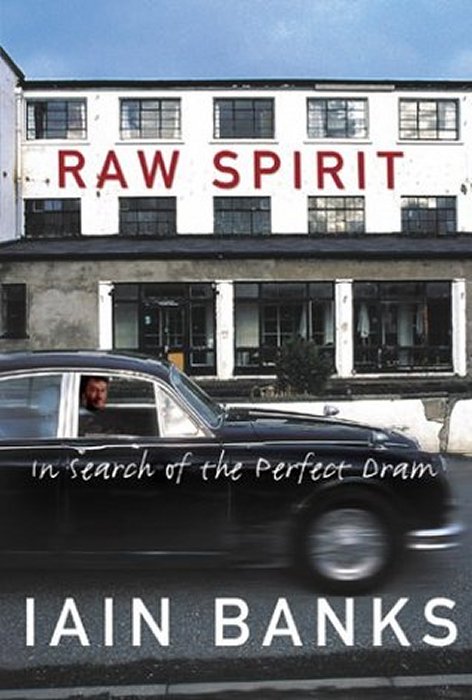
So begins Iain Banks’ Raw Spirit: In Search of a Perfect Dram and those people familiar only with Iain M Banks the gritty science fiction writer or his even grittier ‘normal’ fiction written as Iain Banks are in for a surprise as this is a genuinely funny book interspersed with rants about the Second Iraq war which had just started as he set of in search of the “R” word. As a fan of both Banks and whisky, purchasing this book when it came out did not take much consideration and I recently pulled it back off the shelves as later this year I’m doing my own trip round some distilleries and like Banks I’m starting with Islay.

Rereading the book was a surprise, my 14 year old memory of what was covered is clearly faulty, yes there is whisky aplenty and distilleries also get pretty good coverage but a large part of the book is really about Banks’ love affair with Scotland and its “Great Wee Roads” or GWRs as they are referred to throughout. There is a lot more said about getting to the distilleries (both the roads and vehicle chosen to make the journey) than there is covering them or their production. There is also a considerable amount of reminiscences of past holidays, fun times in out of the way properties and time spent with old friends. The book is really as close as we ever got to an autobiography by Banks who sadly died in 2013 from cancer aged just 59. If you want a book about whisky then you are really better off with Michael Jackson’s definitive tome, but if you want a book about the joy of travelling around Scotland looking for whiskies and the friendships and fellowships that it can engender then this is for you.

Let’s take a random chapter and breakdown the coverage of each subject, “12: Porridge and Scottishness, Football and Fireworks” has a total of 20 and a bit pages:

  • Porridge, why he doesn’t like it and other Scottish institutions such as kilts – 2½ pages
  • Six distilleries visited and their whiskies – 7 pages
  • Memories of Monty Python (he was an extra in one of the films)  – 1 page
  • Memories of blowing things up (fireworks with mates) – 4½ pages
  • Travelling – 1 page
  • The joys and tribulations of following Morton Football Club – 4 and a bit pages

That seems to be a pretty average hit rate for the theoretical subject of the book, although the travelling to whisky ration is normally higher than that, at least after you get past chapter one where Banks does stick more closely to his brief. That is not to say that I didn’t enjoy the book, I very much did so, it’s an easy read and you want to follow Banks around the country as he enjoys the scenery, samples whisky and chats with old mates. You feel by the end that the Raw Spirit of the title is more the spirit of Scottishness rather than Scotch and it’s good fun.

As a final note my copy is the first edition hardback printed by Century in 2003, that also appears to be the only Century edition as by 2004 it was a paperback with a completely different cover published by Arrow. Both of these are imprints of Penguin Random House.

The Complete McGonagall – the worlds worst poet

20180731 McGonagall 1

William McGonagall has gone down in history as the worst poet in the world and this book is a collection of almost every poem that can be reliably attributed to him. These have been published in various collections, but Duckworth have produced the most complete versions admittedly by creating extra volumes by merely selecting from the few books and pamphlets printed in the 1800’s along with some previously unpublished works. This book appears to combine an existing seven volumes into one but only two volumes were produced in McGonagall’s lifetime along with lots of single sheet poems sold as he was going along. In reality four of the listed volumes were created by Duckworth in the 1980’s and the three others were considerably shortened by them at the same time in order to provide works for the extra books.

I think we need an example from his first collection printed in 1890 just so that the uninitiated can get the measure of the man’s genius, this was his first poem, dated 1877 and is entitled “An Address to the Rev. George Gilfillan”

All hail to the Rev. George Gilfillan of Dundee,
He is the greatest preacher I did ever hear or see.
He is a man of genius bright,
And in him his congregation does delight,
Because they find him to be honest and plain,
Affable in temper, and seldom known to complain.
He preaches in a plain straightforward way,
The people flock to hear him night and day,
And hundreds from the doors are often turn’d away,
Because he is the greatest preacher of the present day.
He has written the life of Sir Walter Scott,
And while he lives he will never be forgot,
Nor when he is dead,
Because by his admirers it will be often read;
And fill their minds with wonder and delight,
And wile away the tedious hours on a cold winter’s night.
He has also written about the Bards of the Bible,
Which occupied nearly three years in which he was not idle,
Because when he sits down to write he does it with might and main,
And to get an interview with him it would be almost vain,
And in that he is always right,
For the Bible tells us whatever your hands findeth to do,
Do it with all your might.
Rev. George Gilfillan of Dundee, I must conclude my muse,
And to write in praise of thee my pen does not refuse,
Nor does it give me pain to tell the world fearlessly, that when
You are dead they shall not look upon your like again.

Gilfillan when hearing of the poem is reported to have said

“Shakespeare never wrote anything like this.”

which McGonagall took to be a compliment. This was the also the first example of what could be called the curse of being celebrated by McGonagall as a year later in 1878 he had cause to write two more poems about Gilfillan, entitled “Lines in Memoriam of the Late Rev. George Gilfillan” and “The Burial of the Reverend George Gilfillan”. He famously wrote in praise about the Bridge over the Silvery Tay only to subsequently write less that 2½ years later about “The Tay Bridge Disaster” This latter work is a good example of the unintended humorous nature of his works by forcing lots of facts into the poem without worrying if it then made any sense whatsoever and destroying any rhythm that may have been wanted. His need in poetry was to make it rhyme not scan and as long as a tenuous rhyme was achieved he appeared to be happy.

William McGonagall was born in 1825 in Ireland but came with his parents to Scotland as a very young child, indeed he claimed for a long time to have born in Edinburgh but the family soon settled in Dundee which he where he grew up. For the first fifty two years of his life he sometimes dabbled in acting but was by profession a weaver like his father until in 1877 the poetic urge struck him

I remember how I felt when I received the spirit of poetry. It was in the year of 1877, and in the month of June, when trees and flowers were in full bloom. Well, it being the holiday week in Dundee, I was sitting in my back room in Paton’s Lane, Dundee, lamenting to myself because I couldn’t get to the Highlands on holiday to see the beautiful scenery, when all of a sudden my body got inflamed, and instantly I was seized with a strong desire to write poetry, so strong, in fact, that in imagination I thought I heard a voice crying in my ears-
“WRITE! WRITE”
I wondered what could be the matter with me, and I began to walk backwards and forwards in a great fit of excitement, saying to myself– “I know nothing about poetry.” But still the voice kept ringing in my ears – “Write, write,” until at last, being overcome with a desire to write poetry, I found paper, pen, and ink, and in a state of frenzy, sat me down to think what would be my first subject for a poem.

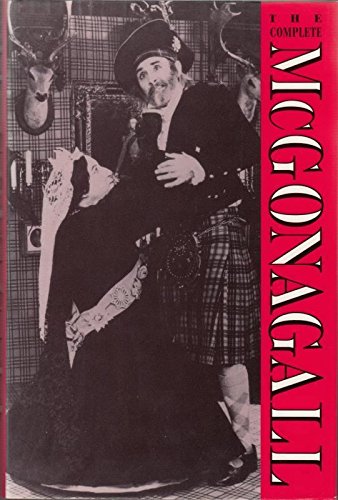
That he knew nothing about poetry was proved by the poem above, but whilst a poet can have a bad day, especially with their earliest works, McGonagall was if anything to get worse. There is a beauty in the total awfulness of his works that sucks the reader in, the Complete Works includes 247 poems and I have read it cover to cover several times. You just can’t believe what it is you are reading. The photo on the cover of the edition I have is of Spike Milligan as McGonagall and Peter Sellers as Queen Victoria as Milligan in particular popularised ‘The Great McGonagall’ from the 1960’s onwards and ensured that his body of work did not get neglected.

20180731 McGonagall 2

His works have been in constant print for many decades, above is the 1966 edition of More Poetic Gems published by David Winter and Sons in Dundee (who were his original publishers) and Gerald Duckworth and Co Ltd as a joint venture. Although appreciated now McGonagall died in poverty in 1902. He had eked out a living more as a sideshow than a poet from 1877 although it is clear that he regarded himself as a much put upon performer who was delivering great work to people who didn’t appreciate his ability. It was quite common for an audience to throw rotten fruit and vegetables and sometimes even fish at him whilst he was reciting, indeed the opening paragraph to the preface of his first published work ‘Poetic Gems’ includes the line

the first person to throw a dish of peas at me was a publican

It isn’t so much the fact that somebody threw a dish of peas at him as that this was just the first time…

Because he had no money when he died he was buried in an unmarked grave in Greyfriers kirkyard in Edinburgh, his grave received a nearby marker in 1999.

William McGonagall
Poet and Tragedian
“I am your gracious Majesty
ever faithful to Thee,
William McGonagall, the Poor Poet,
That lives in Dundee.”

I shall include one final poem and it’s one of the less well known ones “The Death of Captain Webb”. Webb was the first person to swim the English Channel (22 miles at its shortest point). He is something of a local hero here in Shropshire as he was born less than 5 miles from where I am sitting but died in a somewhat foolhardy attempt to swim across the rapids below Niagara Falls. The poem shows McGonagall at his prime, it was written in 1883 and has all his stylistic failings…

Alas brave Captain Webb has acted the part of a fool
By attempting to swim the mighty Niagara whirlpool,
Which I am sorry to say and to relate,
Has brought him to an untimely fate.

’Twas in the year Eighteen hundred and eighty-three,
With the people of America he did agree,
For $10,000, to swim through that yawning whirlpool;
But alas! He failed in doing so — the self-conceited fool.

Captain Webb, he courted danger for the sake of worldly gain
And the thought of gaining for himself — world wide fame;
And although many people warned him not to throw his life away,
He rushed madly to his fate without the least dismay.

Which clearly proves he was a mad conceited fool,
For to try to swim o’er that fearful whirlpool,
When he knew so many people had perished there,
And when the people told him so, he didn’t seem to care.

Had it not been for the money that lured him on
To the mighty falls of Niagara, he never would have gone
To sacrifice his precious life in such a dangerous way;
But I hope it will be a warning to others for many a long day.

On Tuesday the 24th of July, Webb arrived at the falls,
And as I view the scene in my mind’s eye, my heart it appalls
To think that any man could be such a great fool,
Without the help of God, to think to swim that great whirlpool;

Whereas, if he had put his trust in God before he came there,
God would have opened his blinded eyes and told him to beware;
But being too conceited in his own strength, the devil blinded his eyes,
And all thought of God and the people’s advice he therefore did despise.

But the man the forgets God, God will forget him;
Because to be too conceited in your own strength before God it is a sin;
And the devil will whisper in your ear — there’s no danger in the way,
And make you rush madly on to destruction, without the least dismay.

At half-past three o’clock Webb started for the river,
Which caus’d many of the spectators with fear to shiver,
As they wondered in their hearts if he would be such a fool
As to dare to swim through that hell — whirlpool.

Webb was received by the people with loud and hearty cheers;
And many a heart that day was full of doubts and fears;
A many a one present did venture to say –
“He only came here to throw his life away.”

The Webb entered a boat, in waiting, and was rowed by the ferry-man;
And many of the spectators seem’d to turn pale and wan;
And when asked by the boatman how much he’d made by the channel swim,
He replied $25,000 complete every dim.

Have you spent it all? Was the next question McCloy put to him,
No, answered Webb, I have yet $15,000 left, every dim;
“Then” replied McCloy, “You’d better spend it before you try this swim;”
Then the captain laugh’d heartily but didn’t answer him.

When the boat arrived at point opposite the “Maid of the Mist”
The captain stripped, retaining only a pair of red drawers of the smallest grist;
And at two minutes past four o’clock Webb dived from the boat;
While the shouts and applause of the crowd on the air seem’d to float.

Oh, Heaven! it must have been an awe inspiring sight,
To see him battling among that hell of waters with all his might,
And seemingly swimming with ease and great confidence;
While the spectators held their breath in suspense.

At one moment he was lifted high on the crest of a wave;
But he battled most manfully his life to save;
But alas! all his struggling prov’d in vain,
Because he drown’d in that merciless whirlpool God did so ordain.

He was swept into the neck of that hell — whirlpool,
And was whirl’d about in it just like a light cotton spool;
While the water fiend laughingly cried ”Ha! ha! you poor silly fool,
You have lost your life, for the sake of gain, in that hell — whirlpool

I hope the Lord will be a father to his family in their distress,
For they ought to be pitied, I really must confess;
And I hope the subscribers of the money, that lured Webb to his fate,
Will give the money to Mrs. Webb, her husband’s loss to compensate.

In the Tiffany Aching young adult series of books by Terry Pratchett the Pictsies or ‘Nac Mac Feegle’ are a race of 6 inch high beings that are more Scottish than it is probably possible to be. They have as their most feared tactic on the battlefield their Gonnagale who at times of greatest danger recites strange and terrible poetry which has the effect of reducing all that hear it to gibbering wrecks. The poems, and his title, are clearly based on the works of William McGonagall and are a tribute to the man whose writings approach genius by being so atrocious they reach round the spectrum of quality and get there from the other side.

Read him and weep

from laughter
When I was Very Young – A.A. Milne

Although nowadays best known for his stories about his son Christopher Robin and his toys Winnie The Pooh and all the other characters in the Hundred Acre Wood, Alan Alexander Milne would rather be known for his other books and plays. He wrote a surprisingly good crime novel (The Red House Mystery) and over 3 dozen plays along with several books of non-fiction. When I was Very Young is one of his rarest works as the only publication of it is the limited edition from The Fountain Press printed in 1930. Just 842 copies were produced and all were signed by Milne on the limitation page at the back of the book, my copy is number 38. The book comes in a plain card slipcase rather than a dust wrapper although this easily damaged and is often missing from copies for sale

20180619 When I was Very Young 1

The book consists of five short biographical stories from Milne’s childhood which are written in the first person and probably true as the facts that it is possible to check are accurate, such as H.G. Wells being his science teacher at his first school, where his father was head-master. In the book his two older brothers are called David and John (in reality David Barrett Milne and Kenneth John Milne) and the age differences are correct along with the description of all three having blue eyes and golden hair. There are several illustrations by Ernest Shepard and the pages have the feel of handmade paper with rough edges. It’s short, here are only 23 pages of text along with 2 title pages, one page with the copyright information and the limitation page at the back so it definitely only takes a few minutes to read.

20180619 When I was Very Young 2

All of Milne’s Christopher Robin books were also printed as deluxe editions along with several of his plays and other works some of which were also released as signed limited editions. Milne, or at least his agent in America assuming he had one, also seemed to go in for special editions only sold in the USA so there are numerous varieties of some of his titles to collect especially limited editions and pre-signed signed copies. When I was Very Young was not even the first short book by Milne in being initially issued exclusively as such a volume, in 1929 The Fountain Press released The Secret and Other Stories in an edition of 742. The Secret has however since been printed in unlimited modern editions leaving When I was Very Young alone in not being available to a wider readership.

The first page sets the scene

20180619 When I was Very Young 3

After this introduction to the boys David isn’t mentioned in the first two tales, it is clear that Alan and John were close playmates though and the two boys shared a bed for many years but David, as the eldest, presumably had his own room. The first tale is a bit odd as it relates to an apparently shared dream of the two boys when they were about 5 years old for them to wake up one morning and find that everyone else in the world was dead.

As soon as we woke up we should know that it had happened; the absence of the governess from our morning toilet, the discovery of her body in the passage between her room and ours – these would be the first signs. Having explored all over the house to make sure that the thing had been done properly, and that there really were no survivors to say “Don’t” we would then proceed to such-and-such, a sweetshop, step over the body of the proprietress and have our first proper breakfast.

There then follows a drawing by Shepard with the boys eating chocolates and sweets in the shop with the corpse in the background.

20180619 When I was Very Young 4

Not exactly the gentle Winnie the Pooh type tale you might expect! The second story is considerably less disturbing but none the less would be surprising to us nowadays. The two boys had collected various mineral samples and decided that they wanted to show them to somebody at the Geological Museum (then in Jermyn Street). By now it was 1890 and they were 8 and 9 years old and living in St Johns Wood, which is about 3½ miles (5½ km) from the museum. However their father seemed quite happy to let them go on their own as long as they ‘asked a policeman to help them cross Piccadilly Circus’, one of the most busy and therefore dangerous junctions in the city. They manage the trip, meet the curator who spends time with them looking at their small collection and also shows them round the museum and on their way back buy some matches to strike in their bedroom at night after the lights had gone out.

Two very short reminiscences follow, both featuring all three boys, in the first, inspired by a book called The Golden Key they put on an impromptu (and unscripted) play which turns out to be very short and in the second again after being inspired by a book they decide to be sailors and having lined up in front of their father David explains this to him. After consideration their father explains that “There will be examinations to pass”, at this David promptly gives up on the idea.

The final story moves us forward in time again to 1896 when ‘John’ and Alan were both at Westminster Public School and Alan was 14. Although they were boarding students they were allowed out at weekends providing they had somewhere to stay and this one weekend they were staying at the home of some elderly friends of their father. They had found a firework left over from the bonfire night celebrations and decided to extract the gunpowder from it. After a while a fairly disappointing quantity of powder was tipped out…

20180619 When I was Very Young 7

I don’t know why Milne always refers to his brother as John rather than Kenneth or Ken in this short volume, particularly as he always calls him Ken in his book It’s Too Late Now: The Autobiography of a Writer published in 1939 and dedicated as follows; 1880-1929 To the memory of KENNETH JOHN MILNE who bore the worst of me and made the best of me.

Oddly David is called Barry in the autobiography so Alan does like to confuse his readers.

20180619 When I was Very Young 5

The signed limitation page at the back of the book

20180619 When I was Very Young 6