Haroun and the Sea of Stories – Salman Rushdie

The start of the trial of Hadi Matar on the 10th February 2025 for the attempted murder of Salman Rushdie in August 2022 prompted me to go back to the shelf of Penguin Drop Caps volumes far earlier than I planned, as I knew that there I would find Haroun and the Sea of Stories. This novel for children was Rushdie’s first published work after ‘The Satanic Verses’, which had led to the fatwa declared against him by Ayatollah Khomeini of Iran for blasphemy and which almost certainly inspired Matar, a twenty seven year old American of Lebanese descent, to attack Rushdie almost killing him, stabbing him fifteen times, leaving him blind in his right eye, with a severely damaged hand and multiple other injuries. That the novel was published ten years before Matar was born and that Iran had said the fatwa would not be enforced also before he was born seems not to have affected Matar who admitted he had only read a few pages; and Rushdie had said that he was at last leading a relatively normal life without protection in an interview just two weeks before the attack. Still enough of the context as to why I picked the book up, let’s look at this wonderful fantastical story which I hadn’t read before.

Rushdie had me hooked from the opening lines of this novel:

There was once in the country of Alifbey, a sad city, the saddest of cities, a city so ruinously sad that it had forgotten its name. It stood by a mournful sea full of glumfish which were so miserable to eat that they made people belch with melancholy even though the skies were blue.
In the north of the city stood mighty factories in which (so I’m told) sadness was actually manufactured, packaged and sent all over the world, which never seemed to get enough of it. Black smoke poured out of the chimneys of the sadness factories and hung over the city like bad news.

It goes on to say that most places in Alifbey had just one letter as their name so there is the town of G and the nearby valley of K nestled in the mountains of M, this means that lots of places had the same name and therefore post was often delivered to the wrong place. In a helpful couple of pages at the back of the book Rushdie explains that the name Alifbey is based on the Hindustani for alphabet and that another destination on the journey of our heroes, for what sort of children’s book doesn’t have heroes even unlikely ones, is The Dull Lake “which doesn’t exist, gets its name from The Dal Lake in Kashmir, which does”. Rushdie was born in India and lived there until he was seventeen and takes a lot of inspiration in his writing from his youth. I have mentioned our heroes and they are Rashid Khalifa and his son Haroun, these are named after Haroun al-Rashid the legendary Caliph of Baghdad who appears in the Arabian Nights stories. Rashid is the happiest man in the very sad city and is renowned as a storyteller gaining the titles of The Ocean of Notions or the Shah of Blah because he could keep telling tales without repeating himself, weaving stories together without ever losing the intricate plots and therefore whenever he spoke he would draw huge crowds. This made his especially popular with politicians trying to get people to listen to them as elections approach as he could start the rally and pull people together from the surrounding area.

But one day disaster struck, the flow of stories just stopped, Rashid couldn’t string two words together and this was at the start of a tour arranged by politicians so it was vital that the reason was discovered. The second night of the trip saw Rashid and Haroun on a boat on The Dull Lake where Haroun encounters Iff the Water Genie who had come to disconnect the invisible tap that linked Rashid to the Sea of Stories, the source of all his tales. In vain Haroun argued that it was a mistake but finally he convinced Iff to take him to the Earth’s invisible second moon, Kahani, so that he could meet the leader of the Eggheads and appeal for Rashid’s tap to be reconnected. Travelling on a giant mechanical Hoopoe called Butt they arrive on Kahani and find the Ocean of Stories is heavily polluted with the stories dying off so Haroun then has to find out what is causing the pollution and stop it. Along the way he finds Rashid has also made his way to Kahani and has his own quest to undertake.

The book is a wonderful adventure story full of linguistic jokes, like the talking fish with lots of mouths which are called the Plentymaw fish in the Sea and the Pages, or soldiers, arranged into chapters and volumes instead of companies and battalions. It is split into twelve chapters, each no longer than fifteen pages so ideal to be read as to a child as a bedtime story over a couple of weeks. I loved the book and it was so different to the other book by Salman Rushdie I reviewed on this blog back in 2019, The Jaguar Smile. I also have his second novel, Midnight’s Children, which was his first best seller, hopefully I won’t wait another five and half years before reading that.

You can find more about the Penguin Drop Caps series in my overview here, which also includes links to the various books I have reviewed from this set of twenty six books.

Siddhartha – Hermann Hesse

At first sight this is an odd book for a German author, who as a young man had sufficiently strong callings to the priesthood that he briefly attended a seminary. But in 1911, in his mid 30’s, Hesse visited India and was introduced to Hindu mysticism and this has undoubtedly influenced this novel written in 1922. The story is set in ancient India, around 2500 years ago, it follows Siddhartha, and to a lesser extent his friend Govinda, in their quest for spiritual enlightenment. At first this leads them as young men to abandon their family homes and all their belongings and live in the forests as ascetic samanas, training their bodies to need nothing, using extended fasting and lack of clothes apart from a loincloth to preserve decency. This was a life of meditation and a severe deprivation of the body. A sample of the thoughts of Siddhartha are shown below and give a flavour of the sometimes difficult to follow text as Hesse can get caught up in the tautological expressions that he uses to try to explain Siddhartha thought processes for pages as a time.

Siddhartha and Govinda live with other samanas for a long time, occasionally begging for scraps of food as the bare minimum to stay alive but eventually they hear of a great teacher called Gautama (Buddha) and decide to travel to hear him teach. They eventually reach Gautama and hear him speak but whilst Govinda immediately resolves to follow the Buddha, Siddhartha instead explains that he feels that such enlightenment cannot be taught but must be individually gained through experiences and solitary meditation so the two friends part company. Leaving Govinda, Siddhartha travels until he reaches a river and there meets a ferryman who will become a significant character later in the book but for now he simply gets him to the other side whereupon he walks on to the next town. It is here that Hesse completely threw me as I thought I understood the path to enlightenment that Siddhartha was going to follow, but instead, on entering the town he sees a wealthy courtesan and is filled with desire. She however is not interested in the half starved gaunt and long haired ascetic standing in front of her and tells him that if he wants to know her better he has to be wealthy, clean and well dressed and he duly throws over his calling, gets his hair cut and body cleaned and perfumed, becomes a merchant and eventually earns a place in her bed. Definitely not what I had expected.

I admit I was somewhat daunted when beginning the book, not helped by Hesse’s undeserved reputation as a not very approachable writer, but as I read on I got more engrossed by the story and by the time of Siddhartha’s sudden change in direction I was highly intrigued as to where the novel was going and loved the ultimate resolution. It’s probably not a book for everyone, but I thoroughly enjoyed it. This is another of the Penguin Drop Caps series and eventually I will read all twenty six of these books, an explanation of the concept can be found on my my blog introducing the series here where I am also including links to each of the books as I review them.

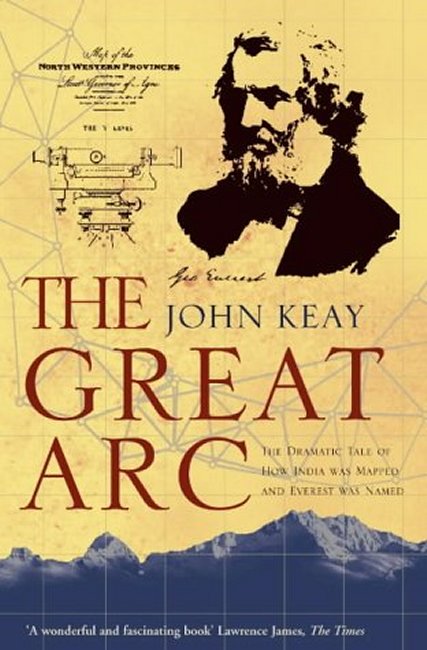
The Great Arc – John Keay

I’ve seen many a ‘trig point’ whilst walking the hills of Britain, these mainly concrete structures on top of high points were used for accurate mapping, specifically to get the correct height of hills and mountains, but quite how they were used was not something I particularly thought about before reading this book. The story John Keay tells is of an epic fifty year project to both start the accurate mapping of India but more importantly to create the longest ‘Great Arc of the Meridian’ a accurate calculation of the curvature of the Earth and it’s variation as you move from the equator to the north pole, one of the most outstanding scientific endeavours of the first half of the 19th century. Started in 1800 by a team led by William Lambton and ultimately completed by George Everest (pronounced ‘eve rest’ not ‘ever rest’ as he and his descendants would repeatedly tell people) the sheer scale of the project can be seen on the map below as a series of phenomenally precise triangles stretch all the way from the southern tip to India right up to the foothills of the Himalayas.

The basic concept is quite simple, first establish a baseline whose length is exactly known but is also long enough to mean that a high point visible from both ends will form a significantly different angle when this is measured by a theodolite from these two points. Using trigonometry you can then calculate the position of this third point and the length of the two inferred sides of the triangle formed. One of these ‘new’ sides can then become the base of another triangle, a new high point selected, measured and so on. It had already been established that the Earth wasn’t round like a ball but more like a grapefruit so flatter at the poles than at the equator but by just how much was it flatter. Measurements had been taken of the length of a degree (1/360 of the circumference of the Earth) and it had been found that in Ecuador (on the equator) it was approximately 111km whilst in Lapland it was around 110km so a whole kilometre shorter.

The problem lies in accurate measurement of a long enough distance, nowadays it is relatively easy but over two hundred years ago the equipment was a lot more primitive and Lambton had to use what was called a chain but was a lot more sophisticated than that. His was made up of forty bars of blistered steel each two and a half feet long and each attached to the next one using a brass hinge, using this he had a measure of one hundred feet (30.48 metres) that he knew to be correct, the problem comes when he needed a long enough base to his first triangle which he decided was a seven and a half mile long (12.07 km) flat stretch of land that needed to be cleared and levelled as much as possible near Madras. Which means that he had to use his chain four hundred times, precisely starting where the previous measure had finished, in a perfect straight line and allow for the expansion of the steel as its temperature rose under the Indian sun even though he only took measurements in the early part of the day. It would take fifty seven days to complete the seven and a half miles and the markers for the two end points can still be seen. From this line he could head north.

Now you have probably seen surveyors with theodolites at building sites but nothing like the giant piece of equipment Lambton used. It needed to be this size not only for stability but to allow for the large brass dials which would make the scale large enough to read extremely accurate measurements of the angles and even then the dials were fitted with microscopes so that the precise figure could be attained. Lugging this massive instrument across India, through jungles, deserts, up mountains and all sorts of other terrain never mind crossing rivers along with all the other equipment, food and tented accommodation for the entire vast team for months at a time was a stupendous achievement with people falling ill or dying both of sickness and animal attacks throughout the fifty years of the survey. Each time it was set up it had to be on a high point with other members of the team at another high point with a marker, initially flags and then later on lights and sometimes it would take weeks for the marker team to reach the next point, it was very slow progress with trees and in some cases houses or parts of whole villages having to be cut down or purchased and then flattened to provide clear sight lines from one point to the next. Six years after starting out a new base line was measured to check the calculated length with reality and amazingly over the six miles (9.66 km) checked the error was just 7.6 inches (19.3 cm) or to put it another way he was out by just 0.0000002%.

William Lambton eventually retired and was replaced by George Everest who carried the survey up to the foothills of the Himalayas but not into Nepal as that kingdom was going through one of its reclusive periods and they were not allowed in even to do scientific work. Besides it was known that the theodolite could see vast distances, possibly even into women’s quarters, and even worse the image seen was inverted and no man wanted his wife, or wives, seen upside down so they were often attacked by villagers or blocked by local rulers from coming through certain parts of India. This added to the geographic, animal and disease problems really slowed progress but Everest was not a man to put up with resistance to his survey and he pressed on regardless. He never saw the mountain that was to be named after him when it was determined to be the world’s highest peak; but nowadays whilst everyone has heard of Mount Everest, who has heard of George Everest? Tragically especially ignored is the brilliant William Lambton who started this magnificent survey so this book is important to raise their profile again. It is also a fascinating description of the hardships endured by the teams who did this amazing project. John Keay has produced a highly readable account of the survey which whilst including details as to how the work was done never gets bogged down in the mathematics which is a trap that would have been so easy to fall into. It was first published in 2000, mine is the 2001 paperback published by Harper Collins and is still easily available and I highly recommend it.

Queen of the Elephants – Mark Shand

20200324 Queen of the Elephants

This book accompanies a 1995 BBC TV documentary of the same name, which I must admit I’ve never seen, but the book is fascinating. Mark Shand had made a previous trip across India on elephant back and recorded it in his book Travels on My Elephant which won him the accolade of ‘Travel Writer of the Year’ at the British Book Awards in 1992. That time he bought his own elephant Tara for the journey and at the end arranged for her to be looked after. This book starts with him visiting Tara for the first time in three years and renewing their relationship, but it is another lady that he had heard so much about whilst making that first journey that is the reason for this trip. Parbati Barua is a legend amongst people involved with the Asian elephant and she had agreed to help make a documentary about the problems they are facing due to their habitat shrinking so fast as humans encroach more and more into what used to be their territory.

Parbati is distinctly unimpressed by Mark’s previous exploit and when she agrees to take him on it is at the lowest grade in the camp, he has to earn her respect by proving (or in the case of making food rolls for the elephants trying hard but failing as he is too slow) to be good at what she expects before he can ride any elephant that belongs to her. Eventually he does get approval and then a certain limited level of respect as he demonstrates his hard learnt abilities from his last trip. Parbati is not easily pleased and this is something he learns very quickly.

At this point I need to bring up my main problem with the book, lots of local words (presumably Hindi) are used which may have been explained in his previous volume and which it takes a while to work out their meaning (assuming you don’t just google them from frustration) if like me you haven’t read it. Either a better explanation at the time they are first used in this work, or a glossary at the back, would have vastly improved the readability of the text. There is a comprehensive bibliography so the omission of a glossary is all the more surprising.

The three month journey that they undertake through West Bengal to Assam was once heavily forested but now is home to apparently endless tea plantations and the Asian elephant, being a creature of the forests unlike it’s African cousin, is being pushed into conflict with the ever expanding human population. As well as the trip with Parbati, Mark also spends some time with a group charged with keeping the two sides apart and sees at first hand the tragic consequences for both elephant and human when this boundary is breached. Parbati is frequently sent for by forest rangers to assist elephants injured by people just as they also come across humans that have been killed by elephants desperate for food and coming into villages where the locals try, and often fail, to persuade them to leave so annoying a huge and powerful animal. You hear so much about the plight of the African elephant it is fascinating to see what is happening to the Asian version not just in India but across the region.

Mark Shand was the brother of Camilla, Duchess of Cornwall, and sadly died on the 23rd April 2014 after a fall in New York. He was leaving a party following a highly successful evening which had raised £950,000 for his elephant charity when he tripped and hit his head on the pavement. Parbati Barua is, at the time of writing, apparently still alive and well and working with elephants.