The Clouded Mirror – L T C Rolt

L T C Rolt, also known as Tom Rolt, was one of the best writers on industrial history and the people who made it, and not only did he write about it but he was personally involved in saving a lot of Britain’s heritage from the Industrial Revolution from the eighteenth and nineteenth centuries for present generations to enjoy. In 1946 he was one of the three founders of the Inland Waterways Association, dedicated to restoring and making use of the long neglected canal network that criss-crossed the UK eventually leaving in 1951, by which time he had a huge new project to work on. He was chairman of the Talyllyn Railway Preservation Society which he helped found in 1950 and which was planning on restoring the old Welsh slate mining railway and turning it into the major tourist destination that it is now and it was through reading as a child his excellent 1953 book ‘Railway Adventure’ about his time rescuing the Talyllyn that I first became aware of him. Rolt died in 1974 having been more responsible for the preservation of what remains of the Industrial Revolution than anyone else and on top of the two organisations I have already mentioned he was a trustee and member of the Advisory Council of the UK Science Museum, joint founder of the Association for Industrial Archaeology, vice-president of the Newcomen Society, a member of the York Railway Museum Committee and helped to form the Ironbridge Gorge Museum Trust amongst many other things. He wrote ‘The Clouded Mirror’ in 1955 and this edition is from The Penguin English Journeys series published in 2009.

The Clouded Mirror is actually three works in one book, the first is acually called ‘The Clouded Mirror’ and surprisingly is concerned with two poets from the 1600’s who were based in the Welsh Marches, the border country between England and Wales with Herefordshire to the east and the Black Mountains to the west. Despite having given the book its title this was extremely dull and made me wonder where the rest of the book was going.

The second part, entitled ‘Kilvert’s Country’was an improvement but still a surprise given everything I thought I knew about the author as it is largely autobiographical and deals with his young childhood from the age of four when his family moved to the outskirts of Hay on Wye. This small town is in the heart of the Welsh Marches so this link at least partly explains Rolt’s fascination with the two poets in ‘The Clouded Mirror’. I know Hay very well as it was the world’s first booktown and I have been going there for decades looking for interesting works to add to my collection. Rolt’s childhood summers from 1914 sound idyllic as he gets older and explores the surrounding countryside. He writes with his customary gentle style beautiful descriptions of the places he gets to and his father sounds like a real character, having been in Australia, South Africa and even an unsuccessful prospector during the Yukon gold rush up in north western Canada. His shooting and fishing expeditions made sure that throughout WWI the family never went short of food and Rolt says that when war finished he realised that he had barely noticed that it had been happening as Hay was so remote from anyway directly affected by the conflict.

Finally there is ‘Canal Crusade’ and this is the section that made the book all worthwhile, for me anyway. It tells some of the stories from the early days of the Inland Waterways Association with Rolt travelling up largely derelict and weed clogged canals to highlight the poor state that this important transport network had reached following decades of neglect. This is Tom Rolt at his best, campaigning and writing about industrial heritage, forcing the railway companies that largely owned the canals in the first half of the twentieth century to finally maintain what they were responsible for. It seems amazing to me now, with the excellent condition that the canals are largely in now and their considerable use by holidaymakers that the stories of silted up waterways, collapsed bridges and what seemed terminal conditions are from just seventy years ago so the Inland Waterways Association must be congratulated in its work even if a major disagreement amongst the three founders meant that only one of them was still there by 1950. Fortunately by then Rolt had the Talyllyn to occupy him.

In short the book is worth reading for the second and third pieces but I won’t bother with the first part if I pick it up to read it again.
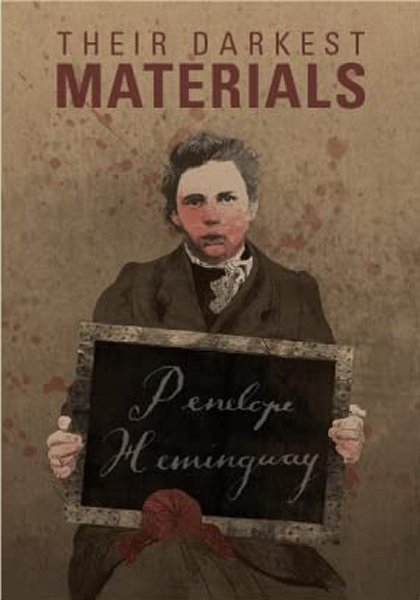
Their Darkest Materials – Penelope Hemingway

20200908 Their Darkest Materials

With a title clearly inspired by the ‘His Dark Materials’ trilogy by Philip Pullman this book heads off in a completely different direction with a theme of death and destitution in the world of knitting and spinning (with a little bit of sewing thrown in). I use the word thrown advisably because although like the proverbial Curate’s Egg it is good in parts, it just feels like a lot of research notes have just been thrown into a mix and the book came out the other side.

The first few chapters are particularly random with a list of press cuttings and court reports where the person who died was either knitting at the time, had knitting about their person when they died or was knitting before they were executed. However as the book later makes clear the poor in the 17th and 18th centuries would normally have some knitting or possibly sewing on the go as it was portable and could be done in times when their normal work was not needing them and could in that way bring in some much needed extra income. The second chapter looks at knitting and spinning in fairy tales with a large section on the folk tale of Rumpelstiltskin but this topic is never referred to again and comes in between chapters one and three which really belong together.

After a while Hemingway gets into her stride and what is actually quite an interesting book emerges as she goes on to explore exploitation in workhouses, mills and something I had not come across before knitting and spinning schools. If Hemingway had expanded her research and written a book about these subjects, which she almost did, then we would have a fascinating work. I loved learning about the knitting and spinning schools of the north east of England and Wales where poor children could get a simple education and learn a trade whilst producing goods for sale which paid for school. In the best of them the children even earned a wage which would help keep the rest of their family from destitution.

The sections on the dark satanic mills as described by William Blake, whilst covering more familiar ground also added much that was new to me. Extracts from wage books show just how desperate things were with families barely able to keep their heads above water even with everyone from the youngest child to the oldest grandparent bringing in as much as they could by working all hours possible. This was well before unions and universal suffrage so the poor had no say in their lives and the mill owners, who could as property owners vote, made sure that laws to improve the lives of their workers struggled to get passed. It took years to get the ten hour limit applied to a workers day and even then it could be avoided by getting the work done at home rather than at a mill when the people were on piecework so paid by output not the time they took to get there.

There is also a chapter on the introduction of artificial dyes which spends most of its time covering the incarceration in an asylum of the wife of one of the pioneers. This sad tale was definitely new to me but it means that the chapter is far too short to tell the story of this revolution in colour which is wonderfully covered in Simon Garfield’s book Mauve, which I really must reread and review in this blog, instead we get a brief overview of the chemists work, which only fits in with the darkest materials theme because it focuses on the story of Mary Dawson.

The real problem with the book is the obvious lack of proof reading, the work is littered with spelling and typographical errors. Most of the spelling mistakes are missing letters in words whilst there are also a lot of words run together with the space between them omitted and numerous examples where sentences suddenly move to the next line part way across the page. There is also a lot of repetition so stories are told again a few chapters later or in one particularly bad example a paragraph is repeated directly after itself.

20200908 Their Darkest Materials 2

It’s a pity that editing wasn’t done properly as there is definitely an interesting book in there but the sloppy way that it has been put together lets it down. It is clearly self published as the publisher is given at the start of the book as ‘At the Sign of the Pretty Baa Lamb Press’. Unfortunately if you follow the website link also given there then you find that the publisher is given as ‘Pretty Baa Lambs Press’, Lamb or Lambs doesn’t really matter but it is an indication of the lack of attention to accuracy in this publication which screams out for a decent editor.