The Big Sleep – Raymond Chandler

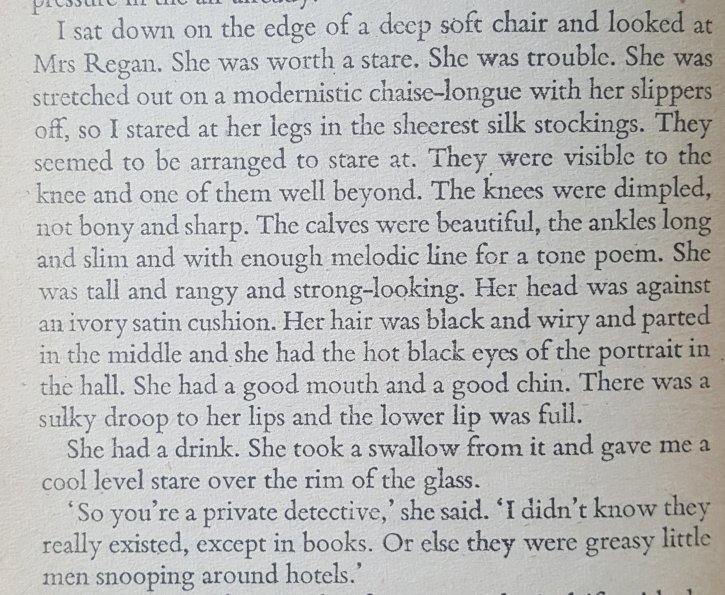
Rightly regarded as one of the finest writers of prose in crime fiction Raymond Chandler was admired by other writers as diverse as W H Auden and Evelyn Waugh. It is his descriptive passages that mark him out and make reading Chandler’s works so much fun even if sometimes his completion of plot lines just isn’t there. In this, his first novel, we never do find out who killed the chauffeur but it doesn’t really matter as the rest of the story is compelling and there are plenty of other crimes that do get fully sorted out. The Big Sleep is a remarkably accomplished work for a first novel, but by the time he wrote it in 1939 he had had short stories published many times over the previous six years, this is also the first appearance of his most famous character Philip Marlowe who appears in the first person so we see everything from his perspective. An example of Chandler’s descriptive writing is shown below, taken from a paperback copy of the novel I also have as I didn’t want to possibly damage the spine of the lovely leather bound edition I was reading.
Chandler was clearly influenced by Dashiell Hammett and his hard-boiled detectives such as Sam Spade in ‘The Maltese Falcon’ . The ‘hard-boiled’ genre is a very specific category of crime fiction featuring a sole detective fighting organised crime, usually in the US prohibition era and whilst this novel isn’t set in prohibition times, definitely not based on the amount of whiskey Marlowe gets through in this book alone, these is definitely organised crime in the shape of casino owner Eddie Mars and his main hit-man Canino. The plot is complex, so I can forgive Chandler not sorting out the chauffeur’s murder, with lots of characters sometimes working together but often double crossing one another. But we start with the elderly General Sternwood, who appears to have only a short time left to live, setting Marlowe on a case to find out about a blackmailer and stop him. Sternwood has two wayward daughters who keep appearing across Marlowe’s tracks in unexpected ways and the final denouement involving the two women was a complete surprise to me. I’m not going to go into any more of the plot which rapidly heads off in all sorts of directions and makes the book one of the most enjoyable I’ve read for a long time as I simply didn’t know what was going to happen next.

In 2005 ‘The Big Sleep’ was included in Time Magazine’s top 100 novels (the list isn’t ranked) and it also came 96th in Le Monde’s 100 books of the century compiled in 1999.

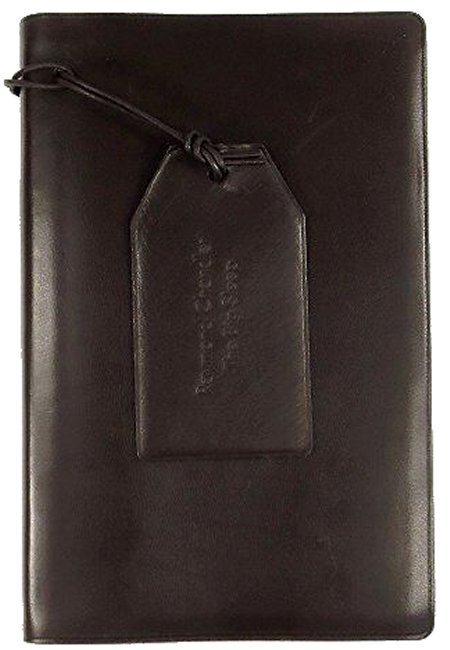
The edition that I read is from a set of six Penguin Classics designed in 2008 by Bill Amberg, the London based leather work studio, each book comes in a sturdy box with a belly band indicating which book is inside. The book itself is fully bound in a soft brown leather with a hole punched right through the cover and all the pages in the top left corner where a leather book mark is attached with the title and author embossed in it. The only thing marking the cover itself is the Penguin Books logo at the base of the spine. It is also incredibly difficult to photograph accurately. The leather cover overlaps the pages by a significant amount making it a yapp binding where over time and repeated reading the leather will fold over to totally encase the book. Each book was published in a limited edition of 1000 and priced at £50 per volume.
A Room with a View – E M Forster

Originally published in 1908 this Edwardian romance and comedy of manners is nowadays regarded as one of the classics in English literature although probably not rated as highly as two of Forster’s other novels ‘Howards End’ and ‘A Passage to India’. I know I have read it before, probably around 1985 when the Merchant Ivory film adaptation came out, but to my genuine surprise I realised that I had completely forgotten the story line when I started reading it again this week. I chose this over the other two, that I also have on my shelves as a good friend of mine in Barcelona has just started reading a brand new Catalan translation along with two friends so I thought it would be fun to join in with the English original.

The novel is in two parts, the first of which is set entirely in Florence, Italy whilst the second part mainly takes place in England. We start with twenty year old Lucy Honeychurch and her much older cousin Charlotte Bartlett, who is acting as her chaperone, newly arrived at the Pensione Bertolini in Florence and bemoaning the fact that neither of them had been allocated a room with a view despite being assured when booking that they would each have a good view of the square and the river. We are then rapidly introduced to the other guests at the hotel as they discuss the situation leading up to Mr Emerson and his son George offering to swap rooms as they do have good views

“What I mean,” he continued, “is that you can have our rooms, and we’ll have yours. We’ll change.”

The better class of tourist was shocked at this, and sympathised with the new-comers. Miss Bartlett, in reply, opened her mouth as little as possible, and said “Thank you very much indeed; that is out of the question.”

“Why?” said the old man, with both fists on the table.

“Because it is quite out of the question, thank you.”

“You see, we don’t like to take—” began Lucy. Her cousin again repressed her.

“But why?” he persisted. “Women like looking at a view; men don’t.” And he thumped with his fists like a naughty child, and turned to his son, saying, “George, persuade them!”

And so within the first couple of pages we hit on the class difference between the Emerson’s and the other guests at the hotel as Lucy and Charlotte were shocked by the suggestion as it would leave the two women under a perceived obligation to two strange men, something that never occurs to either of the Emerson’s. It is this perceived total social unsuitability of these men to the rest of the group that provides the dynamic through the remainder of the book as various characters keep meeting them and recoil regarding their ‘common ways’. In fact a clergyman, Mr Beebe intercedes and convinces Charlotte that the exchange of rooms can be done without obligation so they both end up with a room with a view by the end of the first chapter. I don’t want to give away the plot but suffice to say that Lucy finds herself accidentally alone with George on more than one occasion whilst in Florence to the considerable embarrassment of her and the pleasure of him.

Part two has a sudden shift in location and time, clearly many weeks, if not months have passed and a new character is introduced, Cecil Vyse. We are also at the home of Mrs Honeychurch, Lucy’s mother in the fictional village of Summer Street in Surrey. Slowly various characters that made up the guests at the Pensione Bertolini also appear in the village either accidentally or deliberately and the tensions between the group are reproduced only this time with the added complication of Cecil who has become Lucy’s fiance or her ‘fiasco’ according to her brother Freddy and never a truer word was said in jest. The problems caused by various unseemly, at least to the mores of the time, acts or words by the assorted people and again unfortunate meetings and misunderstandings carry us through a thoroughly satisfying final chapter. I greatly enjoyed the book and the interplay between the characters and although many of the things they regard as shocking or unsuitable would not be so nowadays the fact that Forster is gently poking fun at them is always clear.

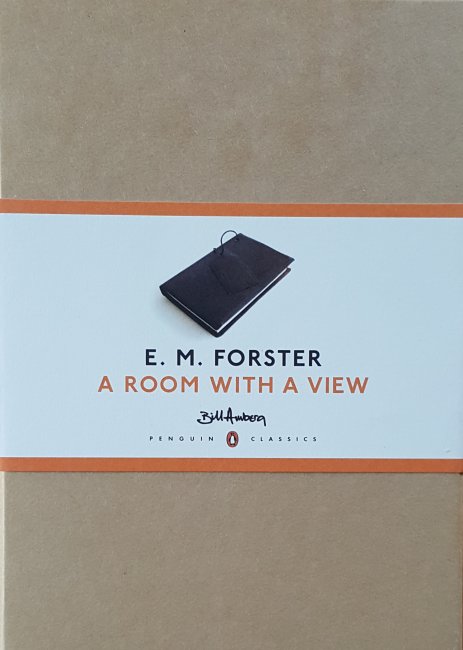
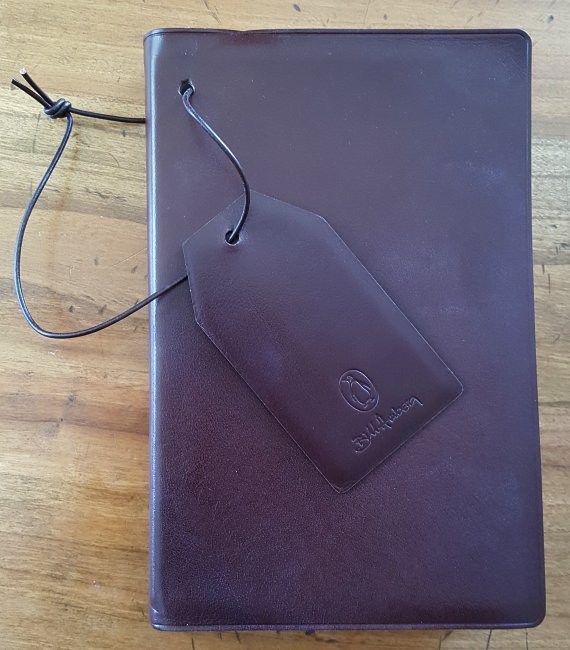
The edition that I currently own is from a set of six Penguin Classics designed in 2008 by Bill Amberg, the London based leather work studio, each book comes in a sturdy box with a belly band indicating which book is inside. The book itself is fully bound in a soft brown leather with a hole punched right through the cover and all the pages in the top left corner where a leather book mark is attached with the titles and author embossed in it. The only thing marking the cover itself is the Penguin Books logo at the base of the spine. It is also incredibly difficult to photograph accurately, the photos below are as close as I could get, with the bookmark being the closest to the actual colour of the leather. The leather cover overlaps the pages by a significant amount making it a yapp binding where over time and repeated reading the leather will fold over to totally encase the book. Each book was published in a limited edition of 1000 and priced at £50 per volume.

For the Penguin Classics leather binding I have chosen a vegetable tanned, buffalo calf. I should stress that all the skins were taken from ‘fallen animals’ – i.e. they died from natural causes – and were sourced from India’s premium calf tannery. They use traditional methods in a totally ecological process, where the water used is recycled after filtering through reed beds. This creates leather that improves with every use, the grain and sheen brightening continually over time.

Bill Amberg

Leaflet included with the book